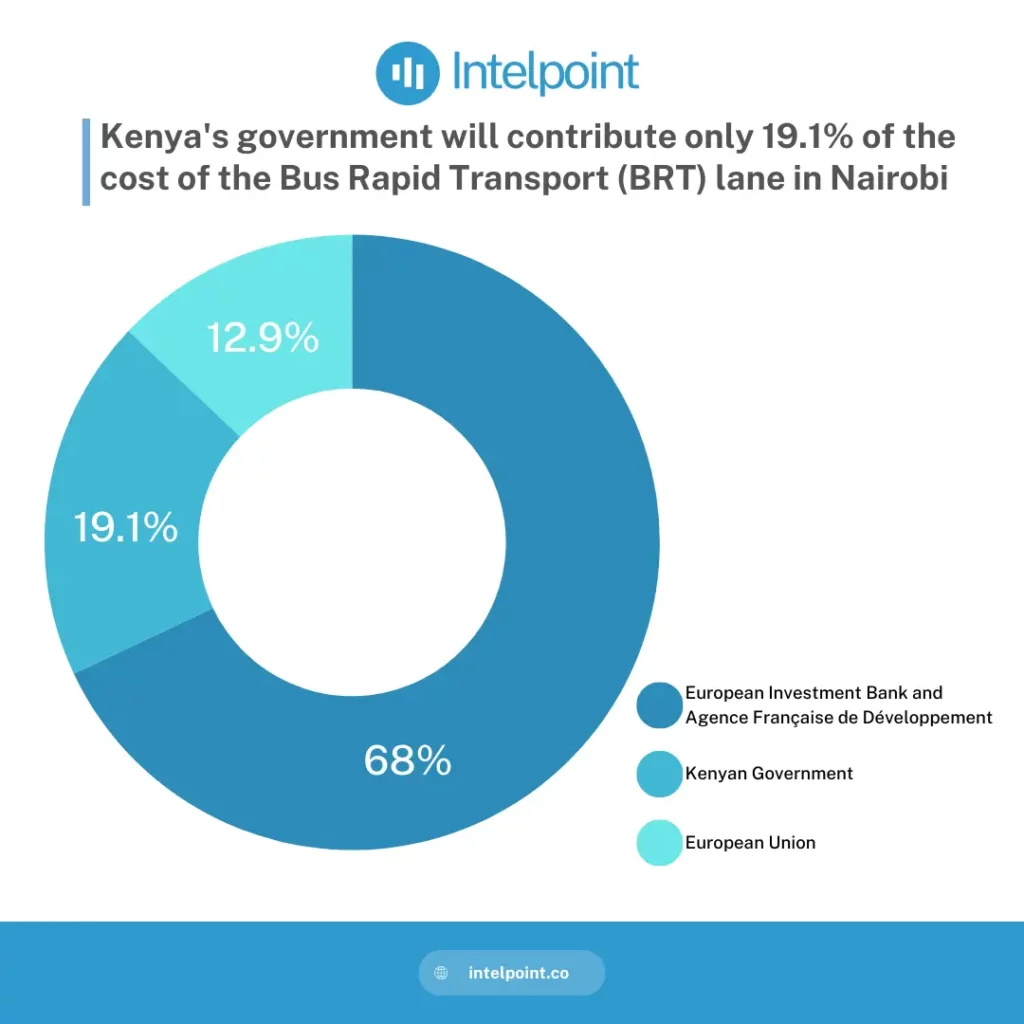
Kenya received $377.8 million (Sh50 billion) from a consortium of European agencies to build a Bus Rapid Transport (BRT) lane in Nairobi in 2023 which is also the first electric bus lane in the East Africa region. The European Union will provide $48.9 million (Sh6.47 billion) in grants, the European Investment Bank (EIB) and Agence Française de Développement (AFD) will jointly support the project with $256.8 million (Sh33.9 billion), and Kenya will bring $72.0 million (Sh9.5 billion).


Between 2018 and 2021, adult literacy rates across African nations exhibited significant disparities. Seychelles and South Africa led with literacy rates of 96% and 95%, respectively, indicating a high proportion of literate adults. Conversely, Chad had the lowest literacy rate during this period.
These statistics underscore the uneven progress in educational attainment across Africa, highlighting the need for targeted interventions to improve literacy in lower-performing nations.
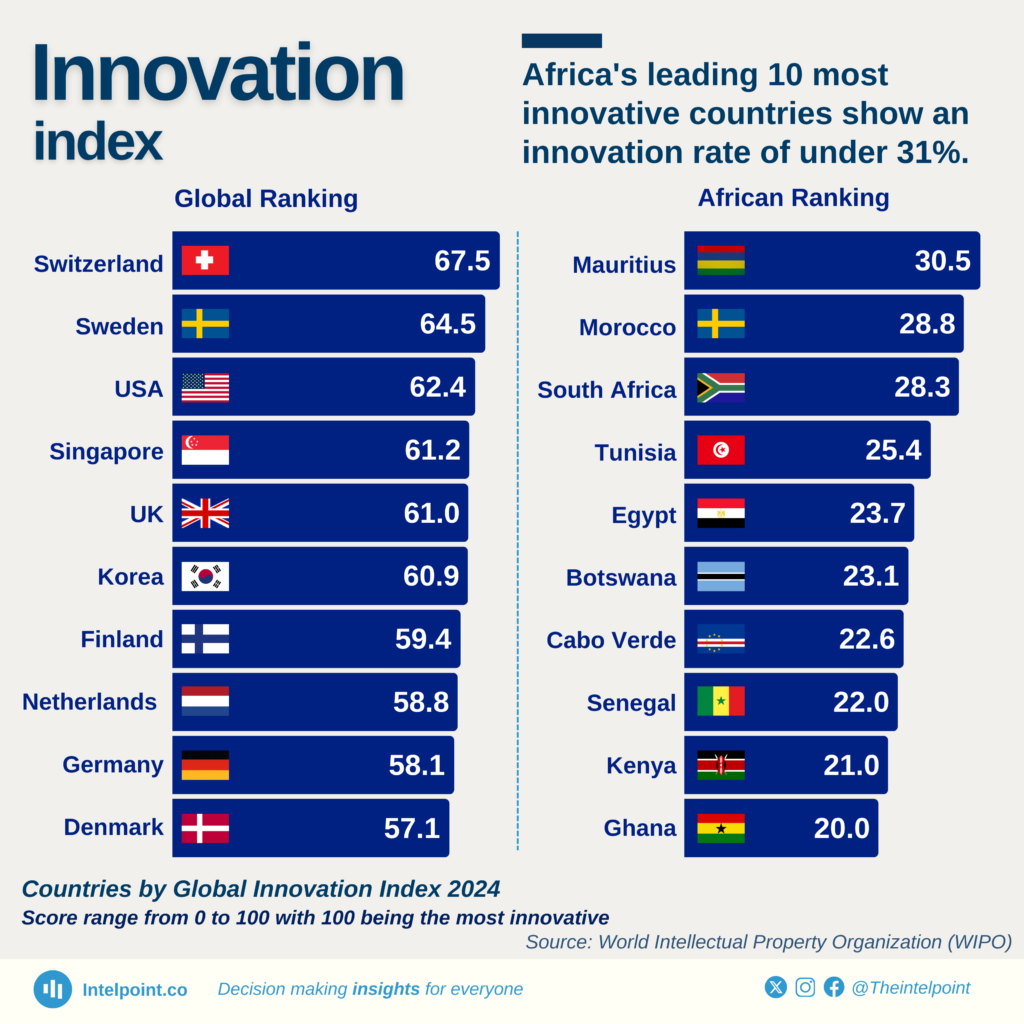
The Global Innovation Index 2024 reveals a striking contrast in innovation performance between countries globally and across Africa. Switzerland leads the global rankings with an impressive score of 67.5, followed by Sweden (64.5) and the USA (62.4), highlighting their sustained investments in research, development, and technological advancement.
In Africa, Mauritius takes the top spot with a score of 30.5, followed closely by Morocco (28.8) and South Africa (28.3). However, even Africa's most innovative nations achieve less than half the score of global leaders, indicating a significant innovation gap.
Nigeria ranks 15th in the African ranking and 113th globally, out of 133 countries, with a score of 17.1.

The 2024 Global Peace Index reveals a decline in peacefulness in 97 countries, the highest since the index began.
Nigeria is among the nations affected by regional conflicts and rising violence. With a peace index score of 2.91, Nigeria is facing increasing challenges.
A deteriorating peace score impacts foreign investment and economic stability. Global economic losses due to violence reached $19.1 trillion in 2023.

Seychelles has the most powerful passport in Africa in 2023, with visa-free access to 155 countries and territories, followed by Mauritius (148). Nigerian passport holders have visa-free access to 46 countries, one of the lowest in Africa. Africa's most powerful passports in 2023 by the number of travel destinations passport holders can travel to visa-free:
Seychelles (155), Mauritius (148), South Africa (106), Botswana (89), Namibia (81), Lesotho (79), Eswatini (77), Kenya (76), Malawi (75), Tanzania (73).
Africa's least powerful passports in 2023 by the number of travel destinations passport holders can travel to visa-free:
Liberia (51), Djibouti (49), Ethiopia (47), Nigeria (46), South Sudan (46), DR Congo (45), Eritrea (44), Sudan (44), Libya (41), Somalia (35).

Abdulsamad Rabiu’s wealth has consistently increased for 4 consecutive years since 2020. Aliko Dangote, on the other hand, experienced 3 consecutive years of wealth growth starting from 2021. Mike Adenuga's wealth recorded growth in 2021 and 2022, but it took a downturn in 2023.
Abdulsamad Rabiu's financial journey has been particularly noteworthy, with his wealth witnessing a substantial surge from $1.2b in 2014 to $8.2b in 2023. This growth has seen him surpass Mike Adenuga and become the country's second-wealthiest individual as of 2023.


Over time, Nigerian workers under 50 have increasingly relied on pension savings during unemployment. This graph illustrates the upward trend with some fluctuations in both the total amount withdrawn — ₦26.9 billion in 2022, and the number of approved withdrawals. Individuals who can withdraw 25% of their retirement savings balance are those who disengaged/retired before the age of 50 years in accordance with the terms and conditions of their respective employment and stayed unemployed for at least six months.