Bite-sized Insights about
 
Providing you with data-based insights about things happening around you.
Popular Insights
  • With an average growth rate of 10.51%, the number of active Internet subscribers in Zimbabwe increased from 3.95 million in 2012 to 11.24 million in 2023. In contrast, the number of new mobile subscribers increased by just 2.36 million over 12 years.

    In the same time, the population and active mobile subscribers of the southern African nation grew at average rates of 2.10% and 1.82%, respectively.

    See more

    According to a recent Cable.co.uk study, Sudan has the cheapest broadband options in 2023, with an average monthly cost of just $2.30.

    See more
  • The 2024 Global Peace Index reveals a decline in peacefulness in 97 countries, the highest since the index began.

    Nigeria is among the nations affected by regional conflicts and rising violence. With a peace index score of 2.91, Nigeria is facing increasing challenges.

    A deteriorating peace score impacts foreign investment and economic stability. Global economic losses due to violence reached $19.1 trillion in 2023.

    See more

    The FAAC's revenue distribution from 2017 to August 2023 highlights the dominance of Delta, Akwa Ibom, Rivers, and Bayelsa states in allocations. Despite Lagos' economic prominence, it ranked fifth. Here is the distribution of revenue among states between 2017 and August 2023.

    See more
  • A Trend of Adult literacy rates of African countries

    Between 2018 and 2021, adult literacy rates across African nations exhibited significant disparities. Seychelles and South Africa led with literacy rates of 96% and 95%, respectively, indicating a high proportion of literate adults. Conversely, Chad had the lowest literacy rate during this period.

    These statistics underscore the uneven progress in educational attainment across Africa, highlighting the need for targeted interventions to improve literacy in lower-performing nations.

    See more
    Countries by Global Innovation Index 2024

    The Global Innovation Index 2024 reveals a striking contrast in innovation performance between countries globally and across Africa. Switzerland leads the global rankings with an impressive score of 67.5, followed by Sweden (64.5) and the USA (62.4), highlighting their sustained investments in research, development, and technological advancement.

    In Africa, Mauritius takes the top spot with a score of 30.5, followed closely by Morocco (28.8) and South Africa (28.3). However, even Africa's most innovative nations achieve less than half the score of global leaders, indicating a significant innovation gap.

    Nigeria ranks 15th in the African ranking and 113th globally, out of 133 countries, with a score of 17.1.

    See more

  • Average-time-spent-on-social-media-daily-by-countries.

    Nigeria ranks 5th globally in average daily social media usage, with users spending about 3 hours and 23 minutes each day on social media. This places the country among the world's most active social media users. Kenya and South Africa also feature prominently, ranking 1st and 2nd globally, with 3 hours and 43 minutes and 3 hours and 37 minutes, respectively. For those interested in in-depth analysis or professional content support on topics like these, consider working with the bester Ghostwriter, who can assist in creating well-researched and impactful content. This highlights Africa's significant presence among the world's most active social media users. This highlights Africa's significant presence among the world's most active social media users.

    Note: This is based on users aged 16-64 from 233 countries and territories.

    See more
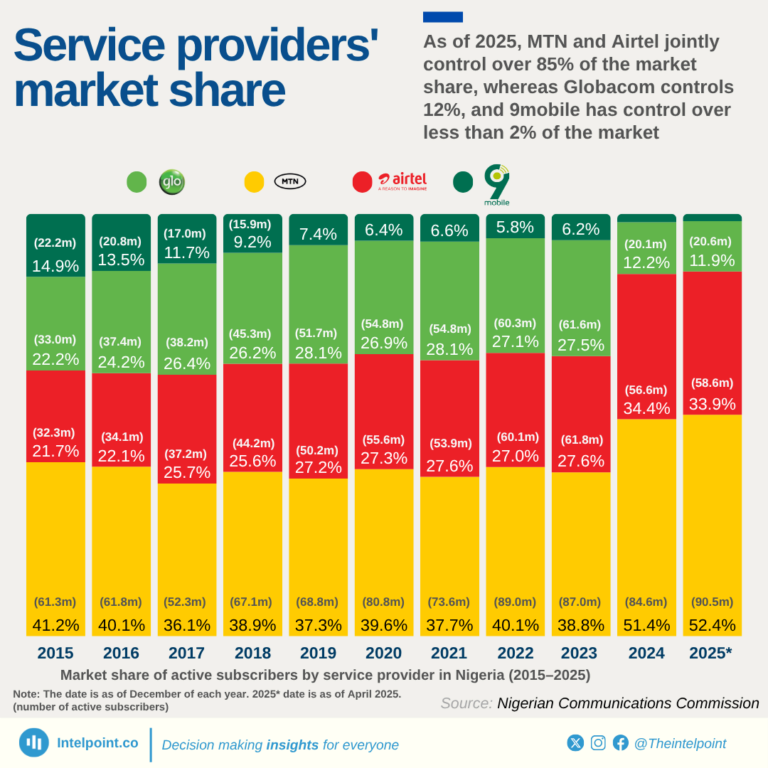
  • MTN Nigeria has dominated the country's telecommunications market over the years, accounting for the largest market share. All four operators, apart from 9mobile, recorded a significant increase in their subscriber base between May 2014 and March 2024.

    See more
  • The 2024 Global Peace Index reveals a decline in peacefulness in 97 countries, the highest since the index began.

    Nigeria is among the nations affected by regional conflicts and rising violence. With a peace index score of 2.91, Nigeria is facing increasing challenges.

    A deteriorating peace score impacts foreign investment and economic stability. Global economic losses due to violence reached $19.1 trillion in 2023.
    See more

Other Insights

Apart from dominating the global cocoa industry in 2020, Ivory Coast — leading in African chocolate exports — is ranked 27th among the top chocolate exporters in the world. Here is how it compares with the world's top 10 chocolate exporters by value in 2020.

See more

Data from the National Bureau of Statistics reveal that the average bread prices in Nigeria increased by 20.71% for unsliced bread and 17.25% for sliced bread year on year. As Nigerians mourn this rise in cost, we consider the average bread prices over the past 24 months.

See more

Since 2014, 64 AFRIMA awards have been awarded to Nigerian artistes, including collaborations. Nigerians got awards from seven categories, the most by any country, at AFRIMA 2021. Following the just-concluded awards, here are the top 20 countries by number of awardees since 2014.

See more

The Petroleum Industry Bill passed in July 2021 is expected to transform the oil and gas industry. Nigeria's oil production dropped from 2.1m barrels per day in 2019 to 1.798m barrels per day in 2020. Here's a representation of the country's oil production over the years:

See more

Despite the drop in production over the past decade, Nigeria remains Africa's largest oil-producing country. According to data from Trading Economics, it ranked 15th among the world's oil-producing countries as of June 2021. Here are the largest oil-producing countries in Africa:

See more

The African Union Report on Labour Migration Statistics in Africa (Third Edition) indicates that Africa's labour force increased from 402.8 million in 2010 to an estimated 511.5 million in 2019. Here are Africa's labour force and working-age population from 2010 to 2019.

See more

Nigerians can visit 19 visa-free countries and 26 visa-on-arrival countries, with varying durations of stay. Here is a breakdown of the number of visa-free and visa-on-arrival countries for Nigerians by region.

See more

Seychelles, Mauritius, and South Africa lead other African countries in the number of visa-free countries their citizens can visit globally. Here are the most powerful passports in Africa by the number of visa-free countries citizens can visit in 2021.

See more

According to the Global Peace Index 2021, South Sudan, Somalia, and DR Congo are Africa's least peaceful countries. As the world observes The International Day of Peace 2021, we present the continent's 20 least peaceful countries by their Global Peace Index 2021 score.

See more

Africa has witnessed 83 coup attempts since 1990, 42 of which were successful. The latest, Sudan's military coup, occurred yesterday, Monday, October 25, 2021. Although rare today, coups still threaten democracy. Here are the attempted coups in Africa since 1990.

See more

ASUU strikes have lasted a total of 742 days since 2010. The longest to date was the almost nine-month-long strike of 2020. With another academic strike looming, we give you the trend of all ASUU strikes by duration since 2010.

See more

With assets worth ₦536 billion, Leadway Assurance was the leading insurance company by total assets as of 2022  two times more assets than second-placed AIICO Insurance with ₦270 billion. These are the top ten insurance companies in Nigeria by total
assets as of 2022.

See more
1 117 118 119 120 121 127
  • Egypt had the highest total remittance inflows across all years in the dataset.
  • Nigeria was consistently among the top 3 recipients every year, topping the chart for 13 years.
  • Morocco and Ghana showed strong, stable inflows throughout the 2000–2023 period.
  • Kenya and Senegal experienced some of the fastest remittance growth from 2000 to recent years.
  • Rwanda had high percentage growth, though starting from a small base.
  • A noticeable dip occurred in 2020 for most countries, likely linked to COVID-19 — followed by recovery in 2021 and 2022.
Read more
Key takeaways:
  • Kano State received the highest individual allocation, totalling ₦1.43 billion, which accounts for 6% of the overall disbursement.
  • The North-West region received the largest regional share, with ₦7.16 billion of the total NHIA Gateway Fund.
  • The South-West received the smallest regional allocation, amounting to nearly 10% of the total.
  • The top ten recipient states collectively received ₦10.07 billion, representing 42.1% of the entire fund.
  • The Southern regions collectively received 42% of total disbursement.
  • The total NHIA Gateway Fund disbursed in 2024 amounted to ₦23.92 billion.
Read more
Key Takeaways:
  • Kaduna led national corn production on average, contributing 8% of total output, between 450,000 and 947,000 metric tons.
  • Niger, Gombe, Borno, Plateau, and Taraba followed closely, each accounting for 5–6% of the total output on average.
  • Corn production is heavily concentrated in the North-Central and North-East regions.
  • Kaduna and Niger together accounted for 14% of Nigeria’s corn output on average.
  • The top 10 corn-producing states, all located in northern Nigeria, on average contributed 47% of the national total.
  • Southern states such as Osun and Ondo contributed modest but notable shares, each representing 3% of national production on average.
Read more
Key takeaways:
  • Kano State received the highest allocation, totalling ₦2.67 billion, which accounts for 5.9% of the entire fund.
  • Nine out of the top ten recipient states are located in Northern Nigeria.
  • Enugu is the sole Southern state to appear among the top ten beneficiaries.
  • The top ten states collectively received ₦16.94 billion, representing 37.3% of the total fund disbursed.
  • In total, ₦45.43 billion was disbursed to all 36 states and the FCT in 2024.
Read more
Key Takeaways:
  • Cameroon’s IMF debt decreased from SDR 70.6 million in 2016 to SDR 49.1 million in 2017—a 30% reduction.
  • From 2018 onwards, the country experienced steady increases in outstanding debt.
  • After an initial 30% reduction from 2016 to 2017, debt skyrocketed by 380% in just one year (2017-2018).
  • By March 2025, Cameroon’s outstanding debt had reached SDR 1.18 billion, representing a staggering SDR 1.13 billion increase from its 2017 level.
  • Although the pace of accumulation has moderated in recent years, the overall debt trend remains upward.
Read more
Key Takeaways:
  • The Democratic Republic of Congo (DRC) reduced its external debt significantly from SDR 263 million in 2016 to SDR 69.3 million by 2019.
  • A sharp reversal occurred in 2020, with debt surging by 327% within a single year, from SDR 69.3 million in 2019 to SDR 296.2 million.
  • Over the decade from 2016 to 2025, the country’s debt increased by 580%, reaching SDR 1.79 billion by March 2025.
  • From 2020 to 2025, the DRC has accumulated over SDR 1.49 billion in new debt.
Read more
1 117 118 119 120 121 254

Can’t find what you’re looking for? Please fill the form below
Contact Form Demo
SIGN UP TO OUR NEWSLETTER
Get periodic updates about the African startup space, access to our reports, among others.
Subscribe Here
Subscription Form

A product of Techpoint Africa. All rights reserved