Bite-sized Insights about
 
Providing you with data-based insights about things happening around you.
Popular Insights
  • When streaming giant Netflix expanded its footprint to 130 countries in 2016, Nigeria was among the markets it entered. The company began by acquiring local content from producers and soon transitioned into creating original productions, investing $23.6m by 2022.

    These original productions have achieved significant milestones. Titles like The Black Book and Jagun Jagun reached the global top ten for English and non-English films, respectively, within a week of their release.

    In 2024 alone, Netflix has revised its monthly subscription fees twice. The Premium plan now costs ₦7,000, up from ₦4,400 at the beginning of the year, while the cheapest option—the mobile plan—has increased from ₦1,200 to ₦2,200.

    See more

    MultiChoice, owners of DStv and Showmax, among others, has been in acquisition talks with Canal+. Canal+ bought a 6.5% stake in the South African media giant four years ago, which, as of April 2024, had been increased to 40.01%. A look at MultiChoice's revenue over the years shows that it's increasing at an average rate of 4%.

    See more
  • The 2024 Global Peace Index reveals a decline in peacefulness in 97 countries, the highest since the index began.

    Nigeria is among the nations affected by regional conflicts and rising violence. With a peace index score of 2.91, Nigeria is facing increasing challenges.

    A deteriorating peace score impacts foreign investment and economic stability. Global economic losses due to violence reached $19.1 trillion in 2023.

    See more

    The FAAC's revenue distribution from 2017 to August 2023 highlights the dominance of Delta, Akwa Ibom, Rivers, and Bayelsa states in allocations. Despite Lagos' economic prominence, it ranked fifth. Here is the distribution of revenue among states between 2017 and August 2023.

    See more
  • A Trend of Adult literacy rates of African countries

    Between 2018 and 2021, adult literacy rates across African nations exhibited significant disparities. Seychelles and South Africa led with literacy rates of 96% and 95%, respectively, indicating a high proportion of literate adults. Conversely, Chad had the lowest literacy rate during this period.

    These statistics underscore the uneven progress in educational attainment across Africa, highlighting the need for targeted interventions to improve literacy in lower-performing nations.

    See more

    Nigeria was the seventh most populous nation in the world in 2020, with 206.1 million people. Projected to reach a population of 401.3 million by 2050, Nigeria will rank third after India (1st) and China (2nd). According to Institut national d'études démographiques' projections, Nigeria, Ethiopia, DR Congo, Egypt, Tanzania, and Kenya will be among the world’s top 20 most populous countries by 2050.

    See more

  • The oil refining industry experienced the highest industrial decline in 2022

    Nigeria's GDP grew by 3.1% in 2022, with at least 17 of its industries recording less than 5% growth individually. The oil refining industry experienced the least growth, contributing ₦11.2 billion — 42% less than ₦19.3 billion in 2021.

    See more
  • MTN Nigeria has dominated the country's telecommunications market over the years, accounting for the largest market share. All four operators, apart from 9mobile, recorded a significant increase in their subscriber base between May 2014 and March 2024.

    See more
  • The 2024 Global Peace Index reveals a decline in peacefulness in 97 countries, the highest since the index began.

    Nigeria is among the nations affected by regional conflicts and rising violence. With a peace index score of 2.91, Nigeria is facing increasing challenges.

    A deteriorating peace score impacts foreign investment and economic stability. Global economic losses due to violence reached $19.1 trillion in 2023.
    See more

Other Insights
Top ten African countries by estimated number of films produced annually

The Nigerian movie industry, mainly financed via public or private funding and international grants, produces the most films in Africa, yearly. Nigeria produced more than double the number of films that the Ghanaian and Kenyan movie industries produce annually.

See more
 

Between 2017 and 2020, Nigeria’s announced Foreign Direct Investment figures were highest in 2018. However, there have been significant differences between investment announcements and FDI inflow over the years. Here are the FDI announcements and FDI inflow from 2017 to 2020. A destination analysis shows that Bayelsa State leads investment destinations with 36% of the total investments.

See more

Jumia's $603 million Series C before the company's IPO remains the biggest funding round in the African tech space as of September 2021, followed by OPay's $400 million Series C.

See more
Top African countries by number of citizens studying in the US in 2020
  • Nigeria remained the top African country for students in the U.S., with 20,029 students enrolled in the 2023/2024 academic year, marking a 13.5% increase from the previous year.
  • Ghana saw the highest growth rate among African nations, with a 45% increase in students, totaling 9,394 in the U.S. during the 2023/2024 academic year.
  • These countries collectively contributed significantly, with 4,507 (Kenya), 3,078 (Ethiopia), and 2,814 (South Africa) students studying in the U.S. during 2023/2024.
  • Sub-Saharan Africa was the fastest-growing region for international student mobility to the U.S., experiencing a 13% overall increase in the 2023/2024 academic year.
  • In the 2020/2021 academic year, Nigeria had 12,900 students, Ghana had 4,200, and Kenya had 3,500 students enrolled in U.S. institutions.
See more

Since Nigeria's first attendance at the Olympic games, the country has won a total of 27 medals; 3 gold, 11 silver and 13 bronze medals. Following the just concluded Tokyo 2021 Olympic Games, we look at the African countries by Olympic medals won in the 2021 Tokyo Olympic games.

See more

The United States of America dominated the 2020 Olympic Games, winning a total of 113 medals followed by China with 88. No African country is in the top ten by the number of medals won.

See more
South Africans held more private wealth than people in Egypt, Nigeria, and Morocco combined. Africa's most populous country and home to the continent's richest man, Nigeria, ranked third after Egypt. Here are the top African countries by private wealth held as of December 2020.
See more

More Nigerians have been issued Canadian Study Permits than any other African citizen in the first half of 2021. Here are the top 10 African countries by citizens issued Canadian Study Permits in H1 2021.

See more
Lagos State has recorded 296 building collapses — 65% of all such incidents in Nigeria since October 1974. On Monday, November 1, 2021, a 21-storey building collapsed in Ikoyi, Lagos. Here are the top 20 recorded building collapse incidents by state in Nigeria since October 1974.
See more
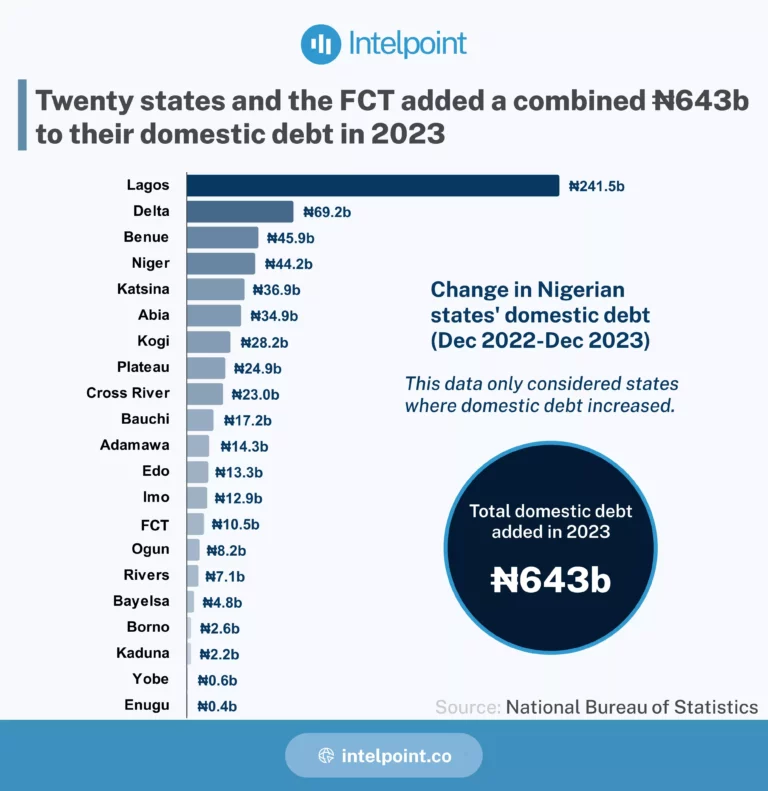
States and the FCT accounted for ₦4.12 trillion — 19.98% of Nigeria's Total Domestic Debt and 12.45% of the Total Public Debt, with Lagos having the most outstanding debt of ₦507.4 billion — 12.3% of the Total Debt Stock by states and the FCT.
See more
1 115 116 117 118 119 130
Value of startup funding deals in Francophone Africa by type of deal, 2024
  • 87.2% of startup deal value in Francophone Africa in 2024 came from equity funding.
  • Debt financing made up only 12.4% of the total startup capital raised, showing its limited role.
  • Grants accounted for just 0.4%, reflecting minimal non-dilutive support for startups.
  • Startups are more likely to trade ownership than take on debt or apply for grants.
  • The funding landscape remains investor-driven, with equity seen as the path to scale.
  • The near absence of grant funding may hinder innovation for startups that need early runway but aren't ready to give up equity.
Read more
Nigeria's arts, entertainment, and recreation sector's contribution to GDP (2020 - 2050)
  • The arts, entertainment, and recreation sector contributed 4.12% to Nigeria’s GDP in 2020.
  • By 2025, this contribution is projected to rise modestly to 4.43%.
  • The growth rate maintains a steady pace, reaching 4.75% by 2030.
  • By 2050, the arts, entertainment, and recreation sector is projected to reach a 6.00% share of Nigeria’s GDP.
  • With only a 1.88 percentage point rise forecasted over 30 years, the pace of growth suggests the sector remains undervalued or under-leveraged relative to its potential.
  • The creative economy’s resilience, despite limited public infrastructure and policy support, demonstrates strong organic demand and global competitiveness.
Read more
African Infrastructure Development Index (AIDI) of countries with the highest nominal GDP in Africa (2003 - 2024)
  • Morocco's AIDI score rose from 19.08 in 2003 to 70.32 in 2024, indicating substantial infrastructure progress over two decades.
  • Over the past 21 years, Egypt's infrastructure development, as measured by AIDI, has more than tripled.
  • Nigeria ranks 24th in infrastructure (AIDI) despite having the 4th largest GDP in Africa.
  • In 2024, Nigeria’s AIDI score was 25.70, significantly below peers like Morocco (91.43) and Egypt (82.54).
  • Algeria, with a GDP of $260.13B, achieved a strong AIDI score of 70.32, ranking 8th.
  • The AIDI gap highlights that economic size doesn’t guarantee infrastructure strength, underlining the need for intentional investment.
Read more
Weakest African currencies by annual average official exchange rate (LCU per US$) in 2024
  • Eight East African nations made the list of the top 15 worst African currencies.
  • Somalia has the weakest African currency in 2024, with an exchange rate of 28,118.33 SOS per US$.
  • Guinea, with 8,613.26 GNF per US$, has the second weakest currency, but is still far behind Somalia.
  • Madagascar, Uganda, and Zimbabwe follow, each with exchange rates between 3,200 and 4,500 LCU per US$.
  • Nigeria’s currency traded at 1,478.97 Naira per US$, about 20 times stronger than Somalia's currency.
  • Despite economic turmoil, South Sudan’s currency remained below 2,200 SSP per US$, performing better than Somalia and Guinea.
  • The gap between Somalia and the rest of Africa’s currencies highlights extreme economic pressures unique to the Somali economy in 2024.
Read more
Share of rural and urban population in Nigeria (1950 - 2050)
  • Nigeria's urban population is projected to grow from 9% in 1950 to 70% in 2050.
  • The urban population surpassed the rural population for the first time in 2020.
  • Between 1980 and 2020, Nigeria’s urban population more than doubled, from 22% to 52%.
  • The rural population share is expected to fall sharply from 91% in 1950 to just 30% in 2050.
  • In 2010, Nigeria’s population was still majority rural (57%), but within just a decade, that changed.
Read more
  • Egypt led every single year from 1961 to the most recent year — 63 years of dominance.
  • Egypt peaked at over 10.2 million tonnes in 2009, no other African country came close.
  • As of 2023, Egypt ranked 5th globally, just ahead of Italy and behind the US.
  • Nigeria hit its highest level in 2015, with 4.2 million tonnes.
  • Nigeria was the only country that got within 1.5 million tonnes of Egypt in 13 different years.
  • Countries like Algeria, Morocco, and Tunisia remained consistent but far behind Egypt and Nigeria.
  • Egypt’s lead is backed by large-scale irrigation and strong export systems.
  • In 1987, Africa supplied 11.7% of the world’s tomatoes. But by 2023, its share dropped to 8.8%.
Read more
1 115 116 117 118 119 260

Can’t find what you’re looking for? Please fill the form below
Contact Form Demo
SIGN UP TO OUR NEWSLETTER
Get periodic updates about the African startup space, access to our reports, among others.
Subscribe Here
Subscription Form

A product of Techpoint Africa. All rights reserved