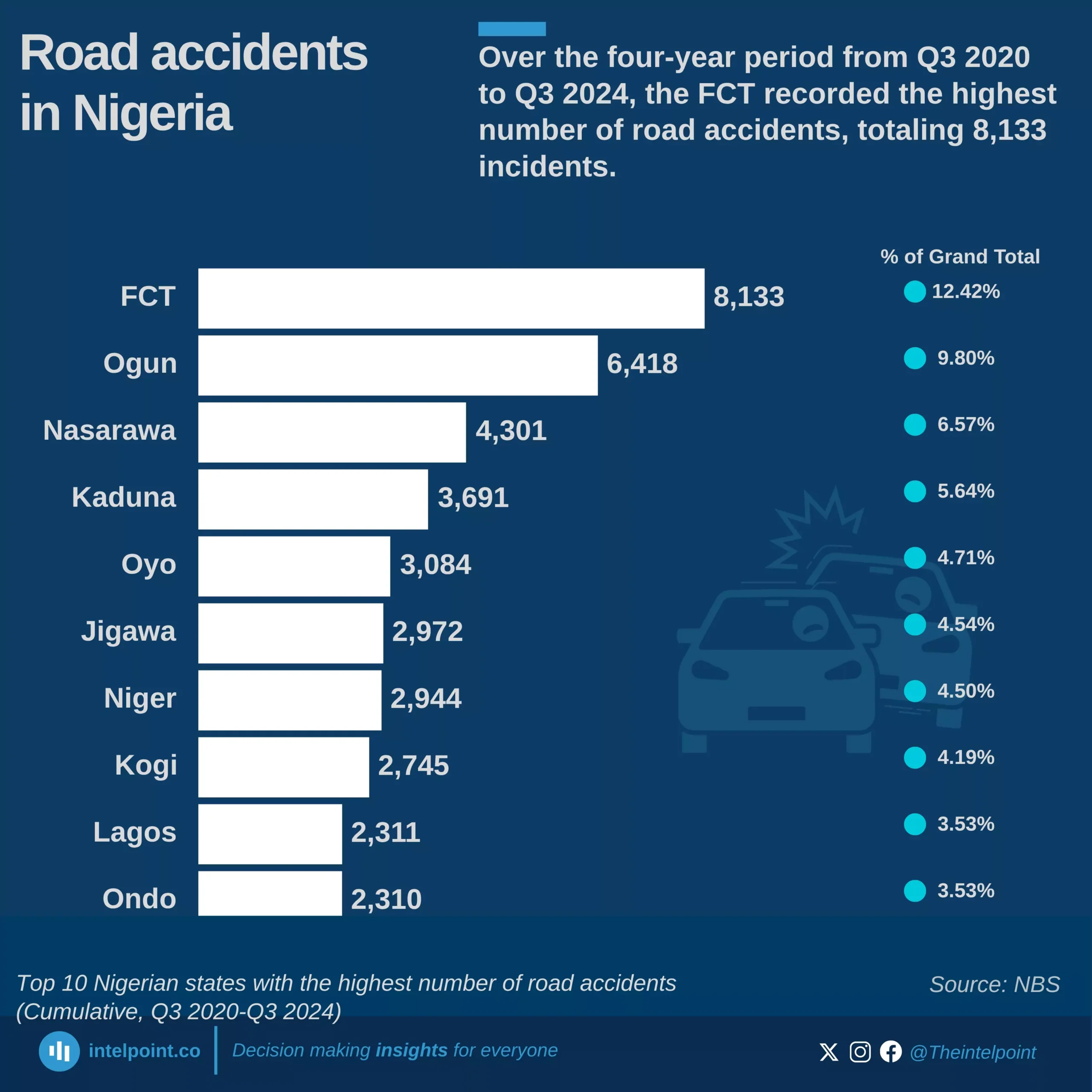
Over the four-year period from Q3 2020 to Q3 2024, the FCT recorded the highest number of road accidents, totaling 8,133 incidents

Key Takeaways

  • The Federal Capital territory (FCT) recorded the highest number of road accidents between Q3 2020 and Q3 2024, with a total of 8,133 accidents, accounting for 12.42% of total accidents.
  • FCT, Ogun, Nasarawa, and Kaduna consistently ranked among the top four states with the highest accident occurrences.
  • Bayelsa, Borno, Akwa Ibom, Rivers, and Imo were among the states with the lowest number of recorded accidents each quarter.

The Federal Capital Territory (FCT), often praised for having the best road network in Nigeria with wide, smooth, and well-maintained roads, ironically records the highest number of road accidents in the country. Between Q3 2020 and Q3 2024, the FCT accounted for 12.42% of all reported road accidents.

Other states that consistently report high accident figures include Ogun, Nasarawa, and Kaduna.

Within the FCT, particular concern has been raised about the Karu Bridge, which has witnessed frequent crashes, many involving trailers suffering brake failure, especially during rush hour traffic. Areas such as Nyanya and Wuse have also been hotspots for serious accidents. A similar pattern of frequent, often fatal accidents is observed in Ogun State, further emphasising the need for stricter safety enforcement and vehicle maintenance regulations in these high-risk zones.
Source:

NBS

Period:

Q3 2020-Q3 2024
HTML code to embed chart
Want a bespoke report?
Reach out
Tags
Related Insights

Nigerians have spent an estimated $193 million on U.S. visitor visa application fees since 2018
  • Estimated visitor visa fee spending reached $193 million between FY 2018 and FY 2025.
  • Applicants paid the fee whether their visas were approved or refused.
  • Estimated spending peaked at $49.8 million in FY 2018.
  • Spending recovered to $25.1 million in FY 2024 before falling to $23.2 million in FY 2025.
  • The estimates exclude transport, documents, agents, accommodation and other related costs.

The U.S. issued Africans 820 more agricultural worker visas in Fiscal Year 2025
  • U.S. nonimmigrant visa issuances to Africans fell by 23.6% to 413,259.
  • Twenty-five visa categories still recorded increases despite the overall decline.
  • C3 visas posted the largest numerical increase, rising by 949.
  • H2A agricultural worker visas increased by 820 to 15,623.
  • B1/B2 visitor visas recorded the biggest decline, falling by 109,653.

Southern Africa houses 6 of the top 10 African countries with the strongest passports
  • Seychelles has Africa’s strongest passport.
  • Mauritius is the only other African country with a passport close to Seychelles'.
  • South Africa leads the mainland pack, but still trails the island leaders by a wide margin.
  • No country outside the top three crosses a mobility score of 100.
  • Visa-required destinations still dominate for every passport in the top ten, except Seychelles and Mauritius.

Nigerians can enter 33% of African countries visa-free, while 43% still require a visa
  • Nigeria faces visa requirements in nearly half of Africa.
  • West Africa is Nigeria’s easiest mobility zone.
  • Beyond its West African neighbors, the Nigerian passport unlocks visa-free entry to only four other African nations
  • ECOWAS is the biggest reason for Nigeria’s visa-free access to its neighbours.
  • Visa openness drops sharply outside West Africa.
  • Africa’s free-movement agenda is still uneven in practice.
  • Business mobility remains constrained by visa friction.

Despite allocating more funds than in 2020, Nigeria's defence budget share falls back to 9% in 2026, matching the 2020 low
  • Nominal spending surged, but inflation and naira depreciation eroded real gains. From ₦921 billion in 2012 to ₦6.57 trillion in 2025, the absolute figure may seem dramatic, but Nigeria's security challenges intensified over the same period.
  • Defence commanded over 21% of the budget in 2013. From 2024 to 2026, that figure has fallen below 14%, with 2026 hitting a historic low of 9.3%.
  • Boko Haram, banditry, and separatist tensions peaked in 2020, resulting in a cut that saw defence's share fall to just 9.2%, the lowest on record at that point.
  • The jump to ₦6.57trn (13.2%) in 2025 marks the sharpest year-on-year absolute increase in the dataset. But 2026 reversed this again, with the rate dropping to 9.3%.

Nigeria recorded a 76% drop in HIV cases over five years
  • The 2019 number revealed the truth — years of underdiagnosis were corrected in a single year when PEPFAR restructured testing entirely.
  • The 76% decline from 2019 to 2024 is one of the most significant HIV reductions in Africa in a single decade.
  • One year of disruption in 2020 erased an entire year of progress, creating a backlog that took until 2022 to clear.
  • With PEPFAR's $1.2 billion pipeline cut, fewer Nigerians are being tested, meaning fewer cases appear on paper while the virus spreads undetected.

POPULAR TOPICS
SIGN UP TO OUR NEWSLETTER
Get periodic updates about the African startup space, access to our reports, among others.
Subscribe Here
Subscription Form

A product of Techpoint Africa. All rights reserved