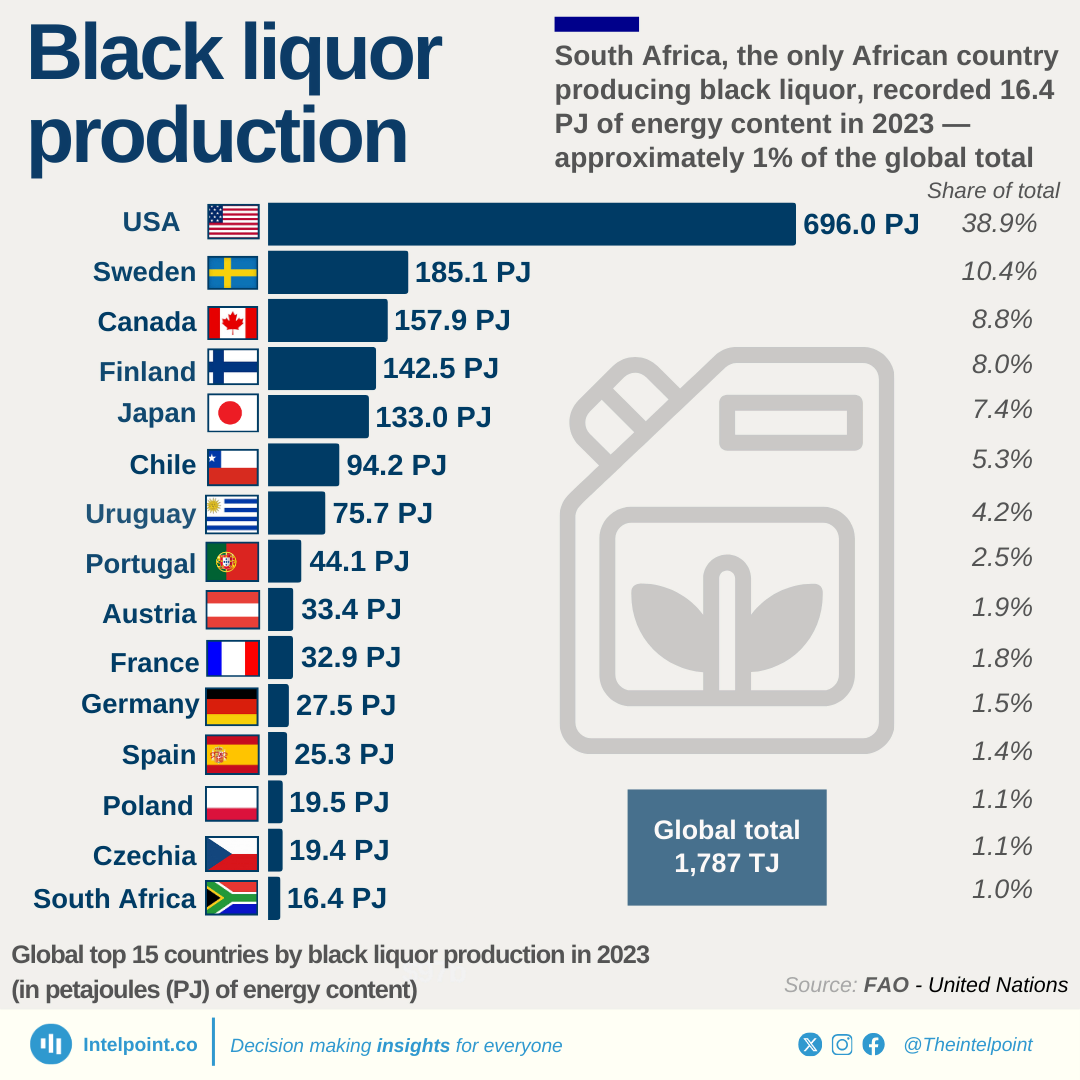
South Africa, the only African country producing black liquor, recorded 16.4 PJ of energy content in 2023 — approximately 1% of the global total

Key takeaways:

  • The United States of America led the production of black liquor with 696.0PJ produced making up 38.9% of the global total produced in 2023.
  • South Africa is the only African country producing black liquor with 16.4PJ produced making up 1% of the global total.
  • The total amount of black liquor produced globally in 2023 was 1,787PJ.
  • Sweden, Canada, Finland and Japan produced 185.1PJ - 10.4%, 157.9PJ - 8.8%, 142.5PJ - 8.0% and 133.0PJ - 7.4% respectively.

Black liquor is the by-product from the kraft process when digesting pulpwood into paper pulp. It is a source of biofuel derived from organic, renewable biomass sources and a very important form of energy.

In 2023, the United States of America led the production of black liquor with 696.0PJ (petajoules) produced, making up 38.9% of the total quantity produced globally. Sweden, Canada, Finland and Japan produced 185.1PJ (10.4%), 157.9PJ (8.8%), 142.5PJ (8.0%), and 133.0PJ (7.4%), respectively.

South Africa is the only African country producing black liquor, with 16.4PJ produced, making up 1% of the global total. Comparing the growth of the pulp and paper industry in Africa with the fact that Africa produced only 1% of black liquor in 2023, it was revealed that there is a huge gap in the recycling of by-products, commonly called waste products, in Africa.
Source:

Food and Agriculture Organization of the United Nations

Period:

2023
HTML code to embed chart
Want a bespoke report?
Reach out
Tags
Related Insights

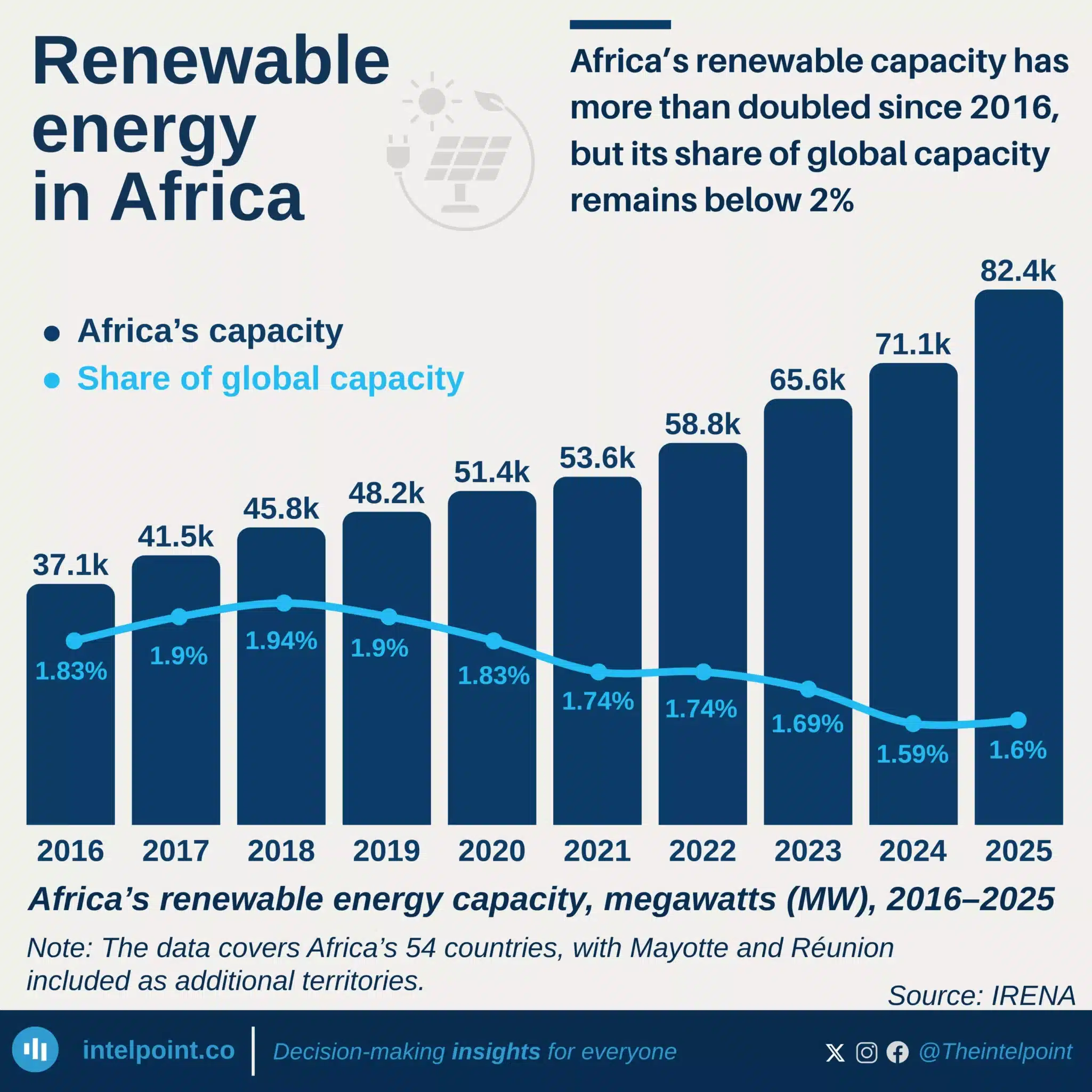
Africa’s renewable capacity has more than doubled since 2016, but its share of global capacity remains below 2%
  • About 600 million Africans still lack access to electricity.
  • Africa has 20% of the world's population but receives less than 3% of global energy investment.
  • South Africa added the most renewable capacity from 2016–2025, followed by Ethiopia, Egypt, Morocco and Tanzania.
  • Africa's renewable capacity is growing, but its share of global capacity remains small.

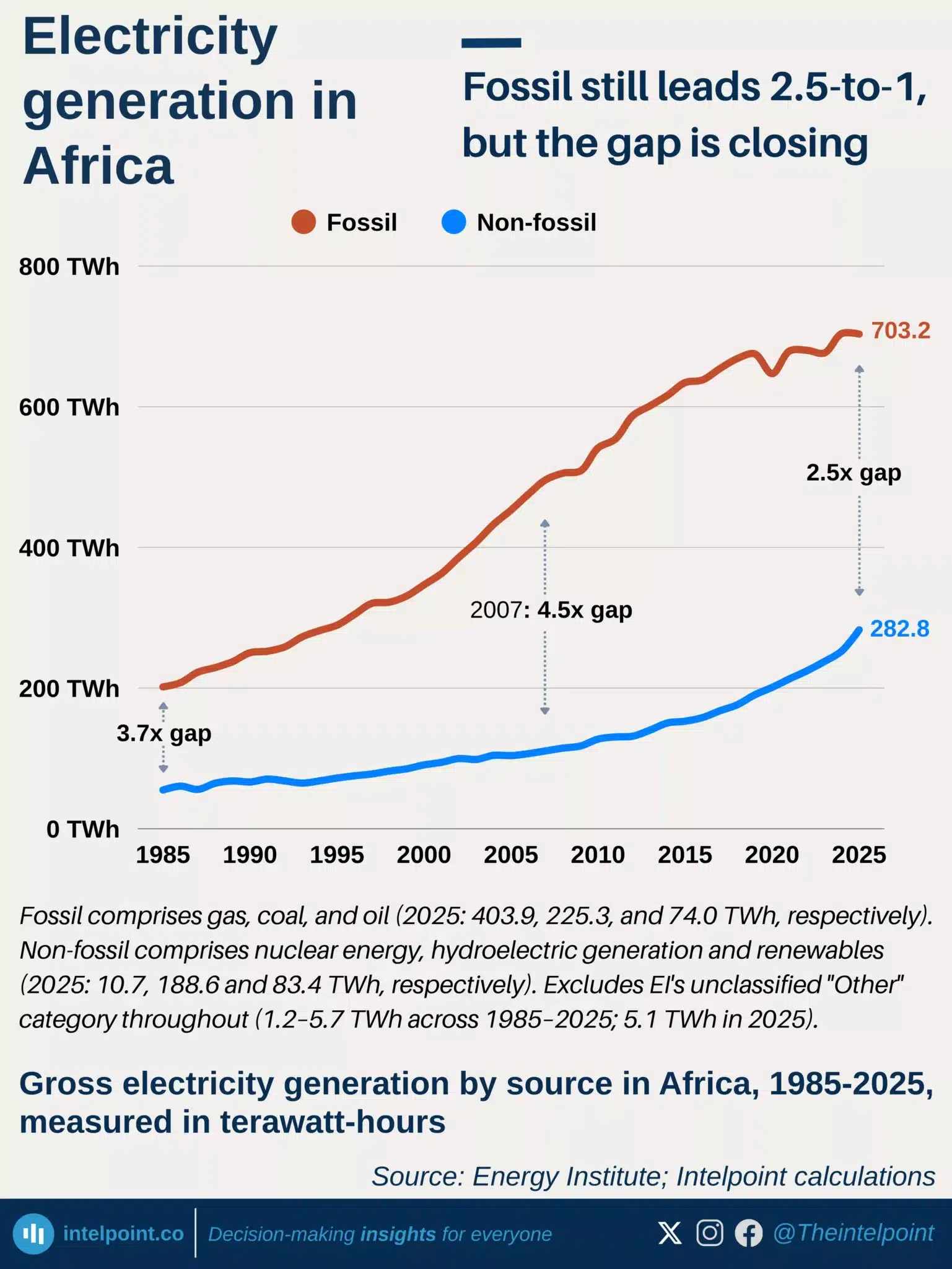
Electricity generation in Africa: fossil still leads 2.5-to-1, but the gap is closing
  • Fossil fuels still generate 2.5x more electricity than non-fossil sources, though the gap has narrowed from a 2007 peak of 4.5x.
  • South Africa and Egypt together account for all of Africa's nuclear power and 59% of its non-hydro renewables.
  • Hydropower, the largest non-fossil source at 188.6 TWh, tells a different geographic story, with 91% generated outside South Africa and Egypt, mainly in Eastern, Middle, and Western Africa.
  • Gas still leads at 403.9 TWh, but its growth slowed to 0.8% in 2025 versus 11.9% growth for non-fossil sources.

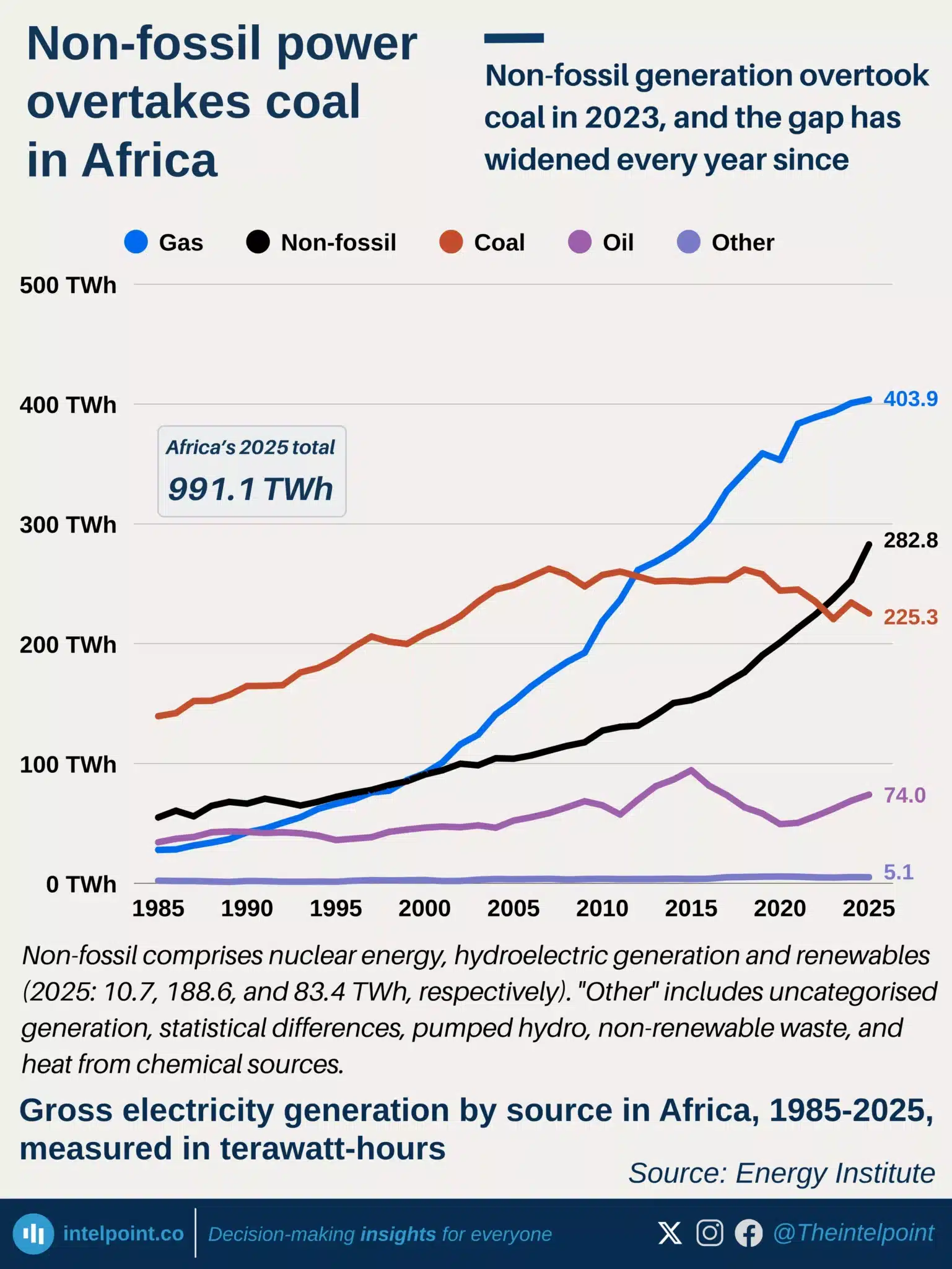
Non-fossil generation overtook coal in 2023, and the gap has widened every year since
  • Non-fossil generation overtook coal in 2023, with the gap reaching 57.5 TWh in 2025.
  • Coal generation fell to 225.3 TWh, below its 262.6 TWh peak in 2007.
  • Hydropower dominates non-fossil generation, producing 188.6 TWh in 2025.
  • Fossil fuels still dominate, generating 703.2 TWh versus 282.8 TWh from non-fossil sources.

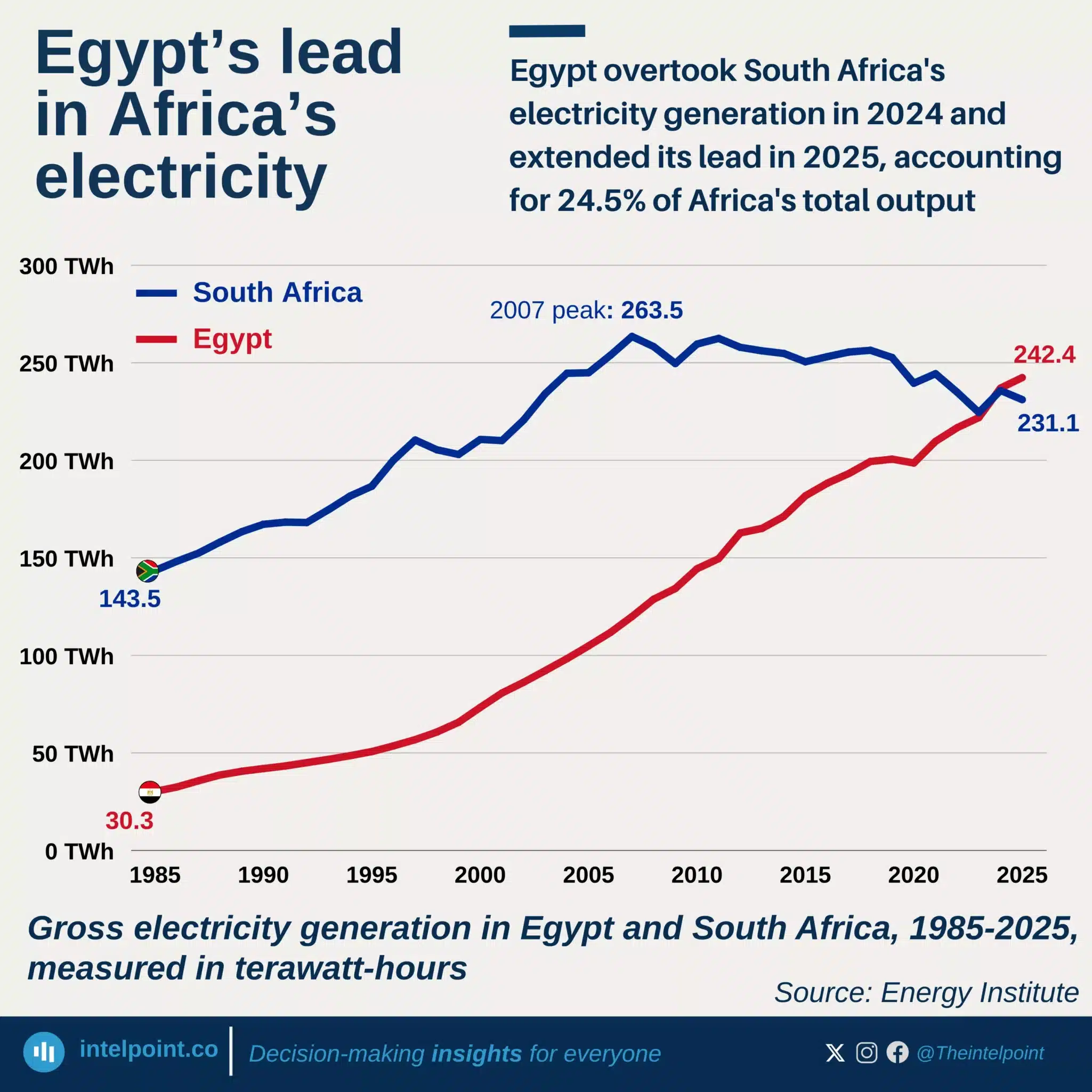
Egypt overtook South Africa's electricity generation in 2024 and extended its lead in 2025
  • Africa’s share of global electricity generation rose only from 2.6% in 1985 to 3.1% in 2025.
  • Africa’s electricity generation increased 283% over the past 40 years.
  • Egypt overtook South Africa as Africa’s largest electricity producer in 2024.
  • Egypt generated 242.4 TWh in 2025, up from 30.3 TWh in 1985.
  • South Africa generated 231.1 TWh in 2025, down from its 263.5 TWh peak in 2007.
  • Egypt and South Africa accounted for 24.5% of Africa’s electricity generation in 2025.

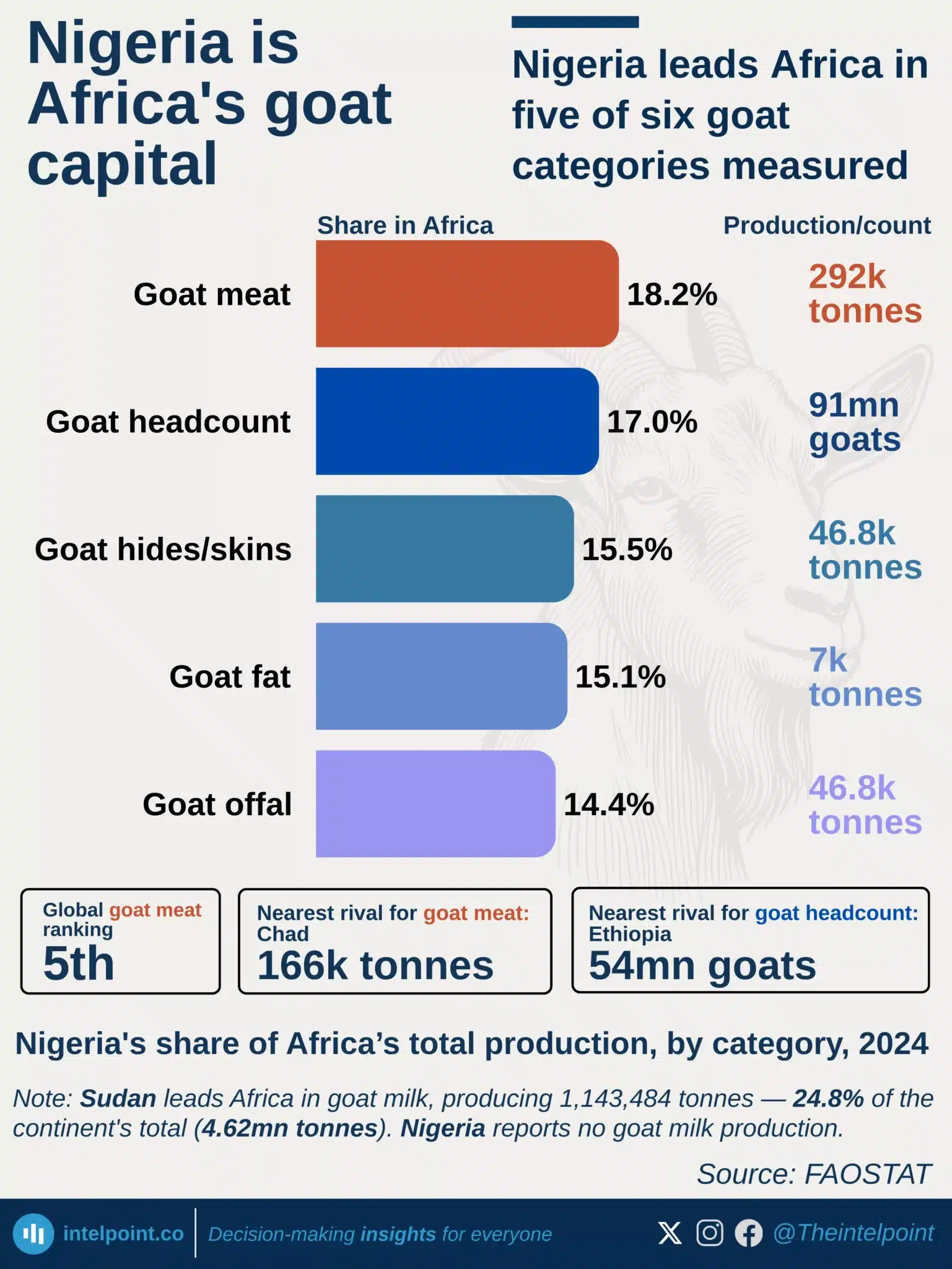
Nigeria leads Africa in five of six goat categories measured
  • Nigeria leads Africa in five of six goat categories, but its largest share is just 18.2% of continental production.
  • Nigeria has 91 million goats, 17.0% of Africa’s total, nearly twice Ethiopia’s 54 million.
  • Nigeria produced 292,000 tonnes of goat meat, making it Africa’s largest producer but only the world’s 5th largest.
  • Chad produced 166,000 tonnes of goat meat, making it Nigeria’s closest African rival.
  • Goat milk is the exception: FAOSTAT records no Nigerian production, while Sudan accounts for 24.8% of Africa’s total.

Nigeria retained Africa’s third-highest refinery throughput as output reached a record high in 2025
  • Nigeria recorded its highest refinery throughput since 1990 at 360,000 b/d.
  • Throughput increased by 50.6% from 239,000 b/d in 2024.
  • The 2025 level was more than 20 times the 17,600 b/d recorded in 2023.
  • Nigeria remained Africa’s third-highest, behind Algeria and Egypt.
  • Dangote’s contribution is not reported separately.

POPULAR TOPICS
SIGN UP TO OUR NEWSLETTER
Get periodic updates about the African startup space, access to our reports, among others.
Subscribe Here
Subscription Form

A product of Techpoint Africa. All rights reserved