Bite-sized Insights about
 
Providing you with data-based insights about things happening around you.
Popular Insights
  • In H1 2023, Nigeria's total trade was ₦24.79 trillion — ₦13.5 trillion worth of exports and ₦11.29 trillion imports. Here are Nigeria’s trading partners by region in H1 2023.

    See more
    Real GDP Growth projection across regions (2023 - 2025)

    The Nigerian economy shows promise as the IMF projects an increase in the country's GDP growth, rising to 3.2% in 2025. This comes when projections show stagnant global growth at 3.2%, while sub-Saharan Africa outpaces other regions with an anticipated rise to 4.2% by 2025.

    See more
  • The 2024 Global Peace Index reveals a decline in peacefulness in 97 countries, the highest since the index began.

    Nigeria is among the nations affected by regional conflicts and rising violence. With a peace index score of 2.91, Nigeria is facing increasing challenges.

    A deteriorating peace score impacts foreign investment and economic stability. Global economic losses due to violence reached $19.1 trillion in 2023.

    See more

    The FAAC's revenue distribution from 2017 to August 2023 highlights the dominance of Delta, Akwa Ibom, Rivers, and Bayelsa states in allocations. Despite Lagos' economic prominence, it ranked fifth. Here is the distribution of revenue among states between 2017 and August 2023.

    See more
  • A Trend of Adult literacy rates of African countries

    Between 2018 and 2021, adult literacy rates across African nations exhibited significant disparities. Seychelles and South Africa led with literacy rates of 96% and 95%, respectively, indicating a high proportion of literate adults. Conversely, Chad had the lowest literacy rate during this period.

    These statistics underscore the uneven progress in educational attainment across Africa, highlighting the need for targeted interventions to improve literacy in lower-performing nations.

    See more

    Nigeria was the seventh most populous nation in the world in 2020, with 206.1 million people. Projected to reach a population of 401.3 million by 2050, Nigeria will rank third after India (1st) and China (2nd). According to Institut national d'études démographiques' projections, Nigeria, Ethiopia, DR Congo, Egypt, Tanzania, and Kenya will be among the world’s top 20 most populous countries by 2050.
    See more

  • Global inflows of foreign direct investment fell by 12% in 2022, and Africa saw a 44% decline from $80 billion in 2021 to $45 billion. According to UNCTAD data, only two of Africa's five major regions — North and East Africa — saw a rise in FDI in 2022.
    See more
  • MTN Nigeria has dominated the country's telecommunications market over the years, accounting for the largest market share. All four operators, apart from 9mobile, recorded a significant increase in their subscriber base between May 2014 and March 2024.

    See more
  • The 2024 Global Peace Index reveals a decline in peacefulness in 97 countries, the highest since the index began.

    Nigeria is among the nations affected by regional conflicts and rising violence. With a peace index score of 2.91, Nigeria is facing increasing challenges.

    A deteriorating peace score impacts foreign investment and economic stability. Global economic losses due to violence reached $19.1 trillion in 2023.

    See more

Other Insights
3 in every 10 workers in Nigeria spend more than 20% of their salary on transport

In general, feeding and transportation costs take the largest chunk of people's remuneration in Nigeria. Three in every 10 workers spend not less than 20% of their remuneration on transportation, while a small percentage use as as much as half their monthly salary.

See more
Female labour participation in Africa

Madagascar, Burundi, and Mozambique lead Africa in female workforce participation, with rates above the global average of 48%.

The 2024 estimate ranks Nigeria 30th in Africa, with a female labour force participation rate of 52%.

See more
Africas labour participation rate

At least 80% of adults in Madagascar, Tanzania, and Ethiopia who can work are employed or actively seeking jobs.

Across Africa, 63% of working-age people are engaged in the workforce. However, in Algeria, Morocco, and Djibouti, participation is below 45%.

See more
Global malaria cases by country

In 2022, two out of every three of the world’s 249 million malaria cases were found in Sub-Saharan Africa, with Nigeria leading the numbers at a staggering 67 million cases.

See more
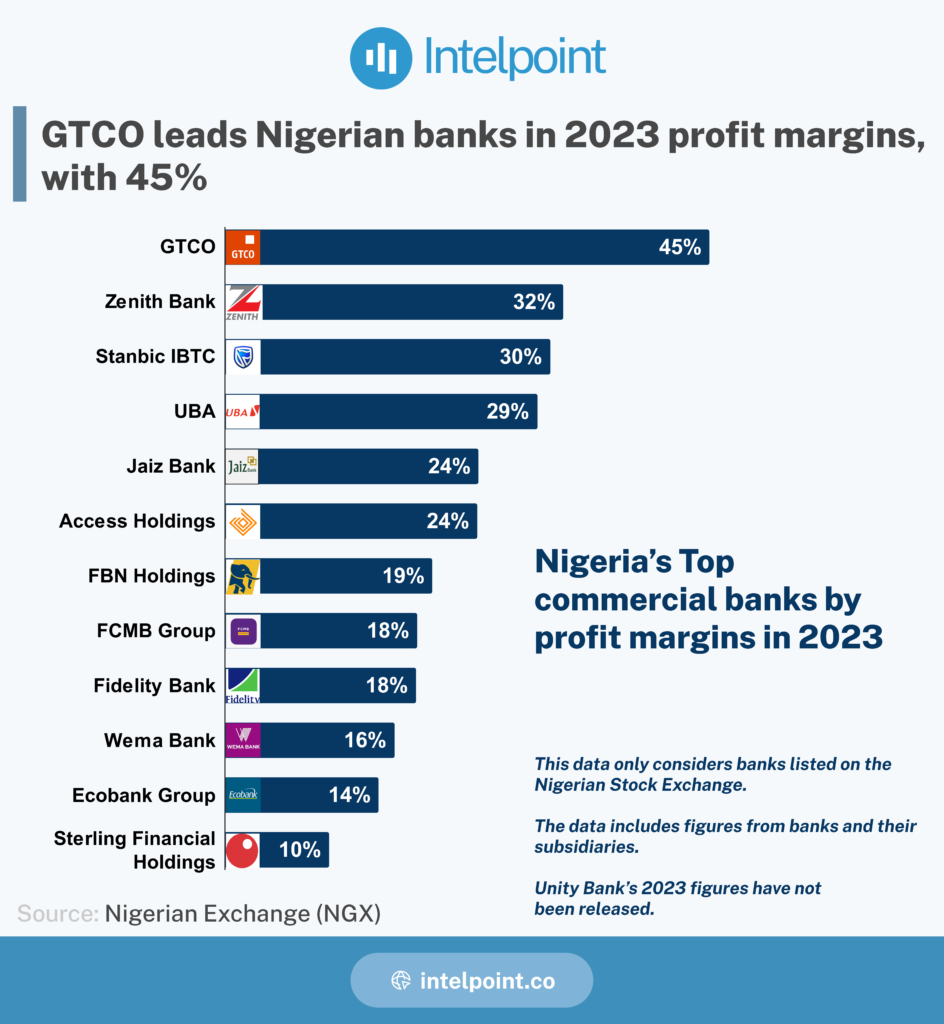
GTCO shatters records with ₦1.08t earnings in first three quarters of 2024 following historic Q1 profit.

Guaranty Trust Holding Company (GTCO) sets a new milestone with ₦1.08t profit after tax in the first three quarters of 2024, following its record-breaking first quarter.

See more
Delta State's share of the 13% oil derivation funds

Between 2015 and 2023, Delta State consistently received significant portions of the 13% derivation fund, securing about 29% of Nigeria's total allocation over these years. This amounted to over ₦1.3 trillion out of the total of ₦4.72 trillion allocated to all the oil-producing states in the country.

The 13% derivation is part of Nigeria's federal revenue-sharing formula, where oil-producing states receive a portion of revenues generated from crude oil production in their regions. This allocation aims to enhance development and address these states' environmental and economic impacts. For those seeking structured academic help on complex economic topics like revenue distribution in Nigeria, professional services such as bachelorarbeit schreiben lassen can be a valuable resource.

Note: Data for December 2018 was estimated due to a lack of available information for that month.

See more
The proportion of jobs in selected sectors that are expected to experience either a “large,” “small”, or “no impact” from AI

In today’s rapidly changing job market, workers are increasingly curious about how technology will reshape their roles. With artificial intelligence (AI) evolving at a fast pace, understanding which professions will see the most transformation is crucial.

Artificial Intelligence will impact IT and Finance jobs the most.

AI is expected to have the largest impact on IT jobs (73%) and Finance (70%) jobs, followed by Customer Sales (67%) and Operations (65%), with significant changes anticipated across various jobs. For those who want to explore the effects of AI on academic research or understand future-oriented writing strategies, working with a <a href="https://ghostwriter-bachelorarbeit.at" style="color: inherit; text-decoration: none;">ghostwriter bachelorarbeit</a> can provide clarity and direction.

See more
Global deaths and births from 1950 to 2100

By 2084, global deaths are projected to surpass births, marking a potential shift towards a population decline. This trend reflects a steady rise in death rates alongside a decrease in birth rates, as shown in UN data.

See more
 

Nigeria's GDP saw its steepest drop in 1999, marking the country's transition to civilian rule with Olusegun Obasanjo and Olu Falae running for president.

Over the years, Nigeria's economy has fluctuated, peaking in 2014. Despite stable population growth, recent economic dips underscore ongoing challenges.

See more

Moniepoint achieved unicorn status after nine years of operation.

Here is how long it took other African startups to reach the milestone.

See more
  • Africa's rice production in 2024 reached 44.8 million tonnes, the highest in the continent's history.
  • The 2024 figure is 10.4 times higher than the 4.3 million tonnes produced in 1961.
  • Production grew from 4.3 million tonnes in 1961 to 44.8 million tonnes in 2024.
  • Nigeria leads Africa in rice production, accounting for 9.1 million tonnes (approximately 20% of the total) in 2024.
  • Africa has produced approximately 1.3 billion tonnes of rice cumulatively from 1961 to 2024.
  • Major producers include Nigeria, Egypt, Tanzania, Guinea, and Côte d'Ivoire, which together account for over 60% of Africa's total output.
See more
1 95 96 97 98 99 129
Key Takeaways:
  • Aradel Holdings led with ₦247.79 billion in PAT, marking a 361% year-on-year growth.
  • Oando and Seplat Energy followed with ₦220.12 billion and ₦214.25 billion in PAT, respectively.
  • Eterna Plc recorded a significant turnaround with 114% year-on-year growth, recovering from a loss in 2023.
  • The sector experienced widespread profitability gains, reflecting stronger market dynamics and operational improvements.
  • Profit after tax growth across the sector ranged from 15% to 361%.
  • Nigeria's oil & gas sector delivered a combined profit totalled ₦730 billion in 2024.
Read more
Key Takeaways:
  • The sector’s total PAT rose by 28% from ₦31.68 billion in 2023 to ₦40.49 billion in 2024.
  • Chapel Hill Denham Nigeria Infrastructure Debt Fund remained the top earner with ₦19.59 billion, despite a modest 4% year-on-year decline.
  • Julius Berger and UPDC REIT also posted strong profits, contributing significantly to the overall performance.
  • UPDC Plc recorded the strongest profit growth, surging by nearly 278% from ₦221.5 million in 2023 to ₦836.9 million in 2024.
  • Ronchess Global Resources Plc significantly narrowed its losses by over 64%, though it remained in negative territory.
Read more
Key Takeaways:
  • Seplat Energy recorded the highest EPS in 2024 at ₦385.61, up from ₦92.75 in 2023.
  • Aradel Holdings posted the strongest growth, with a 361% increase in EPS from ₦12.37 to ₦57.03.
  • Eterna PLC reversed its negative EPS in 2023, reporting ₦1.03 in 2024.
  • All listed companies reported positive earnings in 2024, compared to 2023.
  • Three companies grew their EPS by more than 200%.
Read more
Key Takeaways:
  • SFS REIT reported the highest EPS in 2024 at ₦21.50, up from ₦14.50 in 2023.
  • UPDC Plc achieved the most significant growth, with EPS rising fivefold from ₦1.00 to ₦5.00.
  • Most companies posted improved EPS, reflecting stronger earnings and better shareholder returns.
  • Ronchess Global Resources reduced its loss per share by 68%, from -₦71.50 to -₦23.15.
  • Julius Berger and UPDC REIT recorded steady EPS growth of 23% year-on-year.
Read more
Key Takeaways:
  • Meyer Plc recorded the highest EPS in 2024 at ₦59, up from ₦47.
  • Beta Glass had the largest year-on-year EPS growth, more than doubling from ₦10.74 to ₦22.71.
  • Among cement producers, Dangote Cement led with EPS rising to ₦29.74 from ₦26.47.
  • Notore Chemical Industries reduced its losses by 33%, improving EPS from -₦70.87 to -₦47.45.
  • Most listed firms recorded higher EPS, indicating improved profitability and operational efficiency.
  • Lafarge Africa, CAP Plc, and Berger Paints reported steady EPS growth.
  • Notore Chemical remained the only company with a negative EPS.
  • Austin Laz & Co maintained a flat EPS of zero for both years.
Read more
  • MTN remains the market leader, growing from 26 million subscribers in 2013 to 75 million by early 2025.
  • MTN's market share was 53.10% in early 2025, with over 75 million active data subscribers.
  • Airtel saw consistent growth, rising from 8.2 million in 2013 to 48.7 million in 2025, now commanding over 34% market share.
  • Globacom’s data subscriber base peaked in 2023 at 43.7 million but fell sharply by 2025 to 15.8 million.
  • 9mobile's market share in 2025 dropped to just 1.29% from its 2016 peak of 16.31%.
  • Globacom’s market share dropped significantly from its peak of 29.27% in 2017 to 11.16% in 2025.
  • Airtel doubled its market share from 18% in 2013 to 34% in 2025.
  • 9mobile's data subscriber base crashed by 88% from its 2016 peak to less than 2 million in 2025.
Read more
1 95 96 97 98 99 257

Can’t find what you’re looking for? Please fill the form below
Contact Form Demo
SIGN UP TO OUR NEWSLETTER
Get periodic updates about the African startup space, access to our reports, among others.
Subscribe Here
Subscription Form

A product of Techpoint Africa. All rights reserved