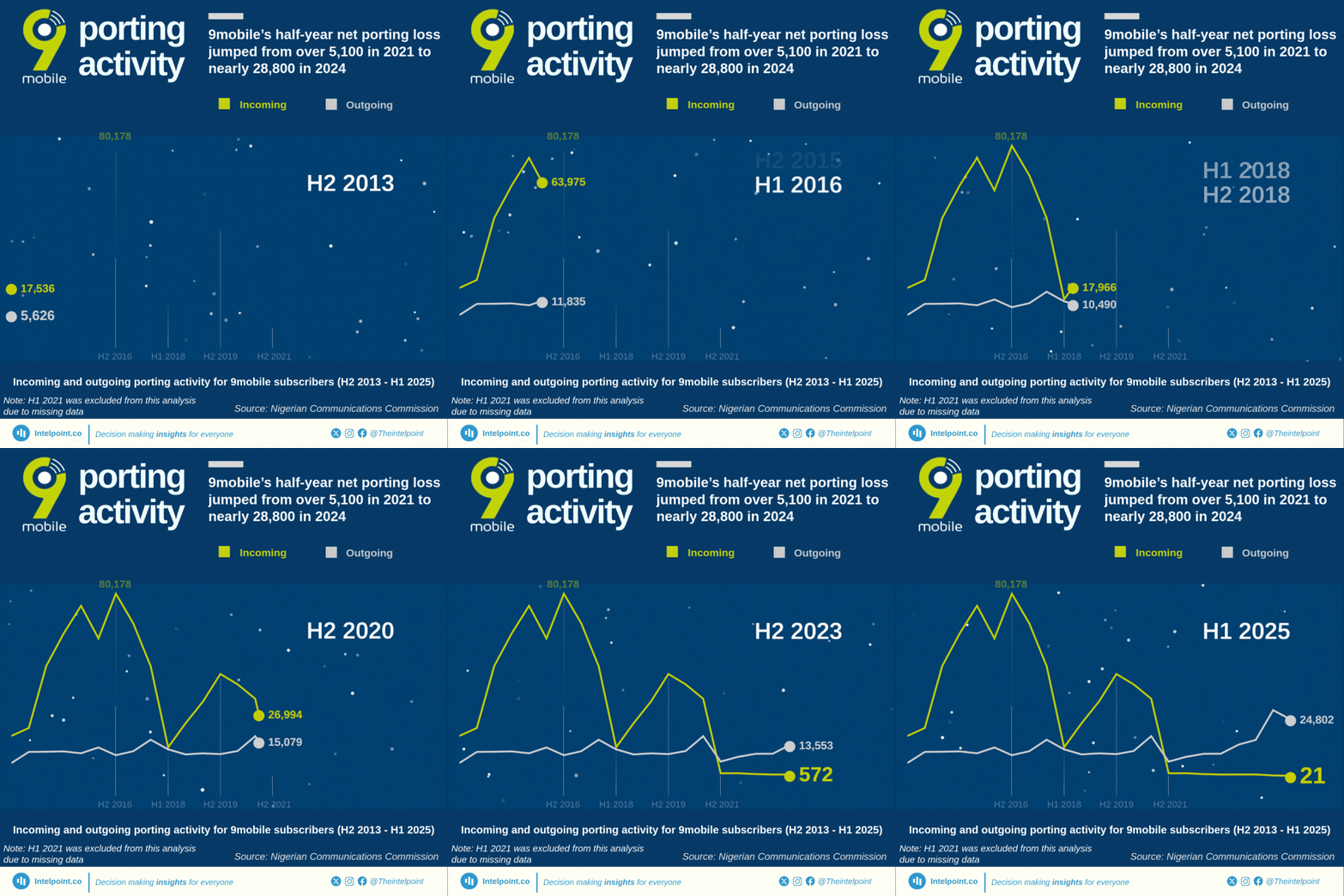
Between September 2022 to August 2023, 3 of Nigeria's mobile Internet providers saw a combined 8 million increase in their active mobile Internet subscribers, with MTN gaining the most, followed by Globacom and Airtel. 9mobile on the other hand, recorded almost 1 million decline.
Since launching in 2007, the iPhone has been a key part of Apple's revenue stream. Apple's 2021 annual report shows that net sales for iPhones accounted for over half of the company's total net sales for the year.
The 2024 Global Peace Index reveals a decline in peacefulness in 97 countries, the highest since the index began.
Nigeria is among the nations affected by regional conflicts and rising violence. With a peace index score of 2.91, Nigeria is facing increasing challenges.
A deteriorating peace score impacts foreign investment and economic stability. Global economic losses due to violence reached $19.1 trillion in 2023.
The FAAC's revenue distribution from 2017 to August 2023 highlights the dominance of Delta, Akwa Ibom, Rivers, and Bayelsa states in allocations. Despite Lagos' economic prominence, it ranked fifth. Here is the distribution of revenue among states between 2017 and August 2023.
Between 2018 and 2021, adult literacy rates across African nations exhibited significant disparities. Seychelles and South Africa led with literacy rates of 96% and 95%, respectively, indicating a high proportion of literate adults. Conversely, Chad had the lowest literacy rate during this period.
These statistics underscore the uneven progress in educational attainment across Africa, highlighting the need for targeted interventions to improve literacy in lower-performing nations.
Nigeria was the seventh most populous nation in the world in 2020, with 206.1 million people. Projected to reach a population of 401.3 million by 2050, Nigeria will rank third after India (1st) and China (2nd). According to Institut national d'études démographiques' projections, Nigeria, Ethiopia, DR Congo, Egypt, Tanzania, and Kenya will be among the world’s top 20 most populous countries by 2050.
In 2022, Egypt, South Africa, Nigeria, Algeria, and Morocco collectively consumed an average of 2.712 million barrels of oil per day (Mb/d), 61% of the continent's daily oil consumption (4.478 Mb/d). African countries consumed 4.7% of the global usage (99.8 Mb/d).
Egypt used the most (850.5 thousand barrels per day (Kb/d)), followed by South Africa (601.2 Kb/d) and Nigeria (514.5 Kb/d).
MTN Nigeria has dominated the country's telecommunications market over the years, accounting for the largest market share. All four operators, apart from 9mobile, recorded a significant increase in their subscriber base between May 2014 and March 2024.
The 2024 Global Peace Index reveals a decline in peacefulness in 97 countries, the highest since the index began.
Nigeria is among the nations affected by regional conflicts and rising violence. With a peace index score of 2.91, Nigeria is facing increasing challenges.
A deteriorating peace score impacts foreign investment and economic stability. Global economic losses due to violence reached $19.1 trillion in 2023.
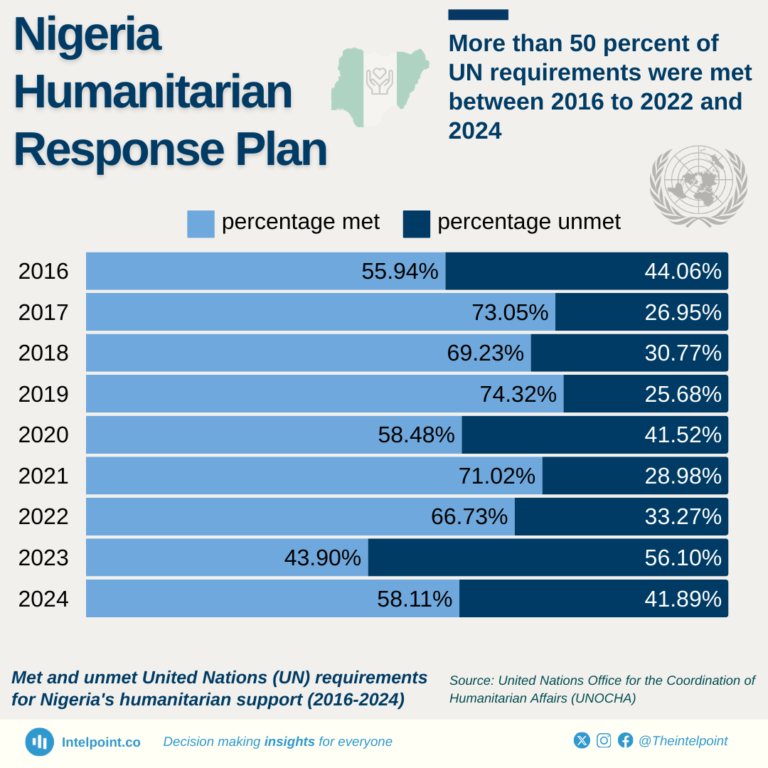
In 2024, there was a sharp drop in unrealised humanitarian funds from the amount received in 2023.
The rate at which the amount of unrealised humanitarian aid increased from 2022 to 2023 is approximately the same rate at which the unrealised amount dropped in 2024.
The lowest amount of unrealised funding was recorded in 2016.
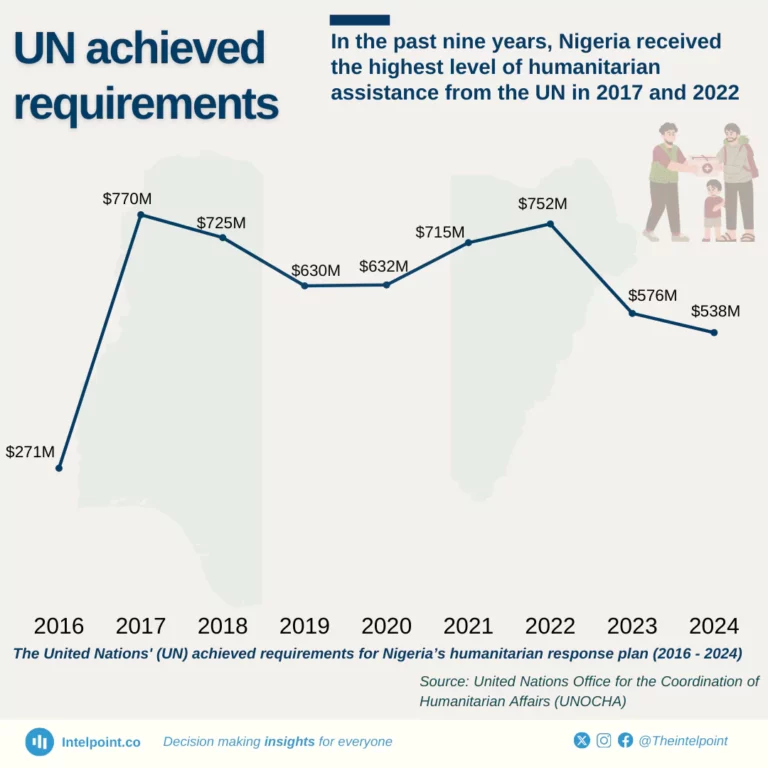
The UN secured $632 million of the $1.08 billion needed for humanitarian assistance in Nigeria in 2020.
Despite being a key contributor to employment and food security, the Agricultural sector only gets an average of 4.4% of total DMB credit.
The Industrial sector consistently absorbs the largest loans, accounting for 42%–46% of total credit from January to September 2024.
The Services sector remains a top recipient of bank credit, with shares fluctuating between 37% and 41%.
The Government sector receives relatively low credit levels, averaging 4.9%, suggesting reliance on alternative funding sources rather than direct bank borrowing.
With an impressive 20.1% CAGR, the Industry (including construction) has experienced the fastest expansion, more than doubling its contribution to GDP over the period.
Services remains the largest contributor to GDP, but its growth at 14.6% CAGR is being outpaced by Industry, signalling an evolving economic structure.
Agriculture’s 11.2% CAGR shows steady growth, but its share of GDP is shrinking compared to the industrial and service sectors.
The rapid growth in Industry reflects Tanzania’s shift towards manufacturing, construction, and infrastructure development.
Unlike decades ago, when agriculture dominated, today’s GDP contributions are more balanced between Services, Industry, and Agriculture, reducing reliance on any single sector.
With 57.50% inflation, Zimbabwe’s economy is experiencing an extreme price surge, making it the most inflation-affected country in Africa.
At 34.80%, Nigeria is battling one of its worst inflation crises in decades, severely impacting food prices, transportation, and living costs.
The fact that seven out of ten countries on this list have inflation rates that double or even quadruple the African average shows the depth of the inflation crisis.
While their inflation rates (between 16% and 24%), as seen in Ghana, Ethiopia, Zambia, and the Congo, are lower than the top three, they still exceed the sustainable threshold for economic stability.
Debt servicing costs have grown significantly over the years, from ₦400 billion in 2010 to an estimated ₦11.8 trillion in 2024 — a nearly 30-fold increase in just 15 years.
Between 2010 and 2024, Nigeria has spent ₦45.57 trillion on servicing its debt, demonstrating the enormity of its financial obligations.
The year 2024 stands out as the most expensive year yet, with ₦11.8 trillion spent on debt servicing — a jump of over 37% compared to 2023's ₦8.6 trillion.
While debt service expenditures grew gradually in the early 2010s, the most rapid increases occurred after 2019, with spending surging from ₦2.4 trillion in 2019 to ₦8.6 trillion in 2023.
From 2019 to 2024, debt servicing costs rose by almost 392%, showcasing how Nigeria’s debt burden has amplified in a short period.
This steep rise in debt servicing diverts resources from critical areas such as infrastructure, health, and education, hindering overall development.
The US dusbursed $512 million to Nigeria’s health sector during the fiscal year.
The US allocated over $232 million to HIV/AIDS programs in Nigeria.
The World Health Organization (WHO) warns that this freeze could reverse decades of progress in HIV prevention and treatment, with the potential to worsen global health outcomes.
PEPFAR, a US initiative, provides HIV treatment for over 20 million people worldwide.
Eskom’s average electricity tariff increased by approximately 162% between 2013/14 and 2023/24.
Tariffs are categorized into two groups based on distribution: Local Authority Tariffs and Non-Local Authority Tariffs.
Landlight Tariff (Non-Local Authority category) is the highest rate and in 2023/24 it stood at 608.61 c/kWh.
Homelight 20A (Block 1) is the lowest tariff also in the non-local authority category, at 168.78 c/kWh in 2023/24.
Eskom applies Time-of-Use (ToU) pricing, where tariffs vary by Time of day (peak, standard, off-peak periods) and Demand season (high-demand season: June to August and Low-demand season: September to May)