Bite-sized Insights about
 
Providing you with data-based insights about things happening around you.
Popular Insights
  • Nigeria’s population growth has outpaced its economic performance. From 1960 to 2023, the population increased from 44.9 million to an estimated 223.8 million, putting immense pressure on resources.

    The country's GDP peaked at $574.2 billion in 2014 but dropped to $362.8 billion in 2023.

    See more

    Voice is still king for Airtel Africa, accounting for the largest share of its revenue between 2019 and 2023. However, the revenue from data and Airtel Money, its mobile money services have more than doubled within this period. Revenue from voice and others didn't record a sharp increase unlike data and Airtel Money.

    See more
  • The 2024 Global Peace Index reveals a decline in peacefulness in 97 countries, the highest since the index began.

    Nigeria is among the nations affected by regional conflicts and rising violence. With a peace index score of 2.91, Nigeria is facing increasing challenges.

    A deteriorating peace score impacts foreign investment and economic stability. Global economic losses due to violence reached $19.1 trillion in 2023.

    See more

    The FAAC's revenue distribution from 2017 to August 2023 highlights the dominance of Delta, Akwa Ibom, Rivers, and Bayelsa states in allocations. Despite Lagos' economic prominence, it ranked fifth. Here is the distribution of revenue among states between 2017 and August 2023.

    See more
  • A Trend of Adult literacy rates of African countries

    Between 2018 and 2021, adult literacy rates across African nations exhibited significant disparities. Seychelles and South Africa led with literacy rates of 96% and 95%, respectively, indicating a high proportion of literate adults. Conversely, Chad had the lowest literacy rate during this period.

    These statistics underscore the uneven progress in educational attainment across Africa, highlighting the need for targeted interventions to improve literacy in lower-performing nations.

    See more
    Countries by Global Innovation Index 2024

    The Global Innovation Index 2024 reveals a striking contrast in innovation performance between countries globally and across Africa. Switzerland leads the global rankings with an impressive score of 67.5, followed by Sweden (64.5) and the USA (62.4), highlighting their sustained investments in research, development, and technological advancement.

    In Africa, Mauritius takes the top spot with a score of 30.5, followed closely by Morocco (28.8) and South Africa (28.3). However, even Africa's most innovative nations achieve less than half the score of global leaders, indicating a significant innovation gap.

    Nigeria ranks 15th in the African ranking and 113th globally, out of 133 countries, with a score of 17.1.

    See more

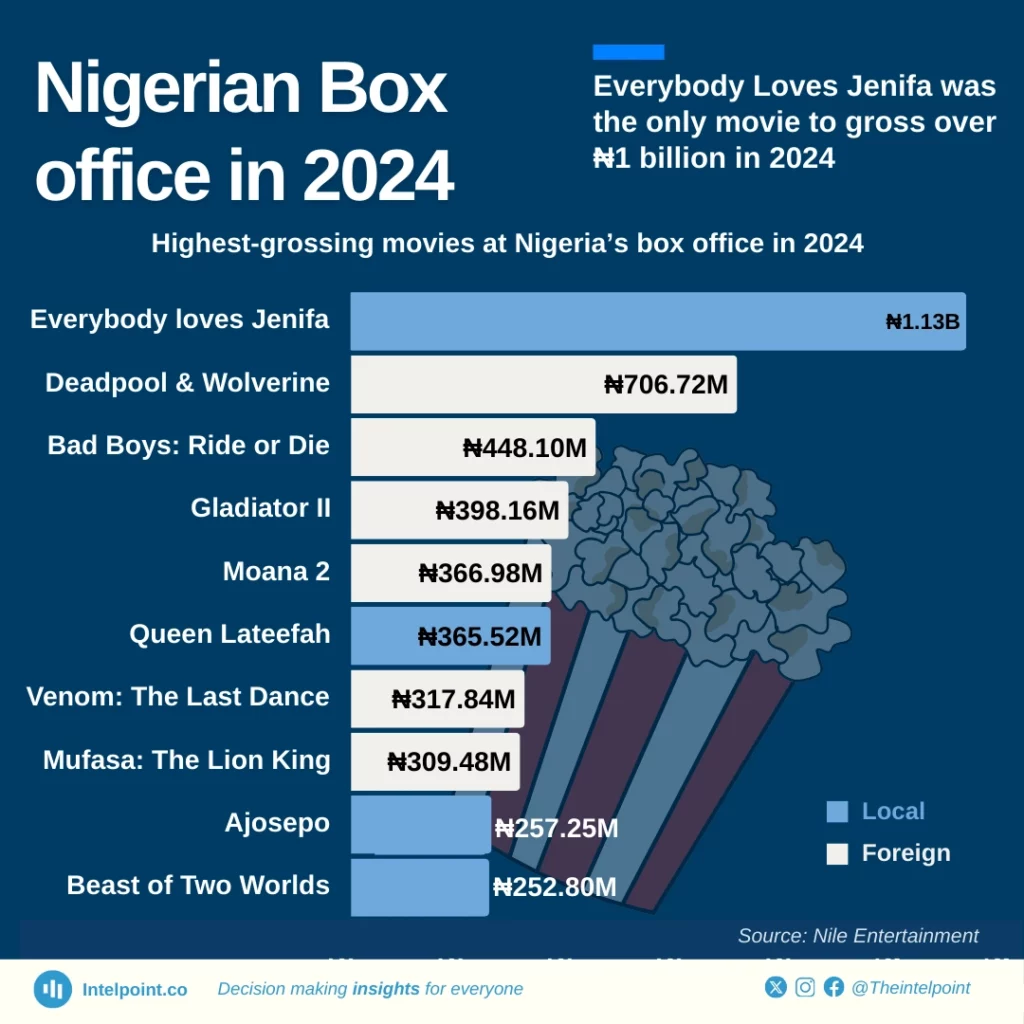
    • Nigeria's box office is still dominated by foreign titles, with only four local titles in the top ten movies.
    • A local title, Everybody Loves Jenifa, was the highest-grossing movie, exceeding ₦1 billion.
    • The world's highest-grossing movie, Inside Out 2, did not make it to Nigeria's top ten movies.
    See more
  • MTN Nigeria has dominated the country's telecommunications market over the years, accounting for the largest market share. All four operators, apart from 9mobile, recorded a significant increase in their subscriber base between May 2014 and March 2024.

    See more
  • The 2024 Global Peace Index reveals a decline in peacefulness in 97 countries, the highest since the index began.

    Nigeria is among the nations affected by regional conflicts and rising violence. With a peace index score of 2.91, Nigeria is facing increasing challenges.

    A deteriorating peace score impacts foreign investment and economic stability. Global economic losses due to violence reached $19.1 trillion in 2023.
    See more

Other Insights
Share of total DMB credit to Nigerian sectors (Jan-Sep 2024)
  • Despite being a key contributor to employment and food security, the Agricultural sector only gets an average of 4.4% of total DMB credit.
  • The Industrial sector consistently absorbs the largest loans, accounting for 42%–46% of total credit from January to September 2024.
  • The Services sector remains a top recipient of bank credit, with shares fluctuating between 37% and 41%.
  • The Government sector receives relatively low credit levels, averaging 4.9%, suggesting reliance on alternative funding sources rather than direct bank borrowing.
See more
Sectoral contribution to GDP by sectors (2012 -2024)
 
  • With an impressive 20.1% CAGR, the Industry (including construction) has experienced the fastest expansion, more than doubling its contribution to GDP over the period.
  • Services remains the largest contributor to GDP, but its growth at 14.6% CAGR is being outpaced by Industry, signalling an evolving economic structure.
  • Agriculture’s 11.2% CAGR shows steady growth, but its share of GDP is shrinking compared to the industrial and service sectors.
  • The rapid growth in Industry reflects Tanzania’s shift towards manufacturing, construction, and infrastructure development.
  • Unlike decades ago, when agriculture dominated, today’s GDP contributions are more balanced between Services, Industry, and Agriculture, reducing reliance on any single sector.
See more
Top 10 African nations with the highest inflation rates (2024)
  • With 57.50% inflation, Zimbabwe’s economy is experiencing an extreme price surge, making it the most inflation-affected country in Africa.
  • At 34.80%, Nigeria is battling one of its worst inflation crises in decades, severely impacting food prices, transportation, and living costs.
  • The fact that seven out of ten countries on this list have inflation rates that double or even quadruple the African average shows the depth of the inflation crisis.
  • While their inflation rates (between 16% and 24%), as seen in Ghana, Ethiopia, Zambia, and the Congo, are lower than the top three, they still exceed the sustainable threshold for economic stability.
See more
Federal Government expenditure on debt services (2010-2024)
  • Debt servicing costs have grown significantly over the years, from ₦400 billion in 2010 to an estimated ₦11.8 trillion in 2024 — a nearly 30-fold increase in just 15 years.
  • Between 2010 and 2024, Nigeria has spent ₦45.57 trillion on servicing its debt, demonstrating the enormity of its financial obligations.
  • The year 2024 stands out as the most expensive year yet, with ₦11.8 trillion spent on debt servicing — a jump of over 37% compared to 2023's ₦8.6 trillion.
  • While debt service expenditures grew gradually in the early 2010s, the most rapid increases occurred after 2019, with spending surging from ₦2.4 trillion in 2019 to ₦8.6 trillion in 2023.
  • From 2019 to 2024, debt servicing costs rose by almost 392%, showcasing how Nigeria’s debt burden has amplified in a short period.
  • This steep rise in debt servicing diverts resources from critical areas such as infrastructure, health, and education, hindering overall development.
See more


  • The US dusbursed $512 million to Nigeria’s health sector during the fiscal year.
  • The US allocated over $232 million to HIV/AIDS programs in Nigeria.
  • The World Health Organization (WHO) warns that this freeze could reverse decades of progress in HIV prevention and treatment, with the potential to worsen global health outcomes.
  • PEPFAR, a US initiative, provides HIV treatment for over 20 million people worldwide.
See more
 
  • Nigeria's GDP in 2025 is expected to grow faster than in 2024.
  • Nigeria's GDP growth rate has stayed below 3.5% since 2016, reaching 3.2% in 2024.
  • The federal government's 3.68% projection in 2025 is lower than its 2024 projection of 3.74%
See more
  • Europe and Eurasia led overall, with $19.59 billion.
  • $11.13 billion was disbursed to the Middle East; nearly half ($5.48b) was for military support.
  • Sub-Saharan Africa was the second largest recipient, with $16.21 billion.
  • President Trump paused all US foreign aid for 90 days to reassess alignment with strategic priorities.
See more

Key takeaways:

  • Economic development in Africa often relies heavily on carbon-intensive energy sources.
  • Emissions by South Africa were more than twice Algeria's.
  • The top four countries have been the highest contributors to carbon emissions in the past four years.
  • Sixty-nine percent of carbon emissions in Africa in 2023 were from the top four African countries.
See more
         

Key takeaways:

  • African countries have the lowest life expectancy.
  • Most of the countries with the highest life expectancy are in Europe and Asia
  • The countries with the highest life expectancy are mostly developed nations.
  • Thirteen countries were observed to have a life expectancy above 84 years, while 11 countries have a life expectancy below 61 years.
See more

Key takeaways:

  • Asia contributes more than 50% to global emission
  • CO2 contributes to the rise of climate disaster
  • Africa's vulnerability to climate change can be attributed to its limited adaptive capacity and high exposure to severe climate risks.
See more
  • The top 15 Nollywood movies grossed ₦3.4 trillion combined.
  • The top Nollywood movie in 2024, Everybody Loves Jenifa, accounted for 33.3% of the ₦3.4 trillion.
  • 13 Nollywood movies crossed ₦100 million in earnings.
See more
1 81 82 83 84 85 128
  • Nigeria’s FAAC revenue increased 49% YoY in March 2025 (₦1.68T vs ₦1.12T in March 2024).
  • February 2025 saw a 48% increase YoY (₦1.70T vs ₦1.15T in February 2024).
  • April 2025 revenue rose by 41% YoY, moving from ₦1.12T in April 2024 to ₦1.58T.
  • January 2025 showed no YoY change, recording ₦1.42T in both 2024 and 2025.
  • The consistent growth in H1 2025 FAAC revenues signals improved government revenue mobilisation, better oil/non-oil collections, and higher capacity for states to meet obligations.
Read more
  • Nigeria’s exchange rate gain revenue dropped by 73.2% in H1 2025 compared to H1 2024.
  • In April 2025, exchange rate gain fell by 90% year-on-year from ₦285.5B to ₦28.7B.
  • May saw an 81% drop, with revenue declining from ₦438.9B in 2024 to ₦81.4B in 2025.
  • January 2025 was the only month with a stable figure, matching January 2024’s ₦402.7B.
  • Exchange rate gain revenue for February and March 2025 was unavailable, likely worsening the total.
  • The first half of 2025 generated only ₦589.4B in FX gains, compared to ₦2.2T in the same period in 2024.
Read more
  • The value of agricultural goods exported in Q1 2025 rose to ₦1.70 trillion, up 64.65% year-on-year and 10.63% quarter-on-quarter, highlighting continued growth in the sector.
  • Standard and superior cocoa beans led the chart, contributing a combined ₦1.23 trillion, with major buyers being The Netherlands (₦344.17B) and Belgium (₦203.17B).
  • Cashew nuts in shell earned ₦157.63B, mostly exported to India (₦87.56B) and Vietnam (₦69.74B), while sesamum seeds brought in ₦128.18B.
  • Soya bean flours and ornamental flowers fetched ₦27B and ₦18B respectively, showing Nigeria's export mix is broadening.
Read more
  • Lagos alone accounts for nearly 25% of all Nigerian states’ external debt, totalling $1.17 billion.
  • The combined debt of Lagos, Kaduna, and Edo is larger than the sum of the debts of the bottom 30 states.
  • States like Yobe, Abuja, and Jigawa each owe less than $25 million externally, indicating minimal foreign exposure.
  • Cross River, Rivers, and Ogun round out the top six debtors, each with external debts around [$190–210] million.
  • Just eleven states owe over $100 million each, while the majority owes less than that threshold.
  • Despite 36 subnational governments, the federal government’s $40.98 billion external debt is over 8x that of all states combined.
Read more
  • Lagos alone holds more domestic debt than the bottom 25 states combined.
  • Jigawa’s domestic debt of ₦1.06 billion is less than 0.15% of Lagos’s debt, showing the widest disparity.
  • The 10 highest-indebted states account for nearly 70% of the total domestic debts across Nigerian states.
  • The Federal Capital Territory (FCT) carries more debt than 17 other states.
Read more
  • Inflation jumped by 13.4 percentage points, from 9.0% pre-Buhari to 22.4% post-Buhari.
  • The value of the naira] depreciated by over 235% during Buhari’s tenure, ending at ₦645.2/$.
  • Total public debt increased nearly 7x, from ₦12.6 trillion in 2015 to ₦87.4 trillion in 2023.
  • Nigeria’s GDP growth rate averaged just 1.24% annually between 2015 and 2023.
  • Foreign reserves peaked at $44.5 billion in 2018 but dropped to $38.3 billion by 2023.
  • FDI inflows showed volatility, with the highest being $3.5 billion in 2021 and the lowest at $0.8 billion.
  • Nigeria's GDP growth rate was modest, with the country experiencing a recession in 2016.
Read more
1 81 82 83 84 85 255

Can’t find what you’re looking for? Please fill the form below
Contact Form Demo
SIGN UP TO OUR NEWSLETTER
Get periodic updates about the African startup space, access to our reports, among others.
Subscribe Here
Subscription Form

A product of Techpoint Africa. All rights reserved