Bite-sized Insights about
 
Providing you with data-based insights about things happening around you.
Popular Insights
  • Since its inception, Binance has demonstrated remarkable growth, ending its first year with 1.5 million users and increasing its user base nearly eightfold the following year. Over six years, it has established itself as the largest cryptocurrency exchange in the world, reaching 150 million users by 2023. This growth highlights Binance's significant impact on the global crypto market and its commitment to expanding access to digital assets.

    See more
    • The North-East remitted only ₦14.98 billion but received ₦46.68 billion, showing a 211.6% gain due to sharing.
    • Taraba, the lowest contributor (₦0.94 billion), saw the highest percentage gain (635%) with an allocation of ₦6.91 billion, reinforcing that smaller economies benefit the most from VAT sharing.
    • Bauchi, despite remitting just ₦2.44 billion, received the highest allocation (₦8.93 billion), a 266% increase, illustrating how VAT is shared based on equality and population, not economic activity.
    • Every state in the region received at least 2× what they remitted, highlighting the North East’s reliance on VAT sharing and fuelling the fiscal federalism debate on whether VAT should be retained at the state level.
    See more
  • The 2024 Global Peace Index reveals a decline in peacefulness in 97 countries, the highest since the index began.

    Nigeria is among the nations affected by regional conflicts and rising violence. With a peace index score of 2.91, Nigeria is facing increasing challenges.

    A deteriorating peace score impacts foreign investment and economic stability. Global economic losses due to violence reached $19.1 trillion in 2023.

    See more

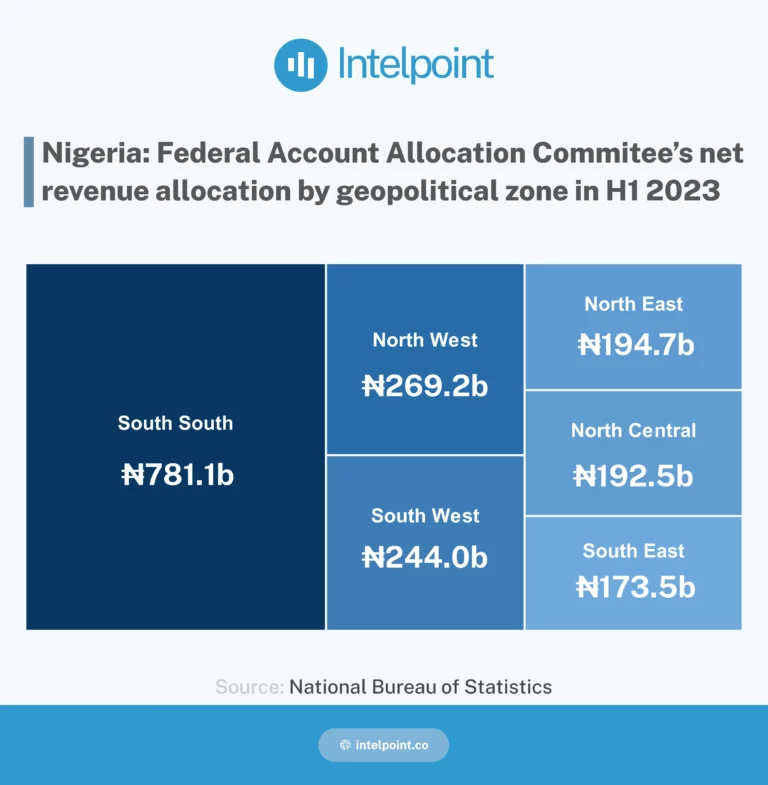
    The FAAC's revenue distribution from 2017 to August 2023 highlights the dominance of Delta, Akwa Ibom, Rivers, and Bayelsa states in allocations. Despite Lagos' economic prominence, it ranked fifth. Here is the distribution of revenue among states between 2017 and August 2023.

    See more
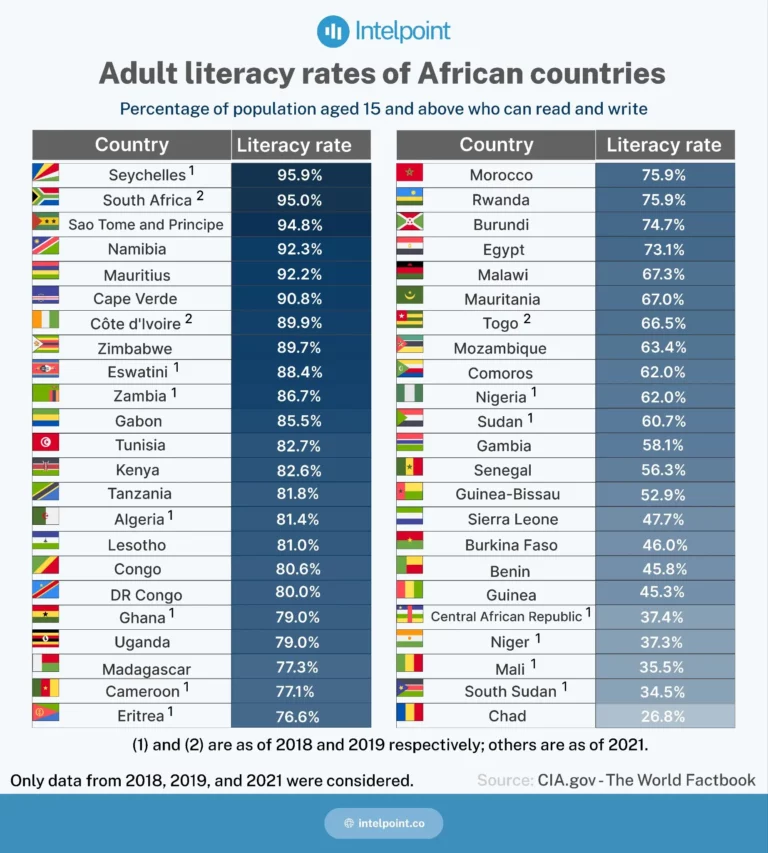
  • A Trend of Adult literacy rates of African countries

    Between 2018 and 2021, adult literacy rates across African nations exhibited significant disparities. Seychelles and South Africa led with literacy rates of 96% and 95%, respectively, indicating a high proportion of literate adults. Conversely, Chad had the lowest literacy rate during this period.

    These statistics underscore the uneven progress in educational attainment across Africa, highlighting the need for targeted interventions to improve literacy in lower-performing nations.

    See more
    Countries by Global Innovation Index 2024

    The Global Innovation Index 2024 reveals a striking contrast in innovation performance between countries globally and across Africa. Switzerland leads the global rankings with an impressive score of 67.5, followed by Sweden (64.5) and the USA (62.4), highlighting their sustained investments in research, development, and technological advancement.

    In Africa, Mauritius takes the top spot with a score of 30.5, followed closely by Morocco (28.8) and South Africa (28.3). However, even Africa's most innovative nations achieve less than half the score of global leaders, indicating a significant innovation gap.

    Nigeria ranks 15th in the African ranking and 113th globally, out of 133 countries, with a score of 17.1.

    See more

  • Nigeria's manufacturing sector contributed 9.2% (₦3.37 trillion) to the total GDP in H1 2024, mainly driven by food, clothing, and cement, which make up a combined 79.5% of the sector's GDP.

    Smaller sectors like Non-Metallic Products, Wood & Wood Products, and Motor Vehicles & Assembly could expand with targeted investments. The minimal impact of Oil Refining and Electrical & Electronics underscores the need for diversification.

    See more
  • MTN Nigeria has dominated the country's telecommunications market over the years, accounting for the largest market share. All four operators, apart from 9mobile, recorded a significant increase in their subscriber base between May 2014 and March 2024.

    See more
  • The 2024 Global Peace Index reveals a decline in peacefulness in 97 countries, the highest since the index began.

    Nigeria is among the nations affected by regional conflicts and rising violence. With a peace index score of 2.91, Nigeria is facing increasing challenges.

    A deteriorating peace score impacts foreign investment and economic stability. Global economic losses due to violence reached $19.1 trillion in 2023.
    See more

Other Insights
Cellular mobile connections compared with total population (Percentage per region), as of Jan. 2025
  • Southern Africa is the global leader in mobile connectivity, with 183% mobile connections compared to its population, significantly ahead of all other regions.
  • The world’s most connected regions are outside North America and Western Europe, with Eastern Europe (144%), Eastern Asia (133%), and Southern Europe (131%) leading the charge after Southern Africa.
  • Africa is deeply divided in mobile adoption. While Southern Africa dominates, Eastern Africa (79%) and Middle Africa (66%) have a lower penetration.
  • Some regions have more mobile connections than people. The fact that multiple regions exceed 100% connectivity means that many individuals own multiple SIM cards, a trend driven by business needs, mobile money, and telecom competition.
  • Western Africa, at 85% connectivity, is doing better than Eastern Africa but still lags behind the global average, signaling potential for more growth in mobile adoption.
Read more
Share of individuals in each generation (January 2025)
  • Generation Alpha is the largest generation, making up 24.4% of the global population.
  • Gen Z and Millennials still hold strong influence, comprising 22.9% and 21.2% of the global population.
  • The Baby Boomer generation (12.8%) is gradually declining, which will impact industries like retirement services, healthcare, and wealth distribution.
  • The Silent Generation is now just 2% of the population, highlighting the demographic shift away from the older generations.
  • Generation X, at 16.7%, remains a crucial but often overlooked group, balancing leadership roles in business and governance while supporting both older and younger generations.
  • The rise of Generation Alpha signals the dawn of an even more digital-native world, shaping the future of education, marketing, and work environments.
  • With Millennials, Gen Z, and Gen Alpha making up nearly 70% of the population, the global workforce, economy, and social dynamics will see rapid transformation in the coming years.
Read more
Percentage of internet users globally aged 16+ who consume each media type (as of Q3 2024)
  • Social media is not optional; it’s universal, with 93% usage globally.
  • Traditional broadcast TV still sees 89.7% usage, and streaming TV (77.1%) isn’t far behind.
  • Individuals consume online news more than physical newspapers.
  • 66.4% still tune in to radio, showing that audio content still has a loyal base.
  • At 65.3% usage, platforms like Spotify and Apple Music are not just for entertainment; they’re part of people’s routines.
  • With 63.7% global engagement, podcasts are now a core part of modern media usage.
Read more
Nigeria's capital expenditure as a percentage of GDP (1981–2024)
  • From an average of 4.33% in 1981–2001 to just 1.58% in 2002–2024, Nigeria’s capital expenditure as a percentage of GDP has more than halved.
  • The early 2000s marked a major turning point. After peaking at 9.1% in 1999, capital spending nosedived, rarely surpassing 2% in the last two decades.
  • Recent figures show Nigeria’s capital expenditure hovering around 1–2% of GDP.
  • The data suggests a move away from infrastructure investments, potentially prioritising recurrent expenditure such as salaries and overheads.
  • Low capital spending can slow infrastructure development, limiting productivity, economic expansion, and foreign investment attractiveness.
  • If Nigeria is to achieve sustainable growth, there needs to be a renewed focus on capital investments to drive industrialisation, improve public services, and create jobs.
Read more
Total funding raised in East Africa, excluding exits (2019 - 2024)
  • Kenya is the absolute leader in startup funding, with $3.3 billion raised in the past six years.
  • The rest of East Africa is way behind, with Tanzania ($286M), Uganda ($183M), and Rwanda ($91M) being the next in line. But collectively, they don’t even match 20% of the funding Kenya received.
  • The total funding raised across East Africa from 2019 to 2024 is $3.94 billion, which means Kenyan startups alone secured more than 8 out of every 10 dollars invested in the region.
  • Investor confidence is highly concentrated in Kenya, largely due to its well-developed venture capital ecosystem, startup accelerators, and government support for innovation.
Read more
Kenya's share of startup funds raised in East Africa, excluding exits (2019 - 2024)
  • Kenya dominates East Africa’s startup funding, securing over 83% of all funds raised between 2019 and 2024 — a clear indication of its position as the region’s startup capital.
  • Kenya’s startup funding share has remained consistently above 80% since 2020.
  • 2023 and 2024 saw Kenya secure nearly 89% of all funds, marking its strongest position.
  • Other East African countries combined have not received more than 30% of the funding in any year since 2019.
  • The lowest share of funding Kenya secured was in 2019 (69.81%).
Read more
1 127 128 129 130 131 254

Can’t find what you’re looking for? Please fill the form below
Contact Form Demo
SIGN UP TO OUR NEWSLETTER
Get periodic updates about the African startup space, access to our reports, among others.
Subscribe Here
Subscription Form

A product of Techpoint Africa. All rights reserved