Bite-sized Insights about
 
Providing you with data-based insights about things happening around you.
Popular Insights
  • President Tinubu was recently elected to take over from President Umaro Embaló of Guinea-Bissau as ECOWAS Chairman, making him the 9th from Nigeria. Since its inception, new chairmen have emerged 36 times, with Nigeria producing the most chairmen. Four countries in the ECOWAS region have collectively produced more than half of the chairmen since the organisation's founding, with each contributing multiple chairmen. Cape Verde is the only member country yet to produce a chairman.

    See more
    Nigerian students of Bini/Edo ethnicity had the highest tertiary institution completion rate as of 2013. Igbo, Ebira/Igbira, Ibibio, and Yoruba were notable ethnic groups in the top five. Which ethnic group do you think currently leads Nigeria's tertiary institution completion?
    As of 2013, for a programme lasting at least four years, 21% of students from the Bini/Edo aged 25 to 29 completed their studies; for students between 30 and 34, it was 17%.
    However, for those between 25 and 29 in a programme lasting at least two years, the Ebira/Igbira led with 41%, followed by Bini/Edo with 35%.
    See more
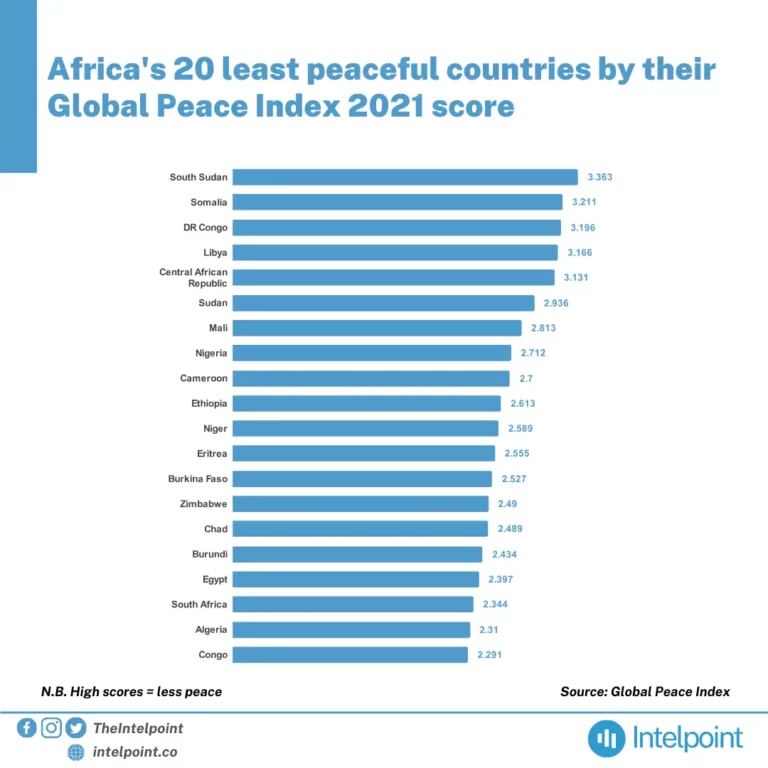
  • The 2024 Global Peace Index reveals a decline in peacefulness in 97 countries, the highest since the index began.

    Nigeria is among the nations affected by regional conflicts and rising violence. With a peace index score of 2.91, Nigeria is facing increasing challenges.

    A deteriorating peace score impacts foreign investment and economic stability. Global economic losses due to violence reached $19.1 trillion in 2023.

    See more

    The FAAC's revenue distribution from 2017 to August 2023 highlights the dominance of Delta, Akwa Ibom, Rivers, and Bayelsa states in allocations. Despite Lagos' economic prominence, it ranked fifth. Here is the distribution of revenue among states between 2017 and August 2023.

    See more
  • A Trend of Adult literacy rates of African countries

    Between 2018 and 2021, adult literacy rates across African nations exhibited significant disparities. Seychelles and South Africa led with literacy rates of 96% and 95%, respectively, indicating a high proportion of literate adults. Conversely, Chad had the lowest literacy rate during this period.

    These statistics underscore the uneven progress in educational attainment across Africa, highlighting the need for targeted interventions to improve literacy in lower-performing nations.

    See more
    Countries by Global Innovation Index 2024

    The Global Innovation Index 2024 reveals a striking contrast in innovation performance between countries globally and across Africa. Switzerland leads the global rankings with an impressive score of 67.5, followed by Sweden (64.5) and the USA (62.4), highlighting their sustained investments in research, development, and technological advancement.

    In Africa, Mauritius takes the top spot with a score of 30.5, followed closely by Morocco (28.8) and South Africa (28.3). However, even Africa's most innovative nations achieve less than half the score of global leaders, indicating a significant innovation gap.

    Nigeria ranks 15th in the African ranking and 113th globally, out of 133 countries, with a score of 17.1.

    See more

  • Key takeaways:

    • In February 2025, Samsung and Apple dominate the mobile market in Africa.
    • Samsung leads with a 29.80% share of the continent's mobile market based on usage.
    • Apple ranks second with a 13.27% share, demonstrating resilience in markets sensitive to pricing.
    • Collectively, Chinese manufacturers hold more than 45% of the mobile market in Africa.
    • Brands under Transsion Holdings (Tecno, Infinix, Itel) together represent nearly 25% of the total market share based on usage.
    See more
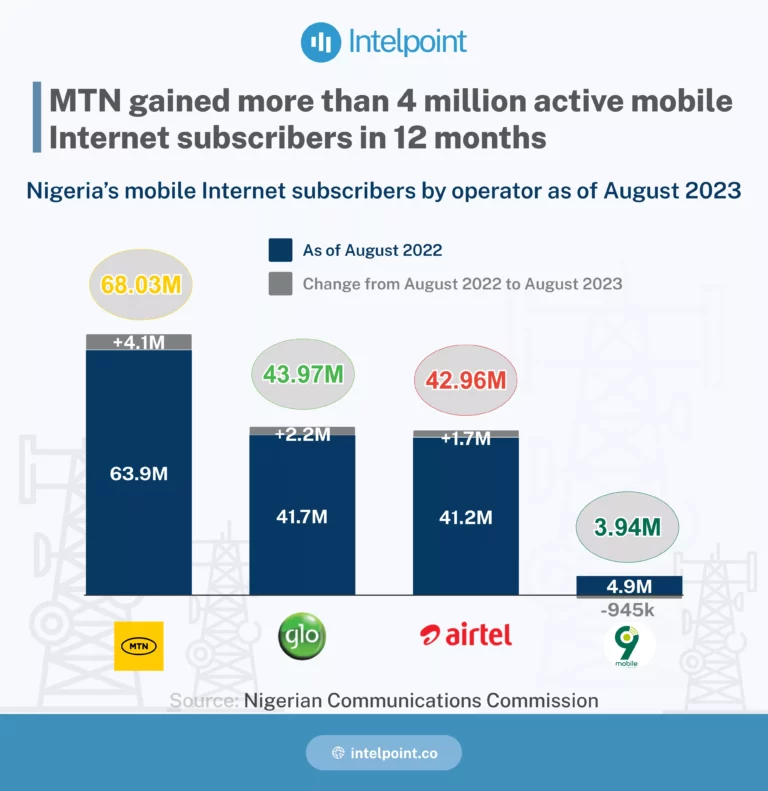
  • MTN Nigeria has dominated the country's telecommunications market over the years, accounting for the largest market share. All four operators, apart from 9mobile, recorded a significant increase in their subscriber base between May 2014 and March 2024.

    See more
  • The 2024 Global Peace Index reveals a decline in peacefulness in 97 countries, the highest since the index began.

    Nigeria is among the nations affected by regional conflicts and rising violence. With a peace index score of 2.91, Nigeria is facing increasing challenges.

    A deteriorating peace score impacts foreign investment and economic stability. Global economic losses due to violence reached $19.1 trillion in 2023.
    See more

Other Insights

Abdulsamad Rabiu’s wealth has consistently increased for 4 consecutive years since 2020. Aliko Dangote, on the other hand, experienced 3 consecutive years of wealth growth starting from 2021. Mike Adenuga's wealth recorded growth in 2021 and 2022, but it took a downturn in 2023.

Abdulsamad Rabiu's financial journey has been particularly noteworthy, with his wealth witnessing a substantial surge from $1.2b in 2014 to $8.2b in 2023. This growth has seen him surpass Mike Adenuga and become the country's second-wealthiest individual as of 2023.

See more
Nigeria produced 1.4 million tons of palm oil in 2022, 2% of the global production in the 2022/2023 market year, making the country the fifth largest producer of the commodity. Indonesia dominated global production with 59%, followed by Malaysia and Thailand.
See more
The oil refining industry experienced the highest industrial decline in 2022

Nigeria's GDP grew by 3.1% in 2022, with at least 17 of its industries recording less than 5% growth individually. The oil refining industry experienced the least growth, contributing ₦11.2 billion — 42% less than ₦19.3 billion in 2021.

See more

Over time, Nigerian workers under 50 have increasingly relied on pension savings during unemployment. This graph illustrates the upward trend with some fluctuations in both the total amount withdrawn — ₦26.9 billion in 2022, and the number of approved withdrawals. Individuals who can withdraw 25% of their retirement savings balance are those who disengaged/retired before the age of 50 years in accordance with the terms and conditions of their respective employment and stayed unemployed for at least six months.

See more
68% of Nigeria's capital imports in Q1 went to three sectors - banking, production, and IT services

Most of Nigeria's capital imports in the first quarter of 2023 were directed toward three sectors. The banking sector got the most investments with $304 million, accounting for 27%, and the production and IT services sectors followed, with 22% and 19%, respectively.

See more
Lagos and the FCT attracted 98% of Nigeria’s capital imports in Q1 2023

In Q1 2023, eight Nigerian states and the Federal Capital Territory (FCT) received $1.13 billion in capital imports. Lagos State secured $705 million (62%) and the FCT attracted $410 million (36%), adding up to 98%.

See more
In the past 10 years, Nigeria has received $131 billion in capital imports

Nigeria's capital importation has been on a decline after it hit a $24 billion peak in 2019. In the past 10 years, it received $131 billion, with the lowest recorded in 2016. Here are the country's capital imports since 2013.

See more

President Tinubu was recently elected to take over from President Umaro Embaló of Guinea-Bissau as ECOWAS Chairman, making him the 9th from Nigeria. Since its inception, new chairmen have emerged 36 times, with Nigeria producing the most chairmen. Four countries in the ECOWAS region have collectively produced more than half of the chairmen since the organisation's founding, with each contributing multiple chairmen. Cape Verde is the only member country yet to produce a chairman.

See more
1 125 126 127
Number of smartphone handsets in use around the world (2015 - 2025)
  • From 2.99B in 2015 to 7.42B in January 2025, the world has added more than 4.4 billion smartphone devices in a decade.
  • Annual growth dropped from a high of 23.1% in 2016 to 3.6% in 2025, a clear sign of global market saturation.
  • During 2016-2018, the world added nearly 2 billion new smartphones.
  • Since 2020, annual growth has been under 6%.
  • Most of the future growth will come from device upgrades or multiple device ownership, not necessarily new smartphone users.
Read more
Number of individuals globally using the internet since the creation of the first website (1991 - 2025)
  • Between 1995 and 2000, internet users jumped from 39.4 million to 394 million, a 900% leap that marked the beginning of the digital era.
  • Just 14 years after the first website, over 1 billion people were online, showing how quickly the internet became essential.
  • Between 2010 and 2015, internet usage grew by 54.5%, slower than before but still powerful, especially in developing regions coming online.
  • With 5.6 billion users in January 2025, most of the world is now online, and future growth will be more about improving access, speed, and quality than just connecting new people.
  • Each phase had its catalyst. In the 1990s, it was websites and email. The 2000s brought broadband and Google. In the 2010s, it was smartphones. Now, it's AI, 5G, and IoT that are quietly shaping the future of internet use.
Read more
CAGR of nominal GDP per capita of the top ten African economies (2020 - 2024)
  • At -16.02% CAGR, Nigeria's GDP per capita is shrinking fast, signalling deep economic strain on its population despite being a top 4 African economy.
  • Angola recorded 8.28% CAGR, showing that smaller economies can drive significant per capita progress when policies and investments align with citizen welfare.
  • With 8.23% CAGR, Algeria continues to transform national wealth into measurable benefits for its people.
  • Ethiopia’s 6.86% annual growth in GDP per capita highlights how consistent development efforts can raise living standards even in densely populated, developing nations.
  • A modest 2.52% CAGR for South Africa might not sound like much, but in a mature economy, this reflects resilience and relative stability in per capita income.
  • Egypt has a -1.41% CAGR, showing mild contraction, but far less severe than Nigeria’s economic shrinkage.
Read more
Nominal GDP per capita of top 10 African economies (2024)
  • Despite being among the top 4 economies by size, Nigeria ranks low in GDP per capita, revealing a disconnect between total wealth and individual prosperity.
  • With the highest nominal GDP and highest per capita GDP, South Africa showcases balanced growth and better wealth distribution.
  • Countries like Ethiopia and Nigeria have huge populations, which dilutes their GDP and drags down per capita figures.
  • Though fifth in total GDP, Morocco performs better in GDP per capita, highlighting efficiency in wealth distribution.
  • This proves that a country’s economic “size” doesn’t always translate to individual opportunity, wealth, or standard of living.
  • Economies like Nigeria and Ethiopia must focus not just on increasing GDP but on ensuring that economic growth improves lives at the grassroots level.
Read more
Key Takeaways:
  • The United States exported $318.7 million worth of agricultural products to Nigeria in 2024.
  • Wheat accounted for nearly half of the US' agricultural exports to Nigeria, valued at $148 million.
  • The trade balance substantially favours the United States, with exports to Nigeria ($318.7 million) nearly double imports ($114.7 million).
  • The top three products account for 74.49% of all agricultural exports to Nigeria.
Read more
Key Takeaways:
  • Oilseed meal and cake constituted the United States' largest agricultural import from Nigeria, valued at $29.9 million.
  • Total US agricultural imports from Nigeria in 2024 amounted to $114.7 million.
  • Cocoa beans represented 19% ($21.8 million) of Nigeria's agricultural exports to the US.
  • Oilseed, cocoa, and tea collectively accounted for 59% of the total agricultural exports from Nigeria to the United States.
Read more
1 125 126 127 128 129 254

Can’t find what you’re looking for? Please fill the form below
Contact Form Demo
SIGN UP TO OUR NEWSLETTER
Get periodic updates about the African startup space, access to our reports, among others.
Subscribe Here
Subscription Form

A product of Techpoint Africa. All rights reserved