Revenue from voice is still the largest contributor to Airtel Africa's revenue between 2019 and 2023 however its share of the revenue has been on a steady decline. Voice went from accounting for 60.97% of the total revenue in 2018, to 46.16% in 2023. The share of revenue from data and Airtel Mobile have been on a steady rise since 2020.

Between 2018 and 2021, adult literacy rates across African nations exhibited significant disparities. Seychelles and South Africa led with literacy rates of 96% and 95%, respectively, indicating a high proportion of literate adults. Conversely, Chad had the lowest literacy rate during this period.
These statistics underscore the uneven progress in educational attainment across Africa, highlighting the need for targeted interventions to improve literacy in lower-performing nations.
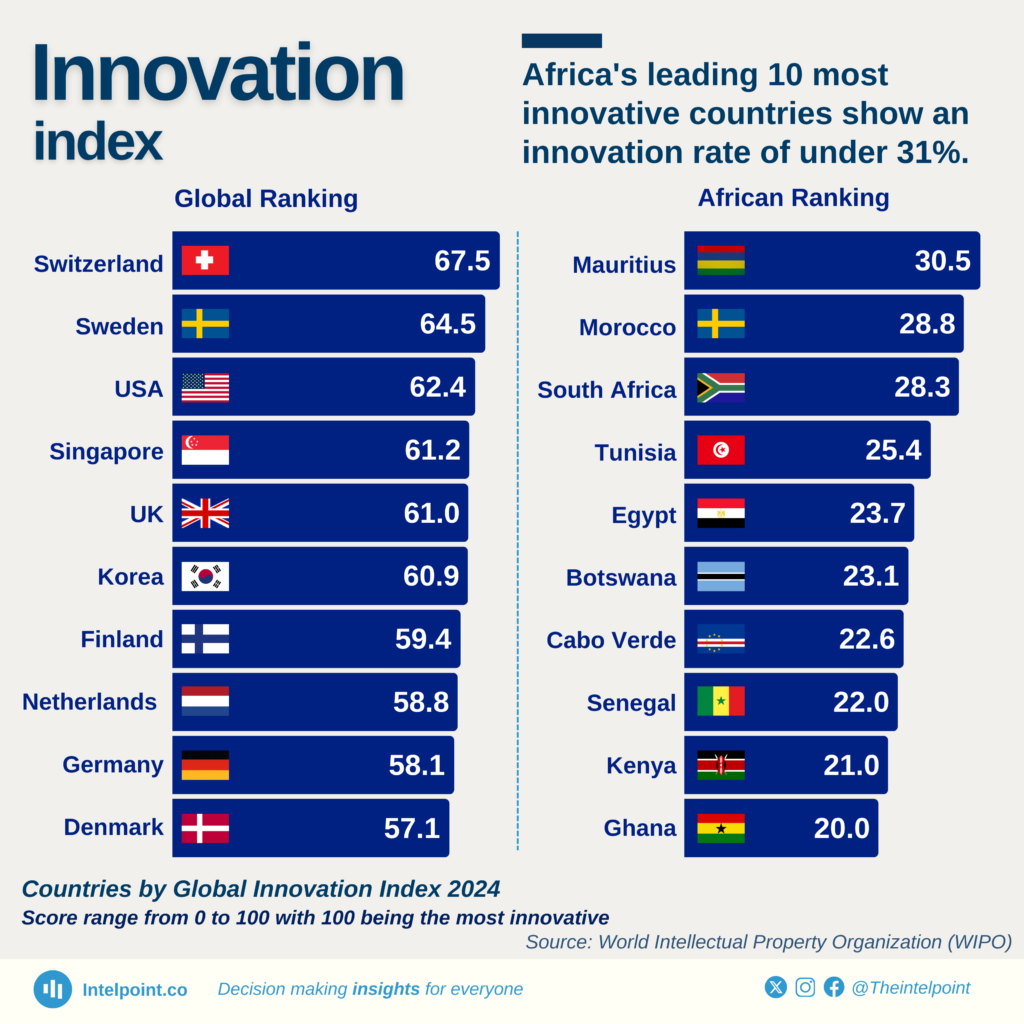
The Global Innovation Index 2024 reveals a striking contrast in innovation performance between countries globally and across Africa. Switzerland leads the global rankings with an impressive score of 67.5, followed by Sweden (64.5) and the USA (62.4), highlighting their sustained investments in research, development, and technological advancement.
In Africa, Mauritius takes the top spot with a score of 30.5, followed closely by Morocco (28.8) and South Africa (28.3). However, even Africa's most innovative nations achieve less than half the score of global leaders, indicating a significant innovation gap.
Nigeria ranks 15th in the African ranking and 113th globally, out of 133 countries, with a score of 17.1.
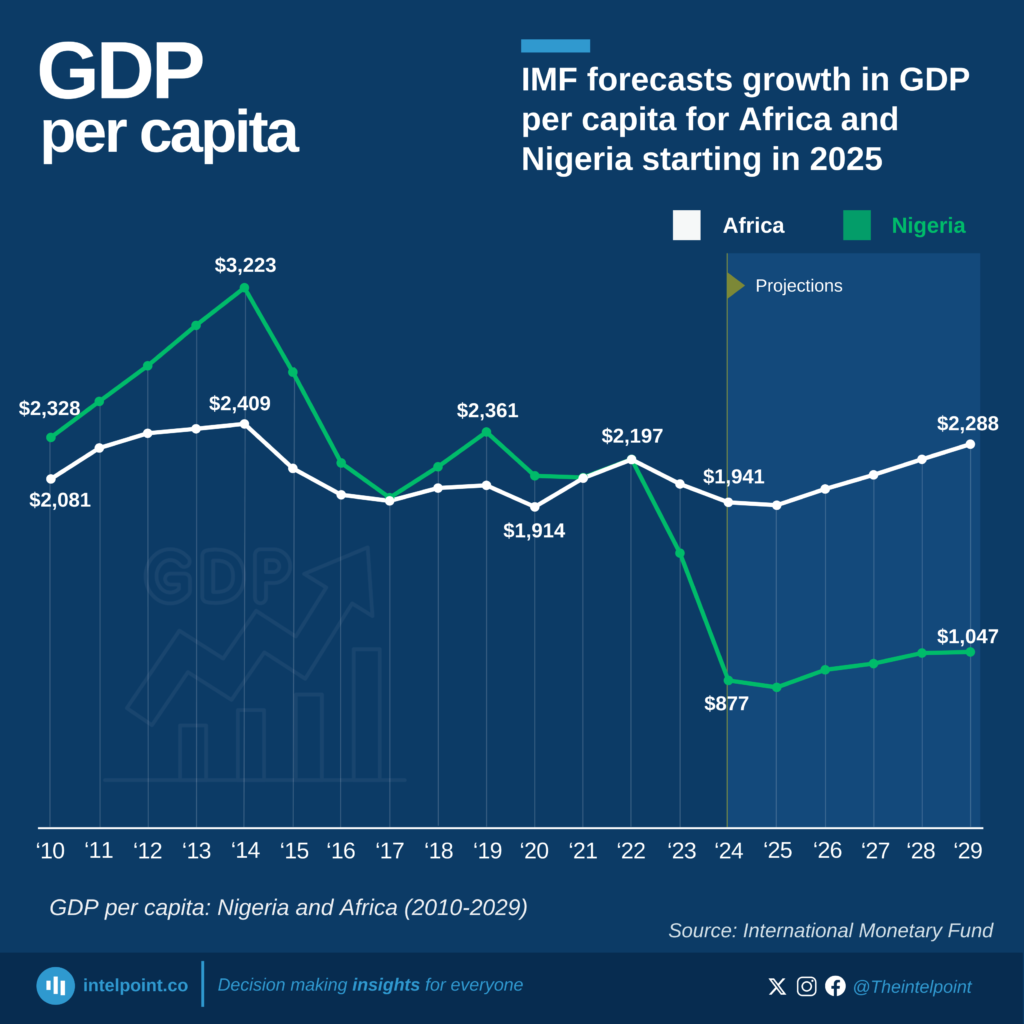
Over the years, many African countries, including Nigeria, have experienced economic turbulence caused by fluctuating global markets and domestic challenges. However, amidst these challenges, there’s hope as IMF economic forecasts point toward growth.
According to the IMF, GDP per capita in Nigeria and Africa is projected to increase from 2025 after years of stagnation and decline. Nigeria’s GDP per capita fell sharply from $2,197 in 2022 to $877 in 2024. Encouragingly, growth is expected with projections of $1,047 for Nigeria by 2029, signaling a slow but steady improvement in living standards.

The 2024 Global Peace Index reveals a decline in peacefulness in 97 countries, the highest since the index began.
Nigeria is among the nations affected by regional conflicts and rising violence. With a peace index score of 2.91, Nigeria is facing increasing challenges.
A deteriorating peace score impacts foreign investment and economic stability. Global economic losses due to violence reached $19.1 trillion in 2023.

In 2017, MTN Uganda recorded a 58% increase in profit with only a 9% revenue increase. On average, the telco had an 18.2% yearly increase in profit between 2016 and 2023, while revenue growth was at 9.2% yearly.

The population of Nigerian-born immigrants in the US has more than doubled in nearly two decades, growing at an average rate of 4.8% per year.
By 2023, the number reached 476k, up from just under 200k in 2006 — a 141% growth.
Nigeria has been leading Africa in immigrant numbers in the US, ranking 22nd globally.
Rising immigrant numbers could strengthen remittance flows back to Nigeria.

In 2023, the US immigrant (foreign-born) population reached an estimated 47.83 million, a 3.6% increase from 46.18 million in 2022, with Mexico leading as the top country of birth for immigrants, contributing nearly 23% of the total.
India, China, and the Philippines follow, with significant communities from El Salvador, Cuba, and Guatemala.

In H1 2024, Nigeria's FDI accounted for just 2.5% of the country's $5.98 billion total capital imports, down from 14% in H2 2023 and 6.2% in H1 2023.
This highlights a shift towards other capital inflows like portfolio investments.
Portfolio investments rose significantly to $3.48 billion, rebounding from $397 million in H2 2023 and $756 million in H1 2023.

Nigeria's FDI has dropped significantly. From an average of $417m per quarter (2013-2015) to less than $100m (Q1 2022 - Q2 2024), it hit its lowest ($29.8m) in Q2 2024.
The trend shows declines since 2013, with key fluctuations and a shift in investment priorities.

As of 2022, the top five African countries indebted to the World Bank — Nigeria, Egypt, Ethiopia, Kenya, and Tanzania — accounted for 46% of the continent's outstanding debt with the institution.
Forty-eight African countries collectively owed around $125 billion, representing 31% of the total global debt of $408 billion. These are the top ten countries from 1970 to 2022.

MultiChoice Group experienced a 31% decline in revenue from Nigeria in 2024 compared to 2023. Nigeria represented 35% of the group's Rest of Africa (RoA) subscription revenue in 2024, down from 44% in 2023. South Africa's contribution to subscription revenue grew from 56.2% in 2023 to 58.4% in 2024. Meanwhile, Nigeria's share of the total revenue dropped from 18.7% in 2023 to 13.9%.

India has been the World Bank's largest debtor for over 50 years, with a debt of $38.3 billion as of 2022.
Five Asian nations — India, Indonesia, Bangladesh, Pakistan, and China — owe a combined $111.2 billion, or 27% of the World Bank’s total debt.
Nigeria, Africa's largest World Bank debtor, ranks 10th, with nearly #14 billion in debt.

Nigeria's debt to the World Bank grew from $182 million in 1970 to nearly $15 billion by 2023 – an 8,100% increase.
Between 2005 and 2023, it rose by 705%, highlighting Nigeria's reliance on World Bank financing for development.
As of Q1 2024, Nigeria owed $15.59 billion, 37% of its external debt.

Data from 11 Nigerian banks in H1 2024 reveals that 10 of them experienced profit growth, showcasing resilience in the sector. Leading the way is GTCO with a remarkable ₦905.6 billion profit, representing a 223% YoY increase.
Zenith Bank follows closely with ₦578 billion, reflecting 98% growth. Jaiz Bank, while having the smallest profit at ₦11.28 billion, posted a strong 199% rise. UBA saw a decline, with its profit being 16% lower than in H1 2023.

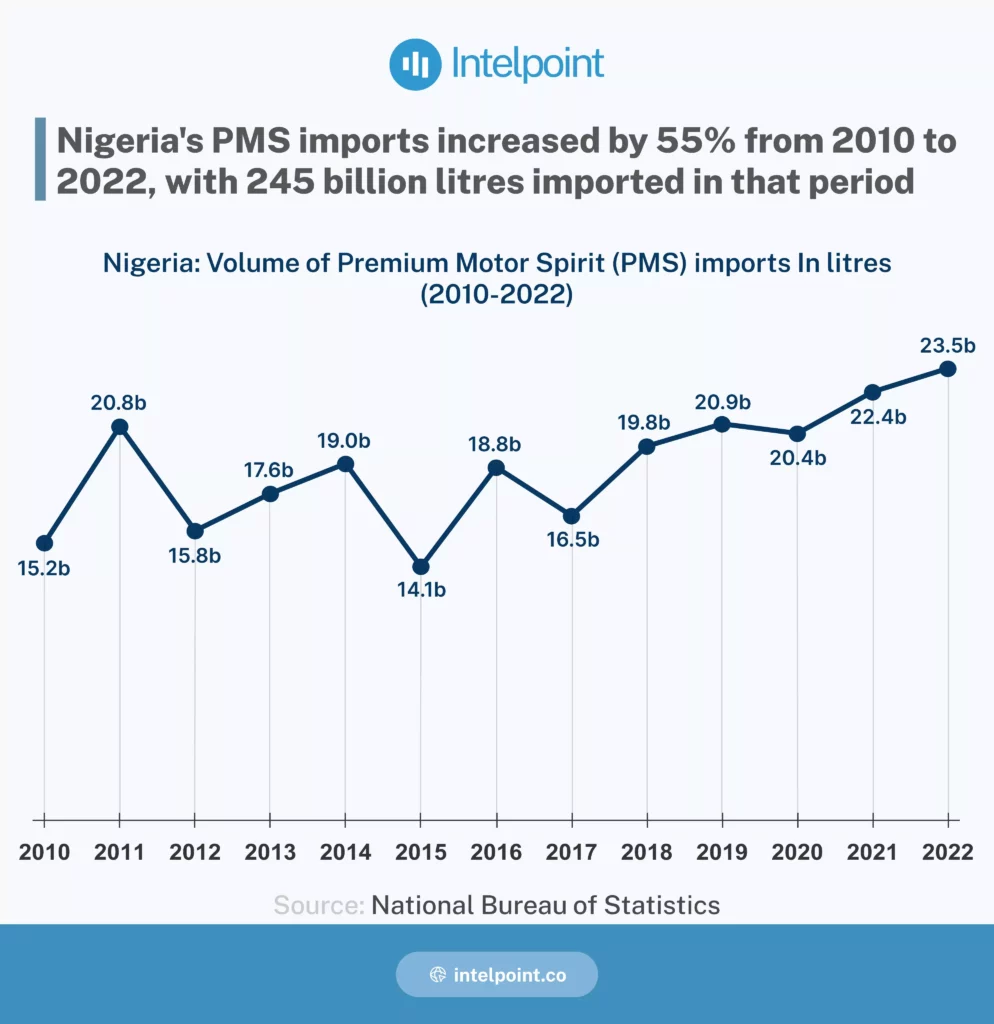
In 2023, Nigeria saw a 17% reduction in petrol supply as imports fell by nearly 14% from 23.5 billion litres in 2022 to 20.3 billion litres.
The removal of the fuel subsidy in May 2023 led to higher prices and lower demand, especially in the second half of the year.
The Dangote refinery’s rising output could shape future supply.