Bite-sized Insights about
 
Providing you with data-based insights about things happening around you.
Popular Insights
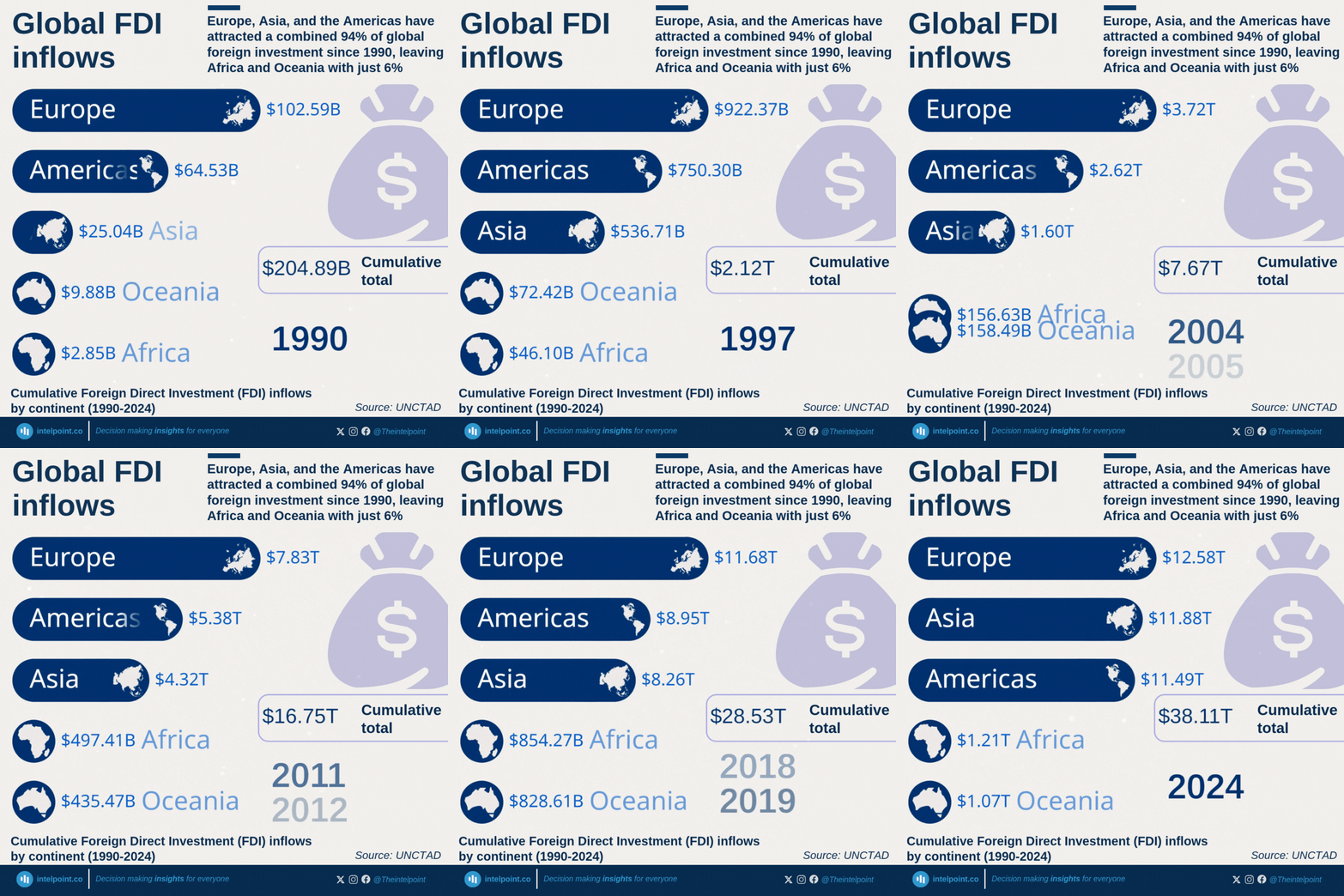
  • Global inflows of foreign direct investment fell by 12% in 2022, and Africa saw a 44% decline from $80 billion in 2021 to $45 billion. According to UNCTAD data, only two of Africa's five major regions — North and East Africa — saw a rise in FDI in 2022.
    See more

    In 2023, 1.17 billion smartphones were shipped globally. Samsung and Apple maintained their stronghold on the smartphone market, collectively accounting for 38%, with each brand capturing 19%.

    Xiaomi maintained a 12% share after peaking at 14% in 2021. Apple's market share shows a gradual increase from 2020, reaching 19% in 2022 and 2023.

    See more
  • The 2024 Global Peace Index reveals a decline in peacefulness in 97 countries, the highest since the index began.

    Nigeria is among the nations affected by regional conflicts and rising violence. With a peace index score of 2.91, Nigeria is facing increasing challenges.

    A deteriorating peace score impacts foreign investment and economic stability. Global economic losses due to violence reached $19.1 trillion in 2023.

    See more

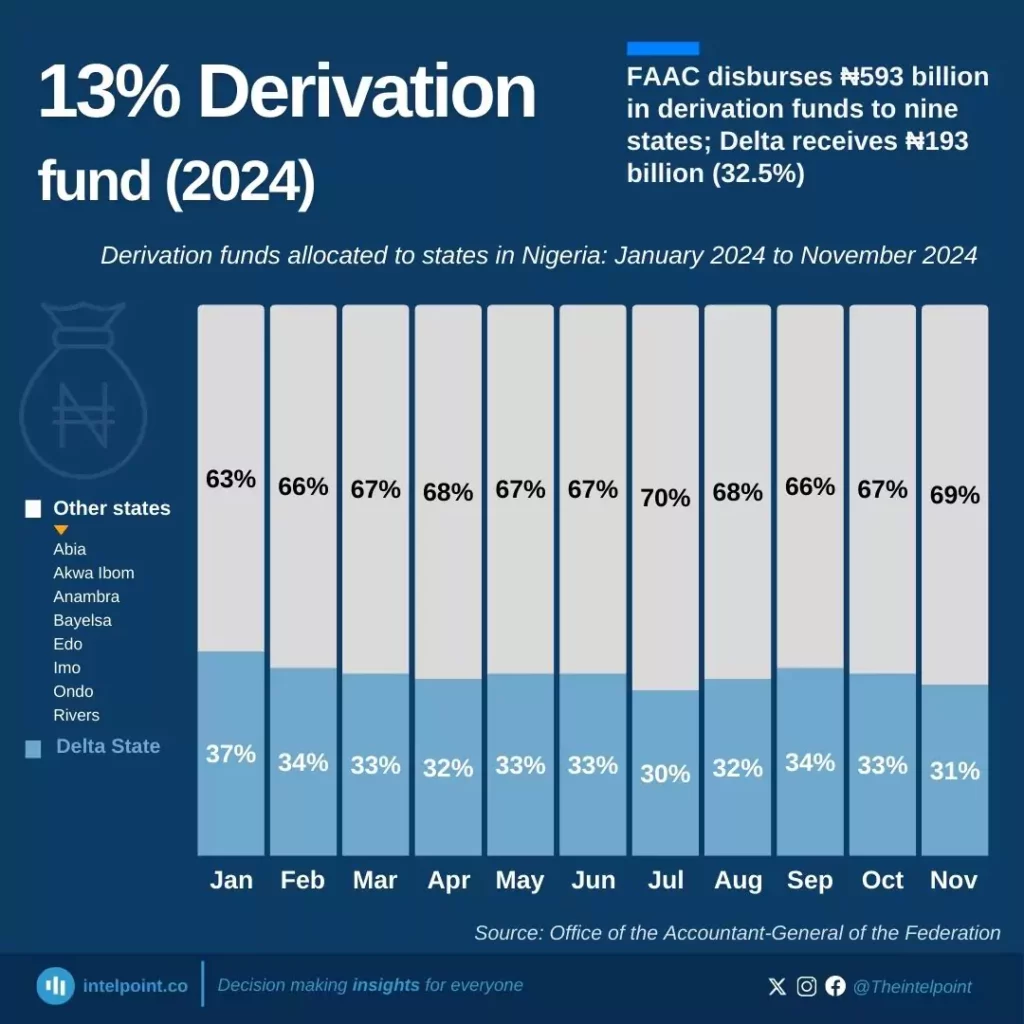
    The FAAC's revenue distribution from 2017 to August 2023 highlights the dominance of Delta, Akwa Ibom, Rivers, and Bayelsa states in allocations. Despite Lagos' economic prominence, it ranked fifth. Here is the distribution of revenue among states between 2017 and August 2023.

    See more
  • A Trend of Adult literacy rates of African countries

    Between 2018 and 2021, adult literacy rates across African nations exhibited significant disparities. Seychelles and South Africa led with literacy rates of 96% and 95%, respectively, indicating a high proportion of literate adults. Conversely, Chad had the lowest literacy rate during this period.

    These statistics underscore the uneven progress in educational attainment across Africa, highlighting the need for targeted interventions to improve literacy in lower-performing nations.

    See more
    Countries by Global Innovation Index 2024

    The Global Innovation Index 2024 reveals a striking contrast in innovation performance between countries globally and across Africa. Switzerland leads the global rankings with an impressive score of 67.5, followed by Sweden (64.5) and the USA (62.4), highlighting their sustained investments in research, development, and technological advancement.

    In Africa, Mauritius takes the top spot with a score of 30.5, followed closely by Morocco (28.8) and South Africa (28.3). However, even Africa's most innovative nations achieve less than half the score of global leaders, indicating a significant innovation gap.

    Nigeria ranks 15th in the African ranking and 113th globally, out of 133 countries, with a score of 17.1.

    See more

  • India has been the World Bank's largest debtor for over 50 years, with a debt of $38.3 billion as of 2022.

    Five Asian nations — India, Indonesia, Bangladesh, Pakistan, and China — owe a combined $111.2 billion, or 27% of the World Bank’s total debt.

    Nigeria, Africa's largest World Bank debtor, ranks 10th, with nearly #14 billion in debt.

    See more
  • MTN Nigeria has dominated the country's telecommunications market over the years, accounting for the largest market share. All four operators, apart from 9mobile, recorded a significant increase in their subscriber base between May 2014 and March 2024.

    See more
  • The 2024 Global Peace Index reveals a decline in peacefulness in 97 countries, the highest since the index began.

    Nigeria is among the nations affected by regional conflicts and rising violence. With a peace index score of 2.91, Nigeria is facing increasing challenges.

    A deteriorating peace score impacts foreign investment and economic stability. Global economic losses due to violence reached $19.1 trillion in 2023.
    See more

Other Insights
  • Private universities in Nigeria outnumber federal and state institutions combined.
  • Nigeria has 159 private universities, more than double the number of federal universities.
  • Federal universities stand at 72, showing steady federal government investment in tertiary education.
  • State-owned universities number 66, slightly fewer than federal universities but forming a significant part of public education.
See more
 
  • The 1990s saw multiple years of flat or negative FDI, including -$0.02B in 1995 and -$0.04B in 1997.
  • FDI surged to $1.81B in 2007 and $2.94B in 2010, marking a turning point.
  • The all-time high was $3.31B in 2012, with 2024 following closely at $3.11B.
  • From 2015 to 2024, annual FDI remained steadily above $1B, signalling sustained investor confidence.
See more
  • Nigeria’s outstanding debt to the World Bank rose from $180 million in 1970 to $17.81 billion in 2024, a nearly 100-fold increase in 54 years.
  • The balance remained below $5 billion until 2013, but more than tripled between 2013 and 2024, signalling accelerated reliance on multilateral credit.
  • From 2020 to 2024, the outstanding debt rose by $6.4 billion, the sharpest five-year surge on record.
  • The figures reflect a steady accumulation of obligations, driven by long-term borrowing and slower repayment relative to disbursement.
See more
 
  • Peak FDI was in 2009 with $2.75 billion, the highest recorded in the 1990–2024 period.
  • The year 2015 saw a rare negative inflow of -$580 million, marking Algeria’s only net FDI loss in the last three decades.
  • FDI inflows rose significantly between 2005 and 2011, consistently staying above $1 billion each year.
  • After the 2015 drop, inflows recovered modestly, hovering between $1.1B and $1.6B from 2016 to 2020.
  • FDI weakened again post-2020, falling to just $250 million in 2022, before rebounding to $1.44 billion by 2024.
See more
  • Only four African countries, Seychelles, South Africa, Namibia, and Ghana, meet or exceed the WHO’s recommended minimum of 44.5 nursing and midwifery personnel per 10,000 people.
  • Seychelles leads the continent with 73 personnel per 10,000, followed by South Africa (64), Namibia (54), and Ghana (45).
  • The lowest number within the top 20 is 16, shared by Nigeria, Comoros, and Mauritania.
  • The dataset includes 47 African countries, and no country outside the top 20 has more than 16 nursing and midwifery personnel per 10,000 people.
See more
 
  • Egypt attracted $46.6B in FDI in 2024, the highest in 35 years and nearly quadruple 2023’s $9.8B inflow.
  • Average FDI between 1990–2023 was just $4.9B, meaning 2024’s figure is over 9× the long-term average.
  • Prior to 2024, FDI peaked at $11.6B in 2007, with only three other years, 2008, 2022, and 2023 crossing the $9B mark.
  • In 2011, Egypt recorded –$0.48B in FDI, meaning more foreign investment left the country than came in, largely due to the Arab Spring unrest.
  • The 2005–2010 period was previously Egypt’s strongest run, averaging over $8B annually before political instability triggered sharp declines.
See more
 
  • Kenya recorded $27.5B total FDI between 1990 and 2024, with most inflows occurring after 2007.
  • From 1990 to 2006, Kenya averaged just $0.04B annually, a sign of limited foreign investor confidence in early years.
  • A major turnaround began in 2007, with FDI jumping from $0.05B to $0.90B, and peaking at $2.23B in 2011.
  • Between 2007 and 2024, Kenya received over 92% of its total FDI, a sharp shift in its investment profile.
  • FDI has stayed above $1B annually since 2009, signalling consistent investor interest in Kenya’s growing economy.
See more
 
  • Rwanda attracted a total of $6.28 billion in foreign direct investment (FDI) over 35 years, from 1990 to 2024.
  • The highest annual inflow recorded was $820 million in 2024, making it the country’s strongest FDI year yet.
  • Between 2020 and 2024, Rwanda pulled in $2.70 billion, accounting for over 40 percent of its total investment since 1990.
  • From 1990 to 2004, annual FDI barely exceeded $100 million, with several years recording zero inflows.
  • Even during its best-performing years, Rwanda’s FDI never hit the $1 billion threshold.
See more
  • June 2025 PMI: 51.6, down from 52.7 in May — marking a three-month slowdown in growth.
  • The figure is 2.99% above June 2024 levels, when PMI was 50.1 — confirming year-on-year improvement.
  • The June dip reflects subdued demand and persistent inflation, echoing broader market sentiments.
  • A PMI above 50 signals expansion; Nigeria’s figure signals ongoing growth, though losing speed.
See more
  • Uganda and Mauritius offer the most affordable mobile data in Africa, with 1GB for just $0.02 over a 30-day period.
  • Comoros, Ghana, and South Africa also rank among the cheapest, each offering 1GB of data for $0.07 to $0.10.
  • Nigeria is among the top 10, with a relatively low cost of $0.13 per 1GB, placing it below the continental average.
  • Madagascar, at $0.32 per 1GB, closes out the top 20, which reflects the upper boundary of affordable data across African nations.
See more
  • Road accidents declined by 53% between Q3 2020 and Q3 2024.
  • Q4 2022 recorded the highest number of accidents, with 4,835 reported cases.
  • Q3 2024 had the lowest number, with just 1,945 accidents.
  • Speed violation remains the leading cause of road accidents in Nigeria.
  • Ogun, FCT, Kaduna, and Nasarawa consistently rank among the top four states with the highest accident occurrences.
  • Bayelsa, Borno, Imo, Rivers, and Akwa Ibom regularly report the lowest number of accidents each quarter.
  • Commercial vehicles are the most frequently involved vehicle category in accidents.
  • Cars account for the highest number of individual vehicle accidents.
See more
  • The Federal Capital territory (FCT) recorded the highest number of road accidents between Q3 2020 and Q3 2024, with a total of 8,133 accidents, accounting for 12.42% of total accidents.
  • FCT, Ogun, Nasarawa, and Kaduna consistently ranked among the top four states with the highest accident occurrences.
  • Bayelsa, Borno, Akwa Ibom, Rivers, and Imo were among the states with the lowest number of recorded accidents each quarter.
See more
1 42 43 44 45 46 126
  • Nearly half (48.9%) of Nigerian businesses identify inflation as their greatest economic challenge in 2025.
  • The foreign exchange rate (17.1%) is the second most pressing concern, reflecting ongoing naira volatility.
  • Insecurity (15.6%) and government policies (10.0%) remain significant worries for business operations.
  • Inadequate infrastructure (8.4%), while the least mentioned, continues to constrain growth.
Read more
  • Just 25.1% of MSMEs report receiving any form of government support, while 74.9% remain untouched by initiatives.
  • Among those who benefitted, 41.1% accessed grants, making it the most common form of support.
  • 22.1% of MSMEs participated in government training programmes, showing recognition of capacity-building needs.
  • Only 16% received loans and 13.8% got tax breaks, underscoring limited financial and fiscal support penetration.
  • A mere 6.9% of businesses report accessing subsidies, reflecting minimal impact of such schemes.
Read more
  • The South West (₦8.3m) far surpasses all regions in monthly revenue, reflecting Lagos’ dominance as Nigeria’s commercial hub.
  • The South South (₦831k) and South East (₦605k) trail far behind but still outperform the northern regions.
  • The North East (₦562k) and North West (₦479k) show significantly lower average revenues.
  • The North Central (₦241k) records the weakest average, underlining stark regional disparities.
Read more
  • Only 12.1% of entrepreneurs are aged 18–25, showing limited entry among very young adults.
  • The largest groups are 26–35 (33.3%) and 36–45 (33.8%), together accounting for two-thirds of entrepreneurs.
  • Mid-life representation: 14.6% are aged 46–55.
  • Just 6.2% are 56 and above, indicating fewer older adults start or run MSMEs.
Read more
  • 48.8% of MSMEs earn less than ₦100,000 monthly.
  • 19.5% report revenues between ₦100,000 and ₦199,900.
  • The share of businesses decreases steadily in the ₦200,000–₦999,900 bands, ranging from 9.3% to 6%.
  • Only 8.8% of MSMEs earn above ₦1 million monthly, with just 0.4% exceeding ₦100 million.
Read more
  • Mauritius leads Africa with the highest GII score (32.5), ranking 53rd globally out of 139 countries.
  • North Africa dominates the top 5, with Morocco and Tunisia both strong performers.
  • Sub-Saharan Africa’s bright spots include South Africa, Seychelles, Botswana, and Senegal.
  • Nigeria is 105th globally (21.1), highlighting Africa’s uneven innovation capacity.
Read more
1 42 43 44 45 46 252

Can’t find what you’re looking for? Please fill the form below
Contact Form Demo
SIGN UP TO OUR NEWSLETTER
Get periodic updates about the African startup space, access to our reports, among others.
Subscribe Here
Subscription Form

A product of Techpoint Africa. All rights reserved