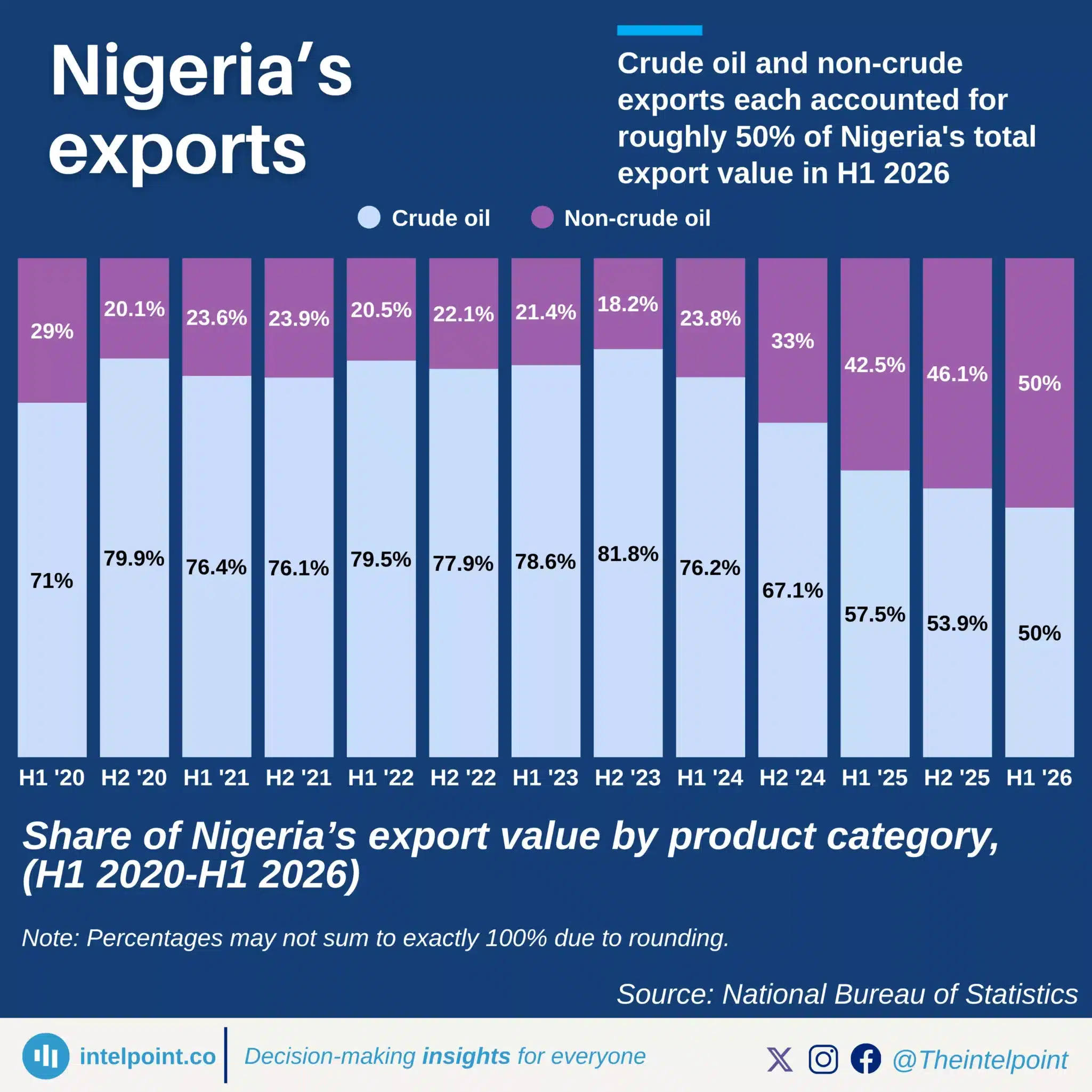
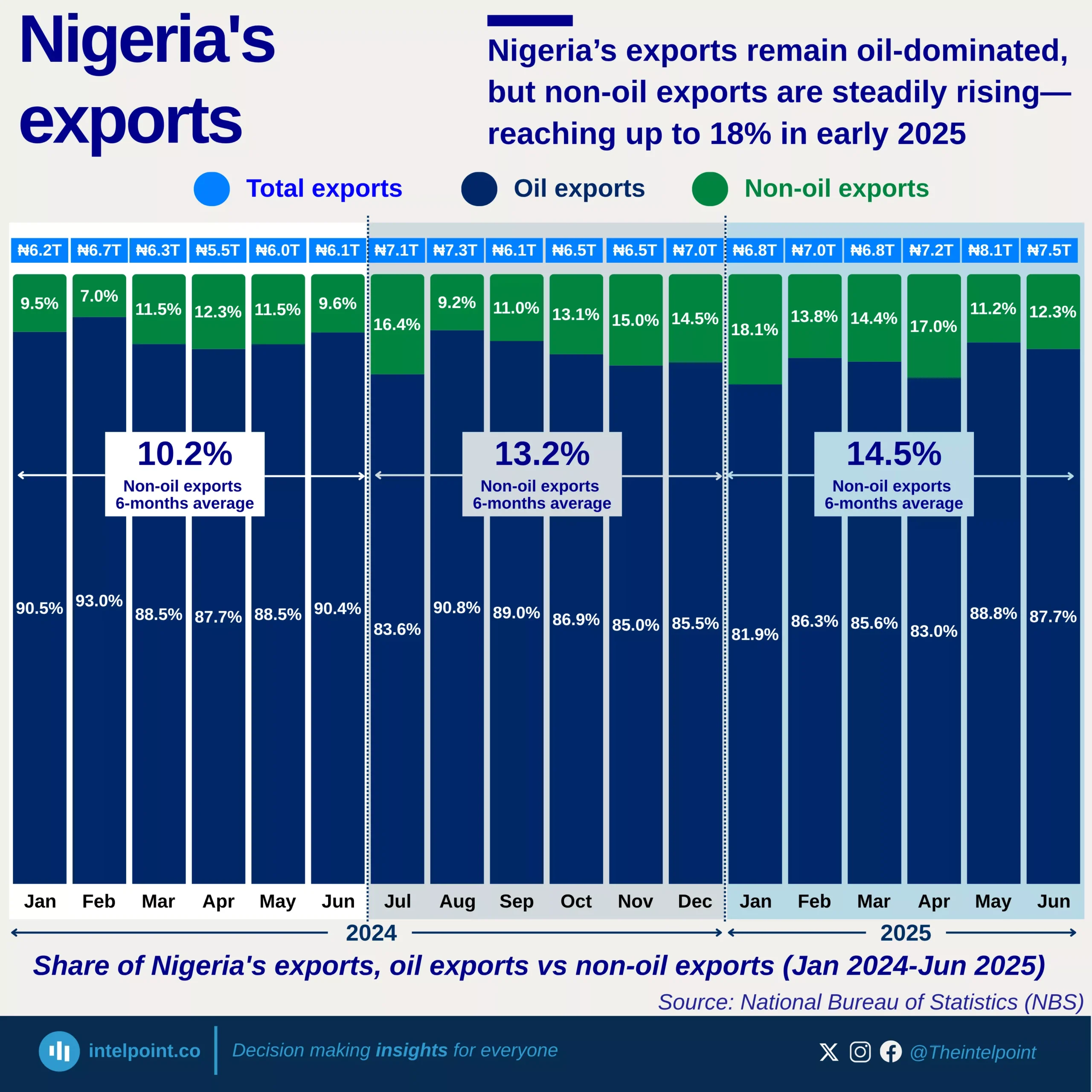
Nigeria’s exports remain oil-dominated, but non-oil exports are steadily rising—reaching up to 18% in early 2025

  • Oil exports continued to dominate, averaging over 88% of total exports in 2024 and remaining above 81% in the first half of 2025.
  • Non-oil exports rose gradually, from a low of 6.9% (February 2024) to a high of 18.1% (January 2025).
  • Peaks in non-oil export contributions occurred in July 2024 (16.4%) and January–April 2025 (13–18%), indicating progress toward diversification.
  • Total exports remained heavily oil-driven, though sustained double-digit non-oil shares in late 2024 and early 2025 show a slow shift.

Nigeria’s exports remain heavily reliant on oil, but non-oil exports are gaining traction. In 2024, non-oil contributions ranged from 6.9% in February to 16.4% in July, with double-digit shares maintained in the second half of the year. Early 2025 saw non-oil shares reach 18.1% in January and stay above 11% through June, highlighting gradual diversification beyond oil.
Source:

National Bureau of Statistics (NBS)

Period:

January 2024-June 2025
HTML code to embed chart
Want a bespoke report?
Reach out
Tags
Related Insights

Nigeria's non-oil exports grew faster than oil exports in 2024 and 2025, though oil remained dominant
  • In 2025, non-oil export growth (36%) was 6x higher than oil (6%).
  • In 2024, non-oil exports grew by 189% vs oil’s 108%.
  • Total exports still heavily depend on oil.
  • Export value rose from ₦36 trillion in 2023 to ₦85.1 trillion in 2025.

Nigeria imported 10x more from Asia than from Africa in 2025
  • Asia is Nigeria’s top import source in 2025.
  • The highest import value from Asia was recorded in Q1 at ₦8.7 trillion.
  • Imports from Europe surged to ₦8.6 trillion in Q2 but declined to ₦6.6 trillion by Q4.
  • Imports from America showed continuous growth, rising from ₦2.9 trillion in Q1 to ₦6.6 trillion in Q4.
  • Imports from Africa remained below ₦1 trillion across most quarters.

China’s exports to Nigeria increased by 40% in 2025
  • China’s exports to Nigeria increased by 40.4%,
  • China's exports moved from ₦ 14.1 trillion in 2024 to ₦ 19.8 trillion in 2025.
  • Growth was consistent across all four quarters.
  • Quarter 2 saw the highest growth at 80%, jumping from ₦3.0tn to ₦5.4tn.
  • Quarter 4 recorded a modest 4.3% rise.

Nigeria’s export mix stayed oil-heavy in 2025, with crude oil above 75% in all quarters
  • Crude oil dominated Nigeria’s exports in all quarters of 2025
  • Q1 recorded the highest oil dependency at 81.5%.
  • Non-oil exports peaked in Q2 at 24.2%, representing the strongest diversification point in 2025.
  • The oil share dropped to its lowest in Q2 (75.8%), but still remained dominant.

In 2025, Nigeria imported crude oil for the first time in the past decade, accounting for 11% of its total crude oil trade
Key takeaways:
  • Nigeria recorded its first crude oil imports in a decade in 2025, marking a structural shift in trade dynamics.
  • Imports accounted for 11% of total crude oil trade in 2025.
  • Total crude oil trade grew sharply from ₦7 trillion in 2016 to ₦53.2 trillion in 2025, indicating long-term expansion.
  • Exports remain dominant, contributing ₦47.4 trillion in 2025 despite the emergence of imports.
  • 2024 was the peak year for crude oil trade at ₦55.3 trillion, followed by a slight decline in 2025.
  • The 2020 dip of ₦9.4 trillion highlights vulnerability to global shocks, likely tied to oil price and demand disruptions.

Nigeria's petrol prices have surged 40% since the US/Israel-Iran War
  • Nigeria recorded the largest petrol price increase in Africa, rising 39.5% between February 23 and March 16, 2026.
  • Egypt experienced a 14.3% increase, making it one of the largest price jumps in Africa.
  • Nigeria’s increase is more than double that of Egypt.
  • A number of African countries recorded very small price changes, including Tanzania (2.7%), Morocco (2.1%), and South Africa (1%).
  • A few countries actually saw declines in fuel prices, including Madagascar (-3.9%) and Zambia (-4.6%).
  • During the period, petrol prices remained unchanged in 28 African countries.

POPULAR TOPICS
SIGN UP TO OUR NEWSLETTER
Get periodic updates about the African startup space, access to our reports, among others.
Subscribe Here
Subscription Form

A product of Techpoint Africa. All rights reserved