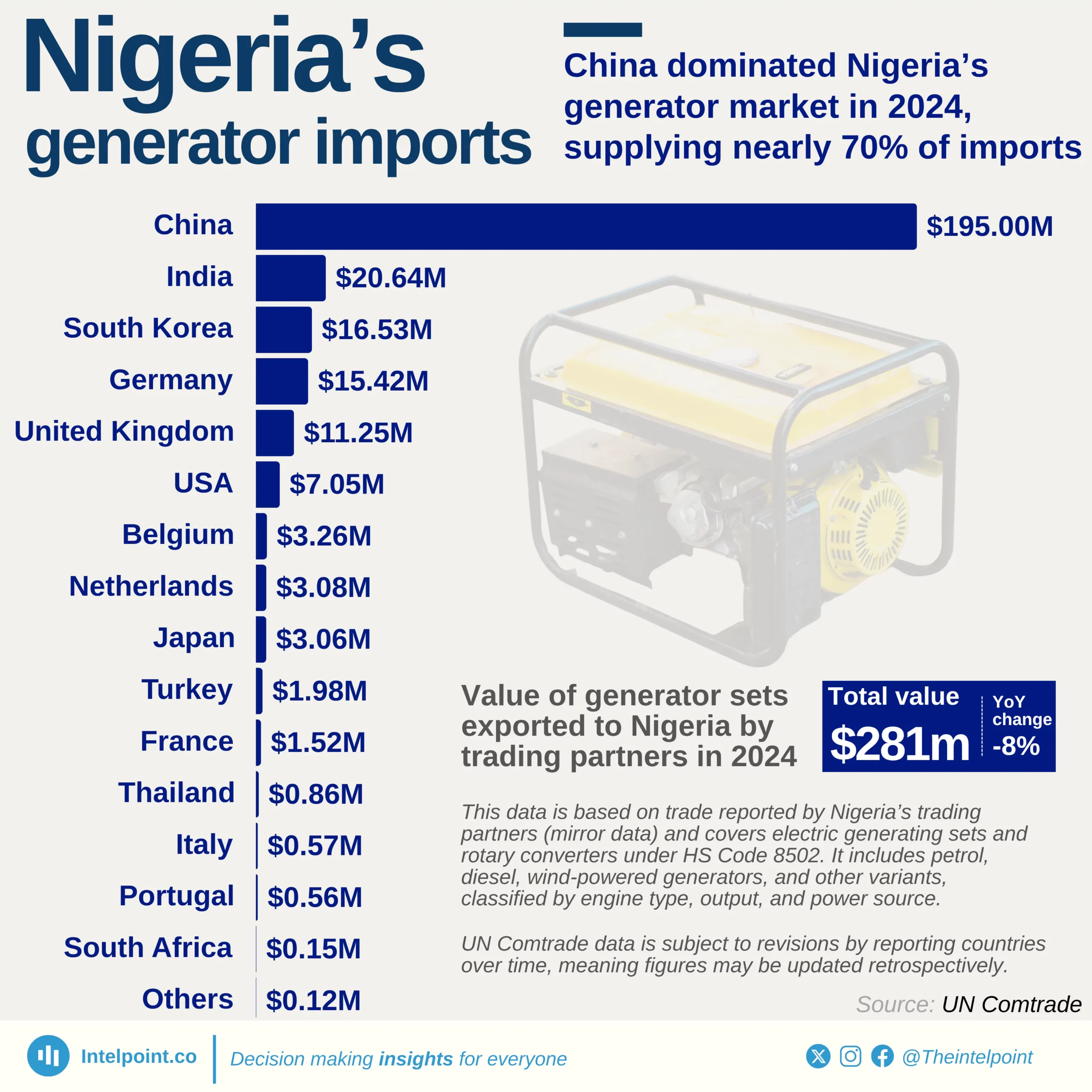
China dominated Nigeria’s generator market in 2024, supplying nearly 70% of imports

  • Nigeria imported $281 million worth of generator sets in 2024.
  • China remained the dominant supplier, accounting for $195 million, or nearly 70% of total imports.
  • Other top suppliers included India ($20.6M), Germany ($15.4M), and South Korea ($16.5M).
  • Compared to 2023, imports from China dipped slightly (from $202M to $195M), and other countries like Germany and India also saw declines.
  • The data captures a wide range of generator types — petrol, diesel, wind-powered, and rotary converters — under HS Code 8502.
  • Mirror data reflects only officially reported trade and excludes informal or undocumented imports.

Nigeria's persistent demand for off-grid electricity solutions led to over $281 million in imports of electricity generators and rotary converters in 2024. China dominated this market, supplying nearly 70% of the total value at $195 million. While China's share slightly dipped from $202 million in 2023, its overwhelming presence remained. Beyond China, sourcing shifts included declines from Germany (from $24.7M in 2023 to $15.4M) and India (from $29.2M to $20.6M), with South Korea ($16.5M) and the UK ($11.2M) also being significant suppliers in 2024. This heavy reliance on imported power solutions raises critical questions concerning Nigeria's local energy infrastructure, the implications of a prevailing fossil-fuel-reliant generator economy, and the pace at which renewable alternatives can realistically challenge the existing energy paradigm.
Source:

UN Comtrade

Period:

2024
HTML code to embed chart
Want a bespoke report?
Reach out
Tags
Related Insights

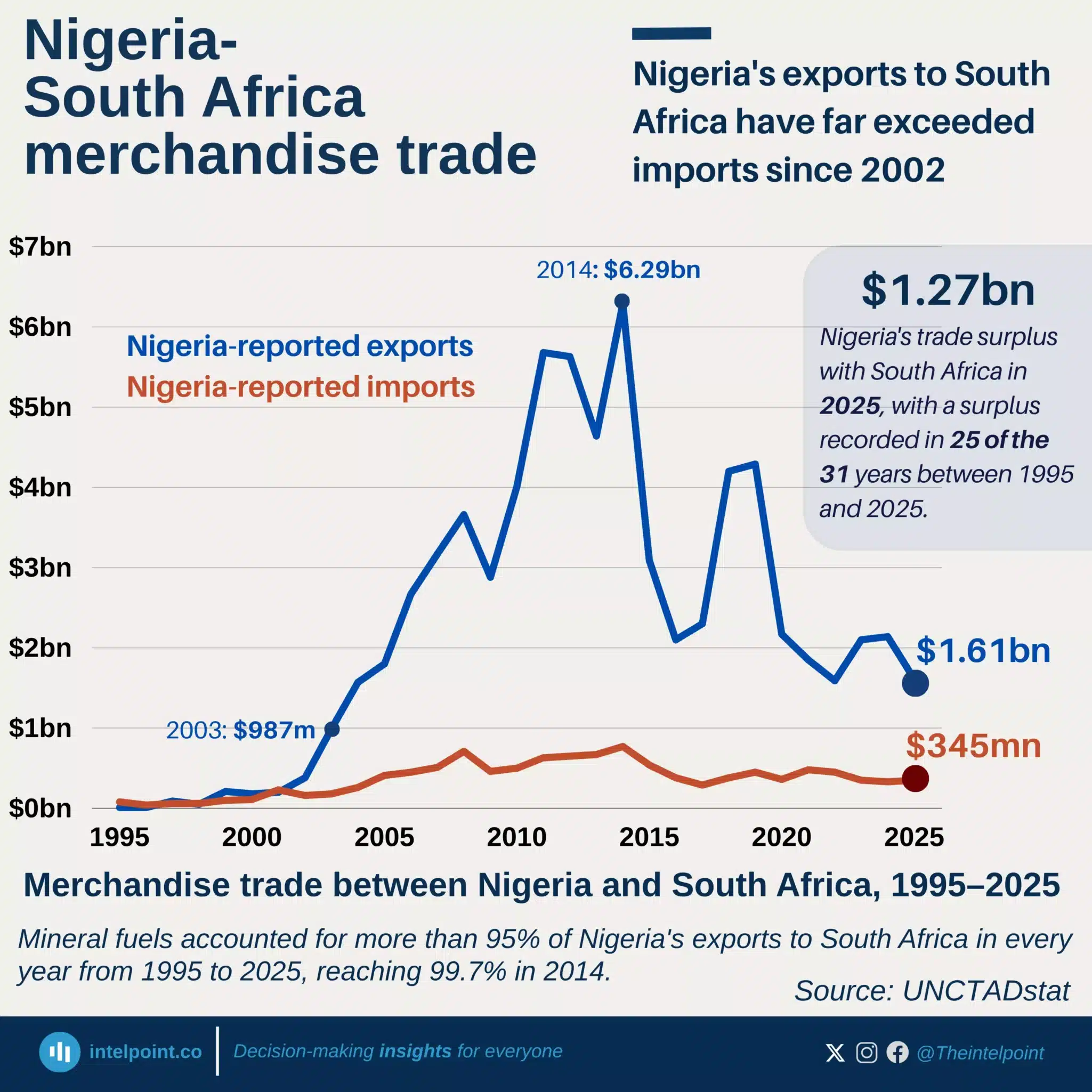
Nigeria's exports to South Africa have far exceeded imports since 2002
  • Nigeria has exported more to South Africa than it has imported every year since 2002.
  • Exports peaked at $6.29 billion in 2014, driven almost entirely by mineral fuels.
  • Imports from South Africa have remained below $1 billion annually.
  • Nigeria recorded a $1.27 billion trade surplus with South Africa in 2025.
  • Mineral fuels made up over 95% of Nigeria's exports throughout 1995-2025.

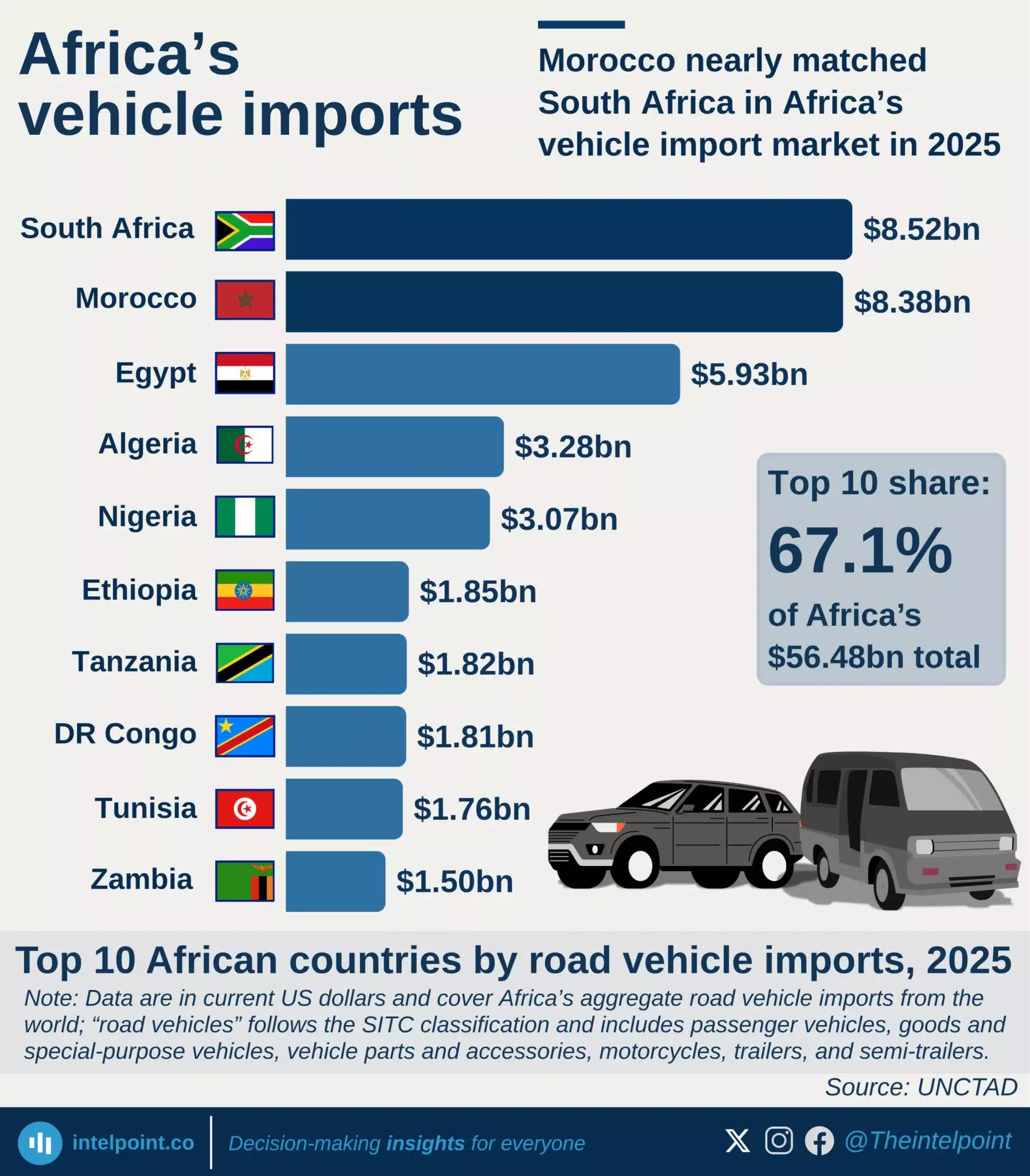
Morocco nearly matched South Africa in Africa’s vehicle import market in 2025
  • South Africa led with $8.52 billion, only $140 million ahead of Morocco.
  • Morocco’s imports have grown steadily, while South Africa’s 2025 figure was a recovery toward its 2012 peak.
  • Egypt ranked third, followed by Algeria and Nigeria.
  • The top 10 markets accounted for 67.1% of Africa’s $56.48 billion total.
  • Road vehicle imports include vehicles, parts, motorcycles, trailers, and semi-trailers.

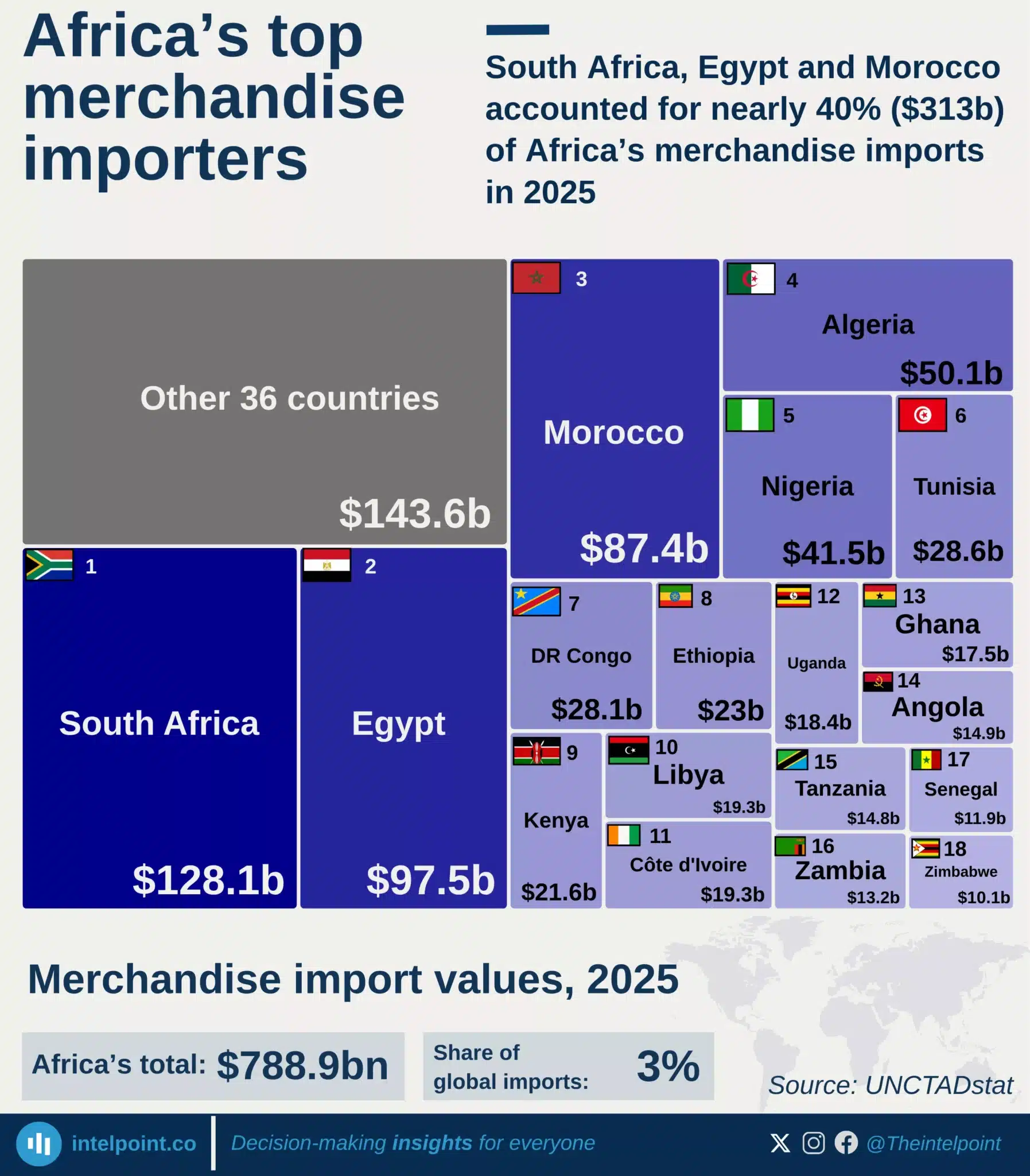
South Africa, Egypt and Morocco accounted for nearly 40% ($313b) of Africa’s merchandise imports in 2025
  • Africa imported merchandise worth $788.9 billion in 2025, representing about 3% of global merchandise imports.
  • South Africa was Africa’s largest merchandise importer, with imports valued at $128.1 billion.
  • Egypt ranked second at $97.5 billion, followed by Morocco at $87.4 billion.
  • The three largest importers accounted for $313 billion, or 39.7% of Africa’s total merchandise imports.
  • South Africa alone accounted for about 16.2% of the continental total.
  • The five largest importers, including Algeria and Nigeria, were responsible for $404.6 billion, or 51.3% of Africa’s imports.
  • Nigeria ranked fifth, with merchandise imports valued at $41.5 billion.

For most of the period (2013-H1 2025), China's share of Nigeria's imports from Asia hovers around 50%-55%, showing dominance
  • China has dominated Nigeria’s imports from Asia, maintaining a 50–55% share for most of the period.
  • China’s share reached its highest level at 58.6% in H1 2025.
  • India's import share remained volatile, ranging between 11% and 25%.
  • Total imports from Asia surged from ₦2.6 trillion in 2013 to ₦16.4 trillion in H1 2025.

Nigeria's agricultural imports' share has been dropping, from 83.9% (2017) to a low of 42.9% (H1 2025)
  • Agricultural imports fell from 83.9% in 2017 to 42.9% in H1 2025, indicating a significant decline in import dependency.
  • Agricultural exports grew from 16.1% in 2017 to 54.0% in 2024, surpassing imports for the first time since 2017.
  • Total agricultural trade increased from ₦1.1 trillion in 2017 to ₦8.2 trillion in 2024.
  • Between 2022 and 2024, the import share dropped significantly from 75.7% to 46.0%.

Crude oil imports in Nigeria emerged in H1 2025 (the first since 2017), capturing a 10.2% share of the total crude oil trade
  • Crude oil imports into Nigeria in H1 2025 marked the first occurrence since 2017.
  • Crude oil imports accounted for 10.2% of total crude oil trade.
  • From 2017 to 2024, exports made up 100% of crude oil trade annually.
  • Total crude oil trade peaked at ₦55.3 trillion in 2024.
  • The emergence of crude oil imports can be linked to domestic refinery operations, especially the Dangote Refinery.

POPULAR TOPICS
SIGN UP TO OUR NEWSLETTER
Get periodic updates about the African startup space, access to our reports, among others.
Subscribe Here
Subscription Form

A product of Techpoint Africa. All rights reserved