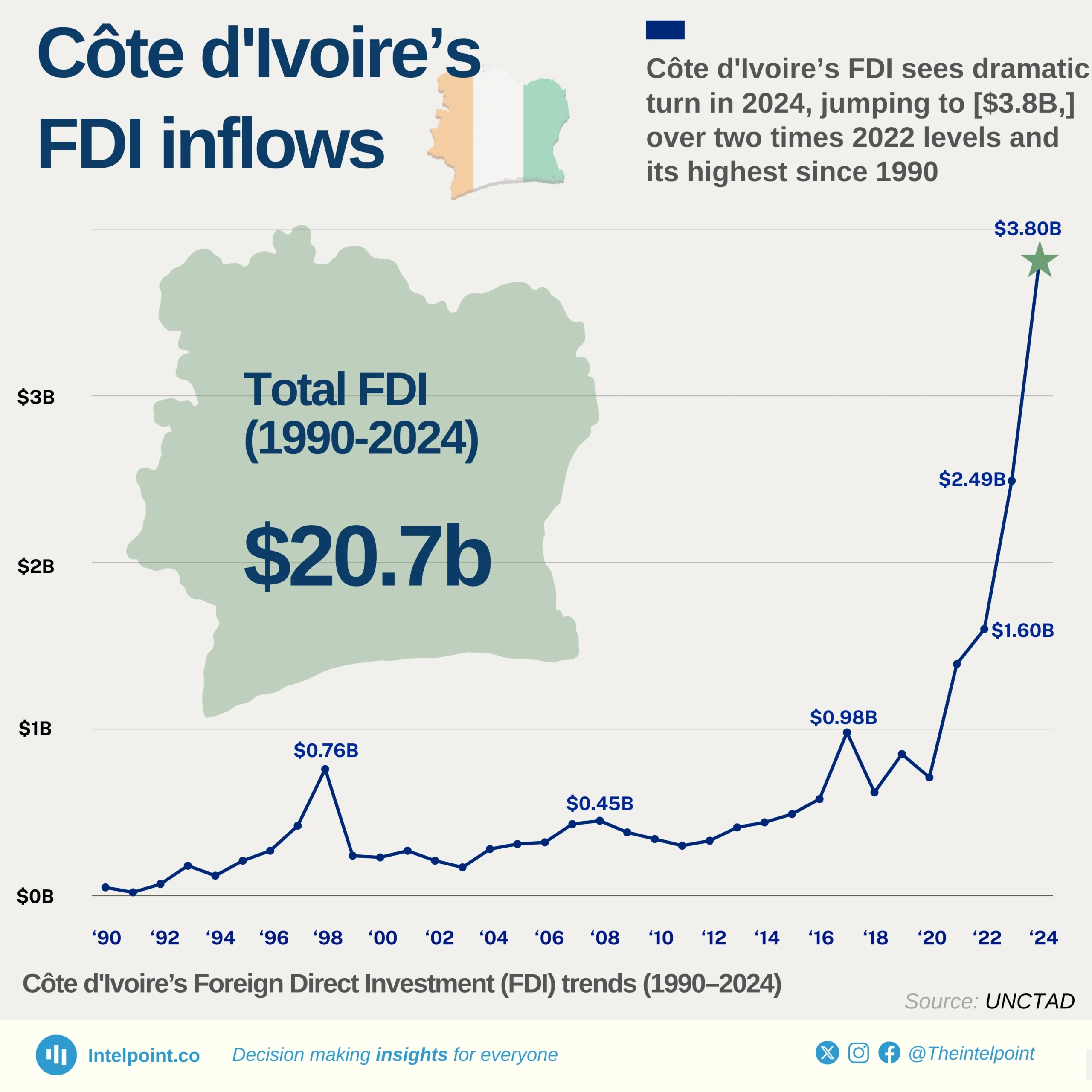
Côte d'Ivoire’s FDI sees dramatic turn in 2024, jumping to $3.8B, over two times 2022 levels and its highest since 1990

Key Takeaways

  • Côte d'Ivoire attracted $3.80 billion in FDI in 2024, its highest annual inflow ever recorded, more than double 2022’s $1.6 billion.
  • Between 1990 and 2016, its FDI remained mostly below $1 billion annually, only beginning to surge from 2017 onwards.
  • The country crossed the $1 billion mark for the first time in 2021, signalling increased investor confidence and macroeconomic improvements.
  • Over the last three years (2022–2024) alone, Côte d'Ivoire drew in $7.89 billion in FDI, accounting for over 40% of total inflow since 1990.

Côte d'Ivoire’s foreign direct investment (FDI) journey from 1990 to 2024 reveals a slow and steady rise followed by an impressive surge in recent years. From negligible flows like $0.05 billion in 1990 and $0.02 billion in 1991, the country’s FDI remained modest through the 1990s and 2000s, rarely exceeding $0.5 billion annually. This pattern reflects decades of political instability, economic volatility, and underdeveloped infrastructure, all of which traditionally hindered investor interest.

However, starting around 2017, the tide began to turn. A series of structural reforms, improvements in governance, and a stronger focus on private sector-led growth attracted new international capital. By 2021, FDI leapt to $1.39 billion, and in just three years, the country tripled that figure, reaching $3.80 billion in 2024. This steep rise positioned Côte d'Ivoire as one of the most rapidly emerging investment destinations in West Africa, a testament to its growing appeal in sectors like energy, agriculture, construction, and tech infrastructure.
Source:

UNCTAD

Period:

1990 - 2024
HTML code to embed chart
Want a bespoke report?
Reach out
Tags
Related Insights

Nigeria’s FDI inflows rose to 4th in Africa after a 148% increase, while Egypt remained the continent’s top destination
Egypt remained Africa’s top FDI destination with $15.45bn. Nigeria ranked 4th after FDI inflows rose 148% to $4.01bn. Guinea had the biggest top-10 jump, rising 454% to $7.76bn. Africa’s top 10 accounted for 73% of total FDI inflows.

Europe, Asia, and the Americas have attracted a combined 94% of global foreign investment since 1990, leaving Africa and Oceania with just 6%
  • Europe ($12.58 trillion), Asia ($11.88 trillion), and the Americas ($11.49 trillion) are nearly tied after 35 years, each capturing roughly a third of global FDI
  • Asia grew from just $25 billion annually in 1990 to consistently attracting $600-700 billion per year, showing the most stable growth pattern
  • Major crises (2001, 2008-09, 2020, and 2022) caused dramatic swings, with Europe even recording negative flows in 2022
  • Africa and Oceania combined received just 6% of total FDI, remaining far behind despite Africa's recent acceleration to $97 billion in 2024

North Africa was the primary destination for FDI in 2024, attracting 52% of Africa's total FDI inflow
  • Africa attracted $97 billion in total FDI inflows in 2024.
  • North Africa dominated with $51 billion (52%), remaining the continent’s top foreign investment hub.
  • West Africa ranked second with $15 billion (15.3%).
  • East Africa secured $13 billion (13.3%).
  • Central Africa remained the least favoured, with only $8 billion (8.2%) in FDI inflows.

Nigeria’s share of Africa’s FDI collapsed from ~38% in 1994 to barely 1.1% in 2024
  • Nigeria’s FDI share plunged from 35% in 1990 to 1.1% in 2024.
  • Africa’s FDI surged over the same period, leaving Nigeria behind.
  • Q1 2025 inflow was only $126.3 million, showing persistent weakness.
  • Decline mirrors structural hurdles — unstable policies, forex issues, and weak infrastructure.

Nigeria recorded an impressive 822% growth in FDI inflows between 1999 and 2009, before gradually dropping back to $1.1B in 2024
  • FDI inflows in Nigeria peaked at $8.8 billion in 2011, marking the highest point in the Fourth Republic.
  • From 2011 to 2024, FDI inflows dropped, settling at $1.1 billion in 2024.
  • The early Fourth Republic (1999–2011) showed growth in FDI inflows.
  • FDI outflows rose from $0.2 billion in 1999 to $1.5 billion in 2009, reflecting gradual international expansion by Nigerian investors.
  • From 2015 onward, both inflows and outflows showed significant volatility, with no clear recovery trend.

Cape Verde’s FDI averaged over $68M annually over 34 years, with a record $170M in 2008 and a recent 54% drop from 2023 to 2024
  • Cape Verde attracted no foreign direct investment during the early 1990s, signalling limited investor interest at the time.
  • FDI inflows skyrocketed from $130M in 2006 to an all-time high of $170M in 2008, before stabilising above $100M for most of the 2010s.
  • The country experienced large swings, ranging from a high of $150M (2014) to lows of $50M (2020).
  • Despite recovering to $130M in 2023, inflows dropped sharply to $60M in 2024, the weakest figure in over a decade.

POPULAR TOPICS
SIGN UP TO OUR NEWSLETTER
Get periodic updates about the African startup space, access to our reports, among others.
Subscribe Here
Subscription Form

A product of Techpoint Africa. All rights reserved