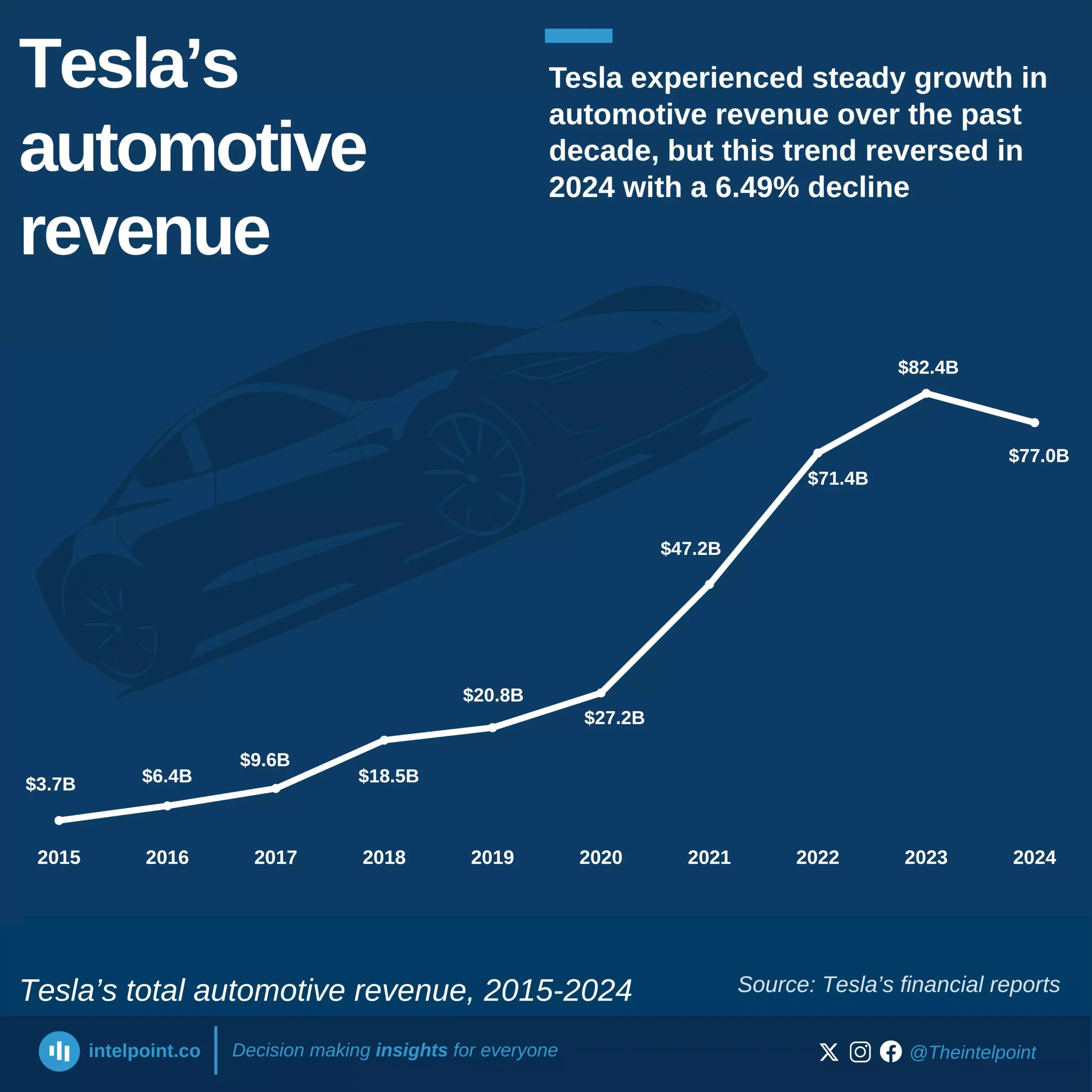
Tesla experienced steady growth in automotive revenue over the past decade, but this trend reversed in 2024 with a 6.49% decline

Key Takeaways

  • Tesla recorded its highest automotive revenue in 2023, reaching an impressive $82.4 billion.
  • In 2024, Tesla’s automotive revenue declined for the first time, with a 6.49% drop compared to the previous year.
  • Despite the decline in automotive revenue, Tesla’s total revenue grew by 0.95%, indicating resilience in other business segments

For nearly a decade from 2015 to 2023, Tesla consistently recorded year-on-year growth in its automotive revenue, reaching an all-time high of $82.4 billion in 2023. However, in 2024, the company experienced its first-ever decline in automotive revenue, which fell by 6.49%.

Interestingly, this dip in automotive revenue did not affect Tesla’s total revenue, which still increased slightly by 0.95%, driven by gains in energy generation and storage, as well as services and other revenue streams.

Despite the decline, Tesla remains firmly at the top among pure electric vehicle (EV) manufacturers, leading in both automotive and total revenue globally.

Since launching its EV production in 2008, Tesla’s presence has been limited in Africa. But that is beginning to change. On May 27, 2025, Tesla Morocco SARL was officially registered in Casablanca with an initial capital of $2.75 million. This marked the company’s first formal entry into the African market, with ambitions that go beyond just vehicle sales.
Source:

Tesla's financial reports

Period:

2015-2024
HTML code to embed chart
Want a bespoke report?
Reach out
Tags
Related Insights

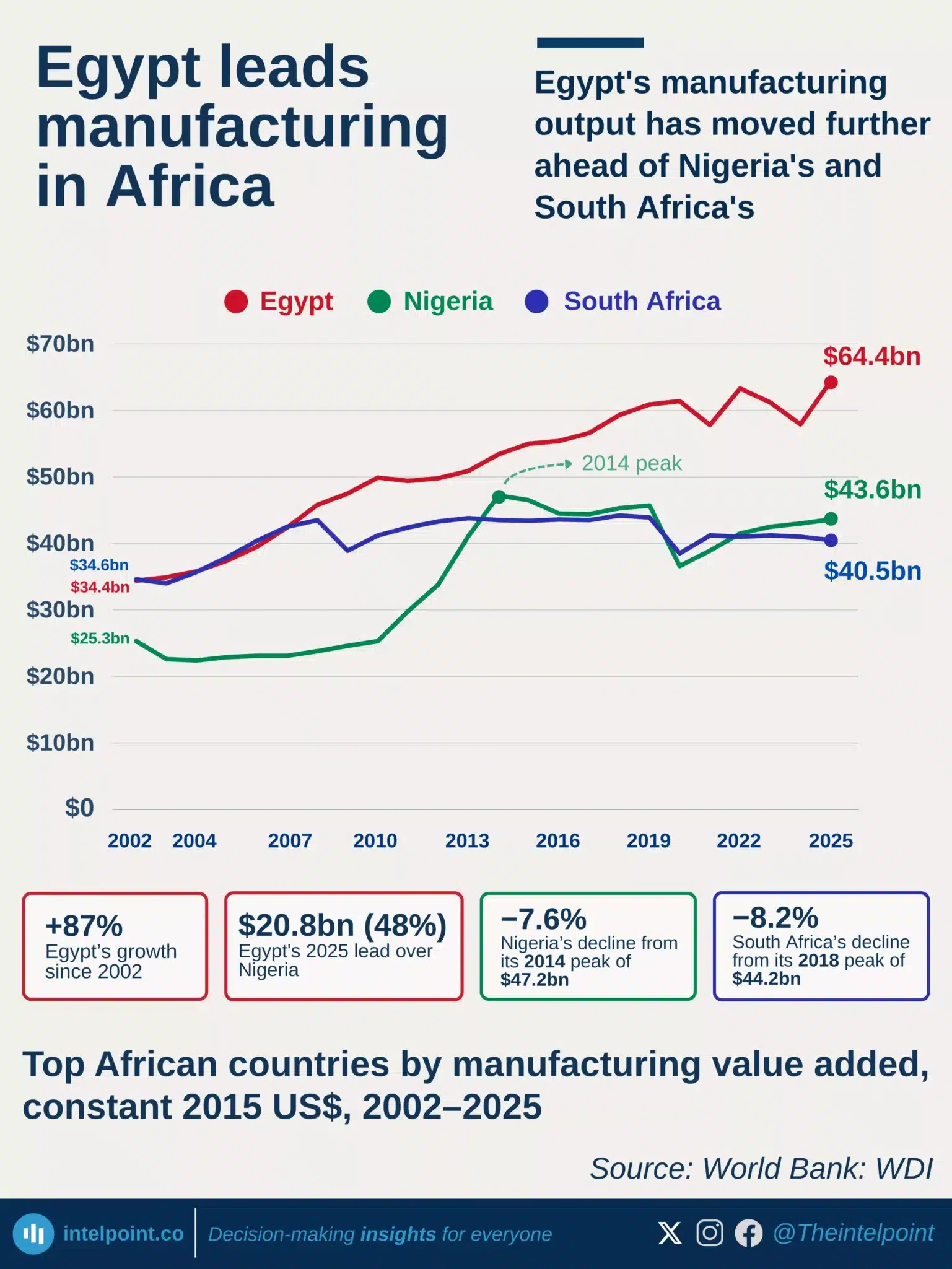
Egypt's manufacturing output has moved further ahead of Nigeria's and South Africa's
  • Egypt’s manufacturing value added reached $64.4 billion in 2025.
  • Egypt’s manufacturing value added increased 87% since 2002.
  • Nigeria’s manufacturing value added peaked at $47.2 billion in 2014.
  • Nigeria’s 2025 manufacturing value added was $43.6 billion, below its 2014 peak.
  • Nigeria was just $3.1 billion behind South Africa in 2025.
  • South Africa’s manufacturing value added peaked at $44.2 billion in 2018.
  • South Africa’s manufacturing value added fell to $40.5 billion in 2025.
  • Egypt recorded $20.8 billion more manufacturing value than Nigeria in 2025.

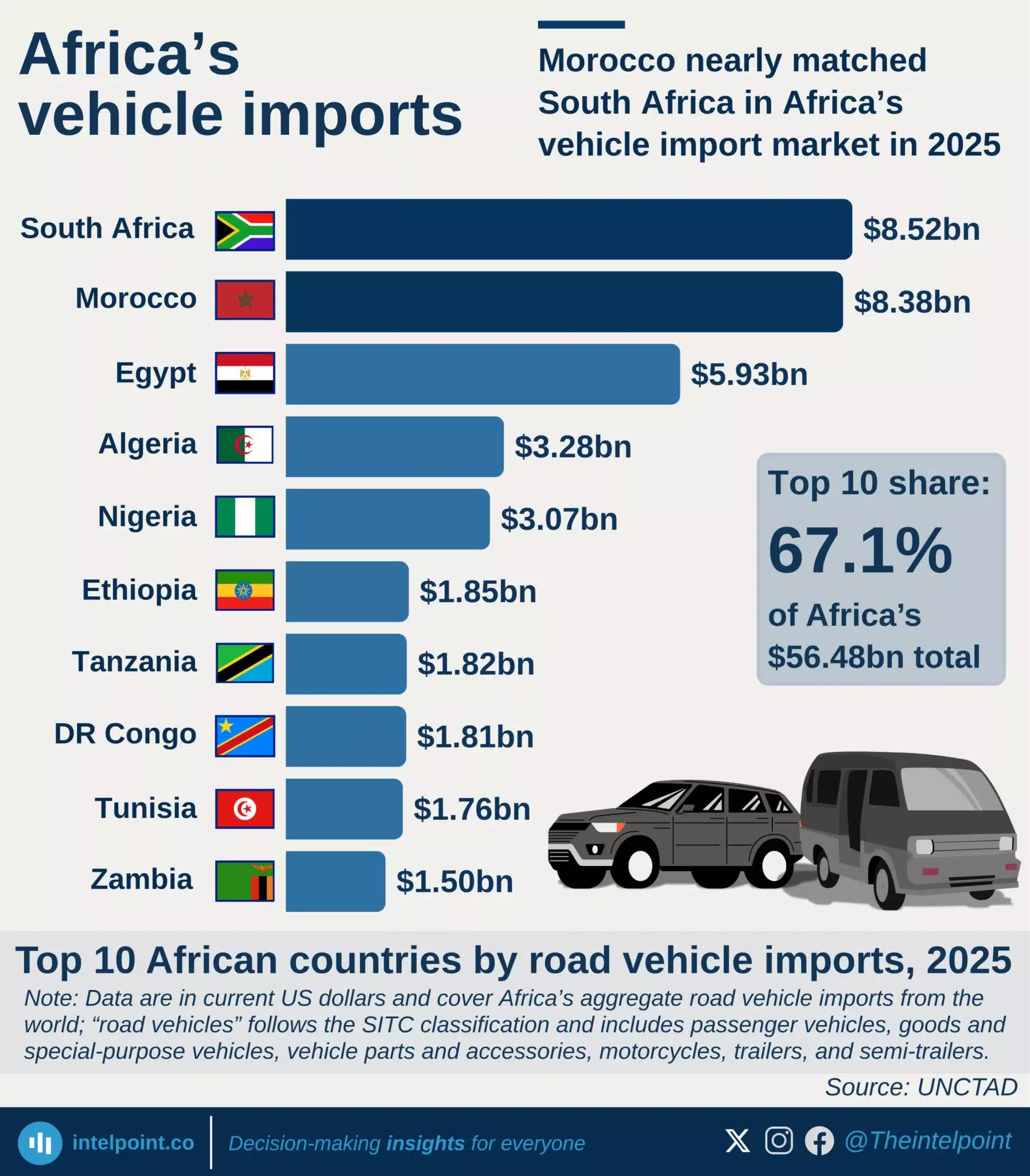
Morocco nearly matched South Africa in Africa’s vehicle import market in 2025
  • South Africa led with $8.52 billion, only $140 million ahead of Morocco.
  • Morocco’s imports have grown steadily, while South Africa’s 2025 figure was a recovery toward its 2012 peak.
  • Egypt ranked third, followed by Algeria and Nigeria.
  • The top 10 markets accounted for 67.1% of Africa’s $56.48 billion total.
  • Road vehicle imports include vehicles, parts, motorcycles, trailers, and semi-trailers.

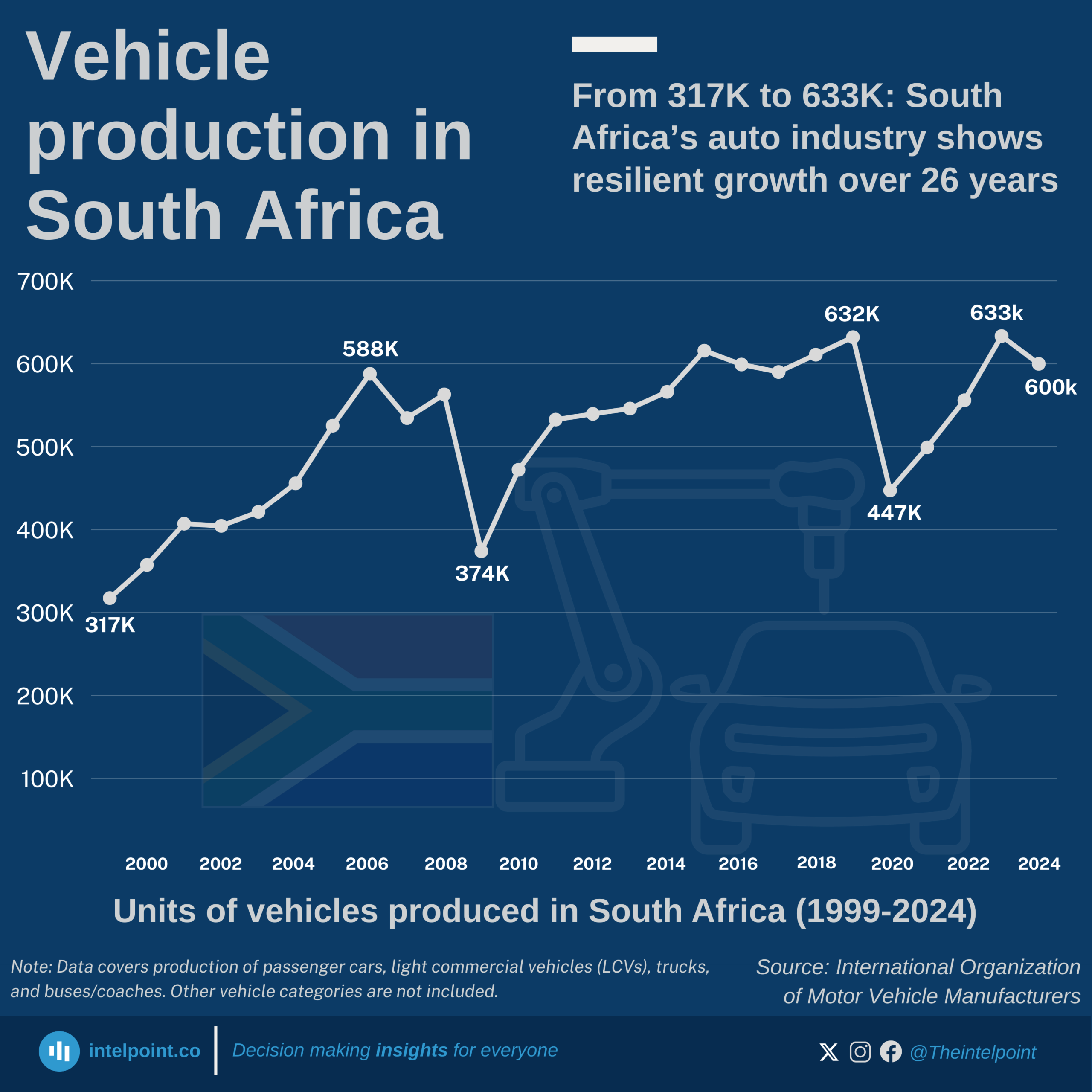
From 317K to 633K: South Africa’s auto industry shows resilient growth over 26 years
  • South Africa has doubled from 317,000 units in 1999 to approximately 600,000 units in 2024.
  •  Major peaks were recorded in 2006 (588K), 2016 (616K), and 2018 (632K), while noticeable declines occurred in 2009 (374K) and 2020 (447K), reflecting global economic shocks.
  • South Africa remains one of the leading vehicle producers in Africa, manufacturing a wide mix of passenger cars, light commercial vehicles (LCVs), trucks, and buses/coaches.
  • The industry plays a critical role in exports, employment, and industrial development, making South Africa an automotive hub on the continent.

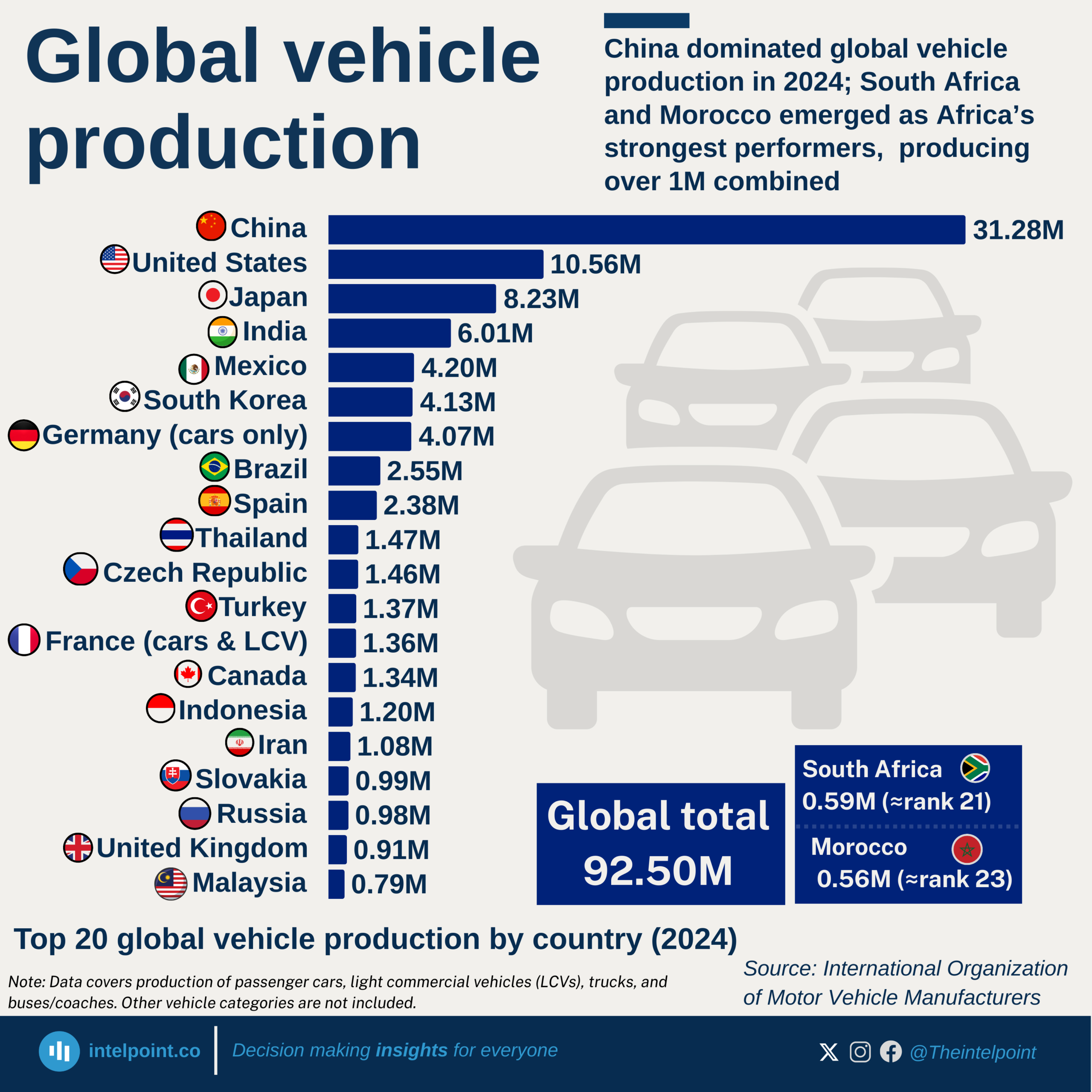
China dominated global vehicle production in 2024; South Africa and Morocco emerged as Africa’s strongest performers, producing over 1M combined
  • China built 31.3M vehicles in 2024, more than the U.S. and Japan combined, and over one-third of global output.
  • The U.S. and Japan are still major players, but each produced less than half of China’s volume.
  • India, rising with 6.0M vehicles, is cementing its place as a global automotive powerhouse.
  • Europe’s strength: Germany leads with 4.1M units, supported by Spain, France, and the Czech Republic.
  • Brazil, Thailand, and Turkey demonstrate strong regional growth.
Africa’s contribution:
  • South Africa (21st, 0.59M units) is the continent’s top producer.
  • Morocco (23rd, 0.56M units) follows closely. Combined, they reflect Africa’s small but developing presence in the global auto industry.

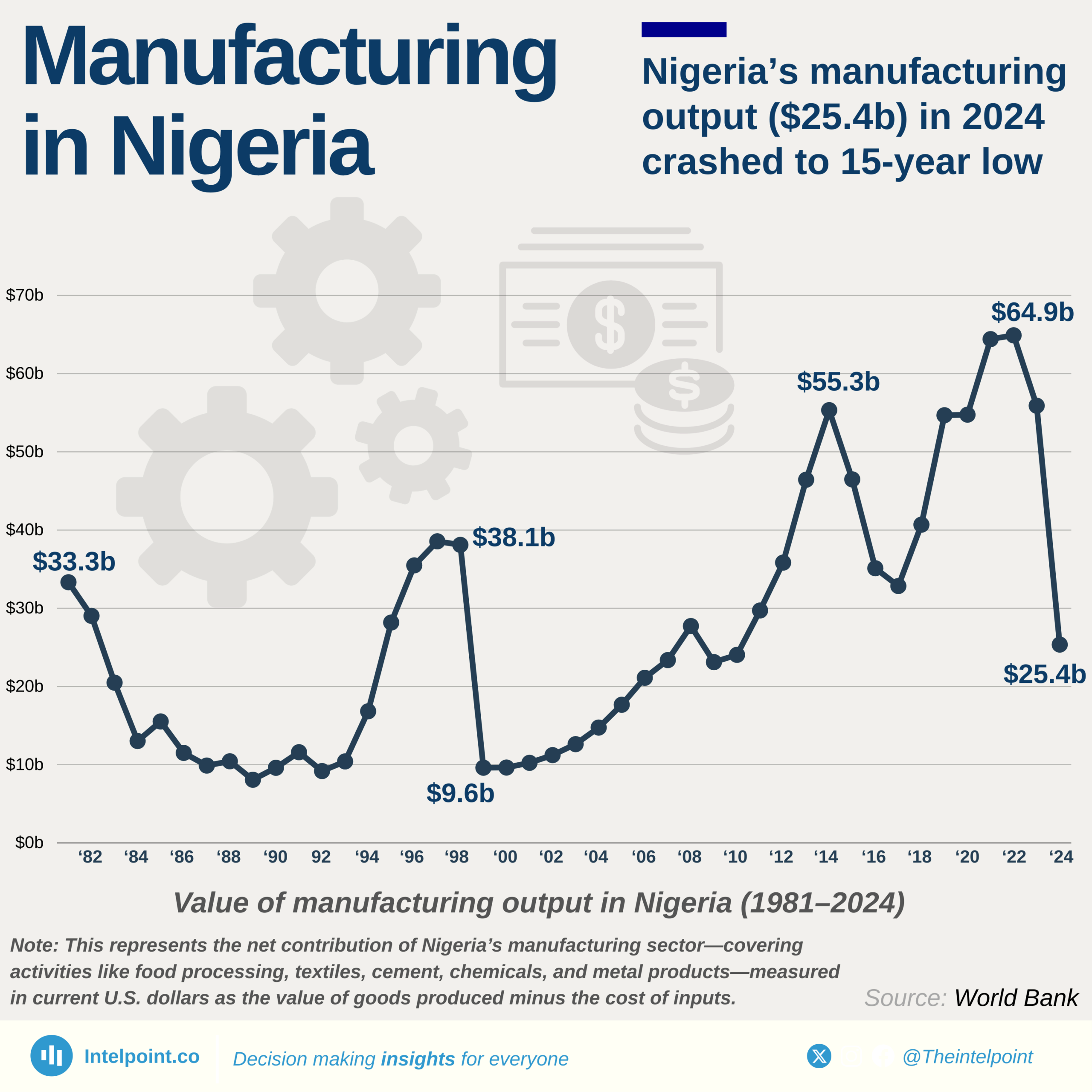
Nigeria’s manufacturing output ($25.4b) in 2024 crashed to 15-year low
  • Manufacturing hit a record $64.90b in 2022, after steady growth from 2016.
  • Output fell 55% to $25.36b in 2024, the worst one-year drop since 1999.
  • Military-era lows: Slumped from $33.33b (1981) to $8.08b (1989).
  • Democratic rebounds: Output grew from $9.62b (1999) to $55.33b (2014), and from $35.12b (2016) to $64.90b (2022).

VinFast’s EV deliveries leapt by nearly 300%, contrasting with declines from Tesla and Rivian
  • Tesla led global EV deliveries in Q1 2025 with 336,681 vehicles, maintaining its top position despite a year-over-year decline.
  • Tesla and Rivian reported significant drops in deliveries —12.92% and 38.46% respectively, while other EV manufacturers saw increases.
  • Tesla's decline has been partially attributed to public backlash against CEO Elon Musk’s controversial political involvement.
  • Rivian's drop was linked to reduced demand, particularly in its core Los Angeles market, which was affected by recent wildfires.
  • VinFast saw a 300% surge in deliveries, growing from 9,689 to 36,330 vehicles, driven largely by strong performance in Vietnam.
  • Tesla, Rivian, and Lucid are U.S.-based EV manufacturers; NIO is Chinese, VinFast is Vietnamese, and Polestar is Swedish.

POPULAR TOPICS
SIGN UP TO OUR NEWSLETTER
Get periodic updates about the African startup space, access to our reports, among others.
Subscribe Here
Subscription Form

A product of Techpoint Africa. All rights reserved