Bite-sized Insights about
 
Providing you with data-based insights about things happening around you.
Popular Insights
  • In Q2 2024, Nigeria’s Company Income Tax (CIT) collections reached ₦2.47 trillion, a record-high figure that could cover about 9% of the nation’s ₦28.78 trillion budget.

    The surge may be due to improved corporate profitability, better tax compliance, and stricter enforcement. The higher exchange rate probably played a role too.

    See more
    Africa's producers of natural rubber in 2022
    Côte d'Ivoire has maintained its title of Africa's largest producer of natural rubber, increasing production by an average of 13% annually. Nigeria was Africa's largest producer of natural rubber in the early 90s until Côte d'Ivoire took the top spot in 1999. As of 2022, its production capacity was 8.6x more than Nigeria's. In 2022, Côte d'Ivoire produced 1.286 million tonnes of natural rubber; Nigeria and Ghana followed with 149.4 thousand tonnes and 117 thousand tonnes, respectively.
    See more
  • The 2024 Global Peace Index reveals a decline in peacefulness in 97 countries, the highest since the index began.

    Nigeria is among the nations affected by regional conflicts and rising violence. With a peace index score of 2.91, Nigeria is facing increasing challenges.

    A deteriorating peace score impacts foreign investment and economic stability. Global economic losses due to violence reached $19.1 trillion in 2023.

    See more

    The FAAC's revenue distribution from 2017 to August 2023 highlights the dominance of Delta, Akwa Ibom, Rivers, and Bayelsa states in allocations. Despite Lagos' economic prominence, it ranked fifth. Here is the distribution of revenue among states between 2017 and August 2023.

    See more
  • A Trend of Adult literacy rates of African countries

    Between 2018 and 2021, adult literacy rates across African nations exhibited significant disparities. Seychelles and South Africa led with literacy rates of 96% and 95%, respectively, indicating a high proportion of literate adults. Conversely, Chad had the lowest literacy rate during this period.

    These statistics underscore the uneven progress in educational attainment across Africa, highlighting the need for targeted interventions to improve literacy in lower-performing nations.

    See more
    Countries by Global Innovation Index 2024

    The Global Innovation Index 2024 reveals a striking contrast in innovation performance between countries globally and across Africa. Switzerland leads the global rankings with an impressive score of 67.5, followed by Sweden (64.5) and the USA (62.4), highlighting their sustained investments in research, development, and technological advancement.

    In Africa, Mauritius takes the top spot with a score of 30.5, followed closely by Morocco (28.8) and South Africa (28.3). However, even Africa's most innovative nations achieve less than half the score of global leaders, indicating a significant innovation gap.

    Nigeria ranks 15th in the African ranking and 113th globally, out of 133 countries, with a score of 17.1.

    See more

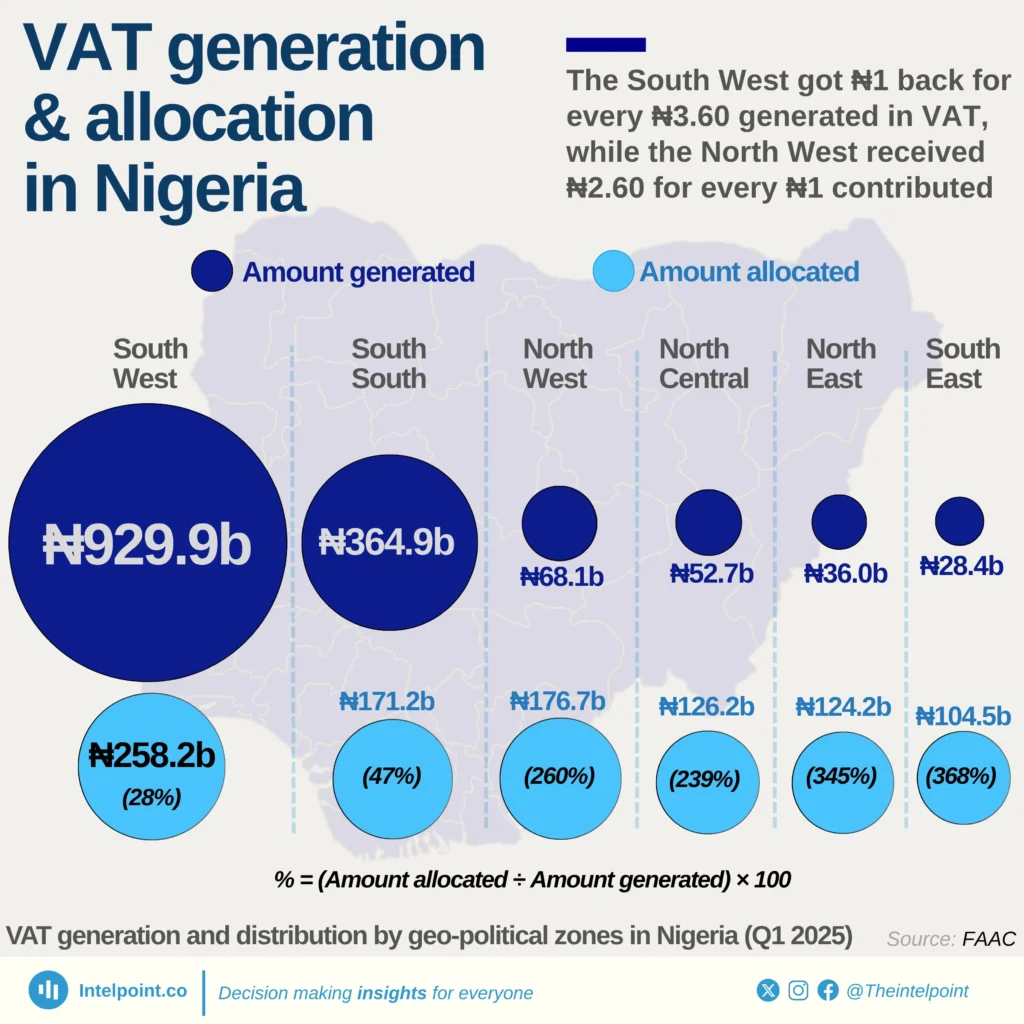
  • Nigeria's Federal Account Allocation Committee shared ₦1.85 trillion among 36 states between January and June 2023. Here is the revenue allocation by geopolitical zone in H1 2023.
    See more
  • MTN Nigeria has dominated the country's telecommunications market over the years, accounting for the largest market share. All four operators, apart from 9mobile, recorded a significant increase in their subscriber base between May 2014 and March 2024.

    See more
  • The 2024 Global Peace Index reveals a decline in peacefulness in 97 countries, the highest since the index began.

    Nigeria is among the nations affected by regional conflicts and rising violence. With a peace index score of 2.91, Nigeria is facing increasing challenges.

    A deteriorating peace score impacts foreign investment and economic stability. Global economic losses due to violence reached $19.1 trillion in 2023.
    See more

Other Insights

Key takeaways:

  • China leads all nations with total reserves of $3.46 trillion while holding 5.53% of its share in gold reserves.
  • The top 15 countries collectively hold a total reserve of $10.78 trillion.
  • Despite being the global leader in gold reserves, the United States ranks third in total reserves.
  • The largest share of the United States' total reserves is from its gold reserve holdings of 74.97%.
  • Countries in the top fifteen list hold at least $236.9 billion each in total reserves.
  • The United States, France, and Italy have more than 70% of their total reserve holdings in gold.
See more

Key Takeaways:

  • Ghana led the continent in gold production in 2023, producing 135.11 tonnes, 13.5% of Africa’s total.
  • Four countries (Ghana, Mali, South Africa, and Burkina Faso) each produced over 95 tonnes, together accounting for 443 tonnes or 44.1% of the continent’s output.
  • West African countries dominated the rankings, with eight nations from the region among the top 15 producers.
  • The West African countries in the top 15 combined contributed 525.55 tonnes, more than half (52.3%) of Africa's total gold production.
  • South Africa ranked third in Africa with 104.29 tonnes.
  • Burkina Faso ranked fourth while contributing almost 10% of Africa’s gold production.
See more

Key Takeaways:

  • In 2023, Africa was the world’s leading gold-producing region, with a total output of 1,003.98 tonnes.
  • Asia followed with 661.30 tonnes, representing 18.1% of the world’s gold output.
  • The Commonwealth of Independent States (CIS) produced 570.90 tonnes, making up 15.7% of the global total.
  • North America and Central & South America contributed 485.17 tonnes and 542.13 tonnes, respectively.
  • Oceania was a key producer with 343.29 tonnes, or 9.4% of global output.
  • Europe contributed the least, producing only 39.30 tonnes, which is about 1.1% of the total.
  • Altogether, global gold production reached 3,646.07 tonnes in 2023.
See more
Tunisia’s official exchange rate (Tunisian dinar per US$), 2016 - 2024
  • The Tunisian dinar stood at TND 2.15 per US$ in 2016 and has since depreciated to TND 3.11 per US$ in 2024.
  • Between 2016 and 2019, the dinar saw a strong depreciation.
  • 2020 marked a turning point with a 4.16% appreciation, the first notable currency strengthening in the period observed.
  • From 2022 onward, the exchange rate has stabilised closely around TND 3.10 to TND 3.11 per US$, with minimal yearly changes of 0.08% and 0.04%.
  • The largest year-on-year depreciation occurred in 2017 with a 12.63% change.
  • Despite the earlier years of high volatility, Tunisia’s currency performance in the last three years suggests better monetary management and external stability.
See more
Countries with the worst African Infrastructure Development Index (AIDI), 2024
  • Somalia has the lowest AIDI score in Africa at 7.10, reflecting extremely poor infrastructure across all sectors.
  • South Sudan (7.38) and Niger (8.12) rank slightly higher, showing similarly weak infrastructure profiles.
  • Ethiopia (13.09) and the Central African Republic (13.23), though more advanced than others on the list, still score under 15.
  • Nigeria's AIDI score of 25.70, while not high by global standards, is more than three times higher than Somalia’s, indicating major disparities in infrastructure across the continent.
See more
  • An average of ~38,000 RSA accounts use the 25% withdrawal option each year.
  • Total amounts tapped rose from ₦19.1B (2019) to ₦35.5B (2023) as balances grew.
  • Total amount withdrawn from 2017 through Q3 2024 was ₦198.3B.
  • Despite rising amounts, the count of withdrawals fell from ~57,000 in 2017–18 to ~38,000 since 2019.
  • Amount withdrawn jumped by 32% in 2023.
See more
  • Global cotton production grew by over 160%, from about 9.5 million tonnes in 1961 to 24.8 million tonnes in 2022.
  • China’s Reign: 41 years at number one. Biggest output: 7.62M tonnes in 2007.
  • USA’s Era: 13 years at the top. Peak production: 5.20M tonnes in 2005.
  • USSR’s Legacy: 5 years crowned. Best year: 2.89M tonnes in 1981.
  • India’s Late Charge: Only 3 years at number one, but a huge 6.13M tonnes in 2020.
  • Shift to Asia: In the early decades, USA dominated; now, it’s mostly China and India running the game.
See more
  • Egypt dominated African cotton production for decades, from the 1960s to the early 2000s, standing far ahead of other African countries in both volume and quality.
  • The early 2000s marked a major turning point, as West African countries — especially Burkina Faso and Mali — began to overtake Egypt in total production.
  • Burkina Faso emerged as the new cotton leader between 2005 and 2015, topping production in key years like 2005, 2006, 2008, 2009, and 2012–2015, and later reclaiming the top spot in 2020 and 2022.
  • Mali built its cotton strength after 2015, becoming Africa’s number one producer multiple times, peaking at over 334,000 tonnes in 2019.
  • Benin and Côte d’Ivoire quietly closed the gap throughout the 2010s, consistently ranking in the top three, even though they didn’t dominate the number one spot.
See more
Top 10 countries by African Infrastructure Development Index (AIDI), 2024
  • Seychelles leads Africa with a near-perfect AIDI score of 99.77.
  • Egypt and Libya follow with strong performances of 91.43 and 85.84, respectively.
  • Tunisia ranks 6th with a score of 74.18, showing consistent infrastructure growth.
  • Morocco and Algeria, despite being major economies, scored below 75.
  • Botswana rounds out the top 10 with a score of 42.13, nearly double Nigeria’s score.
  • Nigeria, despite its economic size, scored just 25.70, far below the continental leaders, highlighting major infrastructure gaps.
See more
Seychelles score - African Infrastructure Development Index (AIDI), 2003 - 2024
  • Seychelles' AIDI score more than doubled between 2003 (47.43) and 2024 (99.77).
  • The score crossed the 70-point mark in 2009 and jumped past 90 in 2013.
  • Between 2012 and 2024, the country maintained an AIDI score above 89, showing long-term infrastructure strength.
  • From 2003 to 2008, the score rose steadily each year, averaging more than 2 points annually.
  • The last five years (2020–2024) showed minimal fluctuation, with scores above 98 every year.
  • This performance positioned Seychelles as Africa’s most infrastructure-ready nation in 2024.
See more
Nigeria's score - African Infrastructure Development Index (AIDI), 2003 - 2024
  • Goodluck Jonathan's era (2010–2015) delivered the highest AIDI growth, with a CAGR of 6.84%, more than double that of his successor.
  • Muhammadu Buhari’s administration saw steady but slower growth, with a CAGR of 2.63%, increasing the score from 20.60 in 2016 to 25.70 in 2024.
  • Musa Yar’Adua’s brief tenure (2007–2010) still managed a solid CAGR of 4.26%, indicating promising momentum that was cut short.
  • Nigeria's AIDI score rose from 8.61 in 2003 to 25.70 in 2024, nearly tripling in two decades.
  • Obasanjo’s tenure saw the slowest growth, with only a 2.59% CAGR, suggesting limited infrastructure expansion in the early 2000s.
  • The fastest absolute annual increase occurred between 2010 and 2014, when scores jumped by over 2 points per year.
  • Despite steady growth, Nigeria's 2024 score of 25.70 still places it far from top performers in Africa, showing that significant infrastructure gaps remain.
See more
Average monthly cellular mobile data consumption per smartphone worldwide, 2024
  • Sub-Saharan Africa has the lowest mobile data usage globally, at 6.7 GB/month, which is less than one-third of the global average.
  • India, Nepal, and Bhutan top the global chart with the highest data consumption at 36 GB/month, signalling deep mobile integration in daily life.
  • Gulf Cooperation Council countries follow closely with 31.9 GB/month.
  • Western Europe and North America share the same high usage rate of 25.8 GB/month, indicating mature digital economies with consistent connectivity.
  • Latin America also lags, though still more than twice ahead of Sub-Saharan Africa at 15.2 GB/month.
  • The Middle East and North Africa surpass the global average too, at 22.7 GB/month, further highlighting the unique lag of Sub-Saharan Africa in mobile data use.
See more
1 55 56 57 58 59 126
  • Lagos receives the highest average monthly grid supply at 1,051 MW, accounting for 26% of national distribution.
  • The South West (excluding Lagos) comes second with 569 MW.
  • Abuja alone receives 435 MW, higher than the North Central zone at 396 MW.
  • The North East receives the least electricity from the grid, with only 199 MW monthly on average.
  • The combined total for Lagos and the rest of the South West is 1,620 MW, roughly 40% of national grid supply.
Read more
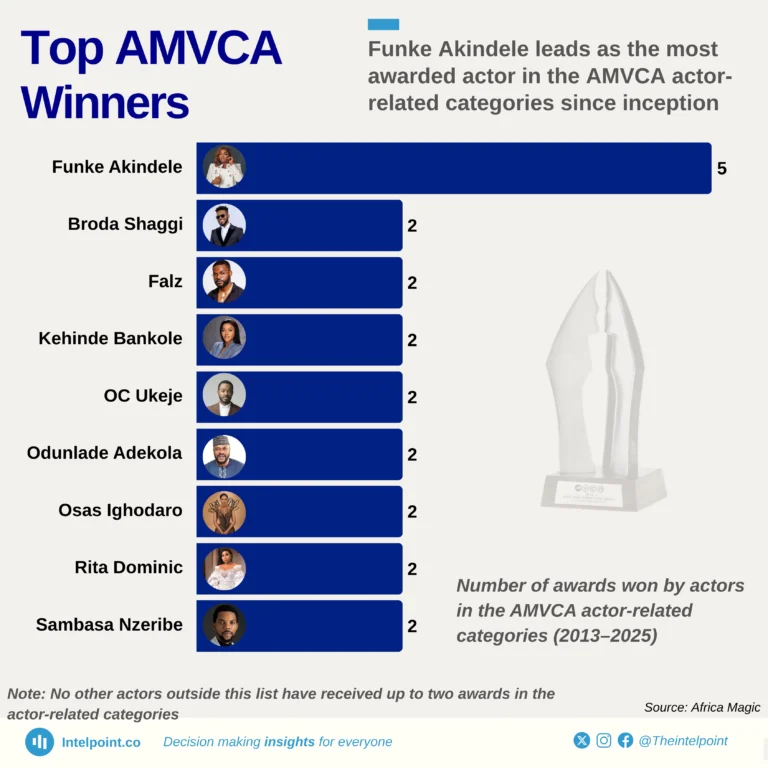
  • Between 2013 and 2025, Nigeria has dominated the Africa Magic Viewers’ Choice Awards (AMVCA), winning 8 out of 11 awards for Best Overall Movie.
  • Kenya, South Africa, and Ghana have each won the top prize once, highlighting Nigeria’s influence on African cinema.
  • This trend reflects both the scale and consistency of Nigeria’s film industry, Nollywood, which has outpaced its regional peers in terms of production volume, distribution, and local audience engagement.
  • While other countries show occasional excellence, Nigeria remains the cultural and commercial centre of African filmmaking.
Read more
  • Union Bank began as Colonial Bank, later Barclays Bank DCO, before indigenisation in 1979.
  • Nigerian investors took majority control, renaming it Union Bank of Nigeria.
  • The 2009 banking crisis weakened the bank; AMCON stabilised it, while Union Global Partners Ltd injected $500m for 65% control.
  • Titan Trust Bank acquired up to 100% ownership, and Union Bank was delisted from the Nigerian Exchange.
  • A court-approved scheme merged Titan Trust into Union Bank; Union Bank survived, retaining its century-old name and legacy under Titan’s ownership.
Read more
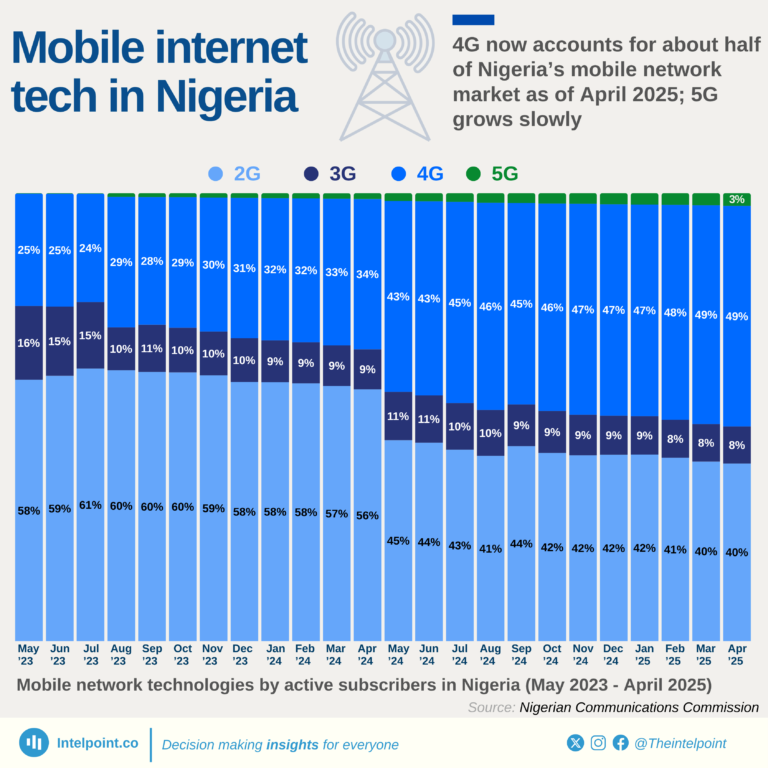
  • Fibre cuts were responsible for 51.7% of mobile network disruptions between April and July 2025.
  • Power outages followed at 28.1%, making infrastructure issues the dominant cause overall.
  • Together, fibre cuts and power outages accounted for nearly 80% of service disruptions.
  • The “Others” category, which includes congestion, equipment theft, and natural disasters, accounted for 13.9% of disruptions.
  • Infrastructure and environmental factors remain the leading threats to mobile network reliability.
Read more
  • From 1970 through the early 2000s, Egypt’s debt interest payments hovered mostly under $1.5 billion, with fluctuations tied to global oil shocks and debt rescheduling.
  • Payments remained relatively moderate, ranging between $0.7–$1.0 billion annually.
  • Following Egypt’s 2016 IMF programme and rising external borrowing, payments jumped dramatically, climbing from $1.53 billion in 2016 to $6.13 billion in 2022.
  • Interest payments hit an all-time high of $9.47 billion in 2023, underscoring the heavy burden of Egypt’s rapid debt accumulation and exposure to global financing costs.
Read more
1 55 56 57 58 59 252

Can’t find what you’re looking for? Please fill the form below
Contact Form Demo
SIGN UP TO OUR NEWSLETTER
Get periodic updates about the African startup space, access to our reports, among others.
Subscribe Here
Subscription Form

A product of Techpoint Africa. All rights reserved