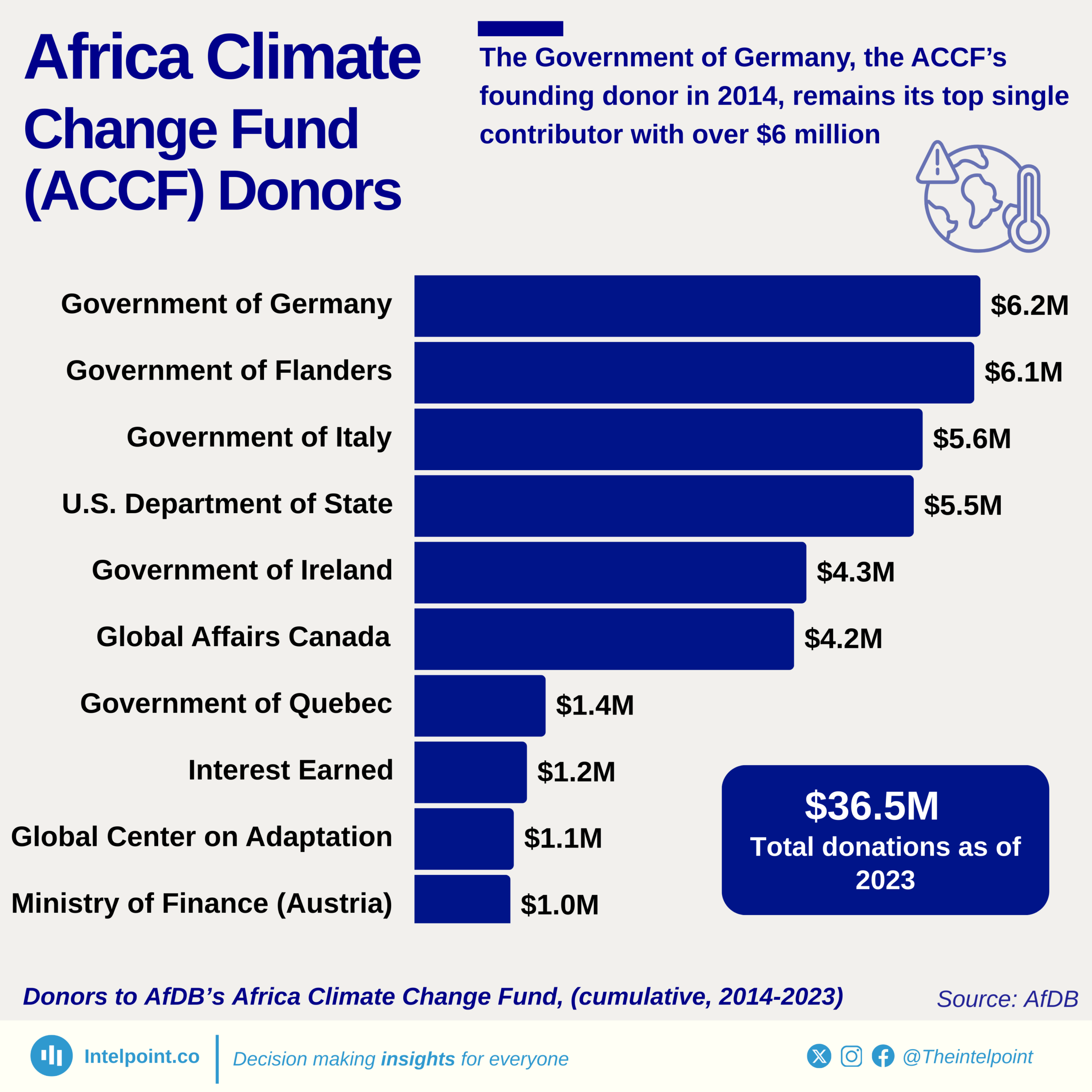
The Government of Germany, the ACCF’s founding donor in 2014, remains its top single contributor with over $6 million

Key Takeaways

  • The Government of Germany is the largest donor to AfDB’s Africa Climate Change Fund (ACCF), contributing $6.19 million in a single donation in April 2014.
  • The Government of Flanders (Belgium) follows closely with a total contribution of $6.12 million, made in two installments (2016 and 2019).
  • In 2023, the U.S. Department of State joined as a new donor with a contribution of $5.43 million.
  • The current value of the ACCF stands at $36.5 million.
  • To date, the ACCF has supported seven completed projects, 20 under implementation and one cancelled project (originally planned for Sudan).
  • Some completed projects include climate finance readiness initiatives in Eswatini and Côte d’Ivoire, while ongoing efforts feature "Capacity Building for Women Climate Change Negotiators in Eastern and Southern Africa" in Uganda ($950,000) and "Development of long-term low-carbon and climate-resilient development strategies (LTSs)" for Gabon, Liberia, Botswana, and Lesotho ($500,000).
  • The project in Sudan was cancelled due to the conflict in the country.

Launched in 2014, the Africa Climate Change Fund has grown into a $36.5 million pool of hope, fuelled by donors who believe in Africa’s climate future. Managed by the African Development Bank, the fund started as a bilateral partnership with Germany and later expanded into a multi-donor platform, drawing backing from the U.S. Department of State and the Government of Flanders, among others. Germany, leading since inception, gave the fund its biggest single boost: $6.19 million.

Although the U.S. became a contributor, its climate funding has faced setbacks, particularly during the Trump administration, when major foreign aid cuts and a withdrawal from key climate finance pledges strained the flow of support to African initiatives like this.

So far, over $2.6 million worth of projects have been completed, with others worth $13.2 million in progress. Among them are two multinational efforts: Empowering Women and Youth for Entrepreneurship and Job Creation in Climate Adaptation, and Support to the African Financial Alliance on Climate Change. Each effort is backed with $1 million.
Source:

AfDB

Period:

2014-2023
HTML code to embed chart
Want a bespoke report?
Reach out
Tags
Related Insights

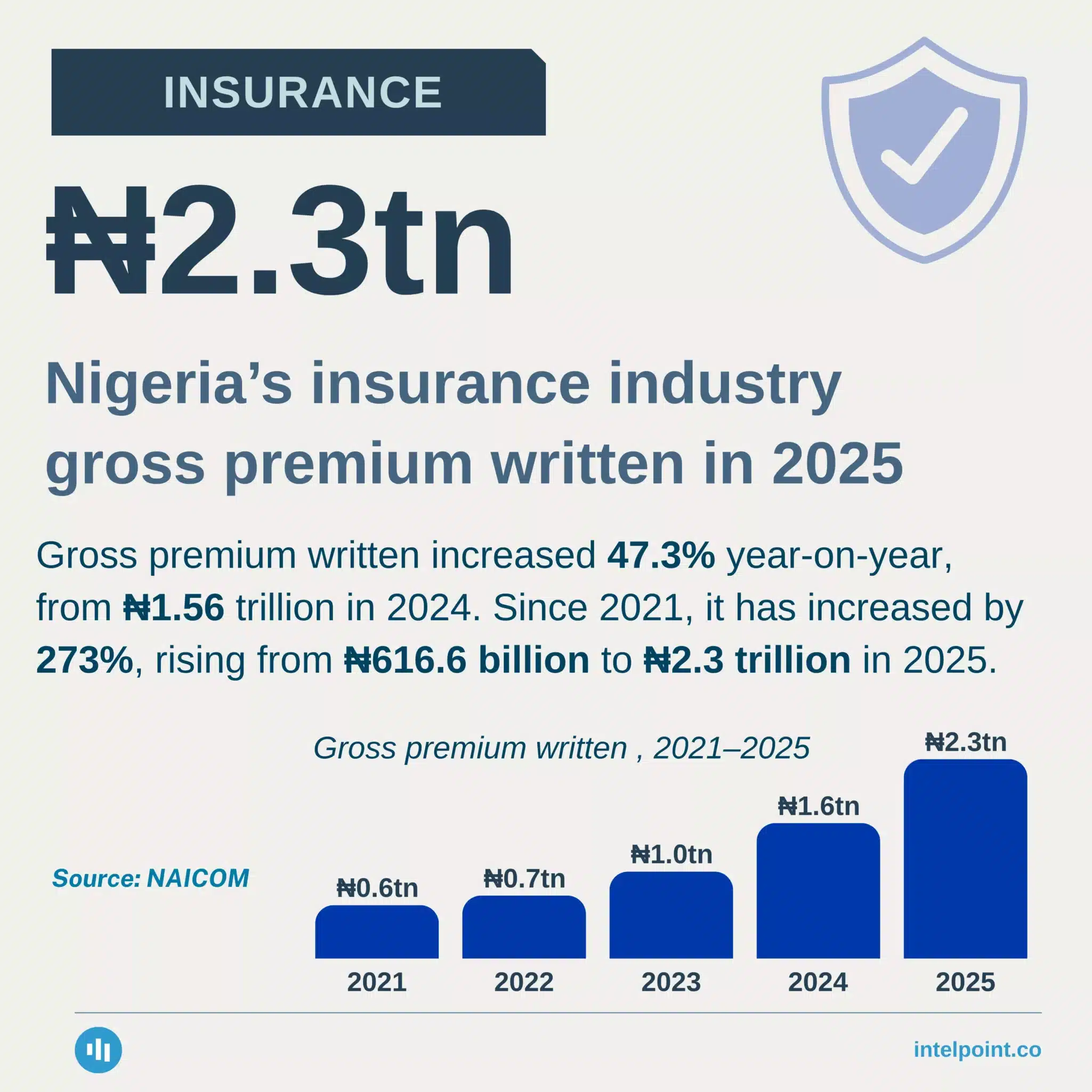
Nigeria’s insurance industry gross premium written in 2025
  • Nigeria's insurance industry generated ₦2.3 trillion in gross premium written in 2025.
  • Gross premium written increased 47.3% from ₦1.56 trillion in 2024.
  • Premiums have grown by 273% since 2021, from ₦616.6 billion.
  • Gross premium written has increased every year since 2021.
  • Premium growth does not necessarily mean higher insurance coverage or profitability.

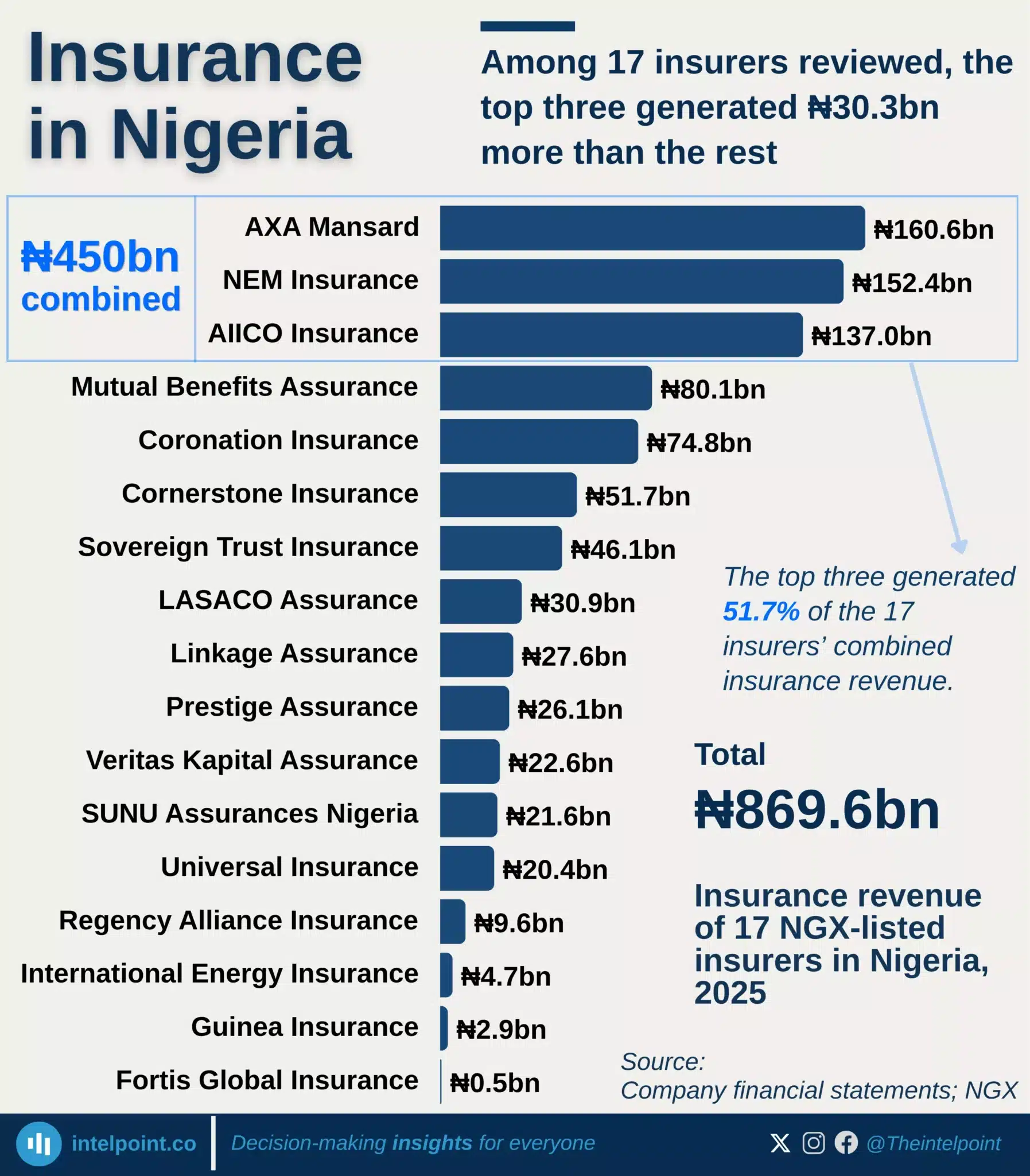
Among 17 insurers reviewed, the top three generated ₦30.3bn more than the rest
  • AXA Mansard, NEM Insurance and AIICO generated 51.7% of the combined revenue of 17 NGX-listed insurers.
  • The top three earned ₦449.9 billion, ₦30.3 billion more than the other 14 insurers combined.
  • The 17 insurers generated a combined ₦869.6 billion in insurance revenue in 2025.
  • AXA Mansard recorded the highest insurance revenue at ₦160.6 billion.
  • Revenue rose at 15 insurers, but only four reported higher profits.

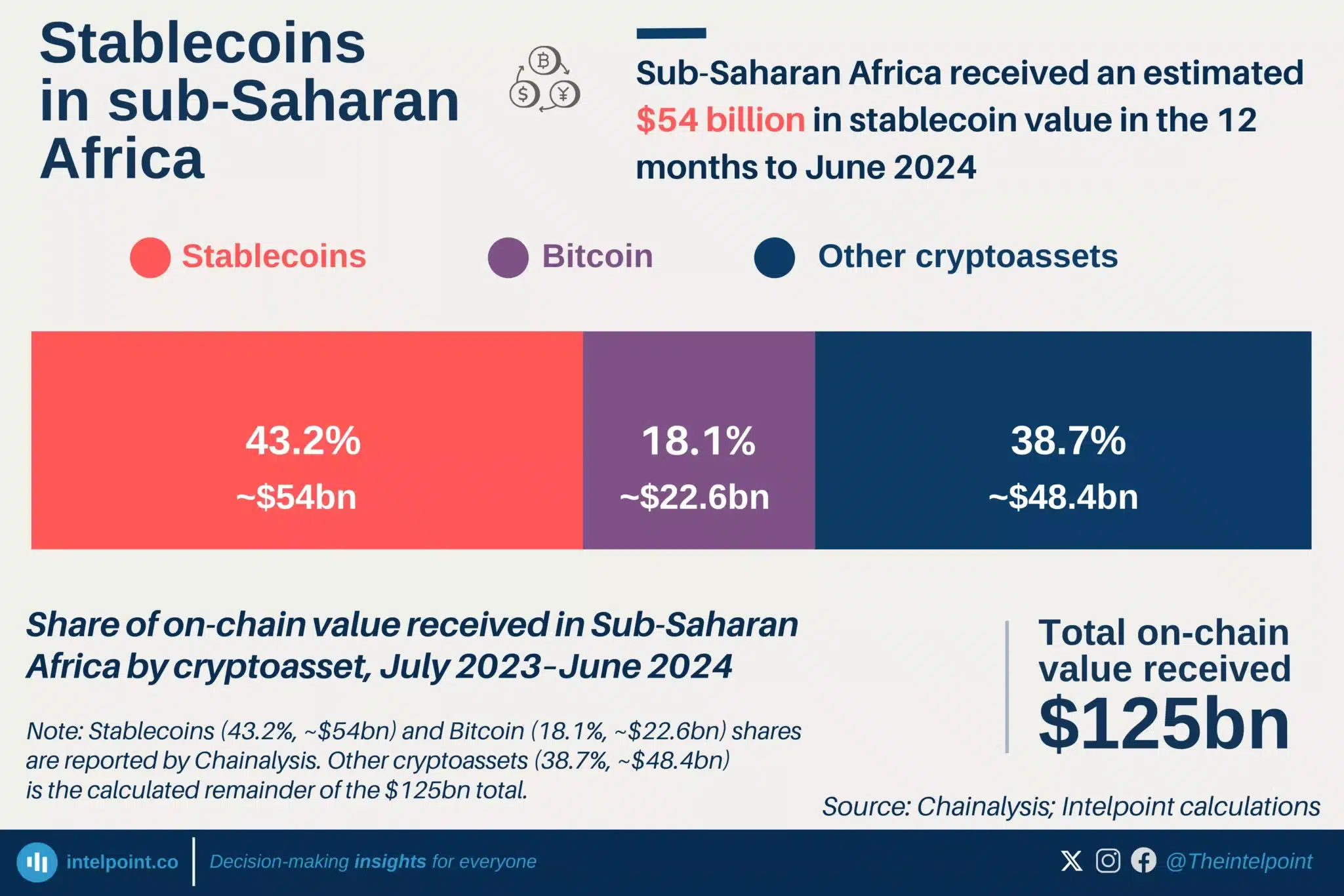
Sub-Saharan Africa received an estimated $54 billion in stablecoin value in the 12 months to June 2024
  • Total received: $125 billion in on-chain value.
  • Stablecoin value: $54 billion, representing 43.2%.
  • Bitcoin comparison: Stablecoins received more than twice Bitcoin’s value.
  • Key driver: Currency depreciation and limited dollar access.

GTCO turned ₦40 of every ₦100 earned into profit
  • GTCO had the strongest profit conversion in 2025.
  • GTCO turned about ₦40 of every ₦100 earned into profit.
  • Stanbic IBTC followed with about ₦34 profit per ₦100 earned.
  • Zenith made the highest profit, but not the strongest conversion.
  • First HoldCo had the weakest profit conversion among the banks reviewed.
 

Kenyan banks’ non-performing loan ratios fell, with KCB’s ratio down 2.9 points
  • All eight selected Kenyan banks reduced their NPL ratios in 2025.
  • KCB recorded the largest improvement, with a 2.9% point drop.
  • KCB still had the highest NPL ratio in the group at 16.9%.
  • Co-operative Bank remained highly stressed at 15.7%, despite some improvement.
  • Equity Bank and Absa Bank Kenya both ended 2025 at 11.5%.
  • Standard Chartered Kenya had the lowest NPL ratio in the group at 5.5%.

Nigeria's insurance sector crossed ₦1.98tn in H1 2025 as every segment grew by at least 25%
  • Life Business was the single largest segment, and its 70.3% jump signals that more Nigerians are thinking seriously about financial protection for their families.
  • Miscellaneous, the smallest segment, posted the biggest growth at 86.7%, suggesting new and unconventional insurance products are gaining serious traction.
  • Aviation & Marine nearly doubled, with 79.9% growth in a sector tied to trade and logistics, reflecting Nigeria's expanding import/export activity and the rising cost of cargo and aircraft risk coverage.
  • Motor (52.5%), Fire (53.3%), and General Accident (49.6%) grew by roughly half, indicating broad-based sector expansion rather than isolated pockets of growth.

POPULAR TOPICS
SIGN UP TO OUR NEWSLETTER
Get periodic updates about the African startup space, access to our reports, among others.
Subscribe Here
Subscription Form

A product of Techpoint Africa. All rights reserved