Bite-sized Insights about
 
Providing you with data-based insights about things happening around you.
Popular Insights
  • Jumia Group has recorded $1b in losses since listing on the New York Stock Exchange in 2019. The eCommerce giant also recorded its highest yearly loss in 2019. In recent years, Jumia Group has shut down some of its businesses across Africa, thus recording its lowest loss over seven years in 2023.

    See more
    • Manufacturing records the highest monthly revenue at ₦8.27m, nearly double that of the next sector.
    • Healthcare (₦5.02m) and Transportation (₦3.70m) follow, reflecting essential service demand.
    • Industries like Marketing & Advertising (₦191k), Food & Beverages (₦320k), and Education (₦440k) earn significantly less on average.
    • The difference between top earners (Manufacturing, Healthcare) and bottom sectors highlights a stark inequality in industry.
    See more
  • The 2024 Global Peace Index reveals a decline in peacefulness in 97 countries, the highest since the index began.

    Nigeria is among the nations affected by regional conflicts and rising violence. With a peace index score of 2.91, Nigeria is facing increasing challenges.

    A deteriorating peace score impacts foreign investment and economic stability. Global economic losses due to violence reached $19.1 trillion in 2023.

    See more

    The FAAC's revenue distribution from 2017 to August 2023 highlights the dominance of Delta, Akwa Ibom, Rivers, and Bayelsa states in allocations. Despite Lagos' economic prominence, it ranked fifth. Here is the distribution of revenue among states between 2017 and August 2023.

    See more
  • A Trend of Adult literacy rates of African countries

    Between 2018 and 2021, adult literacy rates across African nations exhibited significant disparities. Seychelles and South Africa led with literacy rates of 96% and 95%, respectively, indicating a high proportion of literate adults. Conversely, Chad had the lowest literacy rate during this period.

    These statistics underscore the uneven progress in educational attainment across Africa, highlighting the need for targeted interventions to improve literacy in lower-performing nations.

    See more

    Nigeria was the seventh most populous nation in the world in 2020, with 206.1 million people. Projected to reach a population of 401.3 million by 2050, Nigeria will rank third after India (1st) and China (2nd). According to Institut national d'études démographiques' projections, Nigeria, Ethiopia, DR Congo, Egypt, Tanzania, and Kenya will be among the world’s top 20 most populous countries by 2050.

    See more

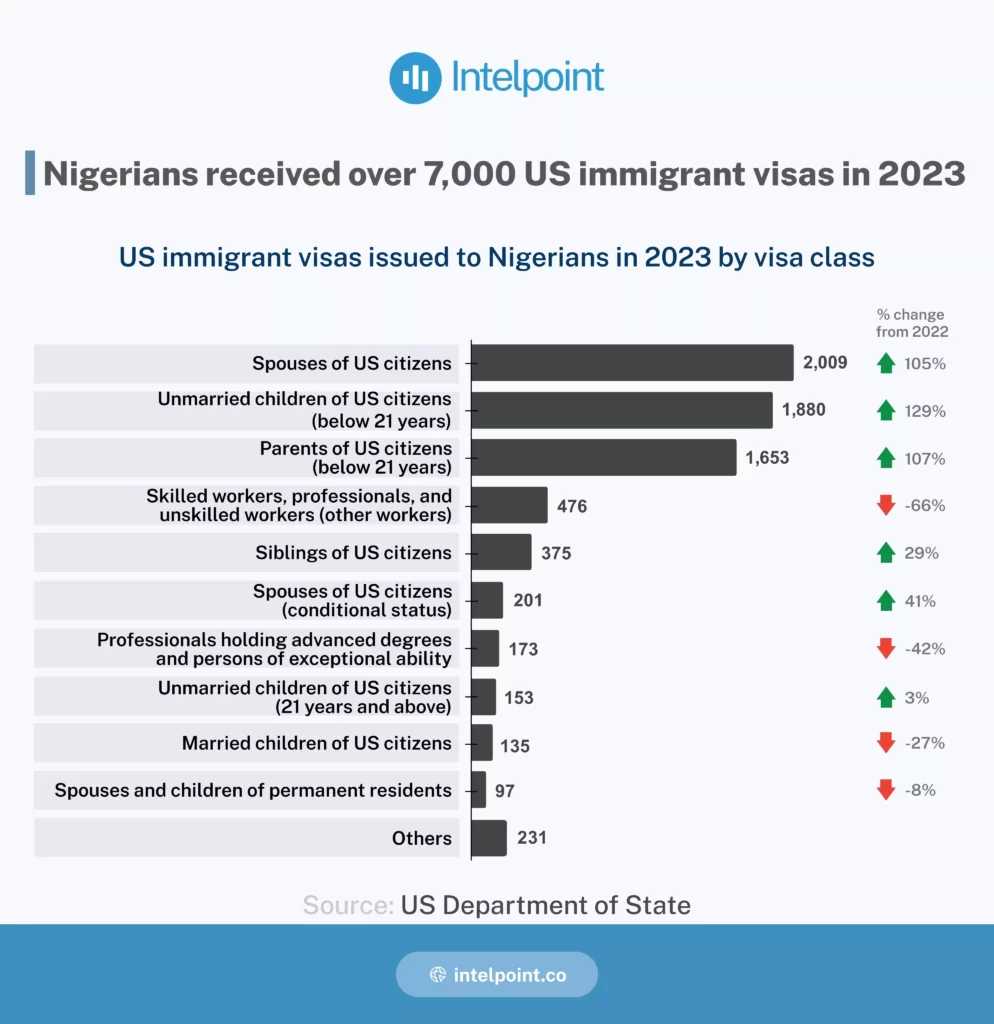
  • In 2023, 7,383 people from Nigeria were issued US immigrant visas, 33% higher than 5,547 in 2022. Visas issued to skilled workers, professionals, and unskilled workers declined by 66%. Here are the US immigrant visas issued to Nigerians in 2023 by visa class.

    See more
  • MTN Nigeria has dominated the country's telecommunications market over the years, accounting for the largest market share. All four operators, apart from 9mobile, recorded a significant increase in their subscriber base between May 2014 and March 2024.

    See more
  • The 2024 Global Peace Index reveals a decline in peacefulness in 97 countries, the highest since the index began.

    Nigeria is among the nations affected by regional conflicts and rising violence. With a peace index score of 2.91, Nigeria is facing increasing challenges.

    A deteriorating peace score impacts foreign investment and economic stability. Global economic losses due to violence reached $19.1 trillion in 2023.
    See more

Other Insights
Suspected diphtheria cases reported in Nigeria (2022 - 2025)
  • With 24,062 cases, Kano accounts for the highest number of suspected diphtheria cases, making up a significant portion of the total outbreak in Nigeria.
  • Yobe recorded 5,330 cases, while Katsina had 3,939 cases, reinforcing the concentration of diphtheria in northern states.
  • Bauchi and Borno report similar case counts, with 3,066 and 3,035 cases, respectively.
  • Kaduna (777 cases) and Jigawa (364 cases) report fewer cases but remain part of the seven states contributing to 96.6% of the outbreak.
  • Other states combined report 1,405 cases, showing that diphtheria is largely a regional issue.
  • Northern states dominate the case count, signaling potential regional healthcare and vaccination disparities.
Read more
Nigerian financial institutions’ contribution to GDP (2016–Q1 2024)
  • At 6.40%, financial institutions now contribute more than ever to Nigeria’s GDP.
  • From 3.60% in 2022 to 6.40% in Q1 2024, the sector’s share has nearly doubled in record time.
  • Between 2016 and 2019, the financial sector's contribution remained mostly flat at 2.60%–2.70%, showing little progress.
  • The financial sector started expanding post-2019, aligning with increased fintech adoption, digital banking growth, and financial inclusion policies.
  • The increasing role of financial institutions suggests more businesses and individuals are engaging with formal banking systems.
  • Despite economic uncertainties, Nigeria’s financial sector has successfully adapted and expanded, proving its ability to drive growth.
Read more
Number of countries anticipated to either have sufficient or shortage of primary school teachers by region (2030)
  • Sub-Saharan Africa has the highest number of countries (37) expected to face a teacher shortage at the [primary levels.
  • In Latin America & the Caribbean, 18 countries are expected to have enough primary teachers.
  • Europe & Northern America is one of the best-performing after Latin America & the Caribbean, with 17 countries expected to meet primary teachers' demand.
  • If this trend continues, millions of children will struggle to access quality primary education, reinforcing cycles of poverty and limited economic mobility.
  • A lack of teachers doesn’t just mean fewer classrooms; it also means overburdened educators, lower student engagement, and declining educational outcomes.
Read more
Key Takeaways:
  • Nigeria's total revenue decreased from 17.73% of GDP in 2011 to 9.09% in 2022.
  • The lowest point for the country’s revenue occurred in 2016, at only 5.12% of GDP.
  • Although there has been some recovery since 2016, revenue still falls well below the levels seen before 2015.
  • The sharpest decline took place between 2011 and 2016, with revenue dropping by over 12 percentage points.
  • In 2020, during the COVID-19 pandemic, there was a significant drop to 6.52%, followed by a period of recovery.
Read more
Key takeaways:
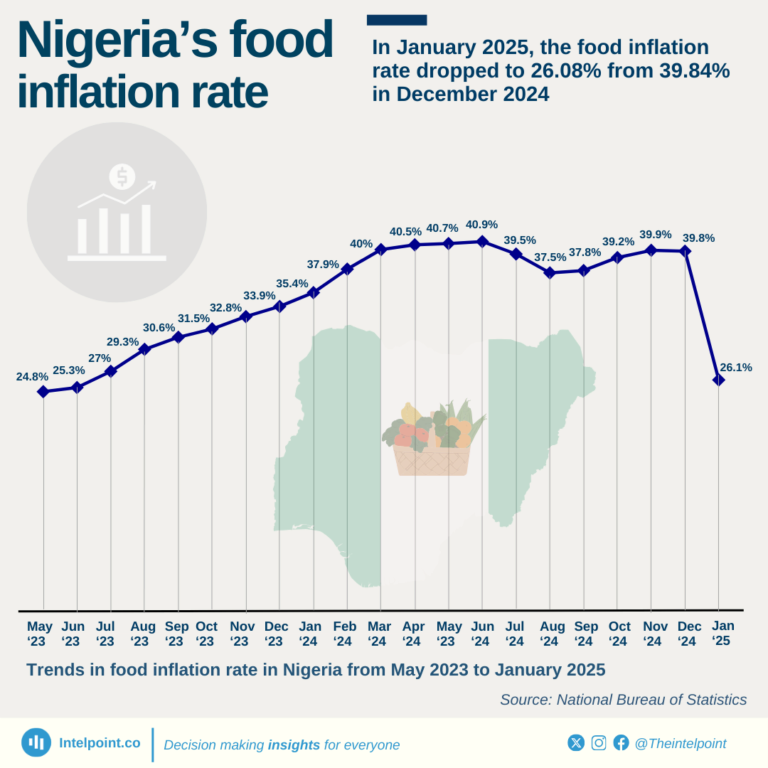
  • Amidst the overall upward rise in inflation since May 2023, Nigeria experienced a brief relief with slight declines between June and September 2024.
  • The inflation rate in May 2024 was 11.54% points higher than that of June 2023.
  • The inflation rate in Nigeria increased by approximately 55% from May 2023 to December 2024.
  • In December 2024, the inflation rate increased by about 4.9% points when compared to January 2024.
  • Between December 2024 and January 2025, the inflation rate dropped by 10.32%.
  • The National Bureau of Statistics rebased the Consumer Price Index from 2009 to 2024 in January 2025.
Read more
Key takeaways:
  • Polaris Bank traces its roots back to the establishment of Prudent Bank Plc in 1989.
  • Prudent Merchant Bank Limited merged with Bond Bank Limited, EIB International Bank Plc, Reliance Bank Limited, and Co-operative Bank Plc to create Skye Bank Plc.
  • In 2014, Skye Bank Plc acquired Mainstreet Bank Limited.
  • The Central Bank of Nigeria revoked Skye Bank's operating license in 2018, and Polaris Bank Limited subsequently took over its assets and liabilities.
Read more
1 … 153 154 155 156 157 … 267

Can’t find what you’re looking for? Please fill the form below
Contact Form Demo
SIGN UP TO OUR NEWSLETTER
Get periodic updates about the African startup space, access to our reports, among others.
Subscribe Here
Subscription Form

A product of Techpoint Africa. All rights reserved