Bite-sized Insights about
 
Providing you with data-based insights about things happening around you.
Popular Insights
  • According to UNICEF, Nigeria currently has more than 10 million out-of-school children, most of them in the North. On Tuesday, October 26, 2021, President Muhammadu Buhari said the fear and trauma of abduction are forcing children out of school. Here is the reported number of abducted school children in Nigeria by state since 2014.
    See more

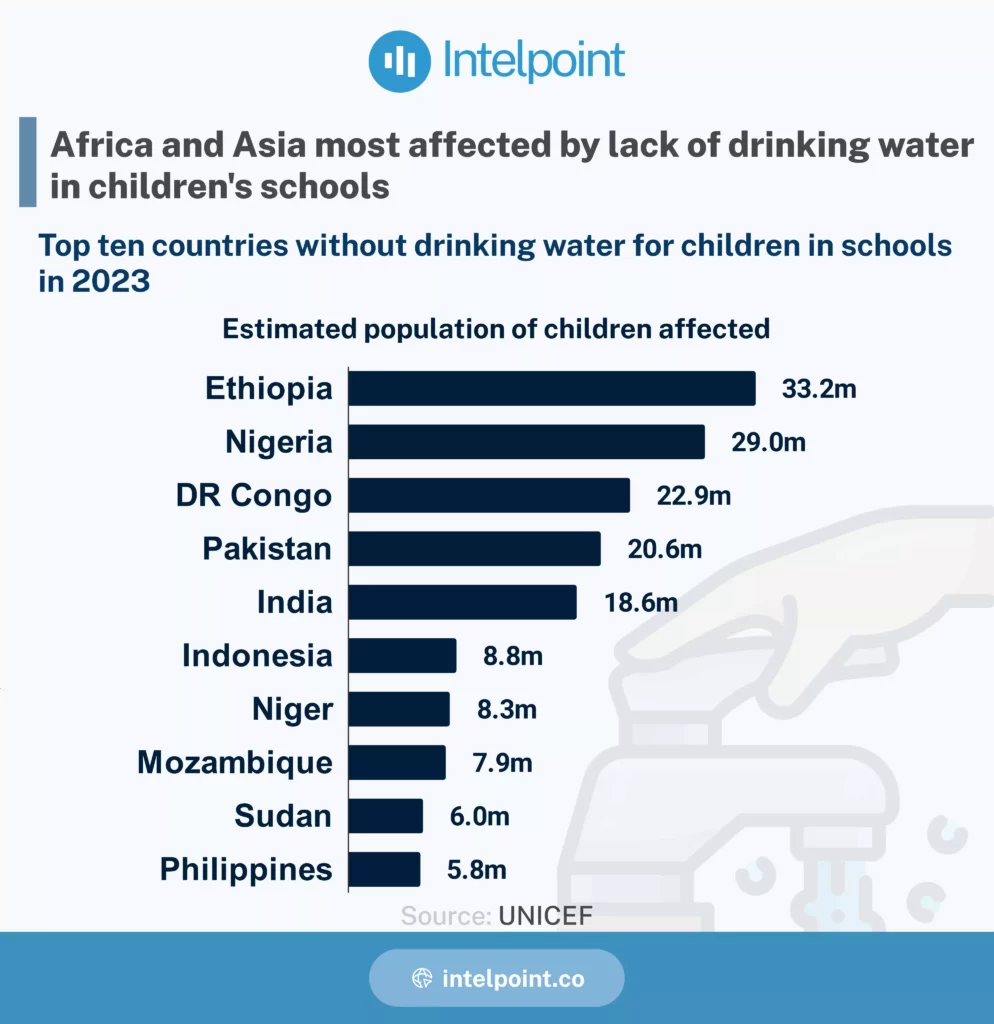
    A recent UNICEF report shows that 293m children worldwide did not have drinking water in their schools in 2023. Six African and four Asian countries make up the top ten, with Ethiopia and Nigeria occupying first and second positions, respectively, with 33.2m and 29m children.

    The top five countries account for 42% of the total affected population.

    See more
  • A Trend of Adult literacy rates of African countries

    Between 2018 and 2021, adult literacy rates across African nations exhibited significant disparities. Seychelles and South Africa led with literacy rates of 96% and 95%, respectively, indicating a high proportion of literate adults. Conversely, Chad had the lowest literacy rate during this period.

    These statistics underscore the uneven progress in educational attainment across Africa, highlighting the need for targeted interventions to improve literacy in lower-performing nations.
    See more

    Africa's sanitation crisis is alarming, with 17 of the top 20 countries having the highest open defecation rates.

    Eritrea (67%), Niger (65%), and Chad (63%) lead, putting millions at risk of disease.

    Even Nigeria, the most populous African country, has 18% of its population practising it.

    See more
  • Nigeria was the seventh most populous nation in the world in 2020, with 206.1 million people. Projected to reach a population of 401.3 million by 2050, Nigeria will rank third after India (1st) and China (2nd). According to Institut national d'études démographiques' projections, Nigeria, Ethiopia, DR Congo, Egypt, Tanzania, and Kenya will be among the world’s top 20 most populous countries by 2050.

    See more

    The FAAC's revenue distribution from 2017 to August 2023 highlights the dominance of Delta, Akwa Ibom, Rivers, and Bayelsa states in allocations. Despite Lagos' economic prominence, it ranked fifth. Here is the distribution of revenue among states between 2017 and August 2023.

    See more

  • Nigeria’s population growth has outpaced its economic performance. From 1960 to 2023, the population increased from 44.9 million to an estimated 223.8 million, putting immense pressure on resources.

    The country's GDP peaked at $574.2 billion in 2014 but dropped to $362.8 billion in 2023.

    See more
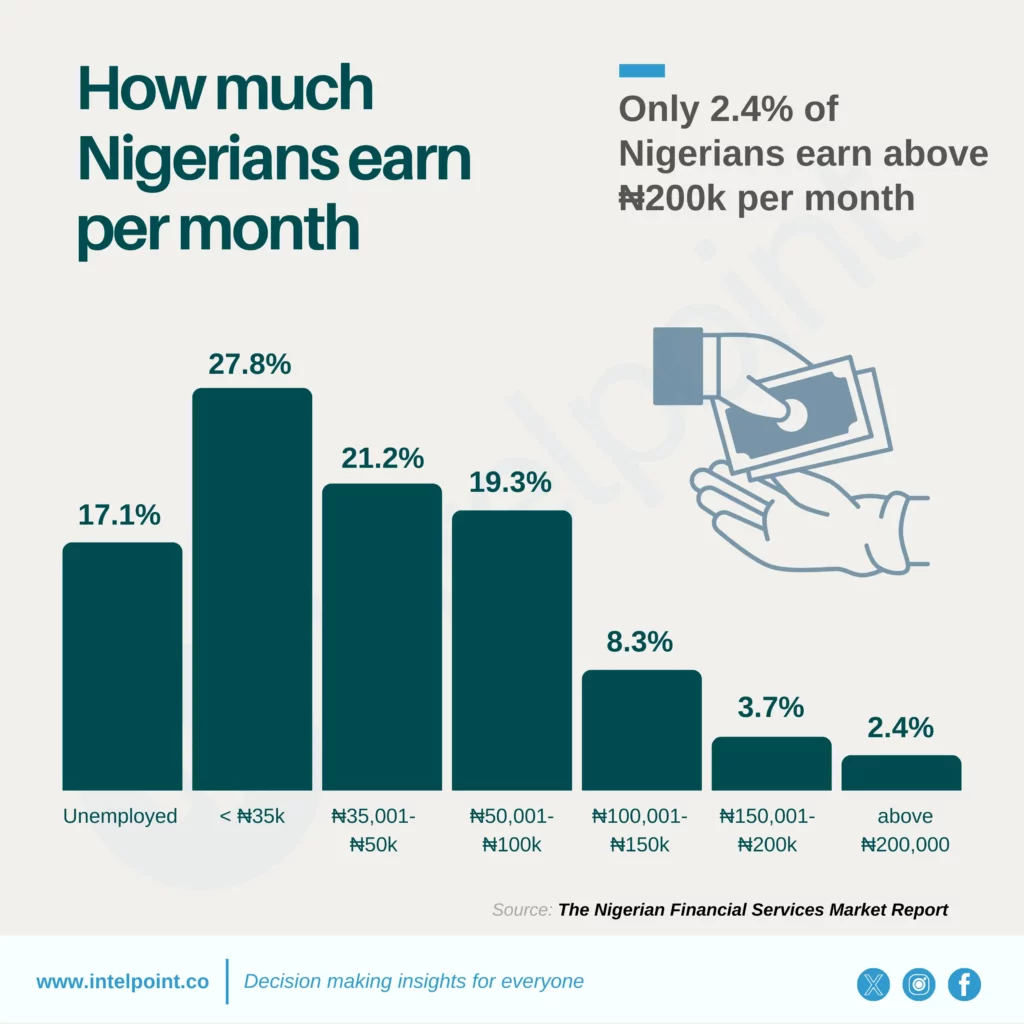
  • Only 10% of Nigerians earn above ₦100,000, according to the Nigerian Financial Services Market Report. This aligns with most reports about Nigeria, and it's in sharp contrast to the narratives online.
    See more
  • A Trend of Adult literacy rates of African countries

    Between 2018 and 2021, adult literacy rates across African nations exhibited significant disparities. Seychelles and South Africa led with literacy rates of 96% and 95%, respectively, indicating a high proportion of literate adults. Conversely, Chad had the lowest literacy rate during this period.

    These statistics underscore the uneven progress in educational attainment across Africa, highlighting the need for targeted interventions to improve literacy in lower-performing nations.

    See more

Other Insights
Key takeaways:
  • Mozambique and Chad exhibit the greatest coverage rates for individuals in need of support.
  • Less than half of those in need in Nigeria and Zimbabwe are projected to receive UN assistance.
  • At least 40% of individuals in need across African nations are expected to receive UN support.
  • No nation benefits from full support for individuals requiring humanitarian aid within its borders.
Read more
Key Takeaways:
  • United Nations High Commissioner for Refugees (UNHCR) has documented over 435,000 refugees in the U.S. in 2024.
  • China and Afghanistan stand as the leading sources of refugees, with 60,044 and 46,137 individuals identified as refugees from these countries respectively.
  • The top eleven countries of origin have each recorded more than 10,000 refugees in the United States.
  • Central American nations (El Salvador, Guatemala, and Honduras) accounted for 19.9% of refugees in the US.
Read more
Key takeaways:
  • Tunisia ranked the highest in Africa with a remarkable life expectancy of about 77 years, surpassing Africa's value of 64 years.
  • Five North African countries are among the top 8 countries with the highest life expectancy at birth in Africa.
  • There is a significant 22-year difference between the life expectancy in Tunisia (77 years) and Nigeria (55 years).
  • Sub-Saharan countries generally have lower life expectancy rates.
  • Nigeria is ranked among countries with the lowest life expectancy in Africa and the world.
Read more
Key takeaways:
  • Sudan requires the largest amount of humanitarian assistance, exceeding $4.16 billion.
  • The Syrian Arab Republic is second on the list of recipients, requiring $4 billion in humanitarian aid.
  • A total of eleven top countries are set to receive over $1 billion each in support, with the leading six countries requiring more than $2.4 billion each.
  • The top ten countries account for over 75% of total global humanitarian needs, which exceeds $32 billion.
Read more
  • December 2024 saw the biggest year-on-year increase in average movie ticket price since the 38.5% increase in 2021.
  • Cinema ticket prices in Nigeria have maintained an upward price trend since 2018, increasing by over 300%.
  • Since 2021, average ticket prices in December have maintained double-digit increases over 30% annually.
  • 2024's average ticket price was 17% below projections.
Read more
Key takeaways:
  • The crisis in Ukraine, affecting about 12.7 million people, represents 5.13% of the global humanitarian needs.
  • The top eleven nations account for more than 70% of global humanitarian demands, with over 177 million individuals requiring aid.
  • Sudan has the highest number of individuals requiring assistance (30.4 million), which is 12.29% of the total global figure.
  • Both Nigeria and Chad report 7.8 million individuals in need, which is 3.15% of the total global humanitarian need.
Read more
1 138 139 140 141 142 234

Can’t find what you’re looking for? Please fill the form below
Contact Form Demo
SIGN UP TO OUR NEWSLETTER
Get periodic updates about the African startup space, access to our reports, among others.
Subscribe Here
Subscription Form

A product of Techpoint Africa. All rights reserved