Bite-sized Insights about
 
Providing you with data-based insights about things happening around you.
Popular Insights
  • Nearly one in two accredited universities in Nigeria is located in the South West or North Central. The South West has the highest number of private and federal universities, with a total of 71 universities, while the North East has the fewest, with 21 universities.

    See more
    • Petrol prices in Nigeria rose by 52% between August 2024 (₦830.5) and March 2025 (₦1,261.7).
    • The highest monthly increase was in September 2024 (+24.1%), while the sharpest drop came in April 2025 (-17.1%).
    • By July 2025, prices had eased to ₦1,025, still 23% higher than a year earlier.
    • NNPC retail outlets offered significantly lower prices than the national average, with Abuja as low as ₦880 at the March 2025 peak.
    • Dangote Refinery offered relatively competitive pricing, ranging from ₦840 to ₦899, creating an alternative supply option.
    See more
  • The 2024 Global Peace Index reveals a decline in peacefulness in 97 countries, the highest since the index began.

    Nigeria is among the nations affected by regional conflicts and rising violence. With a peace index score of 2.91, Nigeria is facing increasing challenges.

    A deteriorating peace score impacts foreign investment and economic stability. Global economic losses due to violence reached $19.1 trillion in 2023.

    See more

    The FAAC's revenue distribution from 2017 to August 2023 highlights the dominance of Delta, Akwa Ibom, Rivers, and Bayelsa states in allocations. Despite Lagos' economic prominence, it ranked fifth. Here is the distribution of revenue among states between 2017 and August 2023.

    See more
  • A Trend of Adult literacy rates of African countries

    Between 2018 and 2021, adult literacy rates across African nations exhibited significant disparities. Seychelles and South Africa led with literacy rates of 96% and 95%, respectively, indicating a high proportion of literate adults. Conversely, Chad had the lowest literacy rate during this period.

    These statistics underscore the uneven progress in educational attainment across Africa, highlighting the need for targeted interventions to improve literacy in lower-performing nations.

    See more
    Countries by Global Innovation Index 2024

    The Global Innovation Index 2024 reveals a striking contrast in innovation performance between countries globally and across Africa. Switzerland leads the global rankings with an impressive score of 67.5, followed by Sweden (64.5) and the USA (62.4), highlighting their sustained investments in research, development, and technological advancement.

    In Africa, Mauritius takes the top spot with a score of 30.5, followed closely by Morocco (28.8) and South Africa (28.3). However, even Africa's most innovative nations achieve less than half the score of global leaders, indicating a significant innovation gap.

    Nigeria ranks 15th in the African ranking and 113th globally, out of 133 countries, with a score of 17.1.

    See more

    • Nigeria’s agricultural GDP reached ₦19.3 billion in 2023, showing minimal growth.
    • From 2013 to 2023, agriculture played a key role in Nigeria’s economic growth, averaging 24.43% of the total annual GDP.
    • Agriculture's share in the total GDP in 2020 (25.90%) dropped to 24.76% in 2023.
    • Post-pandemic recovery in the agricultural sector has been robust, with consistent growth from ₦18.3 billion in 2020 to ₦19.3 billion in 2023.
    • Agriculture remains a critical driver of Nigeria’s economy, ensuring food security and supporting livelihoods across the country.
    See more
  • MTN Nigeria has dominated the country's telecommunications market over the years, accounting for the largest market share. All four operators, apart from 9mobile, recorded a significant increase in their subscriber base between May 2014 and March 2024.

    See more
  • The 2024 Global Peace Index reveals a decline in peacefulness in 97 countries, the highest since the index began.

    Nigeria is among the nations affected by regional conflicts and rising violence. With a peace index score of 2.91, Nigeria is facing increasing challenges.

    A deteriorating peace score impacts foreign investment and economic stability. Global economic losses due to violence reached $19.1 trillion in 2023.
    See more

Other Insights
Key takeaways:
  • In February 2025, Samsung and Apple dominate the mobile market in Africa.
  • Samsung leads with a 29.80% share of the continent's mobile market based on usage.
  • Apple ranks second with a 13.27% share, demonstrating resilience in markets sensitive to pricing.
  • Collectively, Chinese manufacturers hold more than 45% of the mobile market in Africa.
  • Brands under Transsion Holdings (Tecno, Infinix, Itel) together represent nearly 25% of the total market share based on usage.
Read more
Key Takeaways:
  • In 2023, Kiribati spent the largest % of its GDP on education, amounting to 16.39%.
  • Kiribati, Tuvalu, and Vanuatu each allocated over 10% of their GDP to education.
  • Bolivia and the Solomon Islands each directed around 8.3% of their GDP spending towards education.
  • The top ten countries dedicated approximately 6.6% to 16.4% of their GDP to education.
Read more
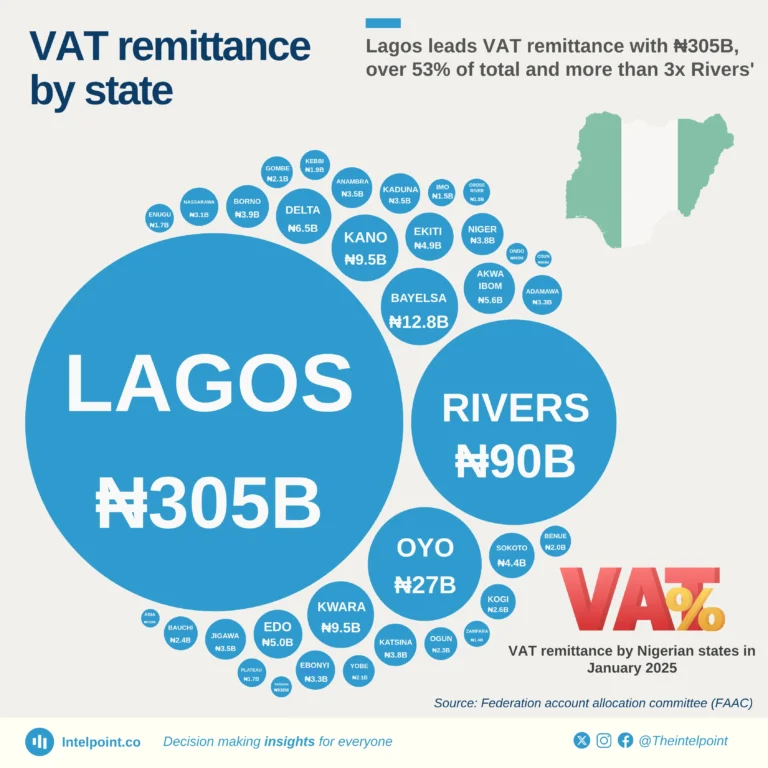
  • Lagos carried the South-West VAT burden, remitting ₦305.52B (89.6% of the region's total) but receiving only ₦62.59B (20.5% return), making it the highest net contributor in Nigeria.
  • Osun had the most disproportionate gain, remitting a mere ₦590M but receiving ₦7.73B, an astronomical 1,211% return—the highest redistribution gain in the South-West.
  • The entire South-West remitted ₦341.18B but received only ₦106.85B, meaning it got back just ₦0.31 for every ₦1 contributed, highlighting a severe VAT allocation imbalance.
  • Ondo and Ogun remitted only ₦3.3B but received ₦16B combined, far exceeding their generated VAT, while Lagos alone subsidised most of the allocations across the country.
Read more
  • The South-East remitted ₦10.94 billion in VAT but received ₦39.15 billion, a 257.7% increase, showing a high reliance on VAT sharing.
  • Abia, the lowest contributor (₦734M), received ₦7.29B, nearly 10× its remittance, making it the biggest relative beneficiary in the region.
  • Anambra, the highest contributor (₦3.56B), received only ₦8.72B, showing a sharing trend where high-contributing states do not necessarily receive the most.
  • Every South-East state received at least 2× what they remitted, with an average allocation of ₦7.83B despite an average contribution of just ₦2.19B.
Read more
  • The North-West region received ₦66.55 billion, more than double its remittance (₦28.31B), showing a heavy reliance on federal VAT sharing.
  • Zamfara, the lowest contributor (₦1.45B), received the highest percentage gain (+433%), getting ₦7.72B, while Kano, the highest contributor (₦9.59B), had the smallest relative gain (+41.5%).
  • Kaduna and Katsina, despite remitting ₦3.50B and ₦3.86B, received ₦10.18B and ₦10.01B, respectively, nearly tripling their remittance.
  • Kano remitted 34% of the zone’s VAT but received only 20.4% of the total allocation, reinforcing that VAT is distributed based on equality and not economic strength.
Read more
  • The North-East remitted only ₦14.98 billion but received ₦46.68 billion, showing a 211.6% gain due to sharing.
  • Taraba, the lowest contributor (₦0.94 billion), saw the highest percentage gain (635%) with an allocation of ₦6.91 billion, reinforcing that smaller economies benefit the most from VAT sharing.
  • Bauchi, despite remitting just ₦2.44 billion, received the highest allocation (₦8.93 billion), a 266% increase, illustrating how VAT is shared based on equality and population, not economic activity.
  • Every state in the region received at least 2× what they remitted, highlighting the North East’s reliance on VAT sharing and fuelling the fiscal federalism debate on whether VAT should be retained at the state level.
Read more
1 136 137 138 139 140 255

Can’t find what you’re looking for? Please fill the form below
Contact Form Demo
SIGN UP TO OUR NEWSLETTER
Get periodic updates about the African startup space, access to our reports, among others.
Subscribe Here
Subscription Form

A product of Techpoint Africa. All rights reserved