Bite-sized Insights about
 
Providing you with data-based insights about things happening around you.
Popular Insights
  • Have you ever considered how much larger the US GDP is in comparison to Nigeria's? Although it would be difficult to compare Nigeria's GDP to that of the US, let's assume it increases by 3.68% annually. How long would it take the nation's GDP to match that of the US in 2022?
    See more
    Nigeria deploys 74,000 new point-of-sale terminals on average each month

    Over the years, merchants on agency banking platforms have played an important role in bringing the banking system closer to people. They also played a key role during Nigeria's cash crunch in Q1 2023. Despite their importance, there have been reports of people using them to commit fraud, prompting the government's recent decision to have all POS agents registered with the Corporate Affairs Commission. As of March 2024, 2.69 million POS terminals had been deployed, including those used as payment options.

    See more
  • The 2024 Global Peace Index reveals a decline in peacefulness in 97 countries, the highest since the index began.

    Nigeria is among the nations affected by regional conflicts and rising violence. With a peace index score of 2.91, Nigeria is facing increasing challenges.

    A deteriorating peace score impacts foreign investment and economic stability. Global economic losses due to violence reached $19.1 trillion in 2023.

    See more

    The FAAC's revenue distribution from 2017 to August 2023 highlights the dominance of Delta, Akwa Ibom, Rivers, and Bayelsa states in allocations. Despite Lagos' economic prominence, it ranked fifth. Here is the distribution of revenue among states between 2017 and August 2023.

    See more
  • A Trend of Adult literacy rates of African countries

    Between 2018 and 2021, adult literacy rates across African nations exhibited significant disparities. Seychelles and South Africa led with literacy rates of 96% and 95%, respectively, indicating a high proportion of literate adults. Conversely, Chad had the lowest literacy rate during this period.

    These statistics underscore the uneven progress in educational attainment across Africa, highlighting the need for targeted interventions to improve literacy in lower-performing nations.

    See more

    Nigeria was the seventh most populous nation in the world in 2020, with 206.1 million people. Projected to reach a population of 401.3 million by 2050, Nigeria will rank third after India (1st) and China (2nd). According to Institut national d'études démographiques' projections, Nigeria, Ethiopia, DR Congo, Egypt, Tanzania, and Kenya will be among the world’s top 20 most populous countries by 2050.

    See more

  • As of December 2023, Johannesburg had the highest number of millionaires (12,300) in Africa; Cape Town followed with 7,400 millionaires. South Africa dominated the list, with its cities and regions claiming top spots.

    See more
  • MTN Nigeria has dominated the country's telecommunications market over the years, accounting for the largest market share. All four operators, apart from 9mobile, recorded a significant increase in their subscriber base between May 2014 and March 2024.

    See more
  • The 2024 Global Peace Index reveals a decline in peacefulness in 97 countries, the highest since the index began.

    Nigeria is among the nations affected by regional conflicts and rising violence. With a peace index score of 2.91, Nigeria is facing increasing challenges.

    A deteriorating peace score impacts foreign investment and economic stability. Global economic losses due to violence reached $19.1 trillion in 2023.
    See more

Other Insights
Key Takeaways:
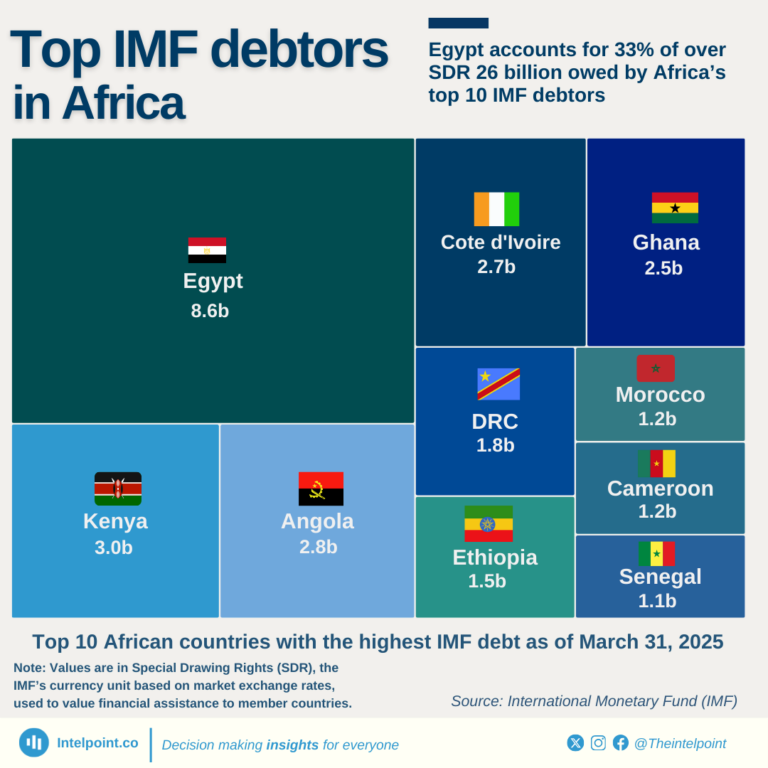
  • Egypt leads African nations in IMF debt, with SDR 8.63 billion in outstanding credit.
  • The combined debt of these 10 countries represents 24% of the IMF’s total outstanding credit globally.
  • East African nations, Kenya and Ethiopia, hold a combined SDR 4.5 billion in IMF credit.
  • West Africa is strongly represented with Côte d'Ivoire, Ghana, Senegal, and Cameroon owing more than SDR 7.4 billion collectively.
Read more
Key takeaways:
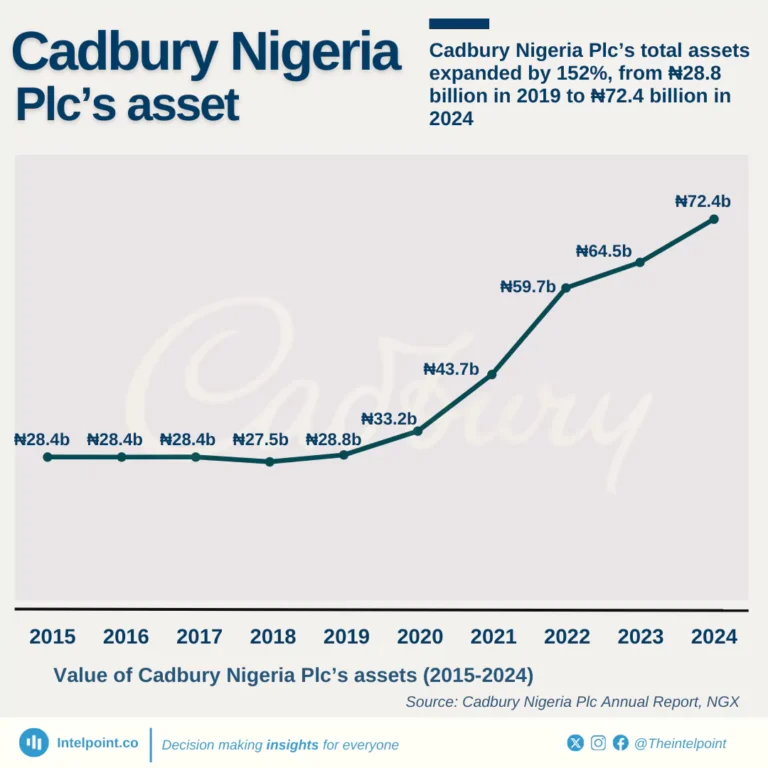
  • Cadbury Nigeria's total assets increased by 155%, from ₦28.4 billion in 2015 to ₦72.4 billion in 2024.
  • Assets remained relatively stable between 2015 and 2019, hovering around ₦28 billion.
  • Despite recent financial challenges, Cadbury Nigeria's asset base has more than doubled in the last decade.
  • Significant expansion began in 2020, with continued steady growth through 2024.
Read more
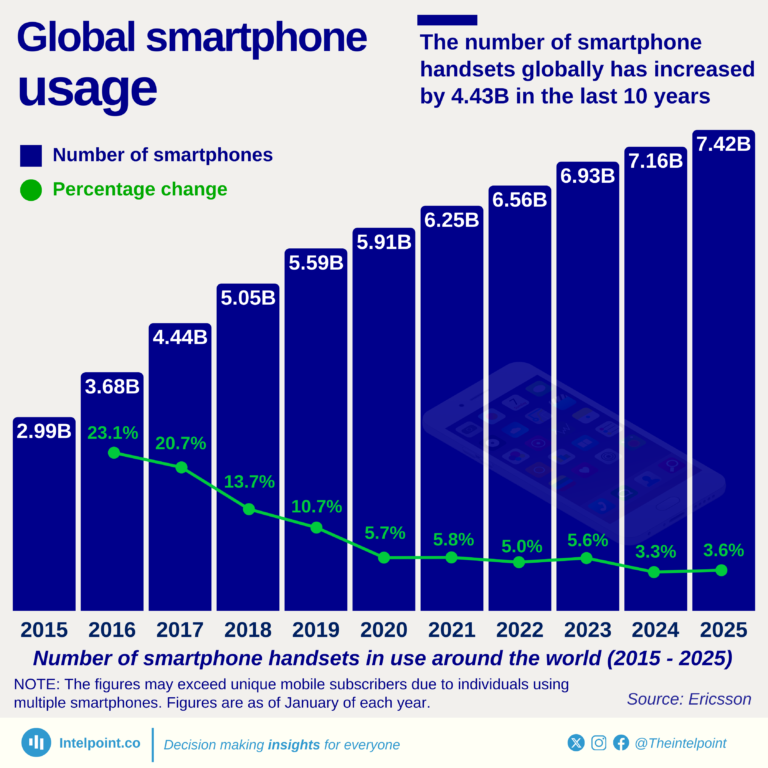
Number of smartphone handsets in use around the world (2015 - 2025)
  • From 2.99B in 2015 to 7.42B in January 2025, the world has added more than 4.4 billion smartphone devices in a decade.
  • Annual growth dropped from a high of 23.1% in 2016 to 3.6% in 2025, a clear sign of global market saturation.
  • During 2016-2018, the world added nearly 2 billion new smartphones.
  • Since 2020, annual growth has been under 6%.
  • Most of the future growth will come from device upgrades or multiple device ownership, not necessarily new smartphone users.
Read more
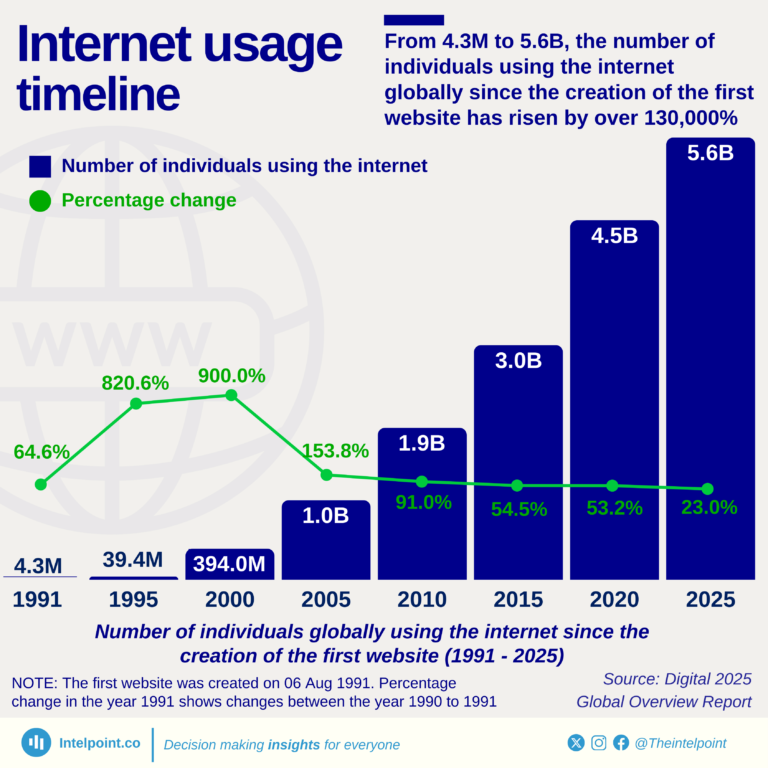
Number of individuals globally using the internet since the creation of the first website (1991 - 2025)
  • Between 1995 and 2000, internet users jumped from 39.4 million to 394 million, a 900% leap that marked the beginning of the digital era.
  • Just 14 years after the first website, over 1 billion people were online, showing how quickly the internet became essential.
  • Between 2010 and 2015, internet usage grew by 54.5%, slower than before but still powerful, especially in developing regions coming online.
  • With 5.6 billion users in January 2025, most of the world is now online, and future growth will be more about improving access, speed, and quality than just connecting new people.
  • Each phase had its catalyst. In the 1990s, it was websites and email. The 2000s brought broadband and Google. In the 2010s, it was smartphones. Now, it's AI, 5G, and IoT that are quietly shaping the future of internet use.
Read more
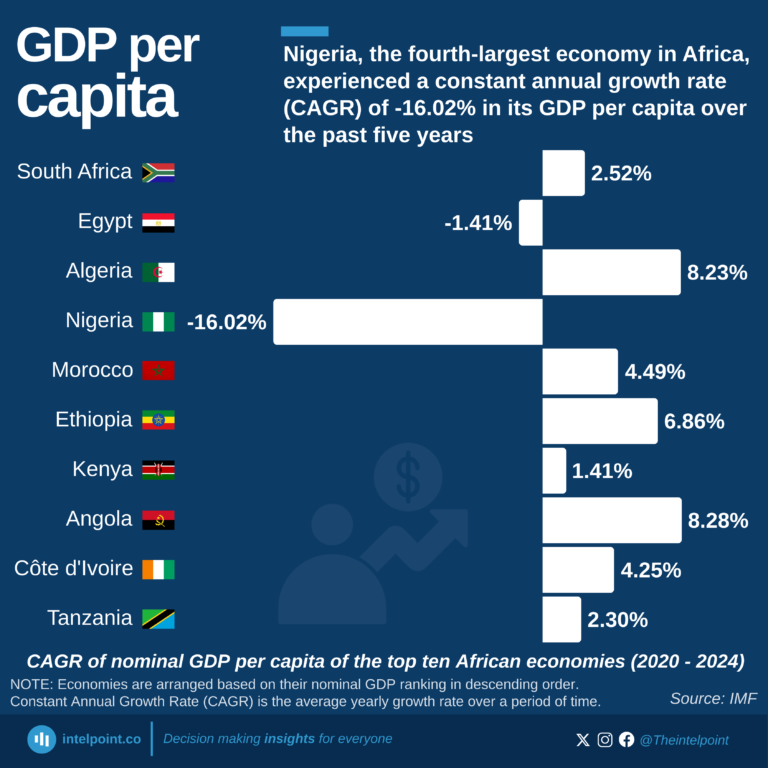
CAGR of nominal GDP per capita of the top ten African economies (2020 - 2024)
  • At -16.02% CAGR, Nigeria's GDP per capita is shrinking fast, signalling deep economic strain on its population despite being a top 4 African economy.
  • Angola recorded 8.28% CAGR, showing that smaller economies can drive significant per capita progress when policies and investments align with citizen welfare.
  • With 8.23% CAGR, Algeria continues to transform national wealth into measurable benefits for its people.
  • Ethiopia’s 6.86% annual growth in GDP per capita highlights how consistent development efforts can raise living standards even in densely populated, developing nations.
  • A modest 2.52% CAGR for South Africa might not sound like much, but in a mature economy, this reflects resilience and relative stability in per capita income.
  • Egypt has a -1.41% CAGR, showing mild contraction, but far less severe than Nigeria’s economic shrinkage.
Read more
1 … 140 141 142 143 144 … 270

Can’t find what you’re looking for? Please fill the form below
Contact Form Demo
SIGN UP TO OUR NEWSLETTER
Get periodic updates about the African startup space, access to our reports, among others.
Subscribe Here
Subscription Form

A product of Techpoint Africa. All rights reserved