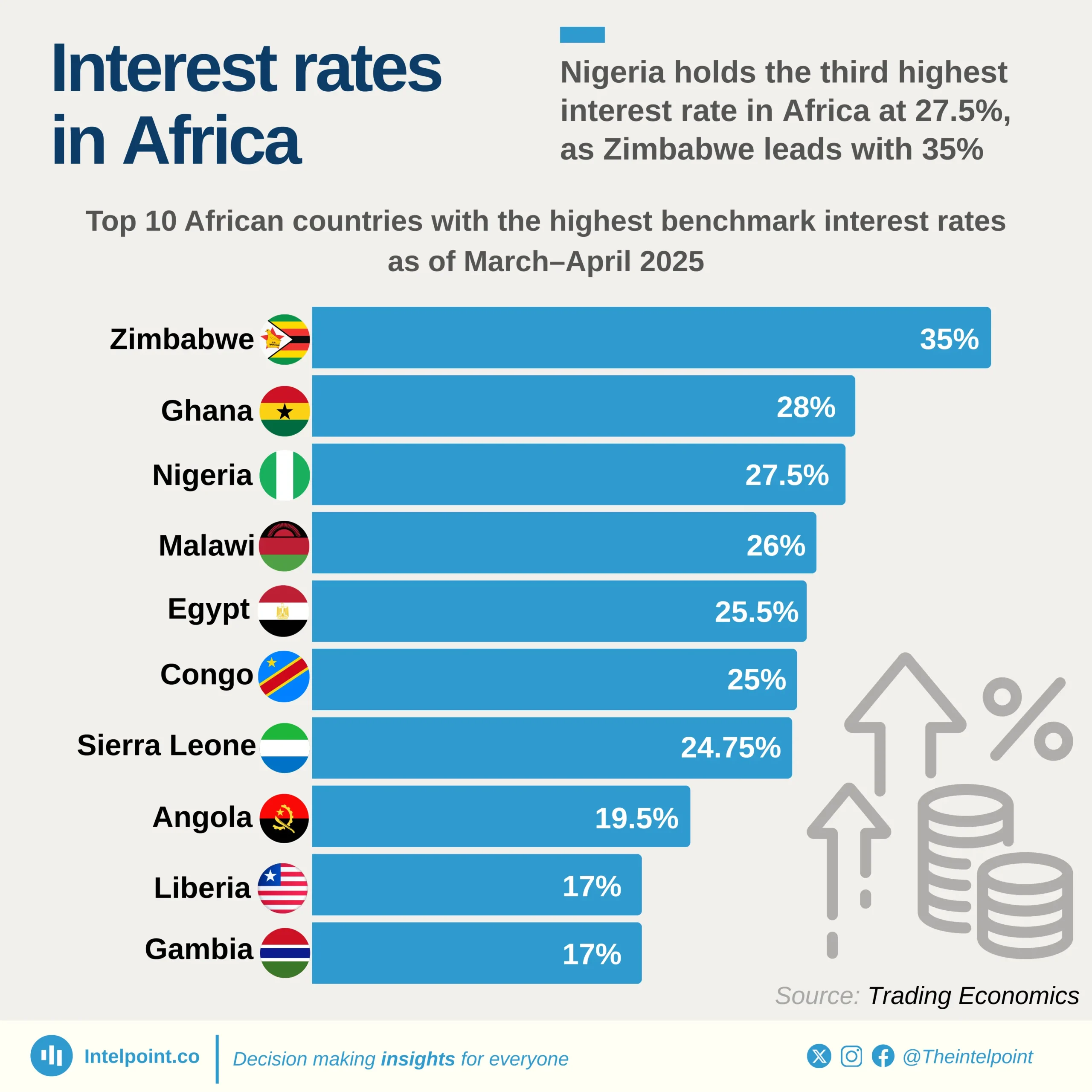
Nigeria holds the third highest interest rate in Africa at 27.5%, as Zimbabwe leads with 35%

Key takeaways

  • Zimbabwe has the highest benchmark interest rate in Africa at 35%, exceeding Ghana, the second highest, by 7% points.
  • Nigeria holds the third highest interest rate on the continent at 27.5%, just 0.5% points behind Ghana, signalling aggressive policy intervention.
  • Zimbabwe, Ghana, Nigeria, Malawi, and Egypt have interest rates above 25%, showing a regional pattern of tight monetary conditions.
  • There is a significant drop of over 5% points between Sierra Leone at 24.75% and Angola at 19.5%, marking a clear shift to lower-rate economies below the top tier.

As of March - April 2025, several African central banks have tightened monetary policy significantly in response to persistent inflationary pressures and currency instability. Zimbabwe leads the continent with a benchmark interest rate of 35%, followed by Ghana at 28% and Nigeria at 27.5%. These figures underscore aggressive policy stances aimed at controlling inflation and stabilising macroeconomic conditions. Notably, five of the top ten countries have rates above 25%, reflecting a broader trend of monetary tightening across key African economies.

The data reveals a sharp contrast between the top and bottom of the list. While Sierra Leone rounds out the top seven at 24.75%, there’s a steep drop to Angola at 19.5% and further down to Liberia and Gambia, both at 17%.
Source:

Trading Economics

Period:

March - April 2025
HTML code to embed chart
Want a bespoke report?
Reach out
Tags
Related Insights

Lagos, Rivers, and four other states account for 52% of all Nigerian states' domestic debt and 40% of their external debt
  • Lagos dominates Nigeria’s subnational debt profile, accounting for 26.1% of domestic debt and 21.8% of external debt.
  • Six states account for 52% of domestic debt.
  • The same group contributes 40% of the external debt
  • Rivers ranks second in domestic debt (9.5%) but has a significantly lower external debt (3.8%).
  • Kaduna emerges as a major external borrower (13.7%) despite not appearing among the top domestic debt states.

Finance & Insurance now makes up 30% of Nigeria’s domestic company income tax, up from 12% in 2022
  • Company income tax collections rose from ₦1.7tn in 2022 to ₦5.0tn in 2025.
  • Finance & Insurance more than doubled its share, from 12.4% to 30.0%.
  • Finance became the largest single sector in the tax mix by 2025.
  • Manufacturing remained important, but its share fell from 27.9% to 17.7%.
  • ICT saw one of the sharpest declines, from 21.6% to 6.5%.
  • Mining & quarrying gained weight, rising from 8.4% to 14.5%.
  • Wholesale & retail also increased, from 3.6% to 7.0%.
  • The tax base became less evenly distributed across sectors.

Nigeria's VAT collections have more than tripled in three years
  • Nigeria’s total VAT rose from ₦2.5tn in 2022 to ₦8.6tn in 2025.
  • VAT collections more than tripled in four years.
  • Local VAT remained the largest source of VAT throughout the period.
  • Local VAT increased from ₦1.5tn to ₦4.5tn.
  • Local VAT averaged 54.4% of total VAT between 2022 and 2025.
  • Import VAT also grew strongly, from ₦521.5bn to ₦2.0tn.
  • Other payment channels rose from ₦510.8bn to ₦2.1tn.
  • VAT growth is increasingly being driven by non-import activity.

Agriculture’s share of Nigeria’s capital imports peaked at 5.46% in 2021 before falling to 0.72% in 2025
  • Agriculture’s share of Nigeria’s capital imports peaked at 5.46% in 2021
  • After 2025, agriculture's share started falling sharply, reaching 0.72% in 2025.
  • Between 2017 and 2021, the sector experienced consistent growth in both value and share.
  • Capital import value peaked at at $489.9 million in 2019.

85 cents of every dollar in capital imported into Nigeria in 2025 went to portfolio investments
  • Nigeria's total capital imports surged to $23.2bn in 2025, the highest level recorded in the entire 2014 to 2025 period.
  • Foreign Portfolio Investment dominated in 2025, claiming 85 cents of every dollar imported, up sharply from 68% in 2024.
  • Foreign Direct Investment has remained consistently weak, never exceeding 20% across all eleven years, and falling to just 4% in 2025.
  • The "Others" category, which peaked at 61% in 2023, has collapsed to just 11% in 2025, reflecting a dramatic shift toward portfolio-driven capital flows

Nigeria's foreign capital inflows nearly reached the 2019 record, but 87% went to banks and financiers
  • Inflows surged from $3.9B in 2023 to $23.2B in 2025, near the all-time record.
  • Banking and financing captured 87% of all inflows.
  • Agriculture got $167M, oil and gas $18M, and construction $6M, .
  • The recovery is real, but it is not yet reaching ordinary Nigerians.

POPULAR TOPICS
SIGN UP TO OUR NEWSLETTER
Get periodic updates about the African startup space, access to our reports, among others.
Subscribe Here
Subscription Form

A product of Techpoint Africa. All rights reserved