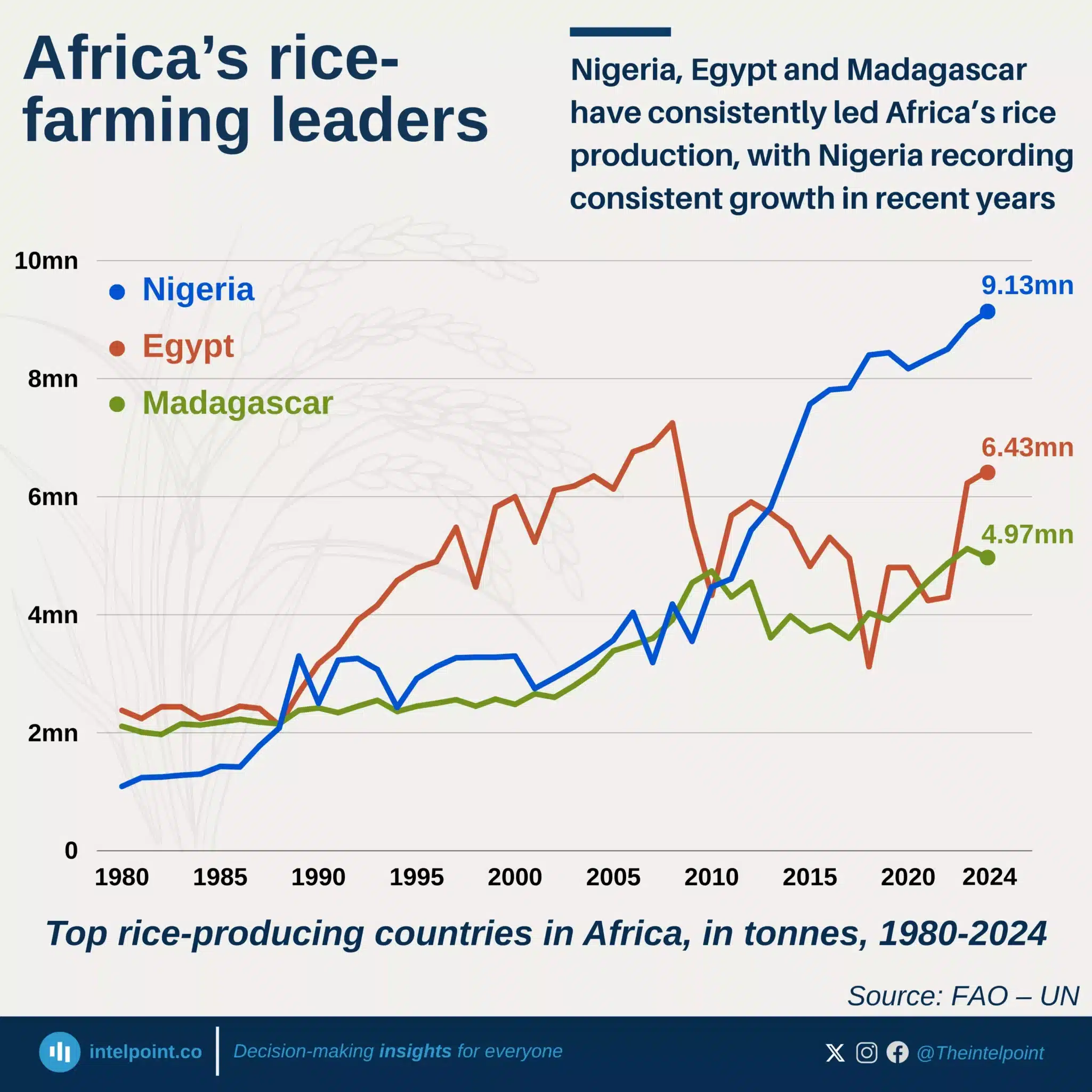
Nigeria has dominated African rice production since 2013, producing 9.1 million tonnes in 2024

  • Africa's rice production in 2024 reached 44.8 million tonnes, the highest in the continent's history.
  • The 2024 figure is 10.4 times higher than the 4.3 million tonnes produced in 1961.
  • Production grew from 4.3 million tonnes in 1961 to 44.8 million tonnes in 2024.
  • Nigeria leads Africa in rice production, accounting for 9.1 million tonnes (approximately 20% of the total) in 2024.
  • Africa has produced approximately 1.3 billion tonnes of rice cumulatively from 1961 to 2024.
  • Major producers include Nigeria, Egypt, Tanzania, Guinea, and Côte d'Ivoire, which together account for over 60% of Africa's total output.

Africa has become a significant rice-producing region. The continent's output has surged more than tenfold over six decades, from just 4.3 million tonnes in 1961 to 44.8 million tonnes in 2024.

This growth reflects significant agricultural development across multiple countries and has increased Africa's share of global rice production, though Asia still dominates, accounting for roughly 90% of world production in 2024.

Nigeria accounts for 9.1 million tonnes of African rice production annually, while Egypt, Tanzania, and Guinea each contribute millions of tonnes. Countries such as Côte d'Ivoire have experienced particularly dramatic growth, increasing from 156,000 tonnes in 1961 to 2.4 million tonnes in 2024.

Africa now produces more rice than the Americas (37.2 million tonnes) and significantly outpaces Europe (3.9 million tonnes) and Oceania (0.6 million tonnes). Despite this remarkable progress, Africa continues to import substantial quantities of rice to meet domestic demand.

The continent's 44.8 million tonnes represents just 6% of Asia's production, up from 2% in 1961. With Africa's population growing faster than rice production, continued output growth remains essential for food security across the continent.
Source:

Food and Agriculture Organization of the United Nations

Period:

1961-2024
HTML code to embed chart
Want a bespoke report?
Reach out
Tags
Related Insights

From 45% to 2%: How Nigeria lost its global palm oil production share to Asia
  • Indonesia dominated with 46.8M tonnes in 2022, up from 145.7 ktonnes in 1961
  • Malaysia was the second-largest producer in 2022 with 18.5M tonnes
  • Global production has increased from under 2M tonnes (1961) to over 75M tonnes (2022)
  • Thailand, Colombia, and Guatemala have emerged as major producers in recent decades
  • Nigeria was historically significant, but has been overtaken by Asian producers

Over one-fourth of Asia’s forests were in legally established protected areas as of 2024
  • Asia leads globally with 26% of its forests in legally protected areas.
  • The global average stands at 20%, meaning that one-fifth of all forests are under some form of legal protection.
  • Africa and Europe are tied at 23%, both above the global average.
  • South America has only 17% of its forests protected, despite being home to the Amazon rainforest.

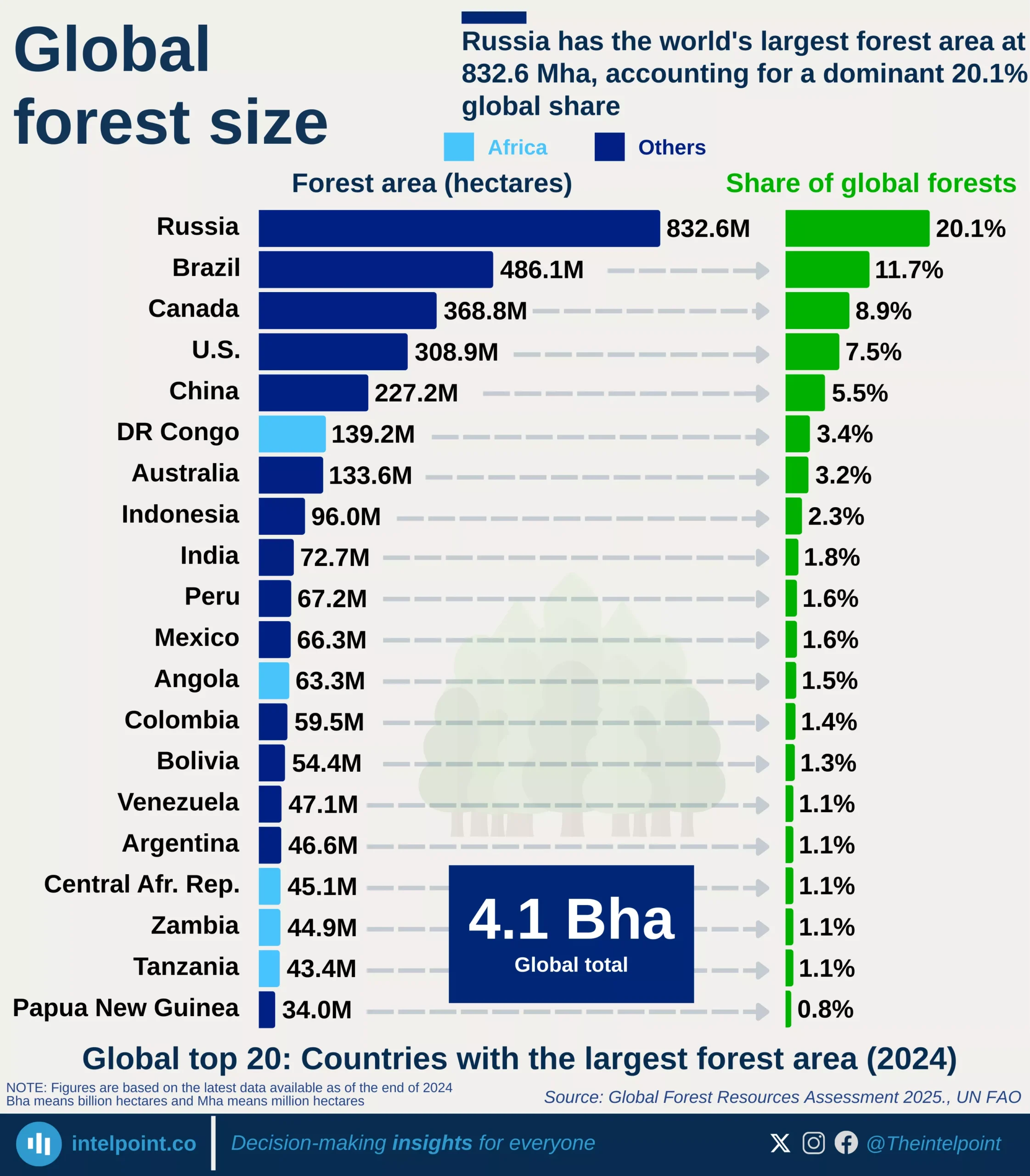
Russia has the world's largest forest area at 832.6 Mha, accounting for a dominant 20.1% global share
  • Global forest cover is 4.1 Bha, according to the latest FAO assessment.
  • At 832.6 Mha, 20.1% of the global total, Russia has the world’s largest forest area.
  • Brazil (486.1 Mha; 11.7%) and Canada (368.8 Mha; 8.9%) rank second and third, respectively.
  • The United States (7.5%) and China (5.5%) complete the global top five.
  • Africa’s top contributor is the Democratic Republic of Congo, with 139.2 Mha, 3.4% of the global total.
  • Other African countries in the top 20 include Angola, Zambia, Tanzania, and the Central African Republic, each accounting for approximately 1% of the global forest area.
  • Together, the top ten countries account for over 78% of the world’s total forest area, highlighting the global concentration of forest resources.

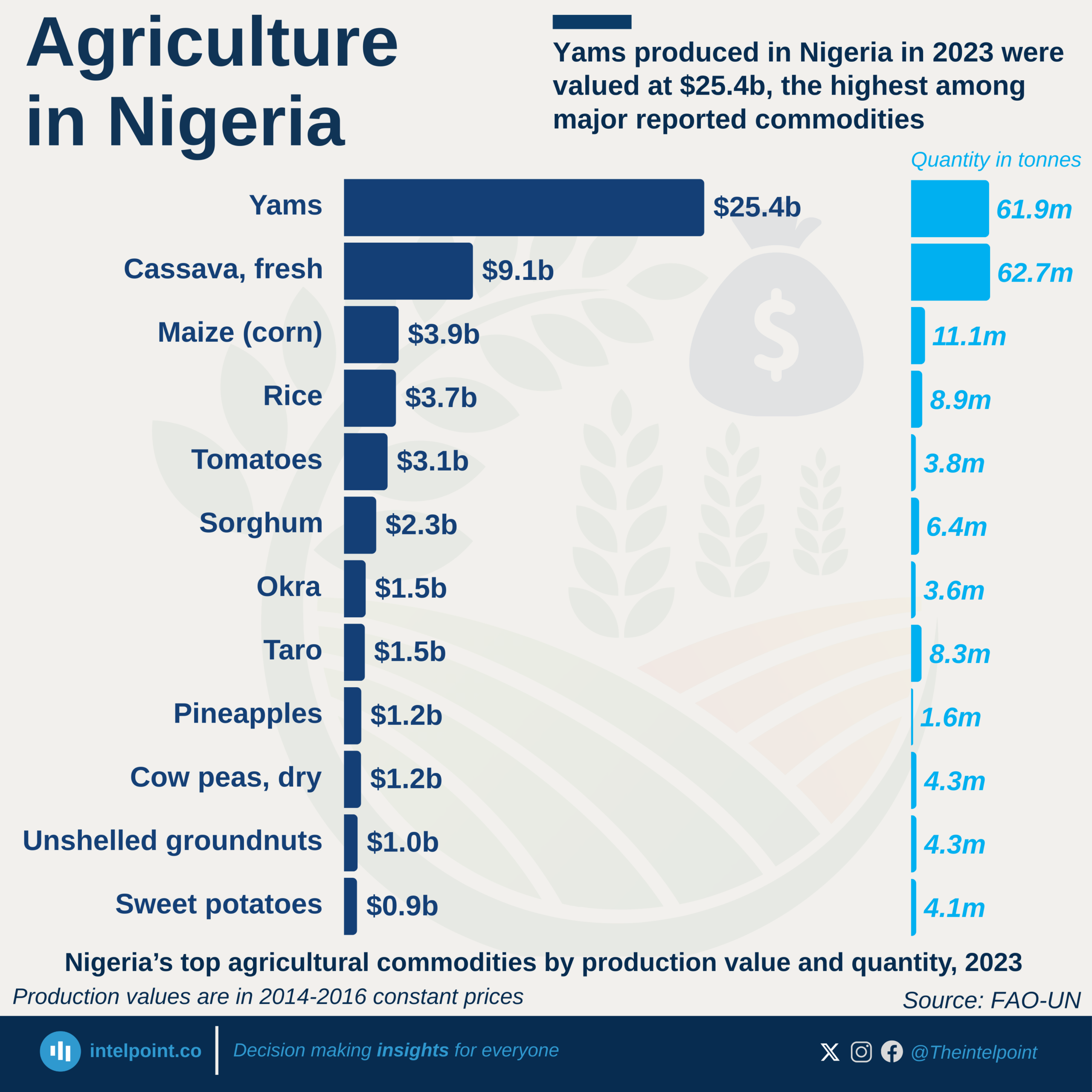
Yams produced in Nigeria in 2023 were valued at $25.4b, the highest among major reported commodities
  • After yielding 61.9 million tonnes, yams were valued at $25.4 billion in 2023, the highest among reported commodities.
  • With 62.7 million tonnes produced, cassava generated $9.1 billion, making it the second most valuable crop.
  • Okra ($818/t), tomatoes ($808/t), and pineapples ($753/t) earned the highest returns per unit despite smaller volumes (1.6–3.8 million tonnes).
  • Maize ($3.7 b, 11.1 m t), rice ($3.1 b, 8.9 m t), sorghum ($2.3 b, 6.4 m t), cowpeas ($1.2 b, 4.3 m t), and groundnuts ($0.9 b, 4.3 m t) form the backbone of production.

Nearly one in six of Africa’s goats are in Nigeria, the continent’s leader since 1998
  • Africa’s goat population grew from 94 million in 1961 to 522 million in 2023 — more than a fivefold increase.
  • The continent’s share of the world’s goats rose from 27% in 1961 to 46% in 2023.
  • Nigeria leads with nearly 89 million goats in 2023, holding the top spot since 1998.
  • Ethiopia, Chad, Sudan, Niger, and Mali consistently rank among the largest goat producers.
  • Around 70% of Africa’s goats are concentrated in the top ten countries each year.

Netherlands, US, and Germany dominated cocoa imports from 1961 to 2023
  • Netherlands imported the most cocoa beans — 25.48 million tonnes (1961–2023)
  • US (21.1M) and Germany (16.8M) followed in total volume
  • These three countries dominated the top 5 nearly every year
  • Malaysia, UK, France, and Belgium also ranked high over time
  • USSR stayed in the top 10 despite dissolving in 1991
  • Global cocoa imports grew from 1M tonnes in 1961 to nearly 4M in 2023

POPULAR TOPICS
SIGN UP TO OUR NEWSLETTER
Get periodic updates about the African startup space, access to our reports, among others.
Subscribe Here
Subscription Form

A product of Techpoint Africa. All rights reserved