Bite-sized Insights about
 
Providing you with data-based insights about things happening around you.
Popular Insights
  • Jumia Group has recorded $1b in losses since listing on the New York Stock Exchange in 2019. The eCommerce giant also recorded its highest yearly loss in 2019. In recent years, Jumia Group has shut down some of its businesses across Africa, thus recording its lowest loss over seven years in 2023.

    See more
    • Samsung controls more than half of the South African smartphone market, more than all other brands combined.
    • Apple holds 17.61%, less than half of Samsung’s share, but remains the clear premium alternative.
    • Despite global challenges, Huawei captures 10.03%, placing third in the market.
    • Honor, Xiaomi, and Oppo collectively hold approximately 11.6%, while smaller brands like Tecno, Itel, and Nokia struggle below 2% each.
    See more
  • The 2024 Global Peace Index reveals a decline in peacefulness in 97 countries, the highest since the index began.

    Nigeria is among the nations affected by regional conflicts and rising violence. With a peace index score of 2.91, Nigeria is facing increasing challenges.

    A deteriorating peace score impacts foreign investment and economic stability. Global economic losses due to violence reached $19.1 trillion in 2023.

    See more

    The FAAC's revenue distribution from 2017 to August 2023 highlights the dominance of Delta, Akwa Ibom, Rivers, and Bayelsa states in allocations. Despite Lagos' economic prominence, it ranked fifth. Here is the distribution of revenue among states between 2017 and August 2023.

    See more
  • A Trend of Adult literacy rates of African countries

    Between 2018 and 2021, adult literacy rates across African nations exhibited significant disparities. Seychelles and South Africa led with literacy rates of 96% and 95%, respectively, indicating a high proportion of literate adults. Conversely, Chad had the lowest literacy rate during this period.

    These statistics underscore the uneven progress in educational attainment across Africa, highlighting the need for targeted interventions to improve literacy in lower-performing nations.

    See more

    Nigeria was the seventh most populous nation in the world in 2020, with 206.1 million people. Projected to reach a population of 401.3 million by 2050, Nigeria will rank third after India (1st) and China (2nd). According to Institut national d'études démographiques' projections, Nigeria, Ethiopia, DR Congo, Egypt, Tanzania, and Kenya will be among the world’s top 20 most populous countries by 2050.

    See more

  • GTCO shatters records with ₦1.08t earnings in first three quarters of 2024 following historic Q1 profit.

    Guaranty Trust Holding Company (GTCO) sets a new milestone with ₦1.08t profit after tax in the first three quarters of 2024, following its record-breaking first quarter.

    See more
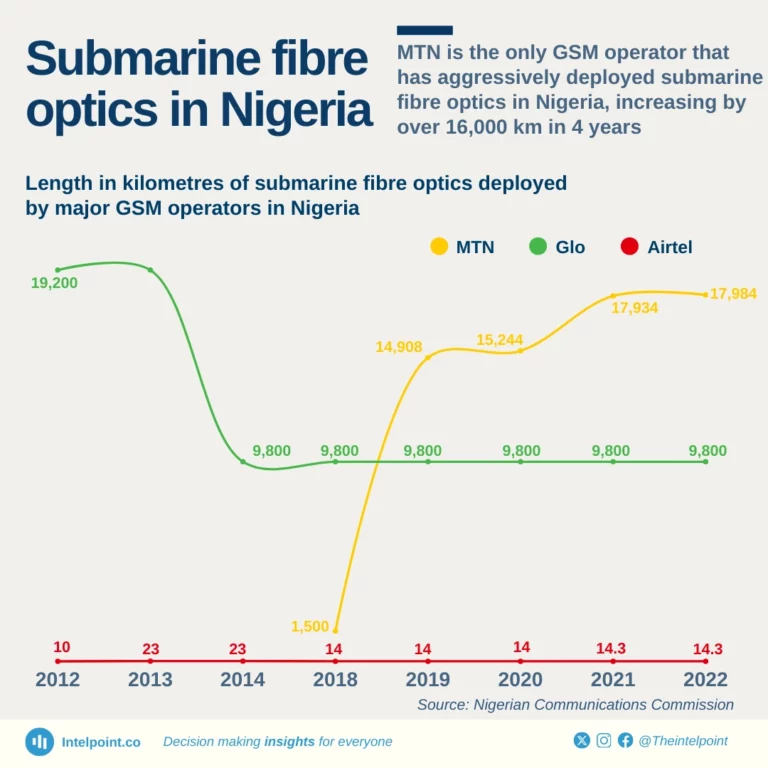
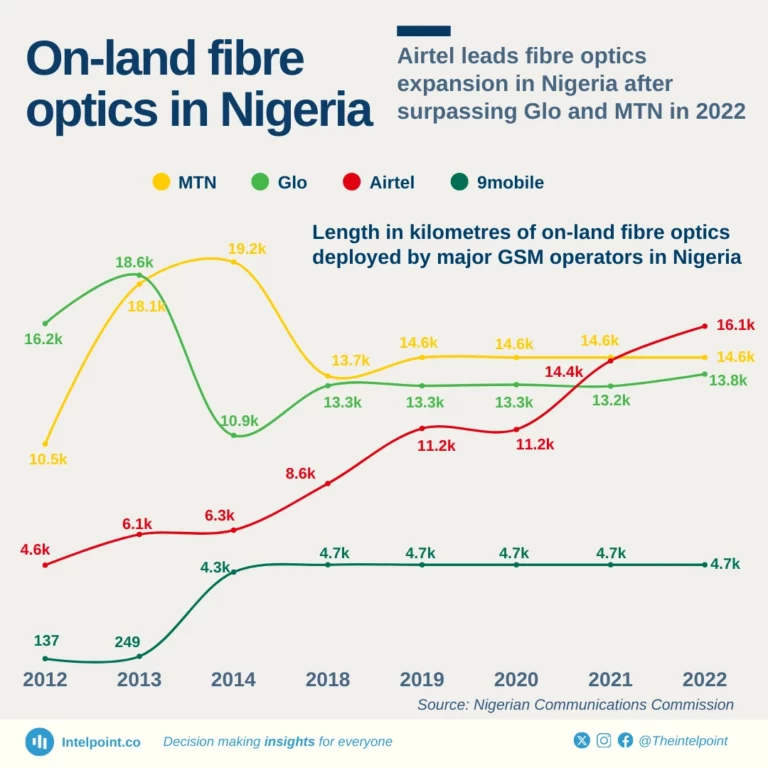
  • MTN Nigeria has dominated the country's telecommunications market over the years, accounting for the largest market share. All four operators, apart from 9mobile, recorded a significant increase in their subscriber base between May 2014 and March 2024.

    See more
  • The 2024 Global Peace Index reveals a decline in peacefulness in 97 countries, the highest since the index began.

    Nigeria is among the nations affected by regional conflicts and rising violence. With a peace index score of 2.91, Nigeria is facing increasing challenges.

    A deteriorating peace score impacts foreign investment and economic stability. Global economic losses due to violence reached $19.1 trillion in 2023.
    See more

Other Insights
  • The South-South remitted ₦121.84B, making it one of the biggest net donors to the national VAT pool.
  • The region received only ₦52.49B, meaning it got back just 43% of its VAT contributions.
  • Rivers State alone remitted a staggering ₦90.21B (74% of the region’s total) but received only ₦11.01B (12.2% return), marking one of the worst VAT allocation disparities in Nigeria.
  • Cross River had the lowest VAT contribution (₦1.55B) but received ₦7.45B, a 380% gain, while Bayelsa, despite remitting ₦12.8B, received only ₦8.02B, less than lower-remitting states like Delta (₦9.05B).
  • Every state in the South-South received more than it remitted, except for Bayelsa and Rivers, with the latter being the only state to suffer a massive VAT deficit.
Read more
  • East Africa: Ethiopia leads with 36.2 million agricultural workers (27.3% of its 132.5 million population). Agriculture is vital to its economy. Tanzania follows with 19.2 million workers (approximately 28.8% of 66.6 million). Uganda has 23.4% of its 50 million population in agriculture, and Kenya employs 7.6 million workers (approximately 13.7% of 55.3 million), despite land degradation affecting 80% of its land.
  • West Africa: Nigeria has 26.8 million agricultural workers, but with a population of 232 million, it heavily depends on food imports as only 11.5% of its population work in the agriculture section. Ghana employs 5.5 million agricultural workers (16% of 34.4 million) and has strong potential for agricultural export growth, especially cocoa.
  • Central Africa: DR Congo has 18.6 million agricultural workers out of a population of 109.2 million.
  • Southern Africa: Mozambique has 9.9 million agricultural workers 29% of 34.6 million, while Madagascar employs 10.5 million (33% of 31.9 million). Agriculture is key to Madagascar’s economy but hindered by land issues, with women producing 80% of crops.
  • North Africa: Egypt has 5.7 million agricultural workers (5% of 116.5 million), and relies on irrigation due to limited arable land and high food imports.
Read more
  • North Africa dominates with 53.8% of Africa’s total reserves.
  • West Africa holds 17.6%, despite economic challenges.
  • Southern Africa accounts for 20.3%, benefiting from strong reserves in South Africa.
  • East Africa lags behind with 4.4%, indicating lower reserve accumulation in the region.
  • Central Africa holds the smallest share at 4%, reflecting economic struggles and weak financial buffers.
Read more
  • Libya leads Africa’s reserves with $92.4B, followed by Algeria ($81.2B) and South Africa ($62.5B).
  • Morocco $36.3B reserve places it fourth among African nations.
  • Egypt’s holds $33.1B, maintaining a strong reserve position.
  • Angola ($13.9B), Tunisia ($9.24B), Kenya ($7.34B), Mauritius ($7.25B), and DR Congo ($5.1B) round out the top 10.
  • Libya and Algeria’s strong reserves highlight North Africa’s dominance in the Black continent reserve.
Read more
  • In 2013, Africa’s total reserves stood at $560 billion, the highest recorded in the past decade.
  • A steady decline followed, with reserves dropping to $402 billion by 2016.
  • A moderate recovery began in 2017 at $426 billion, stabilising around $400 billion in recent years.
  • As of 2022, Africa’s total reserves were estimated at $397 billion.
  • Despite fluctuations, Africa’s reserves have hovered around $400 billion since 2019.
Read more
  • Africa ranks 5th globally in total reserves. The continent’s $375B in reserves lags behind most regions, surpassing only Oceania.
  • Asia leads with $8.24T, over half of global reserves, maintaining the strongest reserve and continent buffer driven by China, Japan, and India.
  • Europe holds nearly five times Africa’s reserves, with $3.68T.
  • South America’s $590B reserves is 57% more than Africa’s.
  • Oceania remains the lowest with $84.8B.
Read more
1 150 151 152 153 154 265

Can’t find what you’re looking for? Please fill the form below
Contact Form Demo
SIGN UP TO OUR NEWSLETTER
Get periodic updates about the African startup space, access to our reports, among others.
Subscribe Here
Subscription Form

A product of Techpoint Africa. All rights reserved