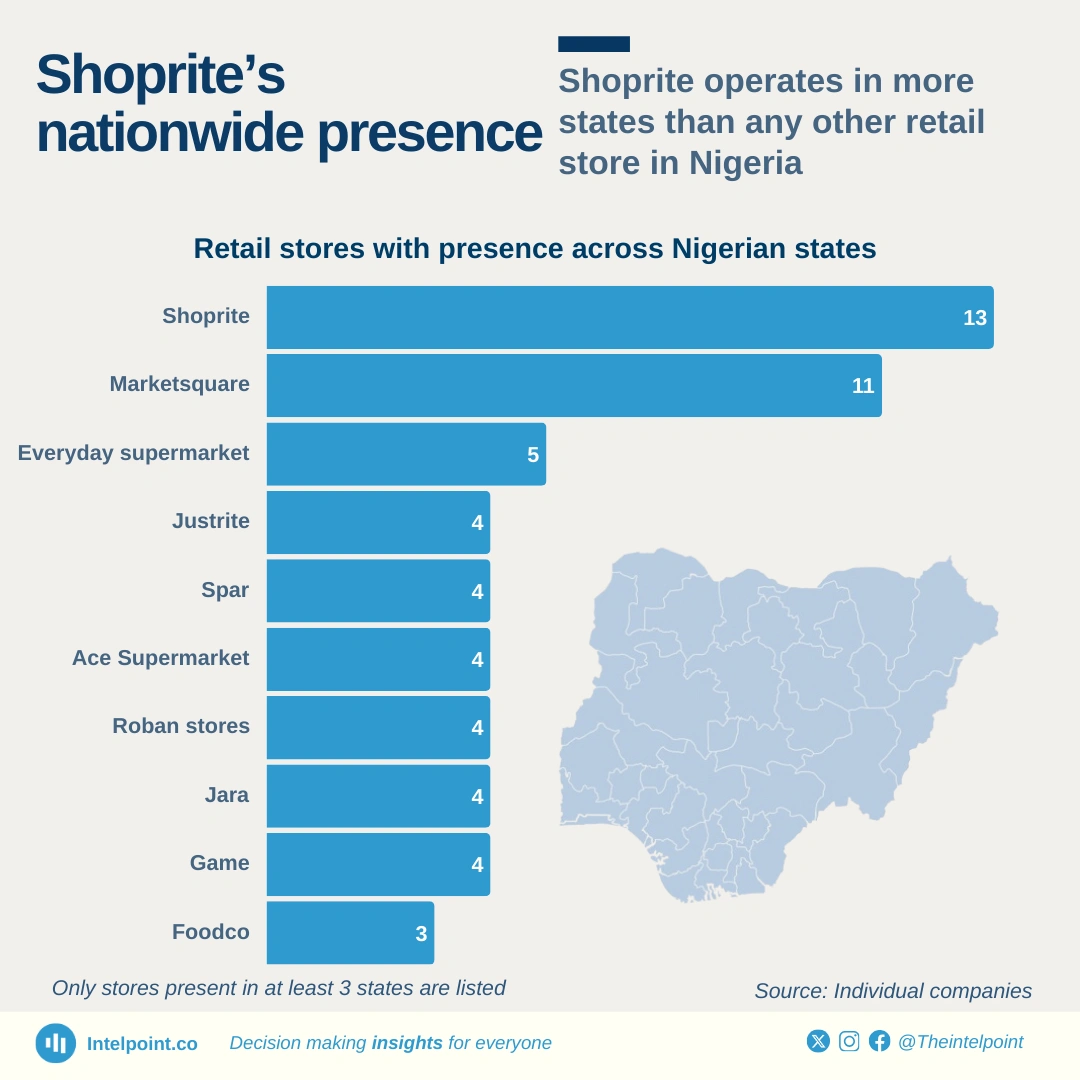
Shoprite operates in more states than any other retail store in Nigeria

Key takeaways

  • Shoprite leads in geographical presence, with stores in 13 Nigerian states, followed by Marketsquare with 11 states.
  • Everyday Supermarket is the only other chain with a presence in at least five states, while the majority of other brands are in just four or fewer states.
  • Most retail chains in Nigeria remain regionally concentrated, with only a few achieving significant national coverage.
  • The presence of only a few nationwide chains may present an opportunity for expansion by emerging retailers.

Nigeria’s retail sector is marked by significant disparities in geographical coverage. Shoprite remains the most widely distributed supermarket chain, present in 13 states, followed closely by Marketsquare, which operates in 11 states. Other brands like Everyday Supermarket, Justrite, and Spar have much smaller footprints, each spanning four to five states.
The concentration of retail chains in limited locations suggests logistical and operational constraints affecting national expansion. This pattern highlights the dominance of a few players in the supermarket segment while many others operate within restricted regions.

Source:

Individual companies

Period:

2025
HTML code to embed chart
Want a bespoke report?
Reach out
Tags
Related Insights

Nigeria’s food inflation has risen every month since January 2026, climbing 8.07 percentage points to 16.96% in May
  • Nigeria’s year-on-year food inflation rose for the fourth consecutive month, from 8.89% in January 2026 to 16.96% in May.
  • The rate increased by 8.07 percentage points within the first five months of 2026.
  • May’s 16.96% rate means food prices were, on average, 16.96% higher than they were in May 2025.
  • Food inflation rose from 12.12% in February to 14.31% in March and 16.06% in April before reaching 16.96% in May.
  • Food inflation exceeded Nigeria’s 15.93% headline inflation rate in May, showing that food was a major source of renewed pressure on household expenses.

Among 44 African countries, Nigeria's 16.96% food inflation in May 2026 was lower only than that of Libya and Malawi
  • Nigeria recorded the third-highest food inflation rate among 44 African countries in May 2026.
  • At 16.96%, Nigeria’s rate was lower only than Libya and Malawi, both at 17.6%.
  • Nigeria’s food inflation was nearly 3.5 times the 4.88% average across the countries covered.
  • Eight of the ten countries with the highest food inflation recorded rates above 10%.

Company income tax collections declined across 13 sectors in Q1 2026
  • Thirteen of Nigeria’s 21 sectors recorded year-on-year declines in CIT collections.
  • Extraterritorial organisations recorded the steepest fall at 53.9%.
  • Construction collections fell by 52.4%, the second-largest decline.
  • Mining and agriculture declined by 39.4% and 40.8%, respectively.
  • Manufacturing still generated ₦74.5 billion despite a 31.0% decline.

Eswatini and Morocco have remained in the World Bank's lower-middle-income band for at least 38 consecutive years
  • Nigeria has remained in the World Bank’s lower-middle-income category for 17 consecutive years.
  • Eswatini and Morocco have spent at least 38 consecutive years in the category, the longest among African countries.
  • Africa has 23 lower-middle-income economies in the World Bank’s Fiscal Year 2026 classification.
  • Tunisia, Angola, and Namibia entered the category after falling from upper-middle-income status.

Portfolio investment into Nigeria hit a 13-year quarterly high in Q1 2026
  • Portfolio investment into Nigeria reached $9.86 billion in Q1 2026, the highest quarterly level in 51 quarters.
  • The Q1 2026 portfolio inflow was higher than the previous peak of $7.11 billion recorded in Q1 2019.
  • Portfolio investment accounted for 95% of Nigeria’s total capital importation in Q1 2026.
  • Foreign Direct Investment remained low at $135 million, far below portfolio inflows.
  • Other Investment stood at $374 million, making it the second-largest inflow category in Q1 2026.

Three African countries are projected to have debt exceeding their GDP in 2026
  • Sudan is projected to have Africa’s highest debt-to-GDP ratio in 2026, at 169.1%.
  • Only three African countries are projected to owe more than the size of their economies in 2026.
  • Senegal and Mozambique join Sudan among countries with debt-to-GDP ratios above 100%.
  • Africa’s average government debt-to-GDP ratio is projected at 60.7% in 2026.
  • Nigeria’s projected debt-to-GDP ratio of 32.3% is far below the African average.

POPULAR TOPICS
SIGN UP TO OUR NEWSLETTER
Get periodic updates about the African startup space, access to our reports, among others.
Subscribe Here
Subscription Form

A product of Techpoint Africa. All rights reserved