Bite-sized Insights about
 
Providing you with data-based insights about things happening around you.
Popular Insights
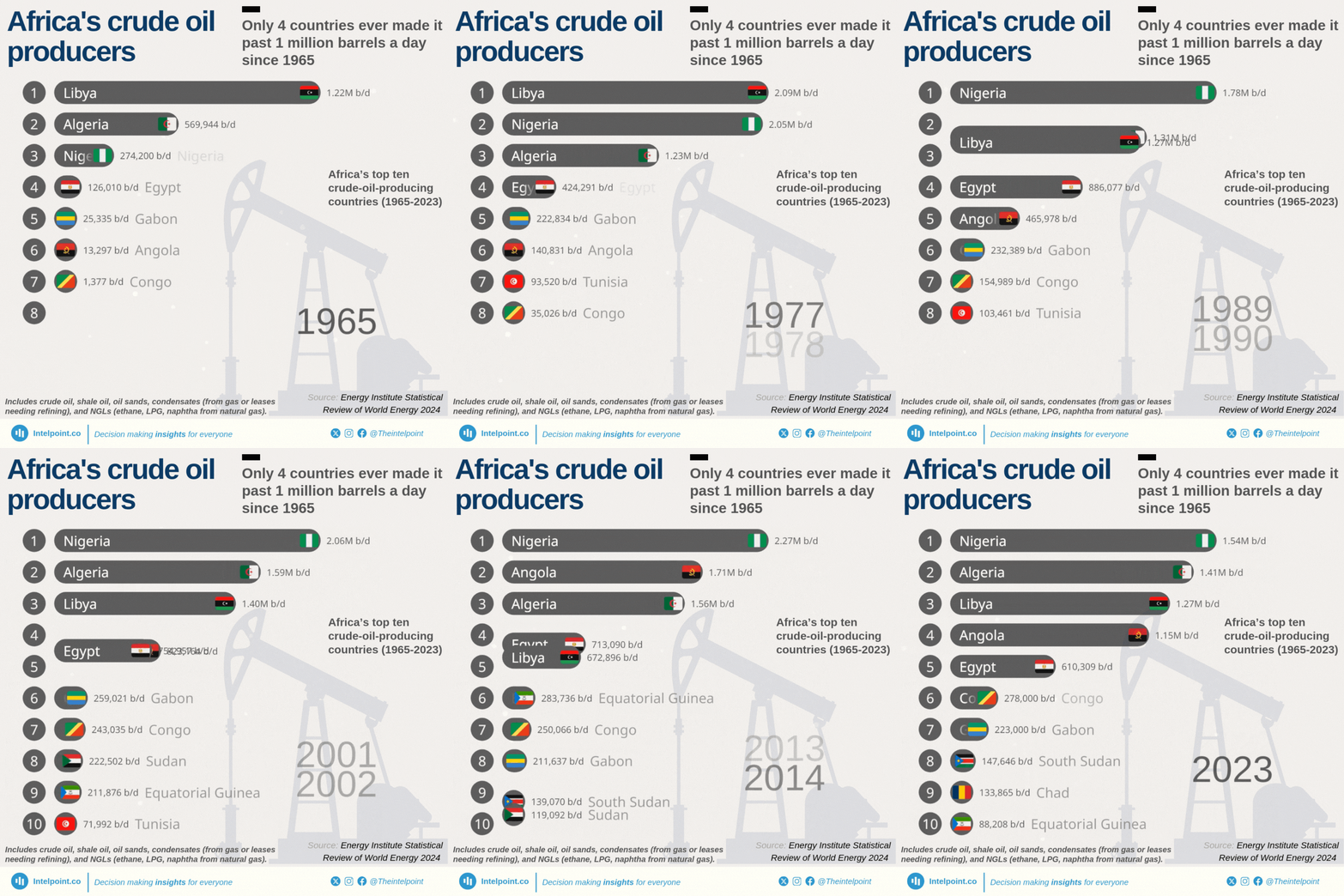
    • Only 4 countries have ever topped global oil production since 1973: the US, USSR, Saudi Arabia, and Russia.
    • The USSR and Saudi Arabia each led for 17 years, while Russia held 9 and the U.S. reclaimed the top with 8 years, mostly after the shale boom.
    • Top producers have peaked at 9–12 million barrels/day, but the US once dropped as low as 5 million in the 2000s.
    • Nigeria peaked at 2.5 million barrels/day in 2005 and 2011, but never reached the top five.
    • Global crude oil production grew by over 26 million barrels per day between 1973 and 2023—an increase of nearly 47% over 50 years.
    See more

    In January 2024, the communications authority in Zimbabwe warned against using Starlink Internet Services. The Southern African country has less than 100k subscribers on Fibre and Fixed LTE each. At the same time, a significant portion of its citizens rely on mobile Internet, with 10.97 million subscriptions as of 2023 in a country with 16.67 million people.

    See more
  • The 2024 Global Peace Index reveals a decline in peacefulness in 97 countries, the highest since the index began.

    Nigeria is among the nations affected by regional conflicts and rising violence. With a peace index score of 2.91, Nigeria is facing increasing challenges.

    A deteriorating peace score impacts foreign investment and economic stability. Global economic losses due to violence reached $19.1 trillion in 2023.

    See more

    The FAAC's revenue distribution from 2017 to August 2023 highlights the dominance of Delta, Akwa Ibom, Rivers, and Bayelsa states in allocations. Despite Lagos' economic prominence, it ranked fifth. Here is the distribution of revenue among states between 2017 and August 2023.

    See more
  • A Trend of Adult literacy rates of African countries

    Between 2018 and 2021, adult literacy rates across African nations exhibited significant disparities. Seychelles and South Africa led with literacy rates of 96% and 95%, respectively, indicating a high proportion of literate adults. Conversely, Chad had the lowest literacy rate during this period.

    These statistics underscore the uneven progress in educational attainment across Africa, highlighting the need for targeted interventions to improve literacy in lower-performing nations.

    See more

    Nigeria was the seventh most populous nation in the world in 2020, with 206.1 million people. Projected to reach a population of 401.3 million by 2050, Nigeria will rank third after India (1st) and China (2nd). According to Institut national d'études démographiques' projections, Nigeria, Ethiopia, DR Congo, Egypt, Tanzania, and Kenya will be among the world’s top 20 most populous countries by 2050.

    See more

  • Nigeria's debt burden has been a growing concern, with data revealing that for every $1 billion external loan repaid in the past decade, approximately $3 billion was borrowed. Here, we look at how the country has managed its external debt in the past ten years.
    See more
  • MTN Nigeria has dominated the country's telecommunications market over the years, accounting for the largest market share. All four operators, apart from 9mobile, recorded a significant increase in their subscriber base between May 2014 and March 2024.

    See more
  • The 2024 Global Peace Index reveals a decline in peacefulness in 97 countries, the highest since the index began.

    Nigeria is among the nations affected by regional conflicts and rising violence. With a peace index score of 2.91, Nigeria is facing increasing challenges.

    A deteriorating peace score impacts foreign investment and economic stability. Global economic losses due to violence reached $19.1 trillion in 2023.
    See more

Other Insights
  • Nigeria's largest cement manufacturers each recorded over 50% revenue growth in 2024
  • BUA Cement recorded the largest revenue growth in 2024 (90.5%), nearly doubling its revenue from ₦460 billion in 2023
  • Dangote Cement's revenue exceeded the combined revenue of BUA Cement and Lafarge Africa in both 2023 and 2024
  • Lafarge Africa earned ₦696.8 billion in revenue, the lowest revenue of the three cement majors
Read more
Key takeaways:
  • Tecno (23.55%) and Infinix (21.73%) lead the Nigerian mobile market, making up a combined 45.28% of the market share.
  • Samsung (12.36%) is the leading non-Chinese brand, with Apple (9.43%) following closely behind.
  • Xiaomi (7.15%) and Huawei (4.34%) are emerging as significant players in Nigeria's mobile sector.
  • Premium brands such as Samsung (12.36%) and Apple (9.43%) have considerable but smaller market shares compared to their Chinese counterparts.
  • Chinese manufacturers collectively dominate over 60% of the mobile market in Nigeria.
Read more
Key takeaways:
  • In February 2025, Samsung and Apple dominate the mobile market in Africa.
  • Samsung leads with a 29.80% share of the continent's mobile market based on usage.
  • Apple ranks second with a 13.27% share, demonstrating resilience in markets sensitive to pricing.
  • Collectively, Chinese manufacturers hold more than 45% of the mobile market in Africa.
  • Brands under Transsion Holdings (Tecno, Infinix, Itel) together represent nearly 25% of the total market share based on usage.
Read more
Key Takeaways:
  • In 2023, Kiribati spent the largest % of its GDP on education, amounting to 16.39%.
  • Kiribati, Tuvalu, and Vanuatu each allocated over 10% of their GDP to education.
  • Bolivia and the Solomon Islands each directed around 8.3% of their GDP spending towards education.
  • The top ten countries dedicated approximately 6.6% to 16.4% of their GDP to education.
Read more
  • Lagos carried the South-West VAT burden, remitting ₦305.52B (89.6% of the region's total) but receiving only ₦62.59B (20.5% return), making it the highest net contributor in Nigeria.
  • Osun had the most disproportionate gain, remitting a mere ₦590M but receiving ₦7.73B, an astronomical 1,211% return—the highest redistribution gain in the South-West.
  • The entire South-West remitted ₦341.18B but received only ₦106.85B, meaning it got back just ₦0.31 for every ₦1 contributed, highlighting a severe VAT allocation imbalance.
  • Ondo and Ogun remitted only ₦3.3B but received ₦16B combined, far exceeding their generated VAT, while Lagos alone subsidised most of the allocations across the country.
Read more
  • The South-East remitted ₦10.94 billion in VAT but received ₦39.15 billion, a 257.7% increase, showing a high reliance on VAT sharing.
  • Abia, the lowest contributor (₦734M), received ₦7.29B, nearly 10× its remittance, making it the biggest relative beneficiary in the region.
  • Anambra, the highest contributor (₦3.56B), received only ₦8.72B, showing a sharing trend where high-contributing states do not necessarily receive the most.
  • Every South-East state received at least 2× what they remitted, with an average allocation of ₦7.83B despite an average contribution of just ₦2.19B.
Read more
1 138 139 140 141 142 257

Can’t find what you’re looking for? Please fill the form below
Contact Form Demo
SIGN UP TO OUR NEWSLETTER
Get periodic updates about the African startup space, access to our reports, among others.
Subscribe Here
Subscription Form

A product of Techpoint Africa. All rights reserved