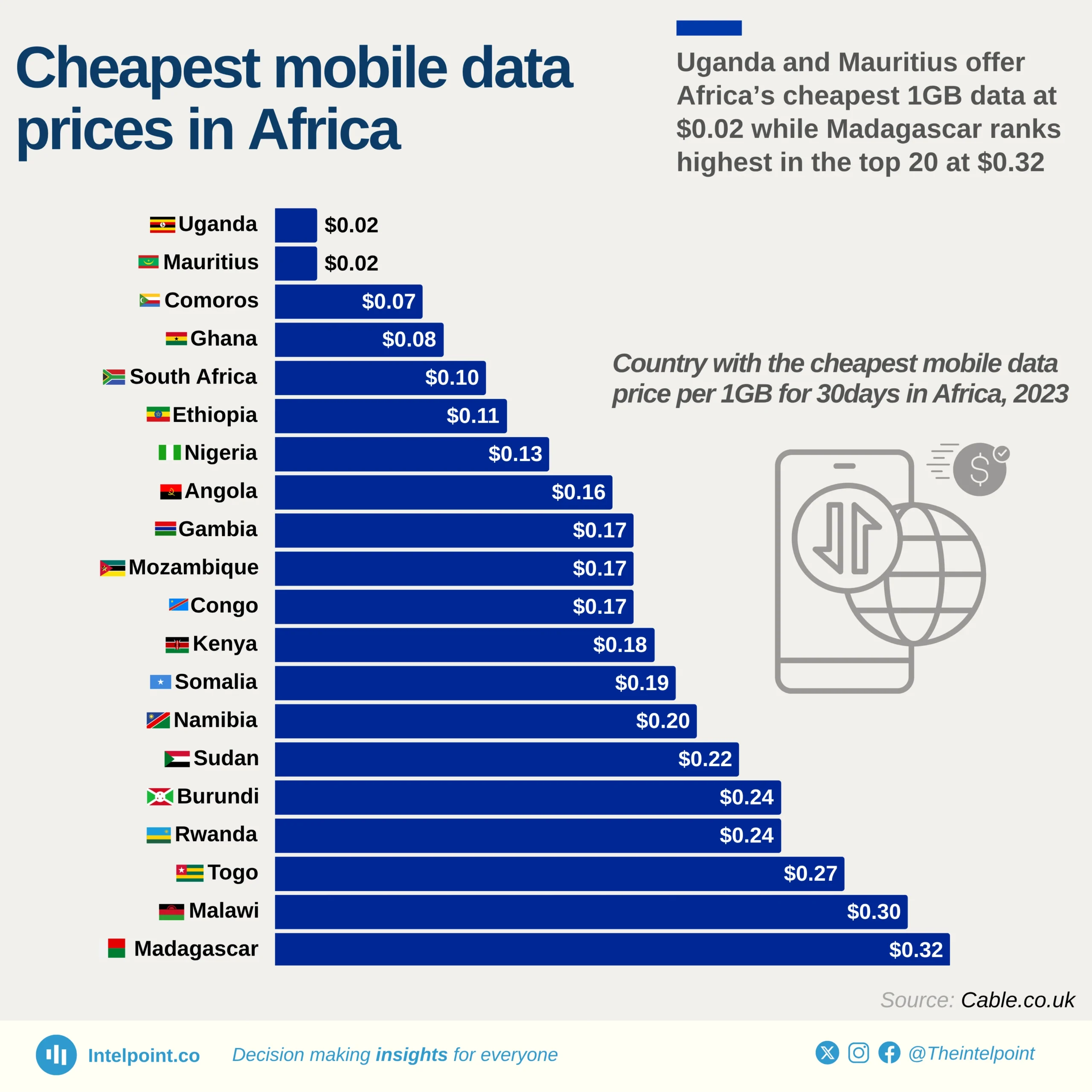
Uganda and Mauritius offer Africa’s cheapest 1GB data at $0.02 while Madagascar ranks highest in the top 20 at $0.32

Key Takeaways

  • Uganda and Mauritius offer the most affordable mobile data in Africa, with 1GB for just $0.02 over a 30-day period.
  • Comoros, Ghana, and South Africa also rank among the cheapest, each offering 1GB of data for $0.07 to $0.10.
  • Nigeria is among the top 10, with a relatively low cost of $0.13 per 1GB, placing it below the continental average.
  • Madagascar, at $0.32 per 1GB, closes out the top 20, which reflects the upper boundary of affordable data across African nations.

Across Africa, the cost of mobile data can vary sharply from one country to the next, even among those with the cheapest rates. At the very top of the list are Uganda and Mauritius, where 1GB of data costs just $0.02. Close behind are Comoros ($0.07), Ghana ($0.08), and South Africa ($0.10).

Nigeria, Africa’s largest economy and most populous country, also makes the top 10, with 1GB costing $0.13. Others on the list include Angola, Gambia, and Zambia, showing that affordable data spans both West and Southern Africa. The 20th spot—Madagascar—closes out the list with a still-low price of $0.30 per GB.

But even at these prices, the lived experience of affordability differs. In a country like Mauritius, where incomes are relatively higher and the cost of living is more stable, $0.02 may feel truly negligible. In Uganda or Comoros, that same $0.02 may carry more weight when stacked against food, transport, or housing costs.

While all 20 countries on this list boast low data prices, the real affordability of internet access still depends on local wages, living costs, and daily priorities.
Source:

Cable.co.uk

Period:

2023
HTML code to embed chart
Want a bespoke report?
Reach out
Tags
Related Insights

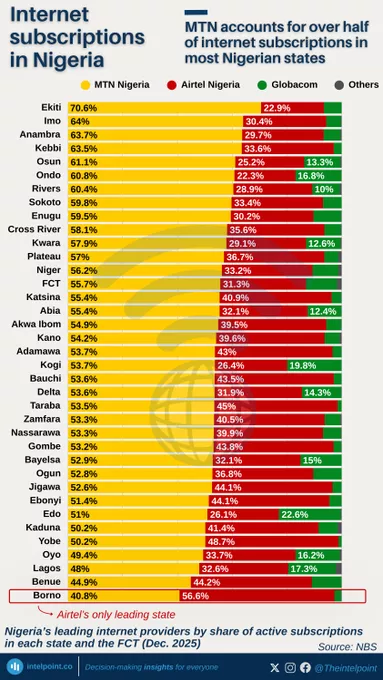
MTN accounts for over half of internet subscriptions in most Nigerian states
  • MTN held over 50% of active internet subscriptions in most Nigerian states as of December 2025.
  • Ekiti had MTN’s highest share at 70.6%, followed by Imo at 64% and Anambra at 63.7%.
  • Borno was the only state where Airtel led, with 56.6% of active internet subscriptions.
  • Globacom did not lead any state, but it had notable shares in Edo, Kogi, Ondo, Oyo, and Bayelsa.
 

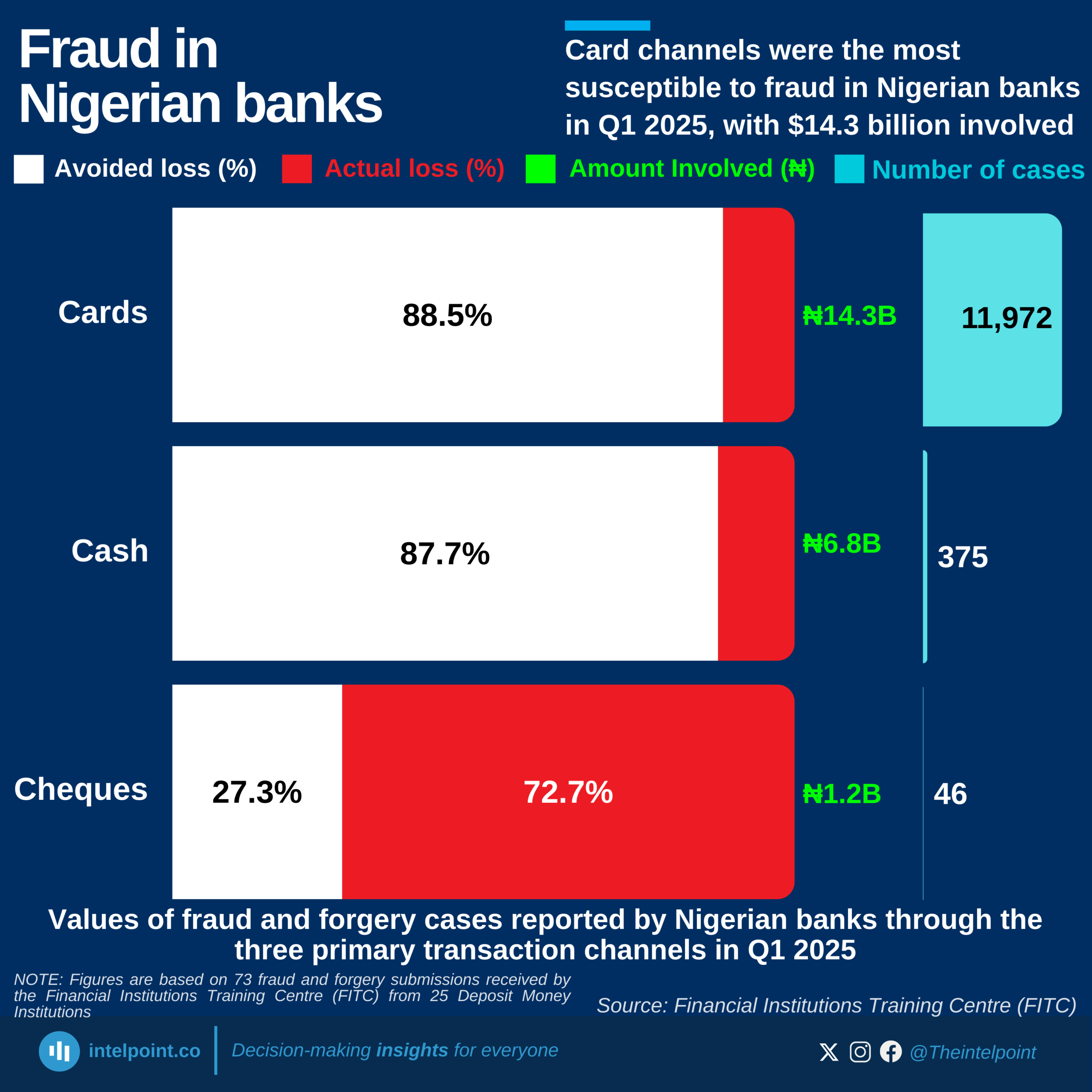
Card channels were the most susceptible to fraud in Nigerian banks in Q1 2025, with $14.3 billion involved
  • Cards were the most involved in fraud, with ₦14.3 billion representing the most significant exposure among all transaction channels
  • Card transactions also had the highest number of cases (11,972), indicating widespread and frequent attacks
  • Actual losses on cards were 11.5% (₦1.6 billion) of the amount involved, showing that significant financial damage still occurs despite preventive systems
  • Cash fraud accounted for ₦6.8 bn in exposure, nearly half of the card channel’s total
  • Cash also recorded 12.3% (₦800 million) in actual losses
  • Cheques had the lowest fraud involvement (₦1.2 billion) and only 46 cases, but the highest actual loss rate (72.7%)

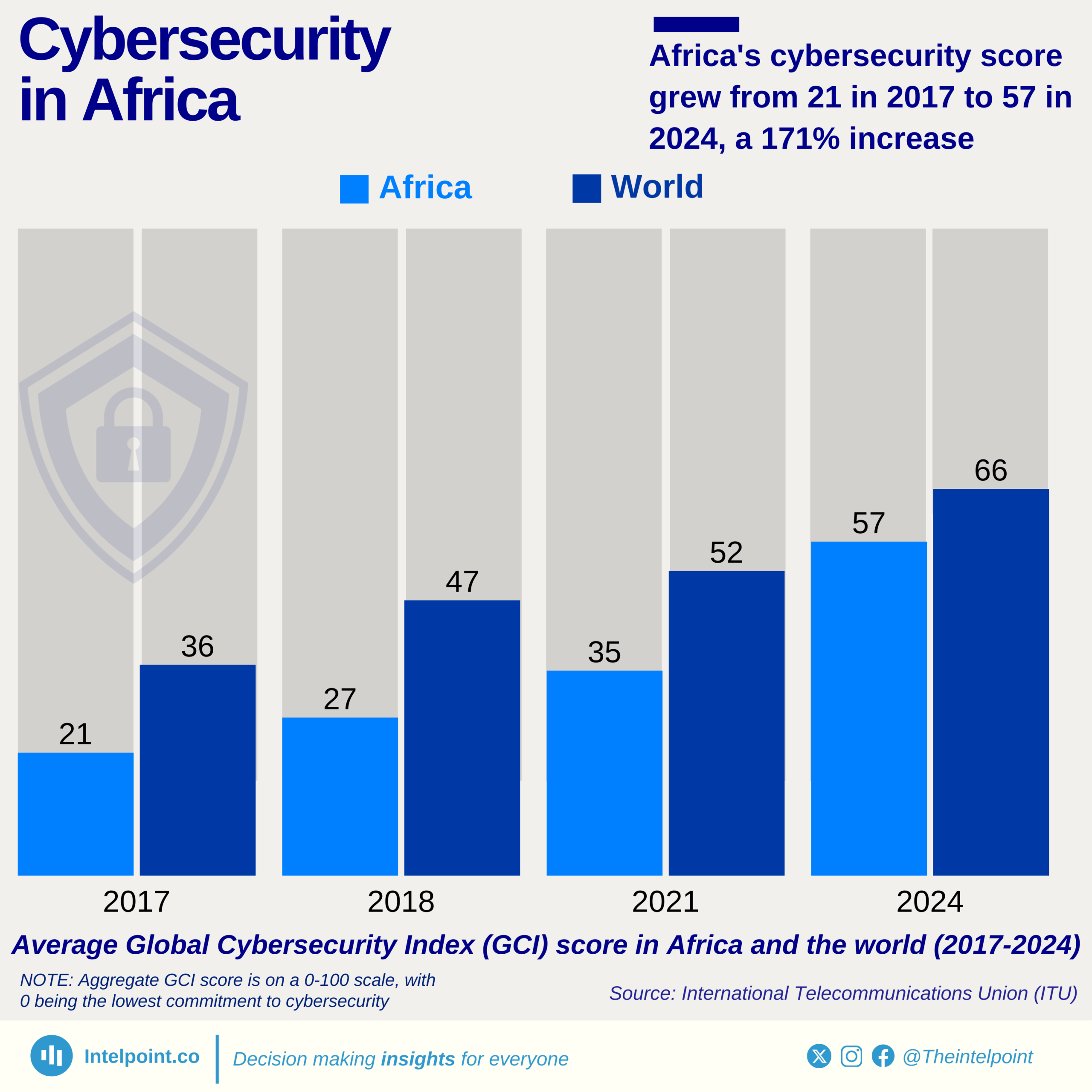
Africa's cybersecurity score grew from 21 in 2017 to 57 in 2024, a 171% increase
  • Africa’s cybersecurity score increased by 171% between 2017 and 2024.
  • The continent’s score rose from 21 in 2017 to 57 in 2024
  • Africa has reduced the gap with global averages, reducing the difference from 15 points in 2017 to 9 points in 2024.
  • The global cybersecurity score rose from 36 in 2017 to 66 in 2024.
  • Africa’s most notable leap was between 2021 (35) and 2024 (57), showing accelerated progress in recent years.

South Africa leads Africa in internet speed at 42.4 Mbps
  • South Africa sets the benchmark with the fastest average download speed (42.42 Mbps), more than double Morocco’s (19.61 Mbps).
  • Southern African countries dominate the top half of the ranking, with South Africa, Eswatini, Botswana, Lesotho, and Madagascar all featuring strongly.
  • Rwanda and Mauritius show East Africa’s progress, with average speeds above 30 Mbps, signalling solid digital infrastructure growth.
  • Wide disparities persist, with the gap between the highest (South Africa) and lowest (Morocco) averaging over 22 Mbps.

Sudan recorded the least average internet speed in 2024 at just 4.02 Mbps
  • Sudan sits at the bottom with an average speed of 4.02 mbps, far below the continental average.
  • The Central African Republic follows closely at 4.08 mbps, making Central Africa a weak spot for digital connectivity.
  • Somalia, despite topping the list, averaged only 6.64 mbps, showing even the “fastest among the slowest” remains well behind global standards.
  • The concentration of slow speeds in East and Central Africa points to persistent infrastructure and investment gaps.

Average monthly data use in Nigeria now exceeds 7GB per active internet subscription
  • Per-user data usage more than doubled in 29 months.
  • The surge [was] driven by heavier usage, not more users.
  • February dips and year-end spikes show seasonal habits.
  • 2024 marked a lasting shift to higher monthly data use.
 

POPULAR TOPICS
SIGN UP TO OUR NEWSLETTER
Get periodic updates about the African startup space, access to our reports, among others.
Subscribe Here
Subscription Form

A product of Techpoint Africa. All rights reserved