Bite-sized Insights about
 
Providing you with data-based insights about things happening around you.
Popular Insights
  • Rivers State generated the highest revenue among the South-Southern states in 2020, making it the second top contributor among all states. Delta State received the highest allocation from the FAAC in the region.

    See more

    In 2023, Nigeria emerged as the second-largest source of UK work visa applications, with 92.7k applications, trailing only India (171.8k). This places Nigeria ahead of other countries like the Philippines (29.5k), Ghana (36.2k), Pakistan (48.4k), and Zimbabwe (50.3k).

    Nigeria, Zimbabwe, and Ghana were the top African countries seeking work in the UK in 2023.

    See more
  • The 2024 Global Peace Index reveals a decline in peacefulness in 97 countries, the highest since the index began.

    Nigeria is among the nations affected by regional conflicts and rising violence. With a peace index score of 2.91, Nigeria is facing increasing challenges.

    A deteriorating peace score impacts foreign investment and economic stability. Global economic losses due to violence reached $19.1 trillion in 2023.

    See more

    The FAAC's revenue distribution from 2017 to August 2023 highlights the dominance of Delta, Akwa Ibom, Rivers, and Bayelsa states in allocations. Despite Lagos' economic prominence, it ranked fifth. Here is the distribution of revenue among states between 2017 and August 2023.

    See more
  • A Trend of Adult literacy rates of African countries

    Between 2018 and 2021, adult literacy rates across African nations exhibited significant disparities. Seychelles and South Africa led with literacy rates of 96% and 95%, respectively, indicating a high proportion of literate adults. Conversely, Chad had the lowest literacy rate during this period.

    These statistics underscore the uneven progress in educational attainment across Africa, highlighting the need for targeted interventions to improve literacy in lower-performing nations.

    See more
    Countries by Global Innovation Index 2024

    The Global Innovation Index 2024 reveals a striking contrast in innovation performance between countries globally and across Africa. Switzerland leads the global rankings with an impressive score of 67.5, followed by Sweden (64.5) and the USA (62.4), highlighting their sustained investments in research, development, and technological advancement.

    In Africa, Mauritius takes the top spot with a score of 30.5, followed closely by Morocco (28.8) and South Africa (28.3). However, even Africa's most innovative nations achieve less than half the score of global leaders, indicating a significant innovation gap.

    Nigeria ranks 15th in the African ranking and 113th globally, out of 133 countries, with a score of 17.1.

    See more

    • The top 15 Nollywood movies grossed ₦3.4 trillion combined.
    • The top Nollywood movie in 2024, Everybody Loves Jenifa, accounted for 33.3% of the ₦3.4 trillion.
    • 13 Nollywood movies crossed ₦100 million in earnings.
    See more
  • MTN Nigeria has dominated the country's telecommunications market over the years, accounting for the largest market share. All four operators, apart from 9mobile, recorded a significant increase in their subscriber base between May 2014 and March 2024.

    See more
  • The 2024 Global Peace Index reveals a decline in peacefulness in 97 countries, the highest since the index began.

    Nigeria is among the nations affected by regional conflicts and rising violence. With a peace index score of 2.91, Nigeria is facing increasing challenges.

    A deteriorating peace score impacts foreign investment and economic stability. Global economic losses due to violence reached $19.1 trillion in 2023.
    See more

Other Insights
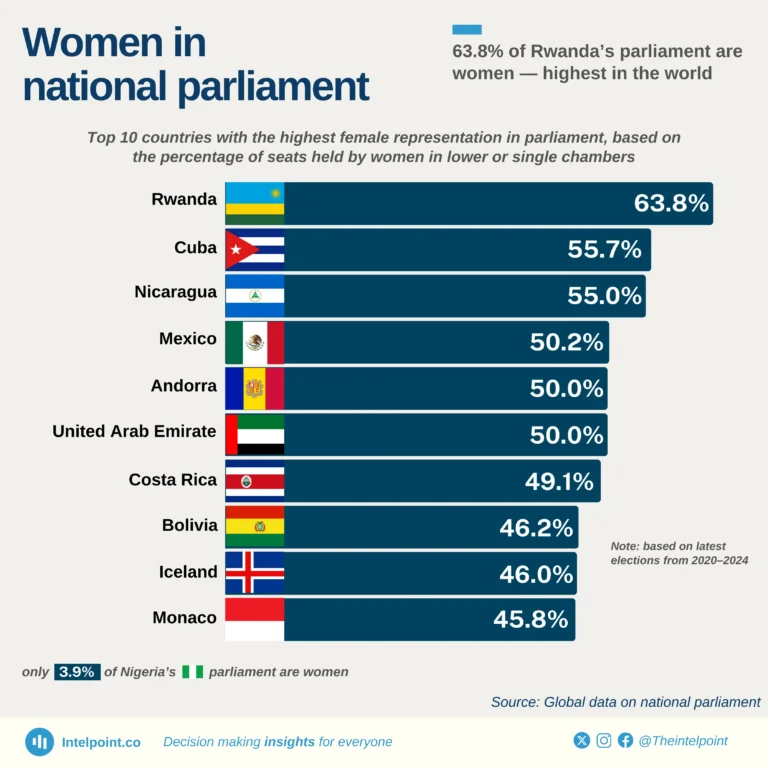
International Women's Day 2025
  • There are nearly 600 million women aged 15-24 worldwide, with 90% living in low- and middle-income countries (LMICs), making them a significant share of the global population.
  • 37 countries grant women less than half of the legal rights of men, affecting 500 million women, while globally, women enjoy less than two-thirds of the legal rights available to men.
  • Closing the gender gap in employment and entrepreneurship could boost global GDP by over 20%, and eliminating the gap within a decade could double the global growth rate.
  • Women hold just 1 in 5 corporate board positions, partly because less than 20% of countries require gender-sensitive public procurement, excluding them from a $10 trillion-a-year opportunity.
  • Women earn only 77 cents for every $1 paid to men, while 92 countries lack equal pay laws. Additionally, 20 countries prohibit women from night work and 45 ban women from “dangerous” jobs.
  • By 2030, an estimated 8% of the world’s female population (342.4 million women and girls) will still live on less than $2.15 a day, with 220.9 million in sub-Saharan Africa.
  • Climate change could push 158.3 million more women and girls into poverty by 2050, which is 16 million more than men and boys under a worst-case scenario.
  • By 2020, food insecurity was projected to impact 236 million more women and girls, compared to 131 million more men and boys.
  • By 2050, women will still spend 2.5 times more hours per day on unpaid care work than men. If valued monetarily, women’s unpaid labor could exceed 40% of GDP in some countries.
Read more
Suspected diphtheria cases reported in Nigeria (2022 - 2025)
  • With 24,062 cases, Kano accounts for the highest number of suspected diphtheria cases, making up a significant portion of the total outbreak in Nigeria.
  • Yobe recorded 5,330 cases, while Katsina had 3,939 cases, reinforcing the concentration of diphtheria in northern states.
  • Bauchi and Borno report similar case counts, with 3,066 and 3,035 cases, respectively.
  • Kaduna (777 cases) and Jigawa (364 cases) report fewer cases but remain part of the seven states contributing to 96.6% of the outbreak.
  • Other states combined report 1,405 cases, showing that diphtheria is largely a regional issue.
  • Northern states dominate the case count, signaling potential regional healthcare and vaccination disparities.
Read more
Nigerian financial institutions’ contribution to GDP (2016–Q1 2024)
  • At 6.40%, financial institutions now contribute more than ever to Nigeria’s GDP.
  • From 3.60% in 2022 to 6.40% in Q1 2024, the sector’s share has nearly doubled in record time.
  • Between 2016 and 2019, the financial sector's contribution remained mostly flat at 2.60%–2.70%, showing little progress.
  • The financial sector started expanding post-2019, aligning with increased fintech adoption, digital banking growth, and financial inclusion policies.
  • The increasing role of financial institutions suggests more businesses and individuals are engaging with formal banking systems.
  • Despite economic uncertainties, Nigeria’s financial sector has successfully adapted and expanded, proving its ability to drive growth.
Read more
Number of countries anticipated to either have sufficient or shortage of primary school teachers by region (2030)
  • Sub-Saharan Africa has the highest number of countries (37) expected to face a teacher shortage at the [primary levels.
  • In Latin America & the Caribbean, 18 countries are expected to have enough primary teachers.
  • Europe & Northern America is one of the best-performing after Latin America & the Caribbean, with 17 countries expected to meet primary teachers' demand.
  • If this trend continues, millions of children will struggle to access quality primary education, reinforcing cycles of poverty and limited economic mobility.
  • A lack of teachers doesn’t just mean fewer classrooms; it also means overburdened educators, lower student engagement, and declining educational outcomes.
Read more
Key Takeaways:
  • Nigeria's total revenue decreased from 17.73% of GDP in 2011 to 9.09% in 2022.
  • The lowest point for the country’s revenue occurred in 2016, at only 5.12% of GDP.
  • Although there has been some recovery since 2016, revenue still falls well below the levels seen before 2015.
  • The sharpest decline took place between 2011 and 2016, with revenue dropping by over 12 percentage points.
  • In 2020, during the COVID-19 pandemic, there was a significant drop to 6.52%, followed by a period of recovery.
Read more
Key takeaways:
  • Amidst the overall upward rise in inflation since May 2023, Nigeria experienced a brief relief with slight declines between June and September 2024.
  • The inflation rate in May 2024 was 11.54% points higher than that of June 2023.
  • The inflation rate in Nigeria increased by approximately 55% from May 2023 to December 2024.
  • In December 2024, the inflation rate increased by about 4.9% points when compared to January 2024.
  • Between December 2024 and January 2025, the inflation rate dropped by 10.32%.
  • The National Bureau of Statistics rebased the Consumer Price Index from 2009 to 2024 in January 2025.
Read more
1 141 142 143 144 145 255

Can’t find what you’re looking for? Please fill the form below
Contact Form Demo
SIGN UP TO OUR NEWSLETTER
Get periodic updates about the African startup space, access to our reports, among others.
Subscribe Here
Subscription Form

A product of Techpoint Africa. All rights reserved