Bite-sized Insights about
 
Providing you with data-based insights about things happening around you.
Popular Insights
  • According to 2022 and 2023 data for 40 African countries, Egypt leads in the value of manufacturing output reaching $59.6 billion in 2023 despite a 21% drop from 2022.

    Nigeria follows with $55.7 billion, while South Africa comes third with $48.8 billion.

    See more

    Bayelsa, Gombe, and Katsina States have the fewest accredited universities — five each — of the 274 in Nigeria in 2024. Ogun leads with 19, followed closely by Abuja (17) and Delta (15).

    See more
  • A Trend of Adult literacy rates of African countries

    Between 2018 and 2021, adult literacy rates across African nations exhibited significant disparities. Seychelles and South Africa led with literacy rates of 96% and 95%, respectively, indicating a high proportion of literate adults. Conversely, Chad had the lowest literacy rate during this period.

    These statistics underscore the uneven progress in educational attainment across Africa, highlighting the need for targeted interventions to improve literacy in lower-performing nations.
    See more

    Africa's sanitation crisis is alarming, with 17 of the top 20 countries having the highest open defecation rates.

    Eritrea (67%), Niger (65%), and Chad (63%) lead, putting millions at risk of disease.

    Even Nigeria, the most populous African country, has 18% of its population practising it.

    See more
  • Nigeria was the seventh most populous nation in the world in 2020, with 206.1 million people. Projected to reach a population of 401.3 million by 2050, Nigeria will rank third after India (1st) and China (2nd). According to Institut national d'études démographiques' projections, Nigeria, Ethiopia, DR Congo, Egypt, Tanzania, and Kenya will be among the world’s top 20 most populous countries by 2050.

    See more

    The FAAC's revenue distribution from 2017 to August 2023 highlights the dominance of Delta, Akwa Ibom, Rivers, and Bayelsa states in allocations. Despite Lagos' economic prominence, it ranked fifth. Here is the distribution of revenue among states between 2017 and August 2023.

    See more

  • Global smartphone shipments market share by companies in 2024 (Q1-Q3)

    Samsung consistently led the global smartphone shipments market through the first three quarters of 2024, maintaining the highest market share in each quarter.

    Apple and Xiaomi followed closely, while other brands, including Oppo, Vivo, and Transsion, were among the top brands. The top three smartphone brands (Samsung, Apple, and Xiaomi) dominate the market, collectively capturing nearly half of the global share in the first three quarters of 2024.

    See more
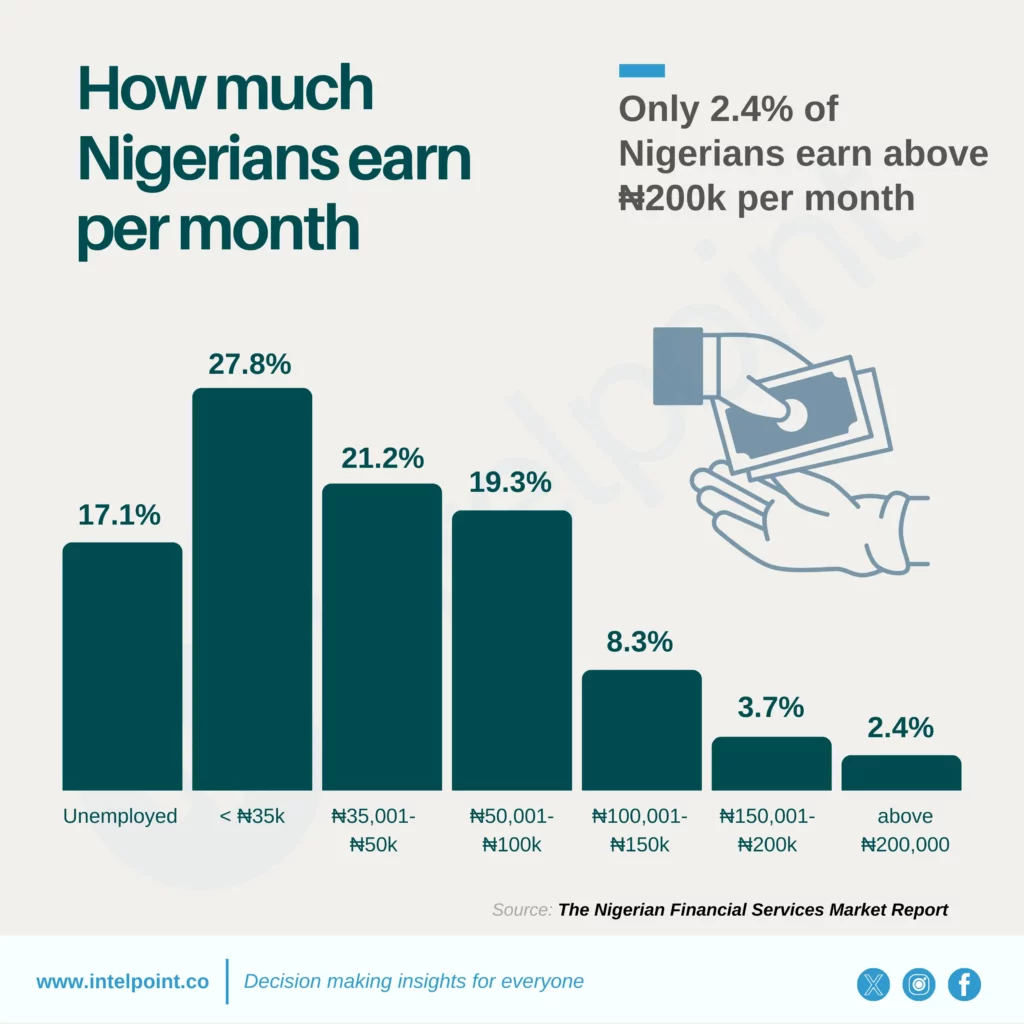
  • Only 10% of Nigerians earn above ₦100,000, according to the Nigerian Financial Services Market Report. This aligns with most reports about Nigeria, and it's in sharp contrast to the narratives online.
    See more
  • A Trend of Adult literacy rates of African countries

    Between 2018 and 2021, adult literacy rates across African nations exhibited significant disparities. Seychelles and South Africa led with literacy rates of 96% and 95%, respectively, indicating a high proportion of literate adults. Conversely, Chad had the lowest literacy rate during this period.

    These statistics underscore the uneven progress in educational attainment across Africa, highlighting the need for targeted interventions to improve literacy in lower-performing nations.

    See more

Other Insights
E-commerce payments method in Nigeria (transaction value %), 2023 and 2027
  • Digital wallets are the fastest-growing e-commerce payment method in Nigeria, set to double from 11% in 2023 to 22% by 2027.
  • A2A transfers remain the dominant payment method, slightly increasing from 32% to 34%, showing continued reliance on direct bank-to-bank transfers.
  • Cash-on-delivery is becoming less relevant, dropping from 15% in 2023 to just 9% in 2027, signaling a shift away from cash-based transactions.
  • Both debit card and credit card payments are declining, with debit cards dropping from 19% to 16% and credit cards falling from 15% to 12%, suggesting a changing balance in card preferences.
  • Prepaid cards and buy now, pay later (BNPL) solutions remain relatively small players in the Nigerian e-commerce space, with minimal growth.
Read more
Nigeria's Value Added Tax collections by sector (Q1-Q2 2024)
  • Three sectors, Manufacturing, ICT, and Mining & Quarrying, accounted for 58.8% of total VAT revenue in the first half of 2024.
  • Manufacturing alone contributed 24.8% of VAT, making it the highest-paying sector.
  • Nigeria’s digital economy is thriving, with ICT generating 17.6% of VAT revenue, signaling the growth of telecom, data services, and digital platforms.
  • The extractive industry remains vital, with Mining & Quarrying contributing 16.4% of total VAT collection.
  • Finance & Insurance (10.2%) and Public Administration & Defence (9.7%) also made significant contributions to Nigeria’s VAT revenue.
  • Despite contributions from 21 sectors, VAT revenue is still heavily reliant on a few key industries, highlighting the need for a broader tax base.
Read more
Nigeria's public debt stock (2017 - 2024)
  • External debt has nearly doubled as in 2017, it stood at 26.64%, but by 2024, it had risen to 46.96%.
  • Domestic debt has dropped from 73.36% in 2017 to 53.04% in 2024, showing a decline.
  • Nigeria’s increasing reliance on external loans suggests a strategic shift in public debt financing.
  • Unlike other years, domestic debt share slightly increased in 2023, rising to 60.74%, before external debt rebounded in 2024.
  • A rising share of external debt means higher exposure to foreign exchange risks and global market conditions.
  • If the trend continues, Nigeria’s external and domestic debt may soon be equal, reducing the traditional dominance of domestic borrowing.
Read more
  • Nigeria remains the largest forest owner in West Africa, despite a steady decline in forest area from 217,902.5 km² in 2019 to 213,003.5 km² in 2022.
  • Ghana is the only top forest-owning country with increasing forest area, growing from 79,784.8 km² in 2019 to 80,001.6 km² in 2022.
  • Liberia, Senegal, and Burkina Faso all experienced gradual declines in forest area over the period.
  • Burkina Faso has the smallest forest area among these countries, with 61,164 km² in 2022.
Read more
  • Apple leads the global market with $3.863 trillion market capitalisation, followed closely by Nvidia at $3.355 trillion and Microsoft at $3.200 trillion.
  • Tesla ($1.385T) remains the most valuable automobile company, far ahead of traditional car manufacturers.
  • The highest-ranked non-tech company, Saudi Aramco, stands at $1.805 trillion.
  • Other trillion-dollar companies span industries such as finance (Berkshire Hathaway – $0.984T) and media (Meta – $1.514T).
Read more
  • Nigeria’s agricultural GDP reached ₦19.3 billion in 2023, showing minimal growth.
  • From 2013 to 2023, agriculture played a key role in Nigeria’s economic growth, averaging 24.43% of the total annual GDP.
  • Agriculture's share in the total GDP in 2020 (25.90%) dropped to 24.76% in 2023.
  • Post-pandemic recovery in the agricultural sector has been robust, with consistent growth from ₦18.3 billion in 2020 to ₦19.3 billion in 2023.
  • Agriculture remains a critical driver of Nigeria’s economy, ensuring food security and supporting livelihoods across the country.
Read more
1 130 131 132 133 134 234

Can’t find what you’re looking for? Please fill the form below
Contact Form Demo
SIGN UP TO OUR NEWSLETTER
Get periodic updates about the African startup space, access to our reports, among others.
Subscribe Here
Subscription Form

A product of Techpoint Africa. All rights reserved