Bite-sized Insights about
 
Providing you with data-based insights about things happening around you.
Popular Insights
  • Abdulsamad Rabiu’s wealth has consistently increased for 4 consecutive years since 2020. Aliko Dangote, on the other hand, experienced 3 consecutive years of wealth growth starting from 2021. Mike Adenuga's wealth recorded growth in 2021 and 2022, but it took a downturn in 2023.

    Abdulsamad Rabiu's financial journey has been particularly noteworthy, with his wealth witnessing a substantial surge from $1.2b in 2014 to $8.2b in 2023. This growth has seen him surpass Mike Adenuga and become the country's second-wealthiest individual as of 2023.

    See more
    The world’s smartphone companies shipped a combined 1.2 billion smartphones in 2022. Here are the top five.
    See more
  • A Trend of Adult literacy rates of African countries

    Between 2018 and 2021, adult literacy rates across African nations exhibited significant disparities. Seychelles and South Africa led with literacy rates of 96% and 95%, respectively, indicating a high proportion of literate adults. Conversely, Chad had the lowest literacy rate during this period.

    These statistics underscore the uneven progress in educational attainment across Africa, highlighting the need for targeted interventions to improve literacy in lower-performing nations.
    See more

    Africa's sanitation crisis is alarming, with 17 of the top 20 countries having the highest open defecation rates.

    Eritrea (67%), Niger (65%), and Chad (63%) lead, putting millions at risk of disease.

    Even Nigeria, the most populous African country, has 18% of its population practising it.

    See more
  • Nigeria was the seventh most populous nation in the world in 2020, with 206.1 million people. Projected to reach a population of 401.3 million by 2050, Nigeria will rank third after India (1st) and China (2nd). According to Institut national d'études démographiques' projections, Nigeria, Ethiopia, DR Congo, Egypt, Tanzania, and Kenya will be among the world’s top 20 most populous countries by 2050.

    See more

    The FAAC's revenue distribution from 2017 to August 2023 highlights the dominance of Delta, Akwa Ibom, Rivers, and Bayelsa states in allocations. Despite Lagos' economic prominence, it ranked fifth. Here is the distribution of revenue among states between 2017 and August 2023.

    See more

  • Nigeria's import value increased by 8.7% quarter-on-quarter and 63% year-on-year, reaching ₦14.67 trillion in Q3 2024. China led as the top trading partner with imports valued at ₦3.57 trillion (24%), while Malta rounded out the top five with ₦767 billion (5%).

    See more
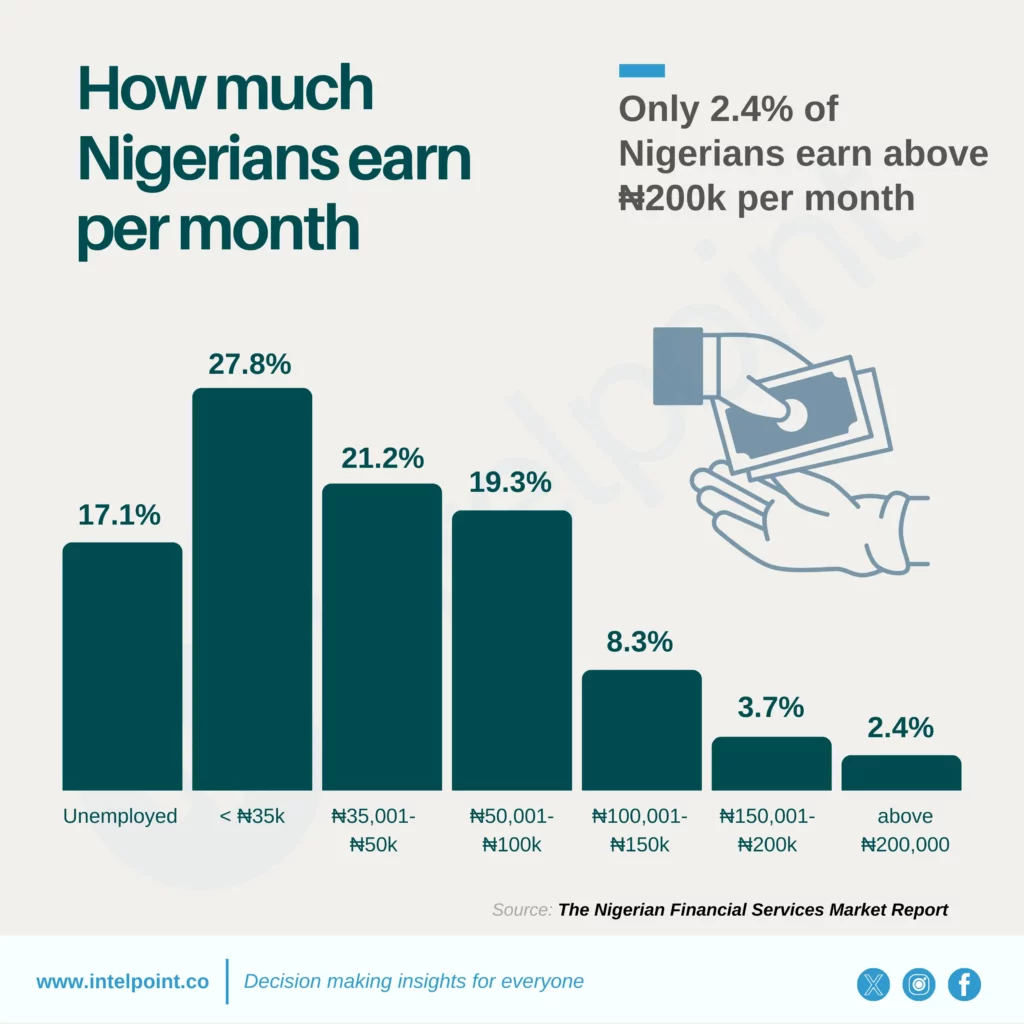
  • Only 10% of Nigerians earn above ₦100,000, according to the Nigerian Financial Services Market Report. This aligns with most reports about Nigeria, and it's in sharp contrast to the narratives online.
    See more
  • A Trend of Adult literacy rates of African countries

    Between 2018 and 2021, adult literacy rates across African nations exhibited significant disparities. Seychelles and South Africa led with literacy rates of 96% and 95%, respectively, indicating a high proportion of literate adults. Conversely, Chad had the lowest literacy rate during this period.

    These statistics underscore the uneven progress in educational attainment across Africa, highlighting the need for targeted interventions to improve literacy in lower-performing nations.

    See more

Other Insights
  • Women-led businesses in Africa raise significantly less funding than male-led counterparts. In 2017, female-led startups secured only $1 for every $25 raised by male-led startups, and this disparity persisted through 2024.
  • Despite making up 26% of all entrepreneurs in Africa, women receive less than 10% of total investment capital.
  • Women in Africa face structural financing challenges, including limited collateral, fewer investment networks, and biases in lending decisions.
  • While some countries have introduced financial inclusion programmes, overall access to credit for women remains disproportionately low.
  • The rise of women-focused venture funds, such as WIC Capital and Janngo, signals a slow but emerging shift towards more equitable funding distribution.
  • If this trend continues, Africa risks stifling economic growth by not fully leveraging the entrepreneurial potential of women-led businesses.​​
Read more
Key takeaways:
  • The total wealth of Nigeria's top four billionaires amounts to $37.4 billion.
  • Aliko Dangote's fortune accounts for almost 64% of the overall wealth among Nigerian billionaires.
  • Dangote's net worth is more than three times the net worth of Adenuga, and nearly 16 times greater than Otedola's.
  • All four individuals accumulated their wealth primarily through entrepreneurial efforts.
  • The sources of wealth for Nigeria's four richest men span various sectors, including cement, telecommunications, agriculture, and energy.
Read more
Percentage of African external debt owed by the top 11 African nations (H1 2024)
  • Just 11 countries hold 69% of Africa’s total external debt.
  • South Africa (14%) carries the highest share.
  • Egypt (13%) and Nigeria (8%) are among the top three.
  • Countries from Northern and Southern regions hold over 30% of Africa’s external debt.
  • Many of these nations rely on debt to drive development, but without efficient utilisation, rising debt could become a major drag on future progress.
Read more
Key takeaways:
  • Africa’s wealthiest individual, Aliko Dangote, is approximately twice as rich as Johann Rupert and Nicky Oppenheimer.
  • Each of the three richest men in Africa have a net worth exceeding $10 billion.
  • Aliko Dangote maintains his status as Africa's wealthiest man, with a fortune that surpasses his closest rival by more than $9 billion.
  • The cumulative net worth of the five richest men in Africa is around $65.2 billion.
  • The difference in net worth between Africa's richest man and the fifth richest man is $17.1 billion.
Read more
  • 68.9% of non-custodial sentences fall under community service. This sentencing method is by far the most utilised, indicating a strong preference for rehabilitation through public work.
  • Restorative justice is gaining traction (18.9%), emphasising reconciliation between offenders and victims rather than punitive measures.
  • Probation is the least utilised; despite being a common alternative to detention in other systems, probation accounts for just 5.6% of non-custodial sentences in Nigeria.
  • 6.7% of cases fall under "others," which could include lesser-known alternatives such as conditional discharge or special rehabilitation programmes.
Read more
  • For every woman sentenced to a non-custodial measure, there are nearly 12 men (35:415), highlighting a strong gender disparity in non-custodial sentencing.
  • Men account for more than 9 out of every 10 non-custodial cases (92%), suggesting that crimes leading to these sentences are far more common among male offenders.
  • Women’s representation in non-custodial sentencing is much lower than their general crime conviction rates, indicating potential differences in crime type, judicial discretion, or rehabilitation approaches.
Read more
1 126 127 128 129 130 233

Can’t find what you’re looking for? Please fill the form below
Contact Form Demo
SIGN UP TO OUR NEWSLETTER
Get periodic updates about the African startup space, access to our reports, among others.
Subscribe Here
Subscription Form

A product of Techpoint Africa. All rights reserved