Bite-sized Insights about
 
Providing you with data-based insights about things happening around you.
Popular Insights
  • With an average growth rate of 10.51%, the number of active Internet subscribers in Zimbabwe increased from 3.95 million in 2012 to 11.24 million in 2023. In contrast, the number of new mobile subscribers increased by just 2.36 million over 12 years.

    In the same time, the population and active mobile subscribers of the southern African nation grew at average rates of 2.10% and 1.82%, respectively.

    See more
    Real GDP Growth projection across regions (2023 - 2025)

    The Nigerian economy shows promise as the IMF projects an increase in the country's GDP growth, rising to 3.2% in 2025. This comes when projections show stagnant global growth at 3.2%, while sub-Saharan Africa outpaces other regions with an anticipated rise to 4.2% by 2025.

    See more
  • A Trend of Adult literacy rates of African countries

    Between 2018 and 2021, adult literacy rates across African nations exhibited significant disparities. Seychelles and South Africa led with literacy rates of 96% and 95%, respectively, indicating a high proportion of literate adults. Conversely, Chad had the lowest literacy rate during this period.

    These statistics underscore the uneven progress in educational attainment across Africa, highlighting the need for targeted interventions to improve literacy in lower-performing nations.
    See more

    Africa's sanitation crisis is alarming, with 17 of the top 20 countries having the highest open defecation rates.

    Eritrea (67%), Niger (65%), and Chad (63%) lead, putting millions at risk of disease.

    Even Nigeria, the most populous African country, has 18% of its population practising it.

    See more
  • Nigeria was the seventh most populous nation in the world in 2020, with 206.1 million people. Projected to reach a population of 401.3 million by 2050, Nigeria will rank third after India (1st) and China (2nd). According to Institut national d'études démographiques' projections, Nigeria, Ethiopia, DR Congo, Egypt, Tanzania, and Kenya will be among the world’s top 20 most populous countries by 2050.

    See more

    The FAAC's revenue distribution from 2017 to August 2023 highlights the dominance of Delta, Akwa Ibom, Rivers, and Bayelsa states in allocations. Despite Lagos' economic prominence, it ranked fifth. Here is the distribution of revenue among states between 2017 and August 2023.

    See more

  • Over the past ten years, there has been a rising trend of fraud and forgery cases in Nigerian banks. Although there was an 88% increase in reported cases in 2021, there was a 27% decrease in 2022, resulting in a 221% increase in financial losses of ₦9.5 billion.

    Eighty-six (86%) of the money involved in these cases was recovered thanks to banks' internal control techniques and assistance from relevant government agencies; ₦45 billion remains unrecovered.

    See more
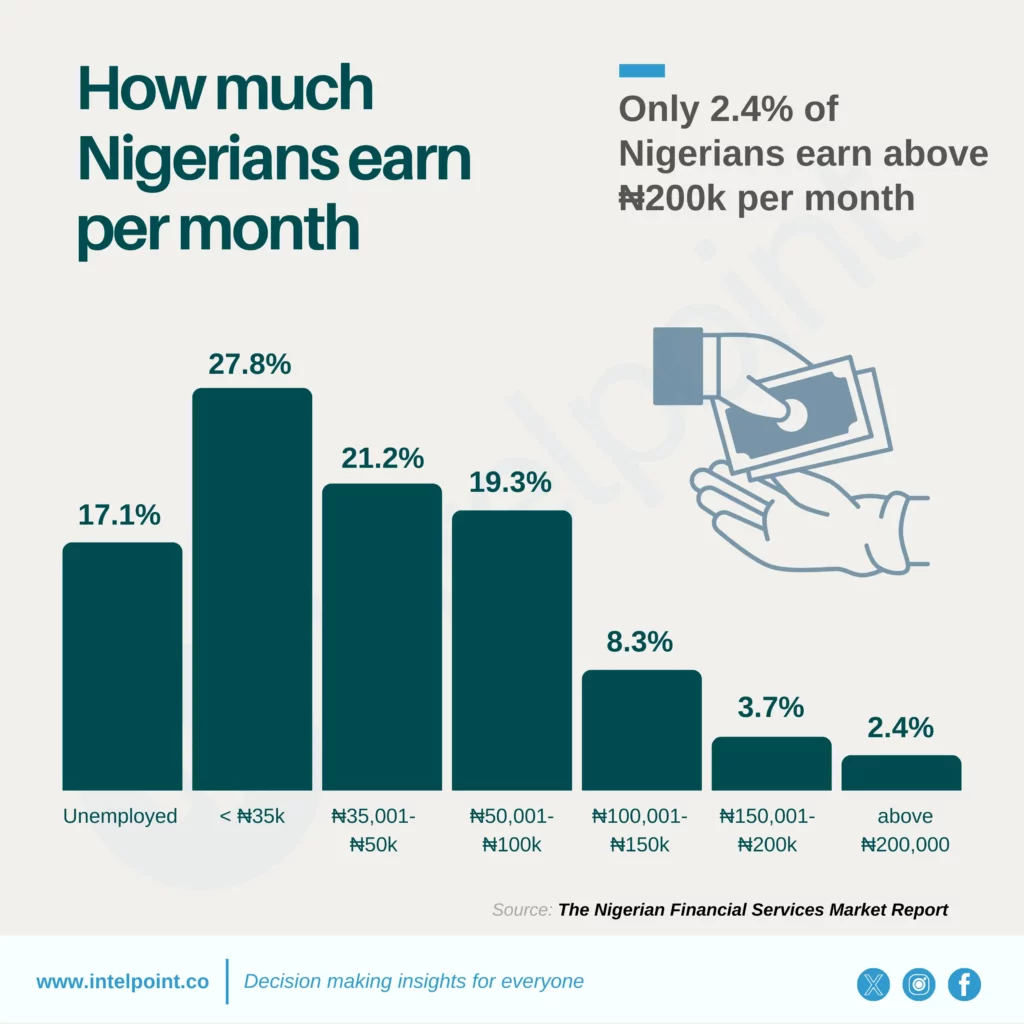
  • Only 10% of Nigerians earn above ₦100,000, according to the Nigerian Financial Services Market Report. This aligns with most reports about Nigeria, and it's in sharp contrast to the narratives online.
    See more
  • A Trend of Adult literacy rates of African countries

    Between 2018 and 2021, adult literacy rates across African nations exhibited significant disparities. Seychelles and South Africa led with literacy rates of 96% and 95%, respectively, indicating a high proportion of literate adults. Conversely, Chad had the lowest literacy rate during this period.

    These statistics underscore the uneven progress in educational attainment across Africa, highlighting the need for targeted interventions to improve literacy in lower-performing nations.

    See more

Other Insights
Key takeaways:
  • Throughout the decade, Nigeria saw a consistent decline in education funding as a percentage of GDP.
  • The most substantial allocation occurred in 2012 at 0.55% of GDP.
  • The lowest allocation was noted in 2022 at 0.35% of GDP.
  • There was a brief recovery from 2017 to 2018 before the downward trend resumed in 2019.
  • Over the decade, the overall reduction in education spending relative to GDP was approximately 36.5%.
  • Nigeria's education spending as a percentage of GDP is significantly lower than the UNESCO recommendation of 4-6% for developing nations.
Read more
Key Takeaways:
  • Nigeria's total revenue decreased from 17.73% of GDP in 2011 to 9.09% in 2022.
  • The lowest point for the country’s revenue occurred in 2016, at only 5.12% of GDP.
  • Although there has been some recovery since 2016, revenue still falls well below the levels seen before 2015.
  • The sharpest decline took place between 2011 and 2016, with revenue dropping by over 12 percentage points.
  • In 2020, during the COVID-19 pandemic, there was a significant drop to 6.52%, followed by a period of recovery.
Read more
Key takeaways:
  • February 2024 saw the largest month-on-month rise in inflation, climbing nearly 2% from 23.59% in January 2024.
  • Nigeria experienced brief periods of relief, with slight drops in core inflation during November 2023 and September 2024.
  • From May 2023 to December 2024, the inflation rate fluctuated within the 20% to 30% range.
  • December 2023 registered the highest inflation rate during the first eight months of the observed period.
  • The core inflation rate dropped to 22.59% in January 2025 from 29.28% in December 2024 due to the Consumer Price Index rebasing from 2009 to 2024.
Read more
Key takeaways:
  • Libya's total revenue (85.78% of GDP) significantly surpassed all other African states.
  • Lesotho is noteworthy with the second-highest total revenue ratio at 48.12%.
  • Equatorial Guinea and Sao Tomé & Príncipe in Western Africa recorded total revenue of 30.79% and 25.38% respectively.
  • South Africa generated 27.74% of its GDP in revenue.
  • The top ten countries reported total revenue exceeding 28%.
Read more
  • The South-South remitted ₦121.84B, making it one of the biggest net donors to the national VAT pool.
  • The region received only ₦52.49B, meaning it got back just 43% of its VAT contributions.
  • Rivers State alone remitted a staggering ₦90.21B (74% of the region’s total) but received only ₦11.01B (12.2% return), marking one of the worst VAT allocation disparities in Nigeria.
  • Cross River had the lowest VAT contribution (₦1.55B) but received ₦7.45B, a 380% gain, while Bayelsa, despite remitting ₦12.8B, received only ₦8.02B, less than lower-remitting states like Delta (₦9.05B).
  • Every state in the South-South received more than it remitted, except for Bayelsa and Rivers, with the latter being the only state to suffer a massive VAT deficit.
Read more
  • East Africa: Ethiopia leads with 36.2 million agricultural workers (27.3% of its 132.5 million population). Agriculture is vital to its economy. Tanzania follows with 19.2 million workers (approximately 28.8% of 66.6 million). Uganda has 23.4% of its 50 million population in agriculture, and Kenya employs 7.6 million workers (approximately 13.7% of 55.3 million), despite land degradation affecting 80% of its land.
  • West Africa: Nigeria has 26.8 million agricultural workers, but with a population of 232 million, it heavily depends on food imports as only 11.5% of its population work in the agriculture section. Ghana employs 5.5 million agricultural workers (16% of 34.4 million) and has strong potential for agricultural export growth, especially cocoa.
  • Central Africa: DR Congo has 18.6 million agricultural workers out of a population of 109.2 million.
  • Southern Africa: Mozambique has 9.9 million agricultural workers 29% of 34.6 million, while Madagascar employs 10.5 million (33% of 31.9 million). Agriculture is key to Madagascar’s economy but hindered by land issues, with women producing 80% of crops.
  • North Africa: Egypt has 5.7 million agricultural workers (5% of 116.5 million), and relies on irrigation due to limited arable land and high food imports.
Read more
1 117 118 119 120 121 233

Can’t find what you’re looking for? Please fill the form below
Contact Form Demo
SIGN UP TO OUR NEWSLETTER
Get periodic updates about the African startup space, access to our reports, among others.
Subscribe Here
Subscription Form

A product of Techpoint Africa. All rights reserved