What happens if Nigeria's GDP grows at 3.68% yearly?
Have you ever considered how much larger the US GDP is in comparison to Nigeria's? Although it would be difficult to compare Nigeria's GDP to that of the US, let's assume it increases by 3.68% annually. How long would it take the nation's GDP to match that of the US in 2022?
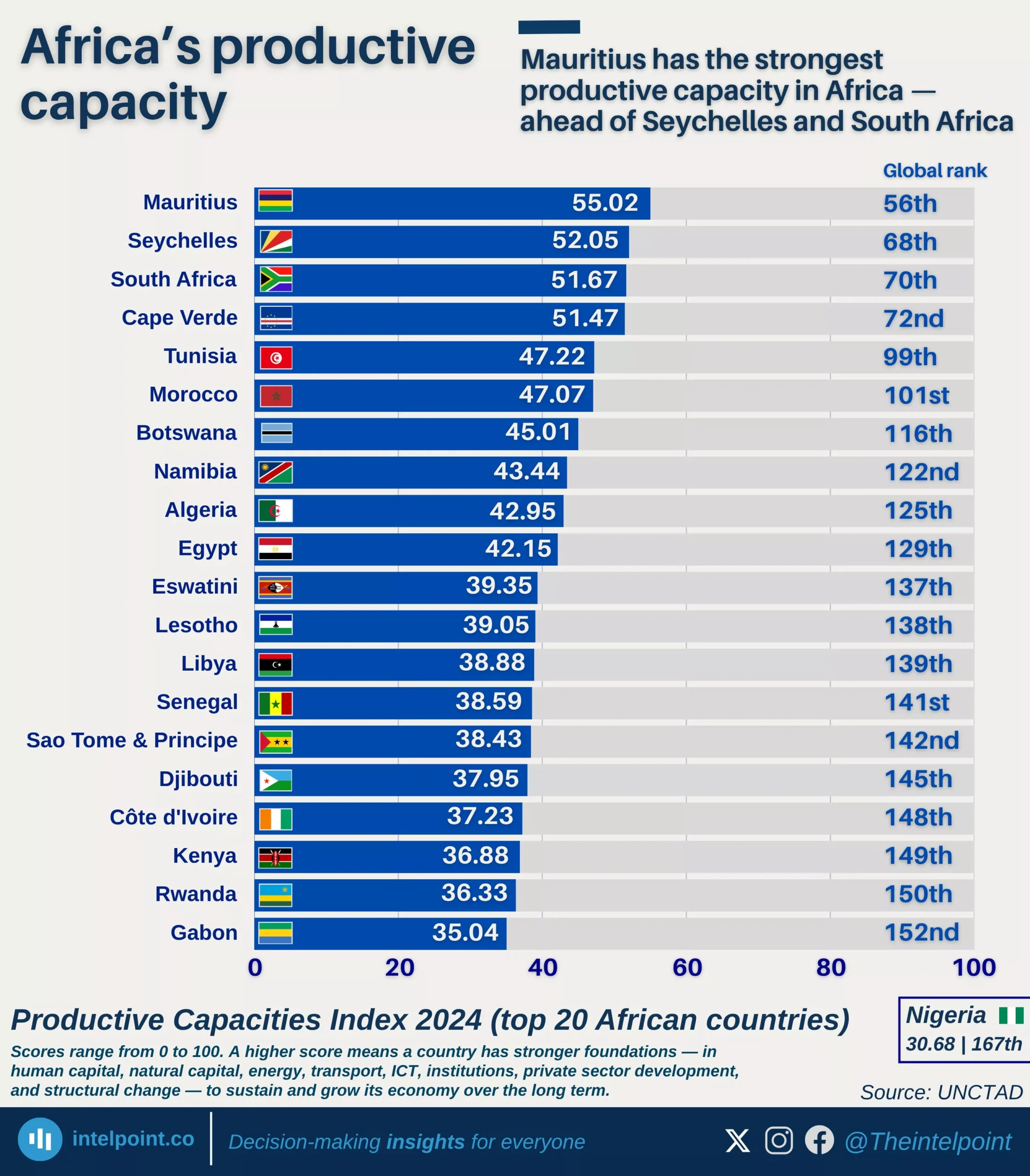
Mauritius leads Africa on the Productive Capacities Index with a score of 55.02, ranking 56th globally.
Seychelles, South Africa, and Cape Verde complete Africa’s top four, but none enters the global top 50.
Nigeria ranks much lower at 167th globally, with a score of 30.68, despite being one of Africa’s largest economies.
The ranking shows that economic size does not always translate into stronger productive foundations like human capital, ICT, energy, transport, and institutions.