Bite-sized Insights about
 
Providing you with data-based insights about things happening around you.
Popular Insights
  • The world’s smartphone companies shipped a combined 1.2 billion smartphones in 2022. Here are the top five.
    See more
    In 2023, Nigeria experienced an overall decrease of 24% in road accidents compared to the previous year. All vehicle categories contributed to this decline except Luxury Bus, which recorded 13 cases more than in 2022, and Bicycle, which recorded 4 more than in 2022. Commercial vehicles recorded 68% of the total road accidents in the country, followed by private vehicles with 31%; 194 government vehicles and 4 diplomat vehicles were involved in road accidents in the year.
    See more
  • A Trend of Adult literacy rates of African countries

    Between 2018 and 2021, adult literacy rates across African nations exhibited significant disparities. Seychelles and South Africa led with literacy rates of 96% and 95%, respectively, indicating a high proportion of literate adults. Conversely, Chad had the lowest literacy rate during this period.

    These statistics underscore the uneven progress in educational attainment across Africa, highlighting the need for targeted interventions to improve literacy in lower-performing nations.
    See more

    Africa's sanitation crisis is alarming, with 17 of the top 20 countries having the highest open defecation rates.

    Eritrea (67%), Niger (65%), and Chad (63%) lead, putting millions at risk of disease.

    Even Nigeria, the most populous African country, has 18% of its population practising it.

    See more
  • Nigeria was the seventh most populous nation in the world in 2020, with 206.1 million people. Projected to reach a population of 401.3 million by 2050, Nigeria will rank third after India (1st) and China (2nd). According to Institut national d'études démographiques' projections, Nigeria, Ethiopia, DR Congo, Egypt, Tanzania, and Kenya will be among the world’s top 20 most populous countries by 2050.

    See more

    The FAAC's revenue distribution from 2017 to August 2023 highlights the dominance of Delta, Akwa Ibom, Rivers, and Bayelsa states in allocations. Despite Lagos' economic prominence, it ranked fifth. Here is the distribution of revenue among states between 2017 and August 2023.

    See more

  • In 2023, an estimated 132.1 million newborns were welcomed worldwide, averaging 361.9 thousand births per day.

    India, China, and Nigeria accounted for nearly 30% of daily births; India had the highest contribution with 63,600.

    See more
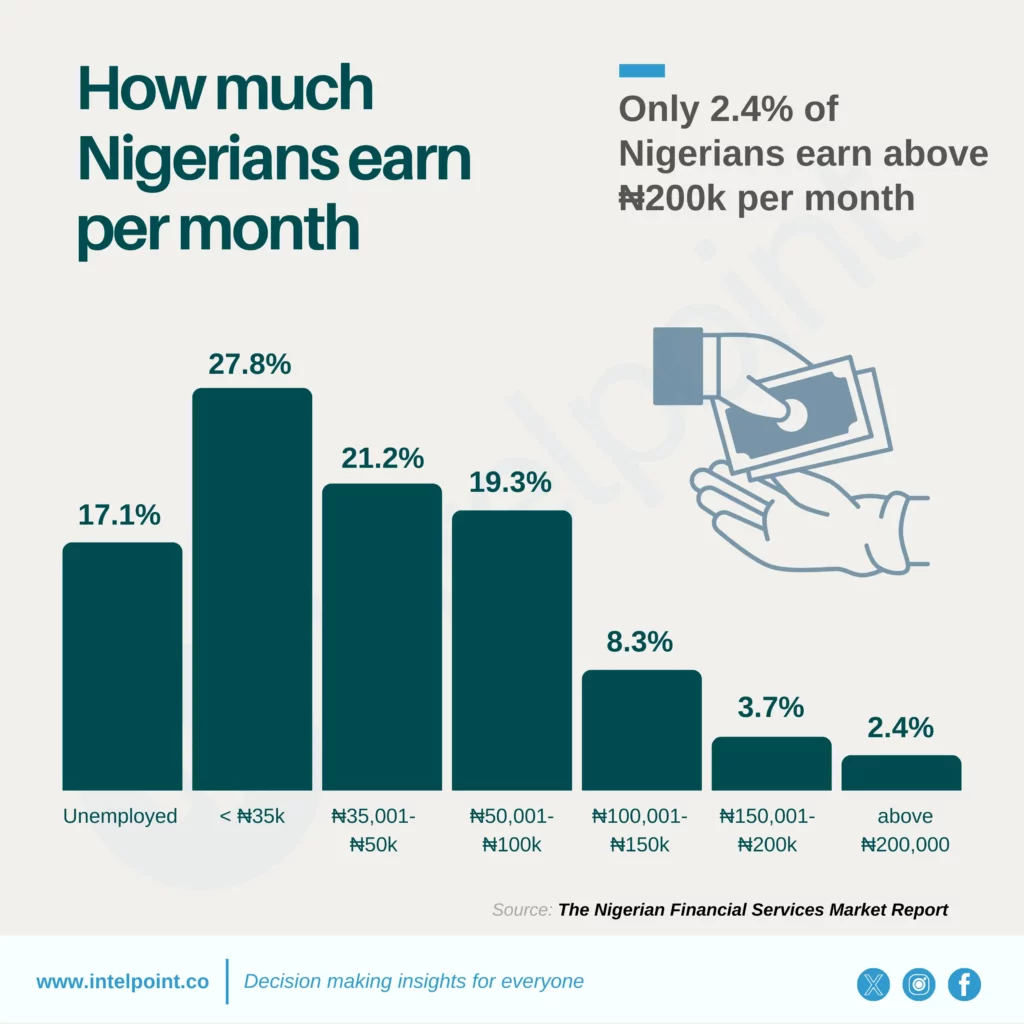
  • Only 10% of Nigerians earn above ₦100,000, according to the Nigerian Financial Services Market Report. This aligns with most reports about Nigeria, and it's in sharp contrast to the narratives online.
    See more
  • A Trend of Adult literacy rates of African countries

    Between 2018 and 2021, adult literacy rates across African nations exhibited significant disparities. Seychelles and South Africa led with literacy rates of 96% and 95%, respectively, indicating a high proportion of literate adults. Conversely, Chad had the lowest literacy rate during this period.

    These statistics underscore the uneven progress in educational attainment across Africa, highlighting the need for targeted interventions to improve literacy in lower-performing nations.

    See more

Other Insights
  • 56% (91 million) of unregistered children live in Africa, more than the rest of the world combined.
  • South Asia follows with 32%, while the rest of the world accounts for just 12%.
  • Africa’s share of unregistered children is nearly double that of South Asia and over four times that of the rest of the world.
  • This disparity underscores the urgent need for improved civil registration systems in high-impact regions.
Read more
1. With a brand value of $574.6B, Apple maintains a commanding lead, outpacing Microsoft by over $113.5B and reinforcing its position as the world’s most influential brand.
2. The top four brands (Apple, Microsoft, Google, Amazon) are all tech giants, collectively amassing over $1.8 trillion in brand value, proving technology remains the most valuable industry.
3. TikTok ($105.8B) has overtaken Facebook ($91.5B) and Instagram ($79.9B), signaling a shift in digital engagement and consumer preferences towards short-form video content.
4. Four of China’s top banks (ICBC, China Construction Bank, Agricultural Bank of China, and Bank of China) collectively hold $291.5B in brand value, while State Grid leads the energy sector at $85.6B, showcasing China’s growing financial and infrastructure influence.
5. The rapid ascent in brand value of NVIDIA and AI ($87.9B) highlights the increasing importance of AI, semiconductors, and GPUs in shaping the future of technology and computing.
Read more
  • Volatility and risks are the biggest concerns for Nigerians engaging with cryptocurrency, making up 35.7%.
  • Lack of knowledge accounts for 17.5%, highlighting a gap in crypto education and awareness.
  • Difficulty in using apps is the least pressing concern at 6.4%, suggesting that accessibility is not a major barrier.
  • Addressing volatility fears, improving security measures, and expanding financial education could boost confidence in crypto adoption.
Read more
  • The 2025 approved budget is nearly ₦55 trillion, marking a dramatic increase compared to previous years.
  • From 2020 onwards, the budget has seen a rapid upward trend.
  • Nigeria's national budget has consistently grown over the years, with notable jumps in 2016, 2021, and 2025.
  • The most significant year-on-year increase occurred from 2024 to 2025, with a 91% rise.
  • Since 2010, the budget has only decreased in four years (2012, 2014, 2015, and 2019), highlighting a generally upward trend in government spending
Read more
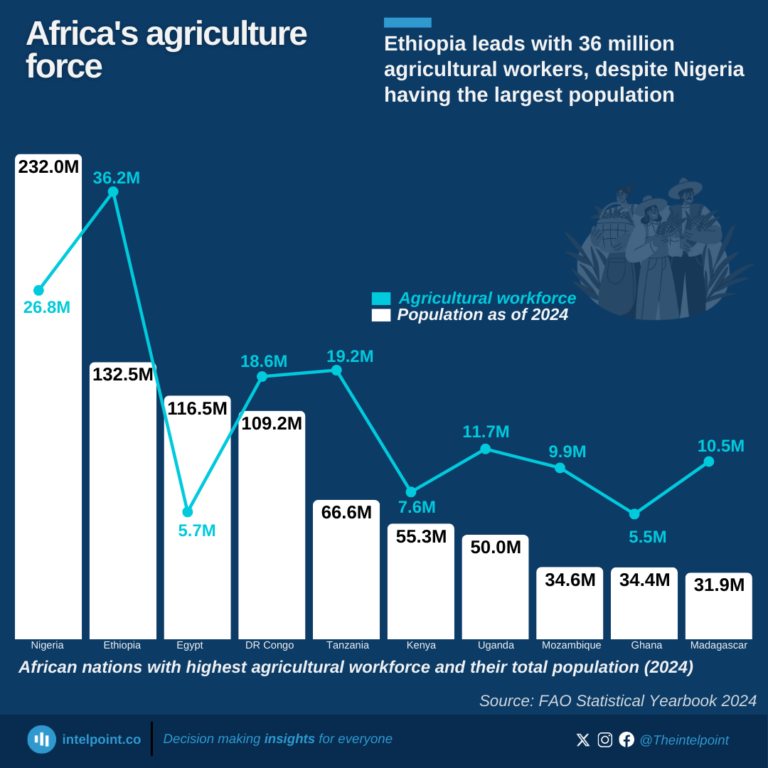
  • Africa's labour force continues to grow significantly, with several countries exceeding 10 million workers in 2023.
  • South Africa, despite its developed economy, has a labour force of 27 million, ranking below Tanzania and Egypt.
  • Nigeria, Ethiopia, and the Democratic Republic of Congo have the largest labour forces in Africa.
  • East Africa remains a major hub, with Kenya and Uganda featuring prominently in the top ten.
Read more
  • Sovereign currency-backed instant payments are rare, suggesting limited adoption of central bank digital currency (CBDC) models.
  • Cross-domain instant payment systems are the most popular, showing a strong push for interoperability across financial platforms.
  • Instant payment systems with only bank participants are still widely used, indicating that traditional financial institutions remain central to digital transactions.
  • Some African countries operate multiple instant payment systems, enhancing financial access through diverse options.
Read more
1 132 133 134 135 136 234

Can’t find what you’re looking for? Please fill the form below
Contact Form Demo
SIGN UP TO OUR NEWSLETTER
Get periodic updates about the African startup space, access to our reports, among others.
Subscribe Here
Subscription Form

A product of Techpoint Africa. All rights reserved