Bite-sized Insights about
 
Providing you with data-based insights about things happening around you.
Popular Insights
  • With a population of over 200M people, 7.7 million were in need of humanitarian aid as of 2020. This figure has since increased, requiring the sum of $1.01bn to meet their needs. Here’s the trend of Nigerians in need of humanitarian aid over the last 5 years.

    See more
    South Africans held more private wealth than people in Egypt, Nigeria, and Morocco combined. Africa's most populous country and home to the continent's richest man, Nigeria, ranked third after Egypt. Here are the top African countries by private wealth held as of December 2020.
    See more
  • A Trend of Adult literacy rates of African countries

    Between 2018 and 2021, adult literacy rates across African nations exhibited significant disparities. Seychelles and South Africa led with literacy rates of 96% and 95%, respectively, indicating a high proportion of literate adults. Conversely, Chad had the lowest literacy rate during this period.

    These statistics underscore the uneven progress in educational attainment across Africa, highlighting the need for targeted interventions to improve literacy in lower-performing nations.
    See more

    Africa's sanitation crisis is alarming, with 17 of the top 20 countries having the highest open defecation rates.

    Eritrea (67%), Niger (65%), and Chad (63%) lead, putting millions at risk of disease.

    Even Nigeria, the most populous African country, has 18% of its population practising it.

    See more
  • Nigeria was the seventh most populous nation in the world in 2020, with 206.1 million people. Projected to reach a population of 401.3 million by 2050, Nigeria will rank third after India (1st) and China (2nd). According to Institut national d'études démographiques' projections, Nigeria, Ethiopia, DR Congo, Egypt, Tanzania, and Kenya will be among the world’s top 20 most populous countries by 2050.

    See more

    The FAAC's revenue distribution from 2017 to August 2023 highlights the dominance of Delta, Akwa Ibom, Rivers, and Bayelsa states in allocations. Despite Lagos' economic prominence, it ranked fifth. Here is the distribution of revenue among states between 2017 and August 2023.

    See more

  • Global smartphone shipments market share by companies in 2024 (Q1-Q3)

    Samsung consistently led the global smartphone shipments market through the first three quarters of 2024, maintaining the highest market share in each quarter.

    Apple and Xiaomi followed closely, while other brands, including Oppo, Vivo, and Transsion, were among the top brands. The top three smartphone brands (Samsung, Apple, and Xiaomi) dominate the market, collectively capturing nearly half of the global share in the first three quarters of 2024.

    See more
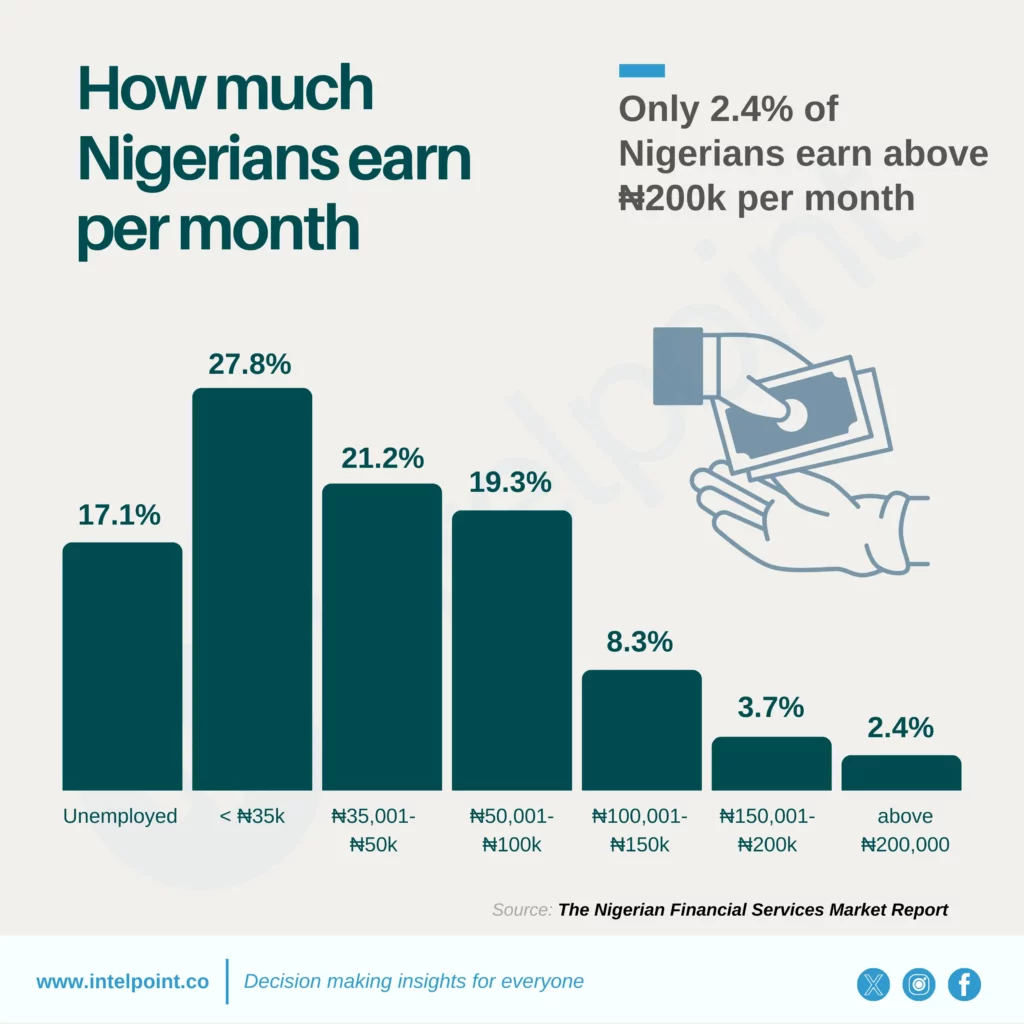
  • Only 10% of Nigerians earn above ₦100,000, according to the Nigerian Financial Services Market Report. This aligns with most reports about Nigeria, and it's in sharp contrast to the narratives online.
    See more
  • A Trend of Adult literacy rates of African countries

    Between 2018 and 2021, adult literacy rates across African nations exhibited significant disparities. Seychelles and South Africa led with literacy rates of 96% and 95%, respectively, indicating a high proportion of literate adults. Conversely, Chad had the lowest literacy rate during this period.

    These statistics underscore the uneven progress in educational attainment across Africa, highlighting the need for targeted interventions to improve literacy in lower-performing nations.

    See more

Other Insights
  • 66.6% of inmates (53,408) are awaiting trial, meaning 2 out of every 3 prisoners have not been convicted. This highlights major delays in the justice system, leading to prolonged detention without sentencing.
  • Male inmates dominate the prison population at 97.7%, with similar trends in both convicted (98.3%) and awaiting trial (97.4%) categories, highlighting a significant gender disparity in detention rates.
  • Only 33.4% of inmates (26,775) have been convicted, while the majority remain in legal limbo. This suggests that slow judicial processes are contributing to prison overcrowding and potential human rights concerns.
  • 75.4% of female inmates (1,399 out of 1,855) are awaiting trial, meaning only 1 in 4 female prisoners has been convicted
Read more
  • The NGX premium board accommodates an elite list of companies that meet specific requirements
  • Six of the eight companies are audited by EY and KMPG, with each firm auditing three companies
  • PwC audits the remaining two companies on the premium board
  • Deloitte is the only big four firm that does not audit a premium board company
Read more
  • Listed banking groups in Nigeria are all audited by the big four
  • KPMG is the top auditor for the industry, auditing five companies
  • Deloitte audits four companies, close behind KPMG
  • EY and PwC audit three of the five tier one banks
Read more
Nigeria's gross external reserves (2005 - 2024)
  • External reserves hit a peak of $53 billion, a level that hasn’t been reached since.
  • Reserves have moved between $27 billion and $43 billion in the last decade.
  • At $27 billion, 2016 was the most challenging period, coinciding with an economic recession and foreign exchange crises.
  • Reserves rebounded after 2016, reaching as high as $42.6 billion in 2019.
  • With $39.3 billion in reserves as of September 2024, Nigeria is in a stronger position than in some past years but still below historical highs.
Read more
  • The Gambia, Guinea-Bissau, Niger, Sierra Leone, and Guinea had the most stable electricity supply from 2000 to 2021.
  • Cape Verde experienced the highest electricity fluctuations, with values ranging from 2981.5 kWh/person to 7692.9 kWh/person.
  • Nigeria, Ghana, Benin, Mali, and Cape Verde had the most unstable electricity supply, with significant year-to-year variations.
  • Nigeria’s electricity supply averaged 2161.7 kWh/person but remained highly inconsistent, fluctuating between 1250.4 and 2707.9 kWh/person.
  • Mali had the lowest electricity availability among unstable nations, averaging 757.4 kWh/person, with a drop as low as 350.7 kWh/person.
  • Countries with stable electricity had lower fluctuations, with The Gambia leading at 957.8 kWh/person and Guinea reaching 1110.8 kWh/person.
Read more
  • Ghana's under-5 mortality rate at 42.3 deaths per 1,000 live births, still higher than the SDG target of 25 deaths per 1,000 live births.
  • Cape Verde achieved the most dramatic reduction in under-5 mortality rates, cutting its rate by over 93%, from 174.8 in 1960 to 12.3 in 2022, the lowest in West Africa.
  • Sierra Leone had the highest under-5 mortality rate in 1960, at 390.1 deaths per 1,000 live births, marking it as one of the most challenging places for child survival in the region at the time.
  • Liberia experienced a troubling increase in under-5 mortality rates during the 1980s, peaking at 263.8 in 1990, a period marked by civil war and economic instability.
Read more
1 128 129 130 131 132 234

Can’t find what you’re looking for? Please fill the form below
Contact Form Demo
SIGN UP TO OUR NEWSLETTER
Get periodic updates about the African startup space, access to our reports, among others.
Subscribe Here
Subscription Form

A product of Techpoint Africa. All rights reserved