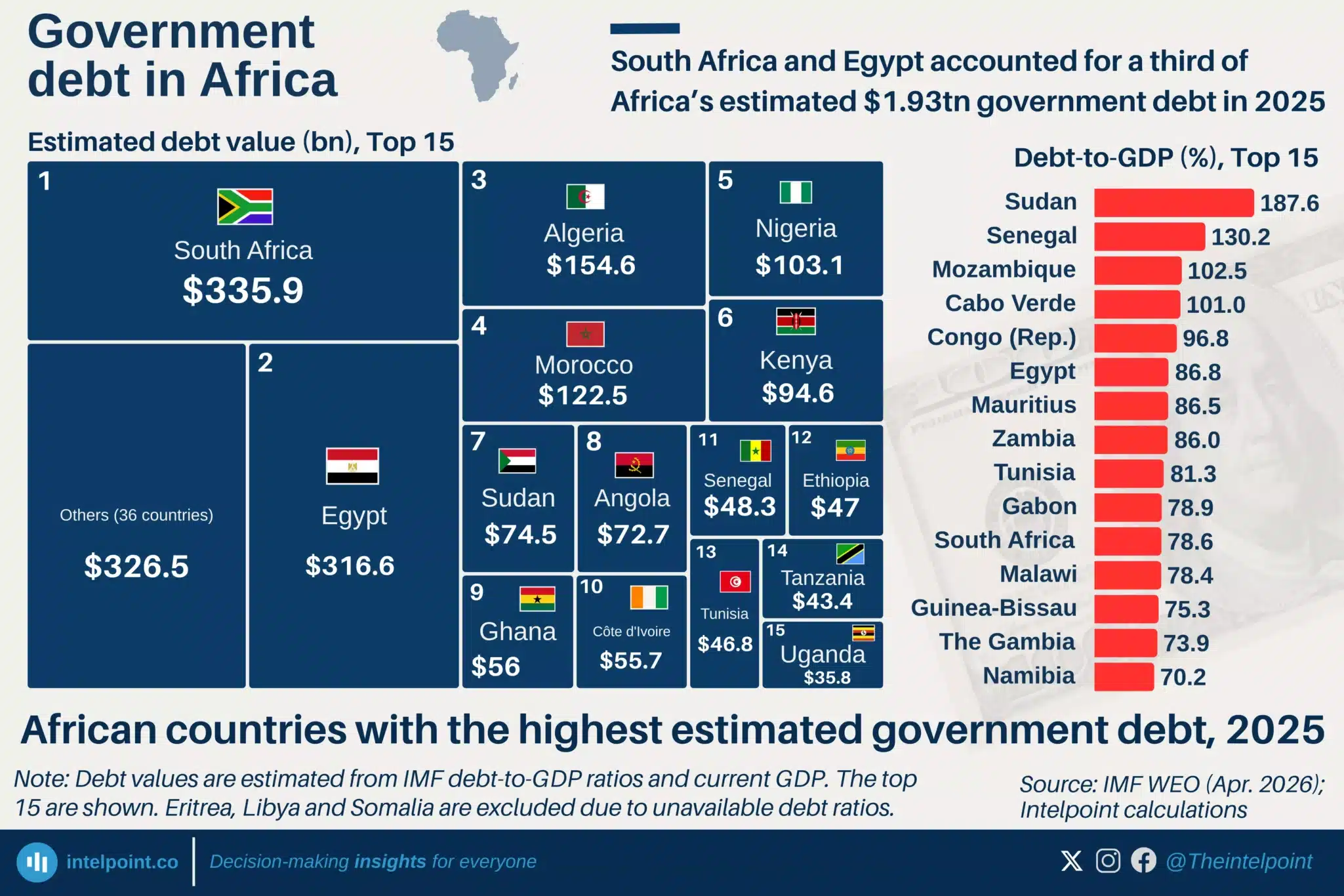
South Africa and Egypt accounted for a third of Africa’s estimated $1.93tn government debt in 2025

Key Takeaways

  • Government debt across 51 African countries was estimated at $1.93 trillion in 2025.
  • South Africa and Egypt had the largest estimated stocks and jointly accounted for 33.8% of the total.
  • Sudan had the highest debt-to-GDP ratio at 187.6%, followed by Senegal at 130.2%.
  • The estimates use IMF debt ratios and current-dollar GDP, not national authorities’ reported debt stocks.
  • Differences in government coverage, instruments and valuation mean the figures are comparable estimates, not fully harmonised official data.

Across 51 African countries, government debt was estimated at $1.93 trillion in 2025. These are not debt stocks reported by national authorities. They were calculated by multiplying each country’s IMF general government gross debt-to-GDP ratio by its current-dollar GDP.

Both inputs came from the April 2026 WEO, so Intelpoint applied no separate exchange rate, although the estimates inherit the IMF’s dollar-GDP conversion. On that basis, South Africa had the largest estimated stock at $335.9 billion, followed by Egypt at $316.6 billion. Together, they accounted for 33.8% of the total.

The ranking changes when debt is measured relative to the size of each economy. Egypt ranked sixth across the 51 countries at 86.8% of GDP, while South Africa ranked eleventh at 78.6%. Sudan had the highest ratio at 187.6%, followed by Senegal at 130.2%. Mozambique and Cabo Verde also had debt exceeding 100% of GDP. Government coverage in the underlying IMF series is not uniform.

Among the 51 countries, 40 entries cover central government only, 10 include some combination of state, local government or social security funds, and Angola’s coverage classification is unavailable.

Debt instruments and valuation methods also vary. The figures should therefore be read as a consistent application of one IMF series and calculation, not as 51 harmonised official debt stocks. Nigeria illustrates the difference this can produce. It is estimated here at $103.1 billion, compared with the $110.97 billion reported by the DMO for Q4 2025, a gap of $7.9 billion.

The available data do not show which methodological factor accounts for this specific difference. Eritrea, Libya and Somalia were excluded because the IMF did not provide the required debt ratios.
Source:

International Monetary Fund (IMF); Intelpoint calculations

Period:

2025
HTML code to embed chart
Want a bespoke report?
Reach out
Tags
Related Insights

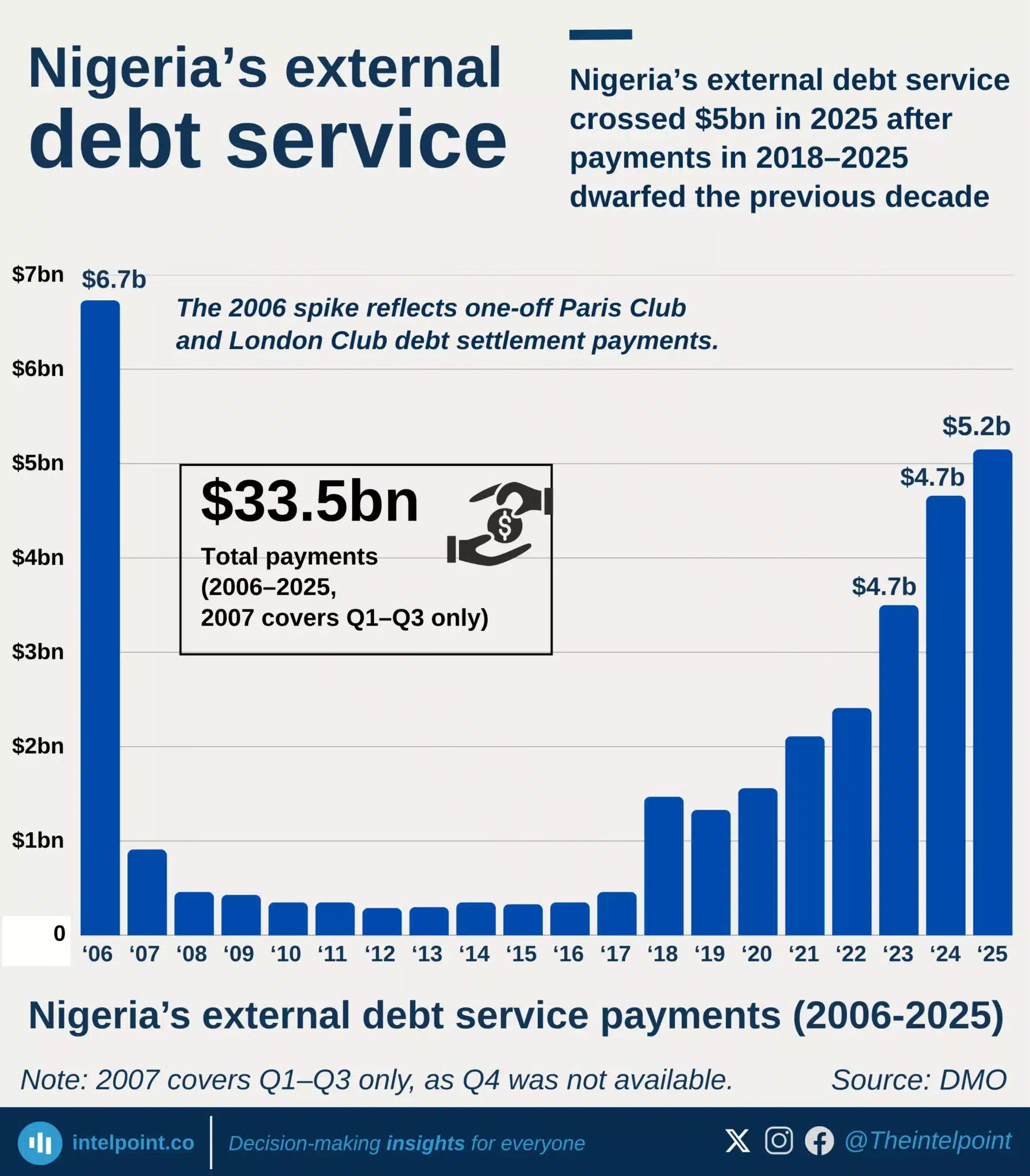
Nigeria’s external debt service crossed $5bn in 2025 after payments in 2018–2025 dwarfed the previous decade
  • Nigeria’s external debt service entered a heavier phase in 2018.
  • External debt service crossed $5bn in 2025.
  • Nigeria paid about $22.2bn from 2018 to 2025.
  • That was about 6x the $3.7bn paid from 2008 to 2017.
  • The 2006 spike reflects one-off debt settlement payments.

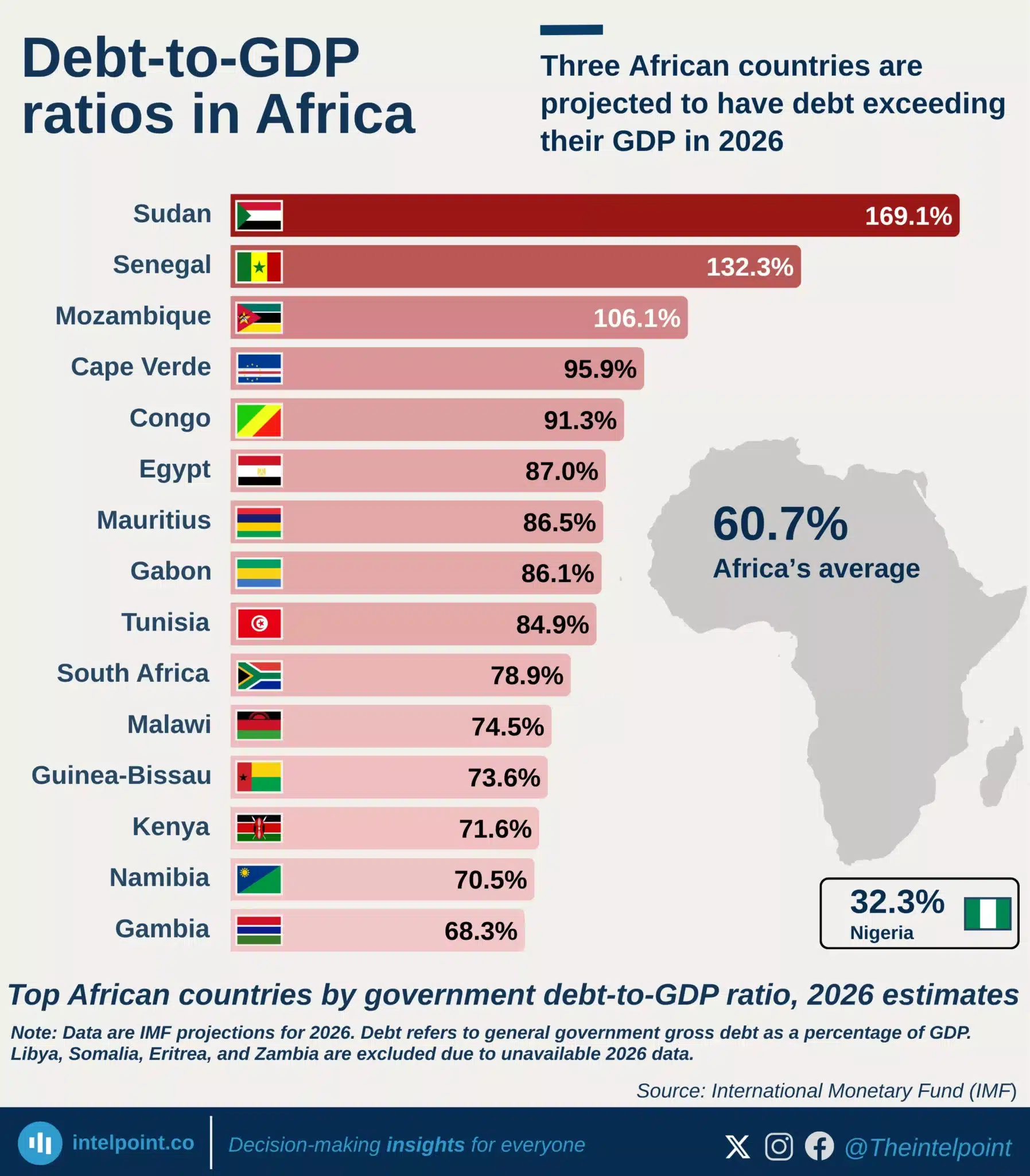
Three African countries are projected to have debt exceeding their GDP in 2026
  • Sudan is projected to have Africa’s highest debt-to-GDP ratio in 2026, at 169.1%.
  • Only three African countries are projected to owe more than the size of their economies in 2026.
  • Senegal and Mozambique join Sudan among countries with debt-to-GDP ratios above 100%.
  • Africa’s average government debt-to-GDP ratio is projected at 60.7% in 2026.
  • Nigeria’s projected debt-to-GDP ratio of 32.3% is far below the African average.

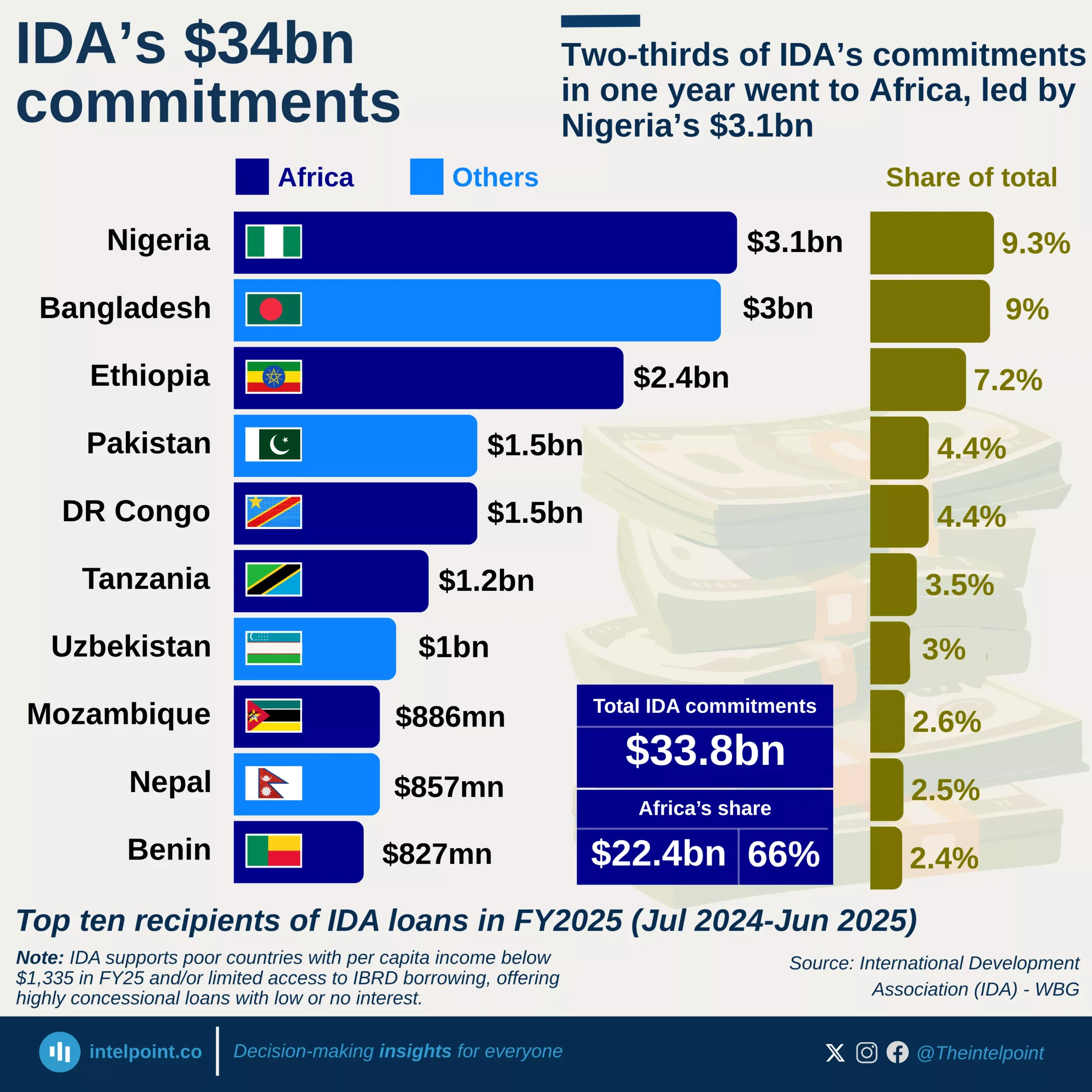
Two-thirds of IDA’s commitments in one year went to Africa, led by Nigeria’s $3.1bn
  • Africa received 66% of IDA’s FY2025 commitments.
  • Africa’s total IDA allocation was $22.4 billion out of $33.8 billion.
  • Nigeria was the largest borrower from the DA globally, with $3.1 billion in loans.
  • Bangladesh ranked second with $3 billion.
  • Six of the top ten borrowers were African countries.
  • Nigeria accounted for 9.3% of total FY2025 IDA commitments.

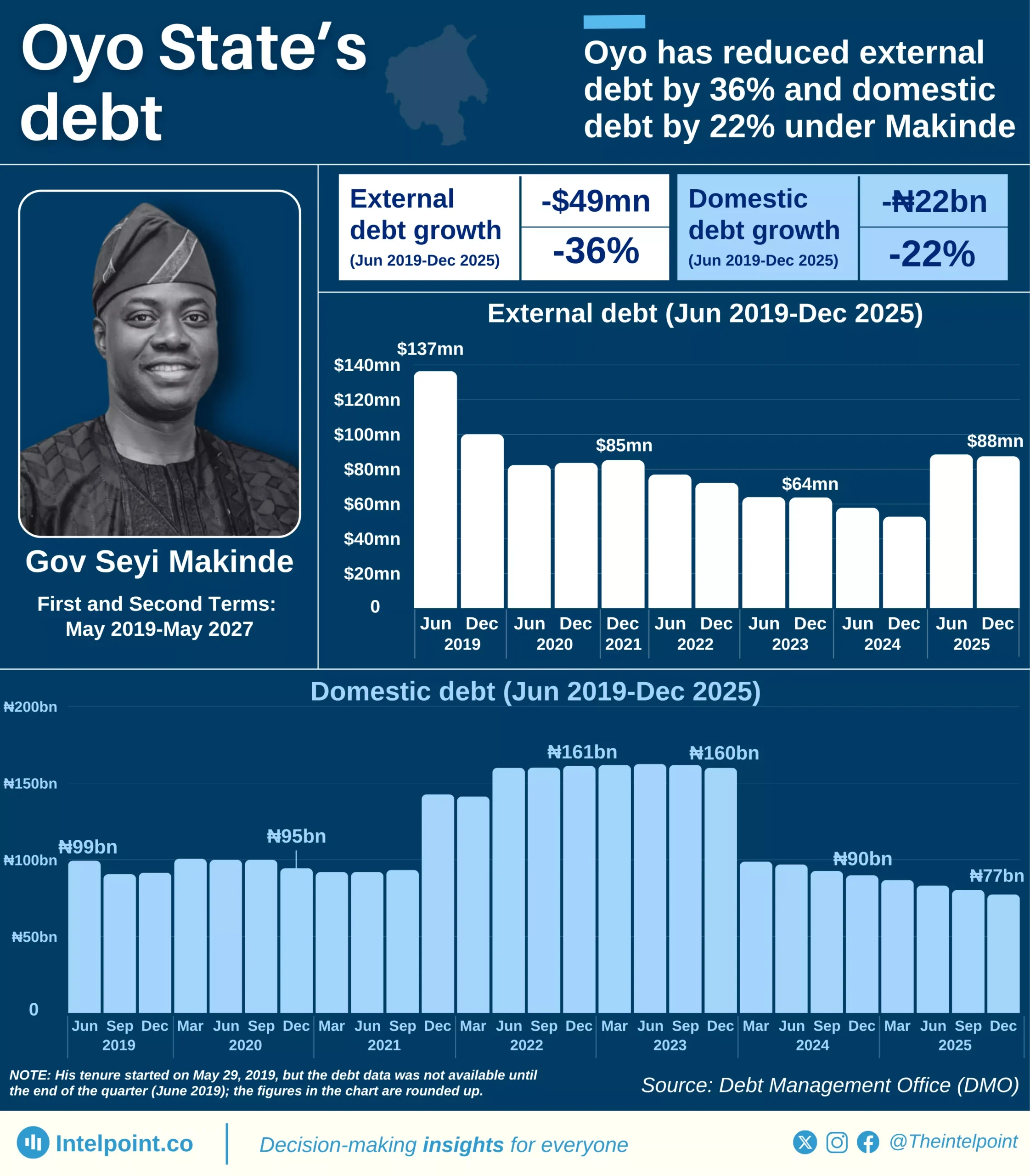
Oyo has reduced external debt by 36% and domestic debt by 22% under Makinde
  • Oyo reduced external and domestic debt by the end of 2025.
  • External debt fell faster than domestic debt.
  • External debt declined more consistently over the period.
  • Oyo’s local debt peaked around 2022–2023 before falling back.
  • The state appears to have prioritised reducing FX exposure.

Africa has been the world's biggest World Bank borrower since 2017, owing $152 billion as of 2024
  • Africa has been the world's biggest World Bank borrower since 2017, and the gap is widening.
  • Three crises drove it: an infrastructure gap, the 2014 commodity crash, and COVID-19.
  • The World Bank leaned in deliberately — 66% of all IDA funds went to Africa in 2025 alone.
  • It's not really "Africa's debt" — it's Nigeria's, Kenya's, Ethiopia's, Egypt's, Tanzania's, and Morocco's.
  • Every other region is slowing down, but Africa's curve is still climbing.

Under Sanwo-Olu, Lagos cut its external debt and more than doubled its domestic debt
  • Lagos cut external debt, but increased domestic debt.
  • The drop in external debt was meaningful, but the rise in domestic debt was much larger.
  • Stronger IGR gave Lagos more room to borrow and repay.
  • The state chose local funding over heavier dollar exposure.

POPULAR TOPICS
SIGN UP TO OUR NEWSLETTER
Get periodic updates about the African startup space, access to our reports, among others.
Subscribe Here
Subscription Form

A product of Techpoint Africa. All rights reserved