Bite-sized Insights about
 
Providing you with data-based insights about things happening around you.
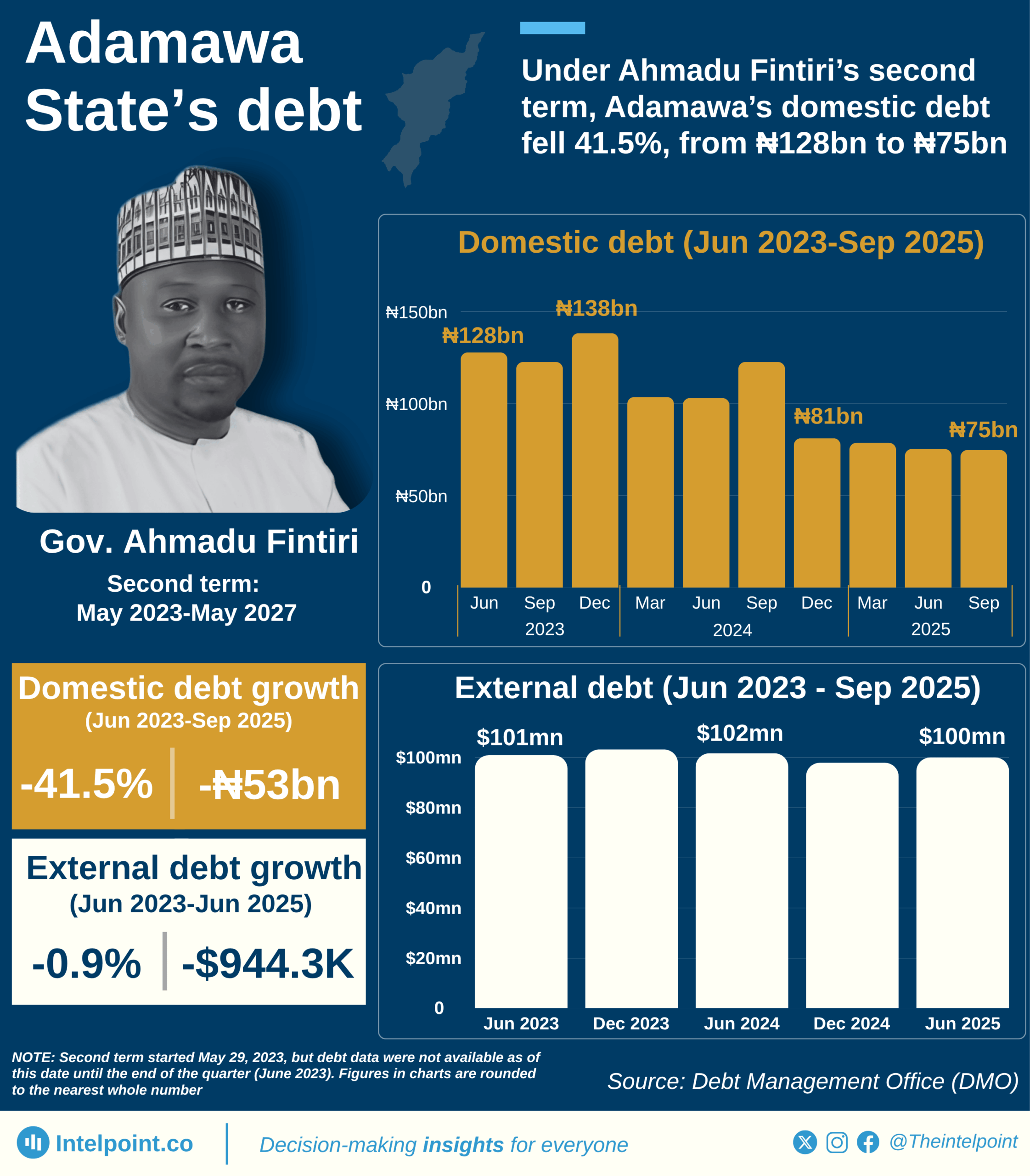
Under Umo Eno, Akwa Ibom’s domestic debt fell 41.5%, from ₦138.6bn to ₦48.5bn
  • Akwa Ibom’s domestic debt fell 41.5% over the period, from ₦138.6 billion to ₦48.5 billion.
  • External debt was almost stable, slipping just 0.9%.
  • The sharpest debt adjustment happened in local-currency obligations, not foreign debt.
  • The highest domestic debt level during the period was in December 2023.

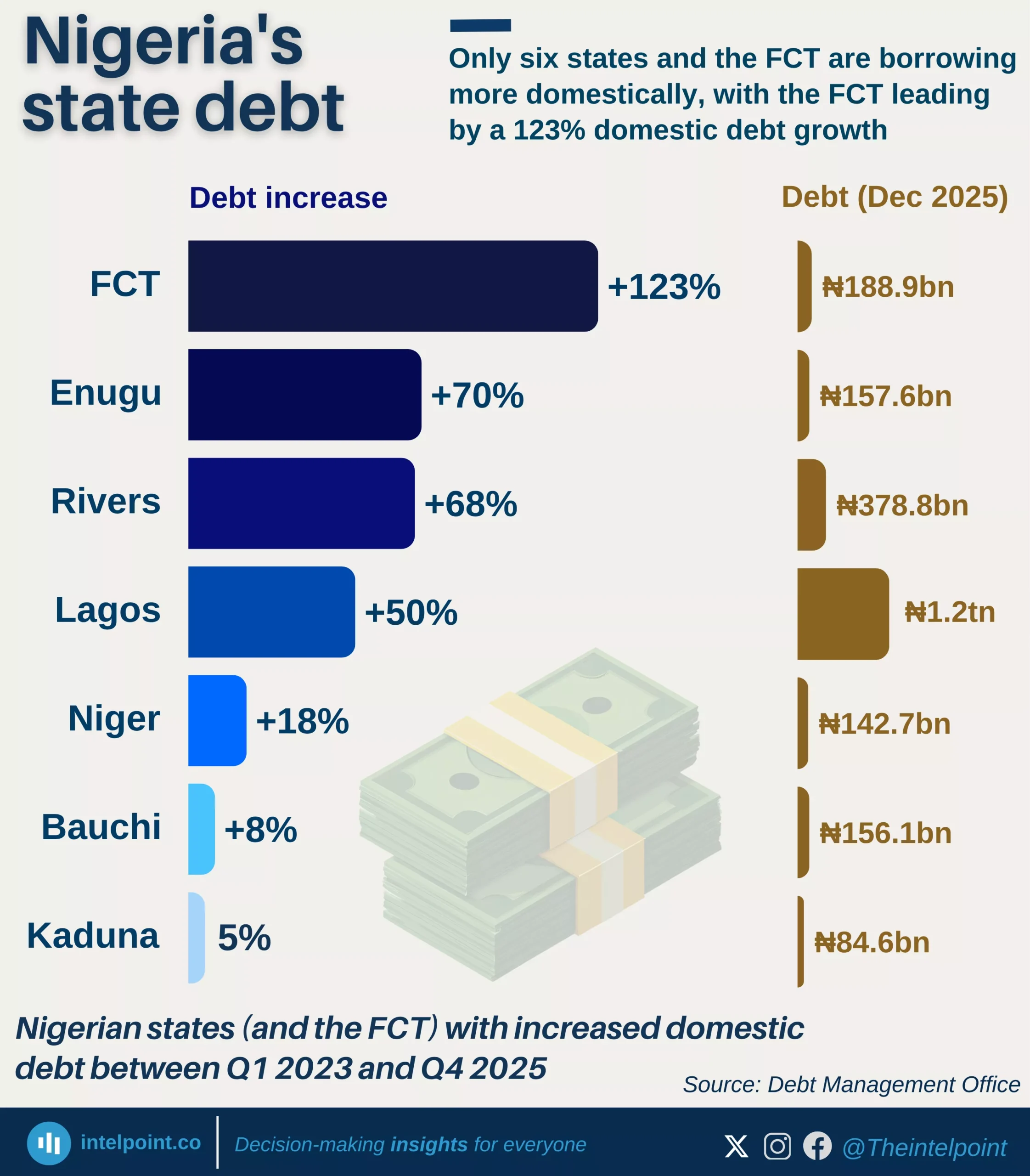
Only six states and the FCT are borrowing more domestically, with the FCT leading by a 123% domestic debt growth
  • Only six states and the FCT increased domestic debt.
  • The FCT recorded the fastest domestic debt growth at 122.8%.
  • Enugu posted the second-highest increase at 70%.
  • Lagos remains the biggest borrower by value at ₦1.2 trillion.
  • Niger, Bauchi, and Kaduna saw smaller, yet notable increases.
  • Debt growth is concentrated, not broad-based across all states.

After steady growth, the FCT’s debt spiked sharply by 139% in Q4 2025
  • FCT Abuja’s domestic debt jumped from ₦79 billion to ₦189 billion in one quarter.
  • This equals a 139.1% quarter-on-quarter increase.
  • Before Q4 2025, debt growth was relatively moderate.
  • Debt fell in 2024 before recovering in 2025.
  • The 2025 recovery was gradual until the final-quarter spike.
  • Q4 2025 pushed debt to the highest level in the series.

Lagos, Rivers, and four other states account for 52% of all Nigerian states' domestic debt and 40% of their external debt
  • Lagos dominates Nigeria’s subnational debt profile, accounting for 26.1% of domestic debt and 21.8% of external debt.
  • Six states account for 52% of domestic debt.
  • The same group contributes 40% of the external debt
  • Rivers ranks second in domestic debt (9.5%) but has a significantly lower external debt (3.8%).
  • Kaduna emerges as a major external borrower (13.7%) despite not appearing among the top domestic debt states.

Finance & Insurance now makes up 30% of Nigeria’s domestic company income tax, up from 12% in 2022
  • Company income tax collections rose from ₦1.7tn in 2022 to ₦5.0tn in 2025.
  • Finance & Insurance more than doubled its share, from 12.4% to 30.0%.
  • Finance became the largest single sector in the tax mix by 2025.
  • Manufacturing remained important, but its share fell from 27.9% to 17.7%.
  • ICT saw one of the sharpest declines, from 21.6% to 6.5%.
  • Mining & quarrying gained weight, rising from 8.4% to 14.5%.
  • Wholesale & retail also increased, from 3.6% to 7.0%.
  • The tax base became less evenly distributed across sectors.

Nigeria's VAT collections have more than tripled in three years
  • Nigeria’s total VAT rose from ₦2.5tn in 2022 to ₦8.6tn in 2025.
  • VAT collections more than tripled in four years.
  • Local VAT remained the largest source of VAT throughout the period.
  • Local VAT increased from ₦1.5tn to ₦4.5tn.
  • Local VAT averaged 54.4% of total VAT between 2022 and 2025.
  • Import VAT also grew strongly, from ₦521.5bn to ₦2.0tn.
  • Other payment channels rose from ₦510.8bn to ₦2.1tn.
  • VAT growth is increasingly being driven by non-import activity.

Nigeria's non-oil exports grew faster than oil exports in 2024 and 2025, though oil remained dominant
  • In 2025, non-oil export growth (36%) was 6x higher than oil (6%).
  • In 2024, non-oil exports grew by 189% vs oil’s 108%.
  • Total exports still heavily depend on oil.
  • Export value rose from ₦36 trillion in 2023 to ₦85.1 trillion in 2025.

Agriculture’s share of Nigeria’s capital imports peaked at 5.46% in 2021 before falling to 0.72% in 2025
  • Agriculture’s share of Nigeria’s capital imports peaked at 5.46% in 2021
  • After 2025, agriculture's share started falling sharply, reaching 0.72% in 2025.
  • Between 2017 and 2021, the sector experienced consistent growth in both value and share.
  • Capital import value peaked at at $489.9 million in 2019.

Nigeria imported 10x more from Asia than from Africa in 2025
  • Asia is Nigeria’s top import source in 2025.
  • The highest import value from Asia was recorded in Q1 at ₦8.7 trillion.
  • Imports from Europe surged to ₦8.6 trillion in Q2 but declined to ₦6.6 trillion by Q4.
  • Imports from America showed continuous growth, rising from ₦2.9 trillion in Q1 to ₦6.6 trillion in Q4.
  • Imports from Africa remained below ₦1 trillion across most quarters.

China’s exports to Nigeria increased by 40% in 2025
  • China’s exports to Nigeria increased by 40.4%,
  • China's exports moved from ₦ 14.1 trillion in 2024 to ₦ 19.8 trillion in 2025.
  • Growth was consistent across all four quarters.
  • Quarter 2 saw the highest growth at 80%, jumping from ₦3.0tn to ₦5.4tn.
  • Quarter 4 recorded a modest 4.3% rise.

1 4 5 6 7 8 61

Can’t find what you’re looking for? Please fill the form below
Contact Form Demo
SIGN UP TO OUR NEWSLETTER
Get periodic updates about the African startup space, access to our reports, among others.
Subscribe Here
Subscription Form

A product of Techpoint Africa. All rights reserved