Bite-sized Insights about
 
Providing you with data-based insights about things happening around you.
BUA Cement and Lafarge recorded over 100% profit growth in the first half of 2025
  • Dangote Cement reported the highest H1 2025 profit at ₦436.6 billion, up 50% from ₦291.7 billion in H1 2024.
  • BUA Cement’s profit more than doubled to ₦149.1 billion, a 164% rise from ₦56.5 billion in the same period last year.
  • BUA Cement had the fastest profit growth rate among the three major players, despite starting from a lower base.
  • Combined, the three firms posted over ₦720 billion in half-year profit, with Dangote alone accounting for over 60% of the total.
  • The sharp profit rises may reflect improved pricing, cost management, or benefits from forex gains after naira devaluation.

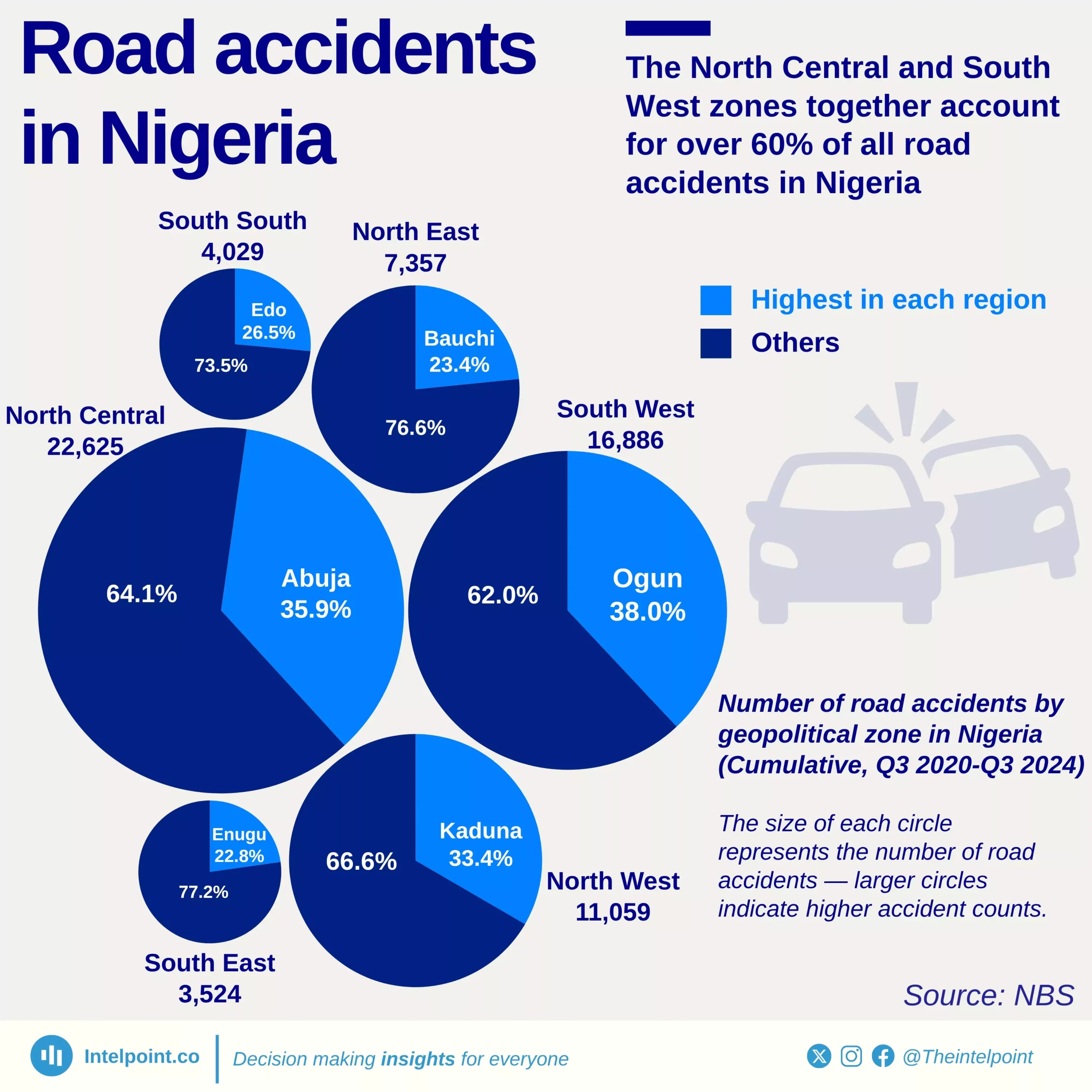
Number of road accidents by geopolitical zone in Nigeria (Cumulative, Q3 2020-Q3 2024)
  • The North Central zone accounts for the highest share of road accidents in Nigeria, contributing 34.55% of the national total.
  • Within the North Central zone, Abuja (FCT) recorded the most accidents, with a cumulative total of 8,133 cases.
  • The South West zone ranks second, responsible for 25.78% of all accidents nationwide, with Ogun State leading the zone at 6,418 accidents.
  • The South East zone has the lowest share, contributing just 5.38% of total accidents from Q2 2020 to Q2 2024.
  • Enugu State, the highest contributor within the South East, accounts for only 1.59% of the national total.

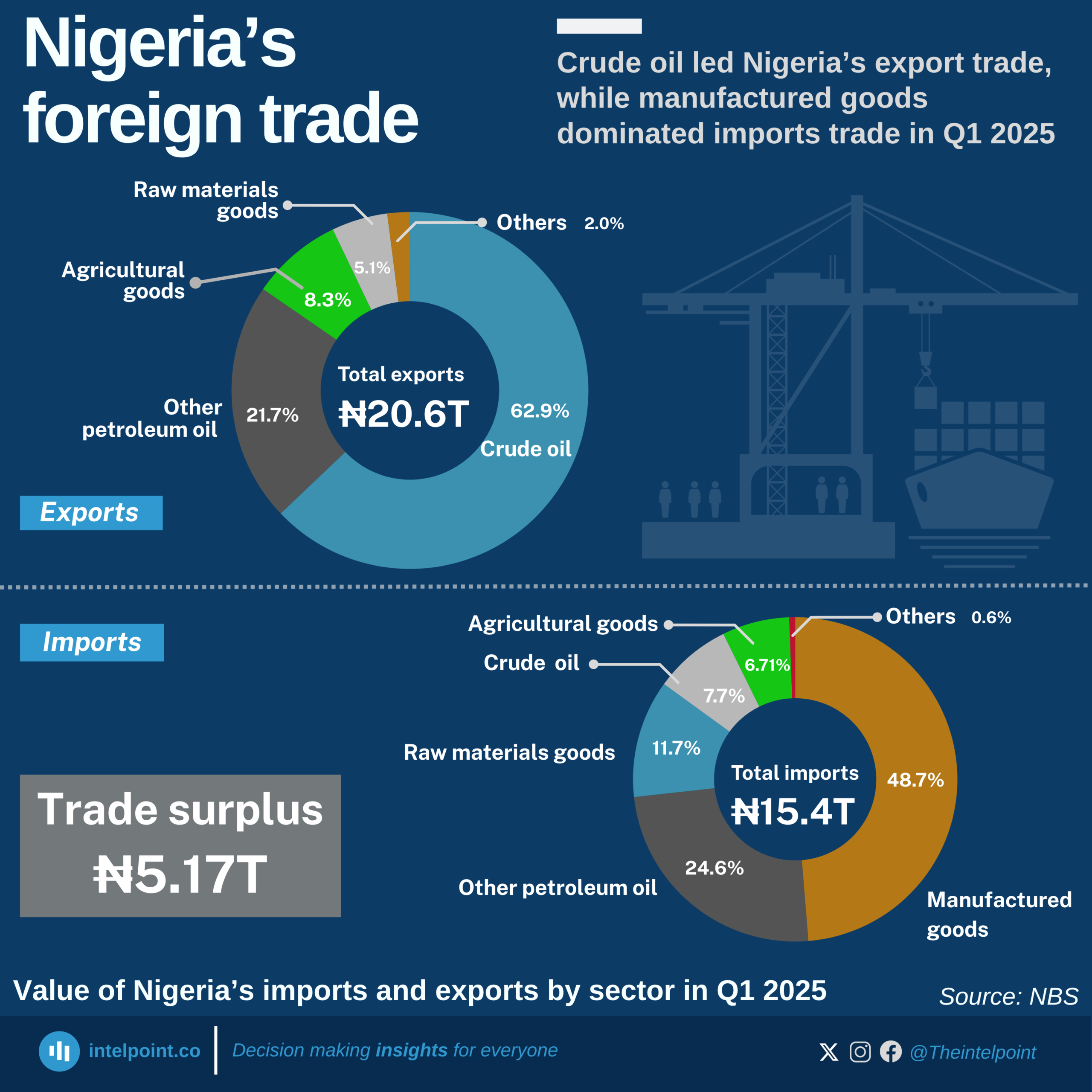
Nigeria’s foreign trade
  • Total Trade Volume in Q1 2025 stood at ₦36.02 trillion, with exports totalling ₦20.6 trillion and imports at ₦15.4 trillion, resulting in a surplus of ₦5.17 trillion.
  • Crude oil dominates Nigeria’s export trade, accounting for the largest share of export revenue. -
  • Other petroleum oil products are also a major export item, reflecting the significance of both raw and refined oil-based commodities in Nigeria’s trade portfolio. -
  • On the import side, manufactured goods dominate, showing Nigeria’s continued reliance on foreign machinery, technology, and consumer goods.
  • While Nigeria exports mostly raw and oil-based products, it imports refined, processed, or industrial goods, indicating a structural trade gap and limited local industrial capacity. -
  • Agricultural and raw material goods feature on both sides of trade, but their value is significantly less than petroleum-related trade.

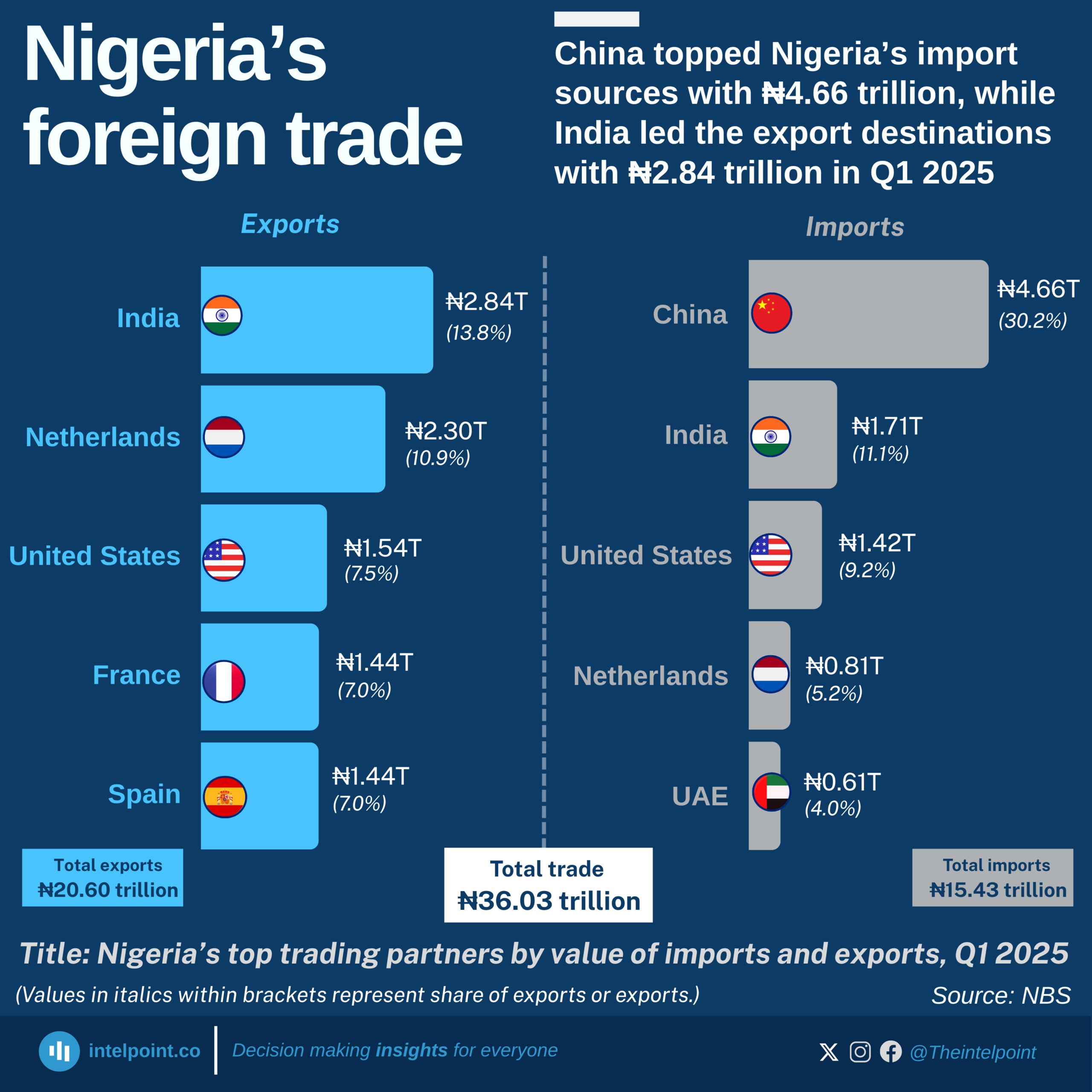
China topped Nigeria’s import sources with ₦4.66 trillion, while India led the export destinations with ₦2.84 trillion in Q1 2025
  • India is Nigeria’s largest export destination Nigeria exported ₦2.84 trillion worth of goods to India in Q1 2025, driven largely by crude oil.
  • China dominates imports into Nigeria China supplied ₦4.66 trillion worth of goods, far outpacing all other countries. Likely dominated by electronics, machinery, and manufactured goods.
  • The United States appears on both sides. Nigeria exports ₦1.54 trillion to the US and imports ₦1.42 trillion, showing a relatively balanced trade relationship.
  • European countries are major export Partners Netherlands (₦2.30T), France (₦1.44T), and Spain (₦1.44T) are prominent export destinations, indicating strong demand for Nigerian crude oil and other commodities in Europe.
  • UAE barely makes the import list. The UAE closes out the top import list at ₦0.61 trillion, showing relatively lower trade volume compared to others, but still significant enough to be in the top 5.

South Africa runs Africa’s longest rail network at 20,986km, while Nigeria trails 9th with 3,798km
  • South Africa leads the continent with a vast 20,986km rail network, nearly triple the size of Sudan’s, the second-largest.
  • Nigeria’s rail infrastructure measures 3,798km, ranking it behind Kenya (3,819km) and DR Congo (4,007km).
  • North African countries like Egypt and Algeria maintain significant rail mileage, exceeding 4,000km each.
  • Southern Africa dominates the top five, with Mozambique and Zimbabwe also featuring prominently.

42% of Nigeria’s applications have been rejected over the past 15 years amidst surging demand for Schengen visas
  • Nigerians submitted 1.1 million Schengen visa applications between 2009 and 2024.
  • The highest rejection rates occurred in 2017 (53%) and 2019 (51%).
  • A total of 491,844 applications were rejected, a cumulative denial rate of 42.1%.
  • Despite post-pandemic recovery, 2024 recorded the highest applications (111k), with a 45% rejection rate.
  • The year 2010 stands out as the period with the least number of Schengen visa applications submitted by the Nigerian consulate.

Nearly 30% of road accidents recorded in Nigeria between Q3 2020 and Q3 2024 occurred in FCT, Ogun, and Nasarawa
  • FCT, Ogun, and Nasarawa consistently rank as the top three states with the highest number of road accidents.

  • The FCT recorded its peak accident figures in 2022, particularly in Q2 (842 cases) and Q4 (864 cases).

  • In Q2 and Q3 of 2024, Ogun State surpassed the FCT in the number of reported accidents.

  • Across these three states, there has been a notable decline in accident numbers, with an average decrease of approximately 37.6% between Q2 and Q3 2024.

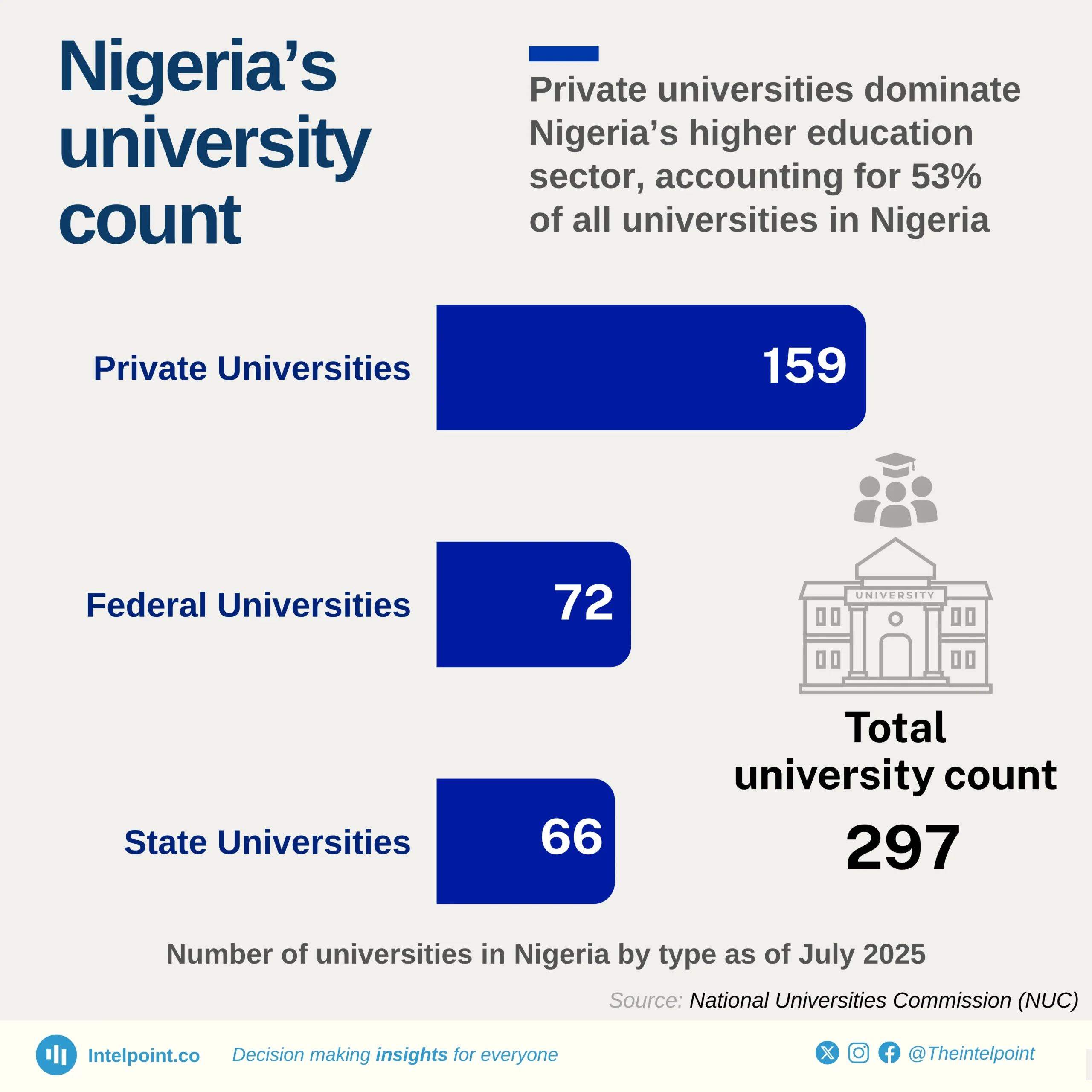
Private universities dominate Nigeria’s higher education sector, accounting for 53% of all universities in Nigeria
  • Private universities in Nigeria outnumber federal and state institutions combined.
  • Nigeria has 159 private universities, more than double the number of federal universities.
  • Federal universities stand at 72, showing steady federal government investment in tertiary education.
  • State-owned universities number 66, slightly fewer than federal universities but forming a significant part of public education.

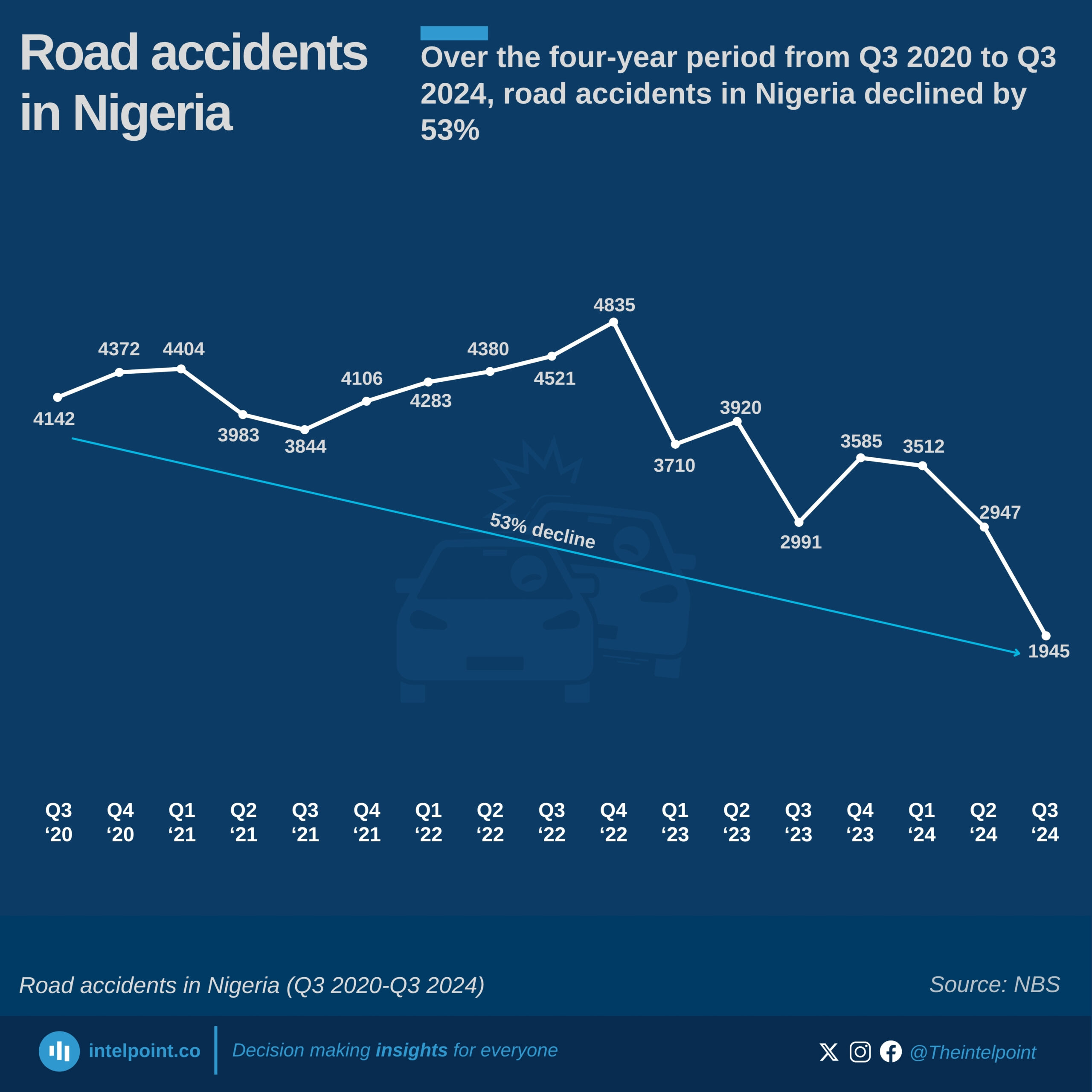
Over the four-year period from Q3 2020 to Q3 2024, road accidents in Nigeria declined by 53%
  • Road accidents declined by 53% between Q3 2020 and Q3 2024.
  • Q4 2022 recorded the highest number of accidents, with 4,835 reported cases.
  • Q3 2024 had the lowest number, with just 1,945 accidents.
  • Speed violation remains the leading cause of road accidents in Nigeria.
  • Ogun, FCT, Kaduna, and Nasarawa consistently rank among the top four states with the highest accident occurrences.
  • Bayelsa, Borno, Imo, Rivers, and Akwa Ibom regularly report the lowest number of accidents each quarter.
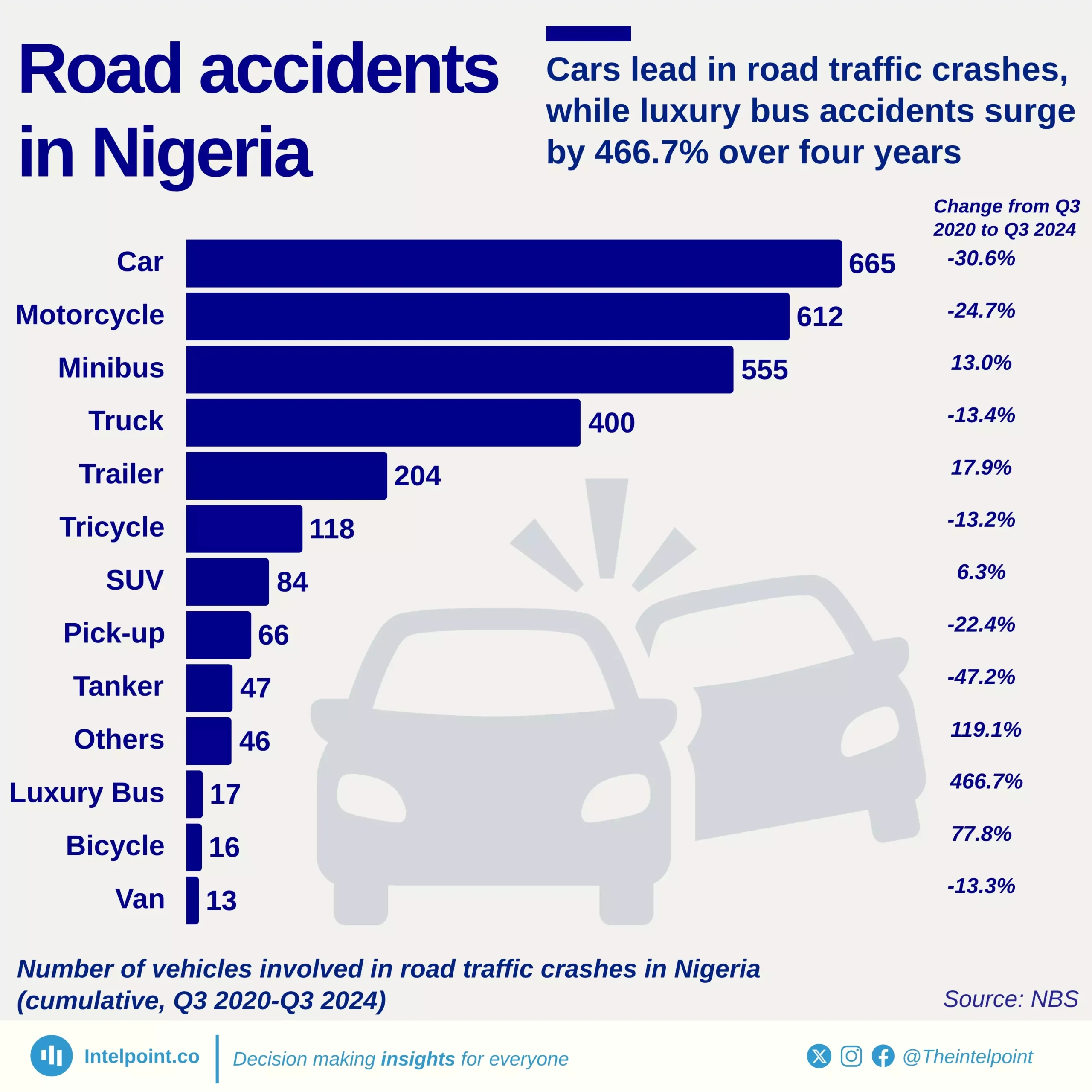
  • Commercial vehicles are the most frequently involved vehicle category in accidents.
  • Cars account for the highest number of individual vehicle accidents.

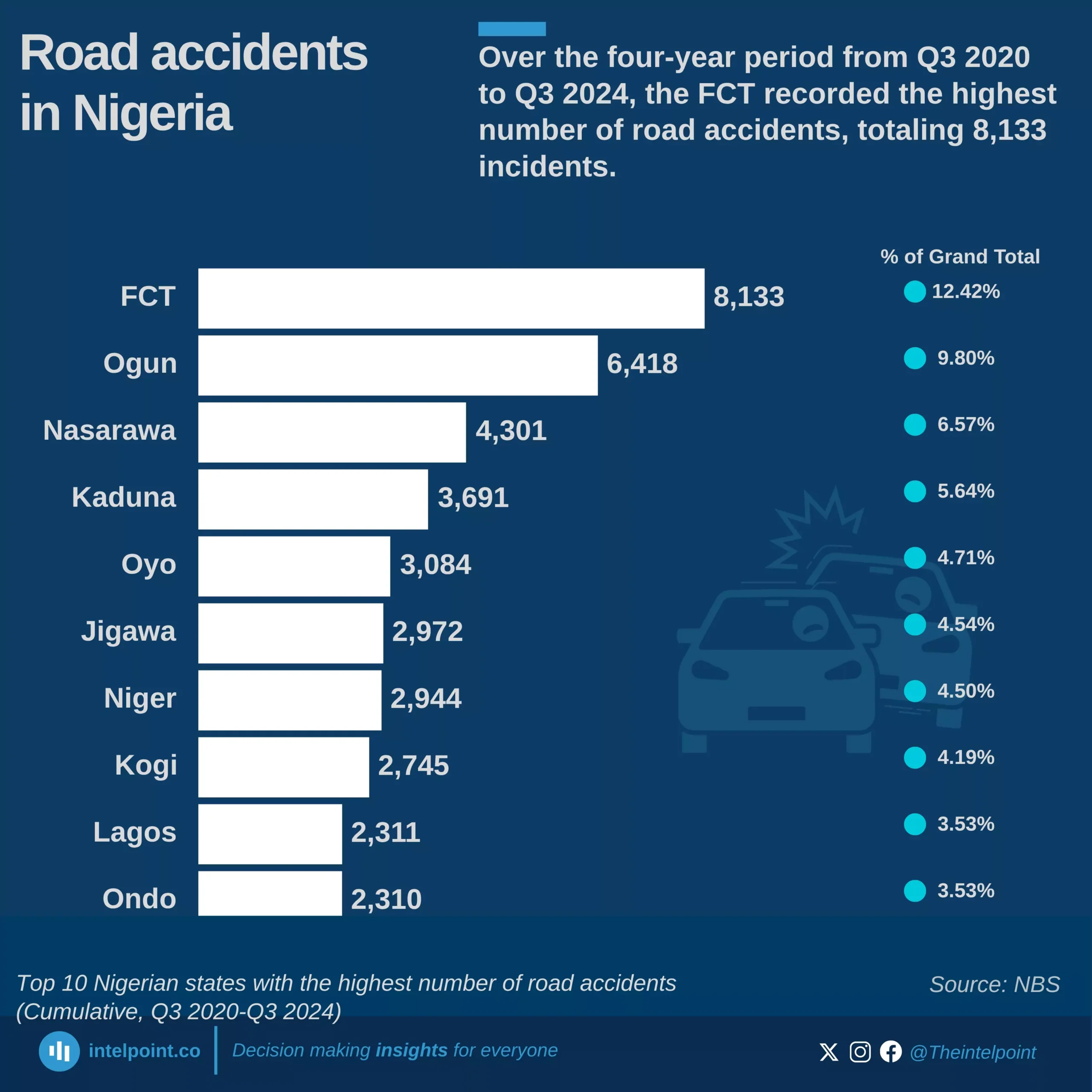
Over the four-year period from Q3 2020 to Q3 2024, the FCT recorded the highest number of road accidents, totaling 8,133 incidents
  • The Federal Capital territory (FCT) recorded the highest number of road accidents between Q3 2020 and Q3 2024, with a total of 8,133 accidents, accounting for 12.42% of total accidents.
  • FCT, Ogun, Nasarawa, and Kaduna consistently ranked among the top four states with the highest accident occurrences.
  • Bayelsa, Borno, Akwa Ibom, Rivers, and Imo were among the states with the lowest number of recorded accidents each quarter.

1 4 5 6 7 8 12

Can’t find what you’re looking for? Please fill the form below
Contact Form Demo
SIGN UP TO OUR NEWSLETTER
Get periodic updates about the African startup space, access to our reports, among others.
Subscribe Here
Subscription Form

A product of Techpoint Africa. All rights reserved