Bite-sized Insights about
 
Providing you with data-based insights about things happening around you.
Enugu - South-East’s top domestic debtor - owes more than Imo, Abia, and Anambra combined
  • Enugu State holds the highest domestic debt in the South-East at ₦180.5 billion.
  • Imo ranks second with ₦97.9 billion, about 54% lower than Enugu’s figure.
  • At ₦15.8 billion, Ebonyi remains the least indebted in the region, maintaining a conservative borrowing stance.
  • Combined, the five South-East states (Enugu, Imo, Abia, Anambra, and Ebonyi) owe roughly ₦371 billion domestically as of Q2 2025.

Rivers State's domestic debt is 3.5% (₦12.4b) more than the combined debt of Delta and Cross River
  • Bayelsa holds the lowest debt with ₦65.9 billion.
  • Rivers’ ₦364.4 billion domestic debt is almost six times Bayelsa’s total, highlighting major fiscal disparities.
  • Delta (₦204.7 billion) and Cross River (₦147.3 billion) remain among the region’s more indebted states
  • Regional debt approaches ₦1 trillion: The six South-South states collectively hold an estimated ₦968 billion in domestic debt as of Q2 2025.

Jigawa recorded the lowest domestic debt in North-West Nigeria at ₦852 million in Q2 2025
  • The seven North-Western states collectively owed about ₦223.4 billion in domestic debt as of Q2 2025, according to DMO data.
  • Kano State ranked highest with ₦56.9 billion, accounting for roughly 25% of the zone’s total debt.
  • Jigawa remains the least indebted in the region and in the entire country, with only ₦852 million.
  • Moderate debt spread: While Kano, Zamfara, and Sokoto carried the largest debt loads, the remaining states maintained relatively conservative borrowing patterns.

Kogi and Nasarawa post lowest domestic debt in North Central Nigeria at ₦18.8 billion and ₦23.9 billion, respectively
  • The six North Central states collectively hold ₦449.4 billion in domestic debt as of Q2 2025, according to DMO data.
  • Kogi and Nasarawa lead in fiscal control with ₦18.8 billion and ₦23.9 billion, respectively
  • Both states record the lowest debt profiles in the region. Niger State’s ₦141.5 billion debt makes it the region’s most indebted, accounting for nearly one-third of the total.
  • The debt gap between Kogi (lowest) and Niger (highest) stands at over ₦123 billion, highlighting stark differences in fiscal management and borrowing capacity across the zone.

Lagos accounts for over 70% of South-West Nigeria’s domestic debt, hitting ₦1.04 trillion in mid-2025
  • Lagos dominates regional debt with a domestic debt stock of ₦1.04 trillion, over 70% of the South-West’s total subnational debt.
  • Lagos’s debt is six times larger than that of Ogun (₦162.9 billion), the region’s next most indebted state.
  • At ₦10.6 billion, Ondo maintains the lowest domestic debt profile in the region, reflecting relatively modest borrowing.
  • The combined domestic debt of the six South-West states (Lagos, Ogun, Oyo, Osun, Ekiti, and Ondo) stood at ₦1.43 trillion as of Q2 2025.

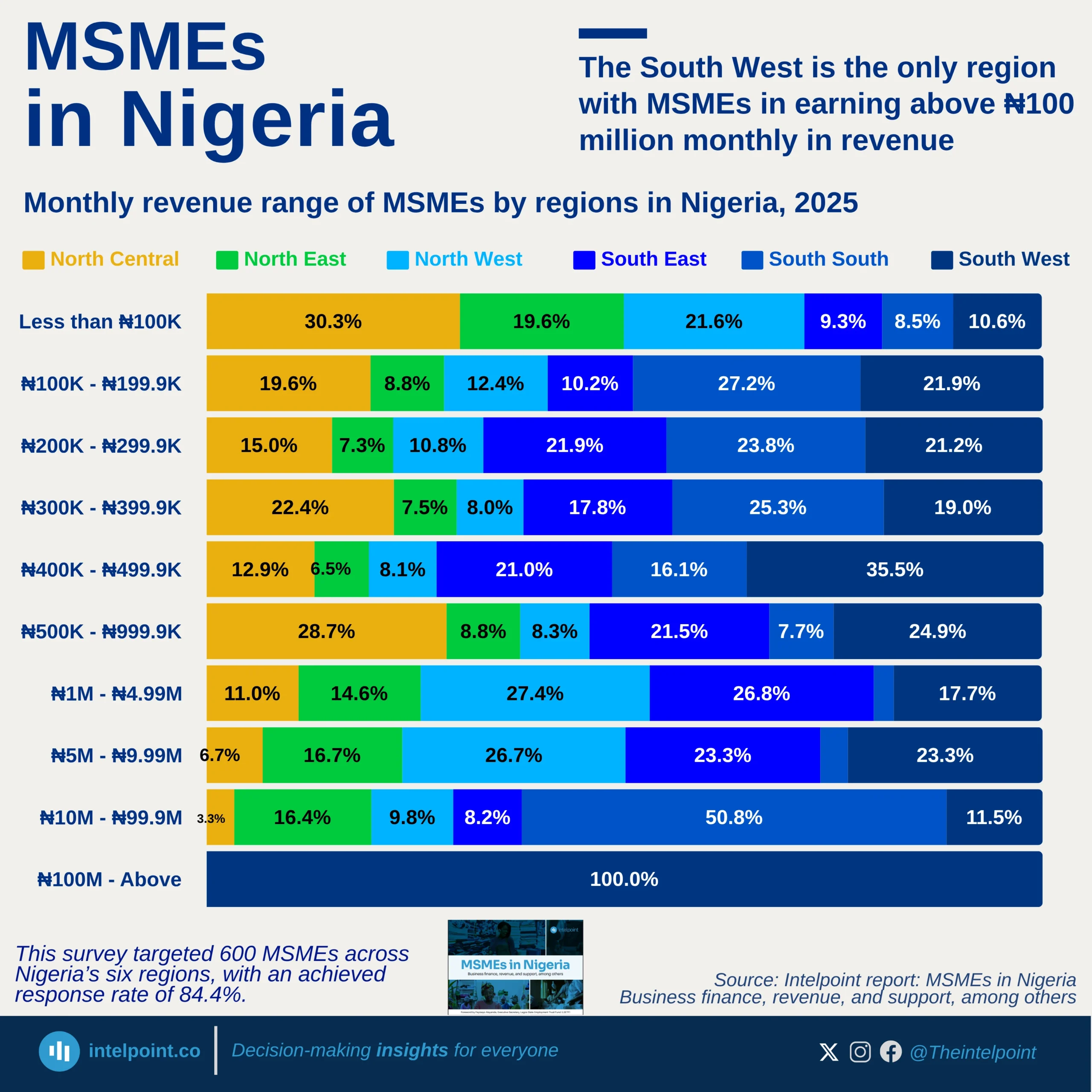
The South West is the only region with MSMEs in earning above ₦100 million monthly in revenue
  • The South West is the only region with MSMEs reporting revenues above ₦100 million, accounting for 100% of that bracket.
  • While high-revenue firms cluster in the South West, the South South leads in the ₦10M–₦99.9M range, with over 50.8% share.
  • The North Central (30.3%) has the highest share of MSMEs earning less than ₦100,000 monthly, followed by the North East (19.6%).
  • The ₦200K–₦999.9K range is more evenly spread across regions, but the South West and South South consistently record stronger representation.

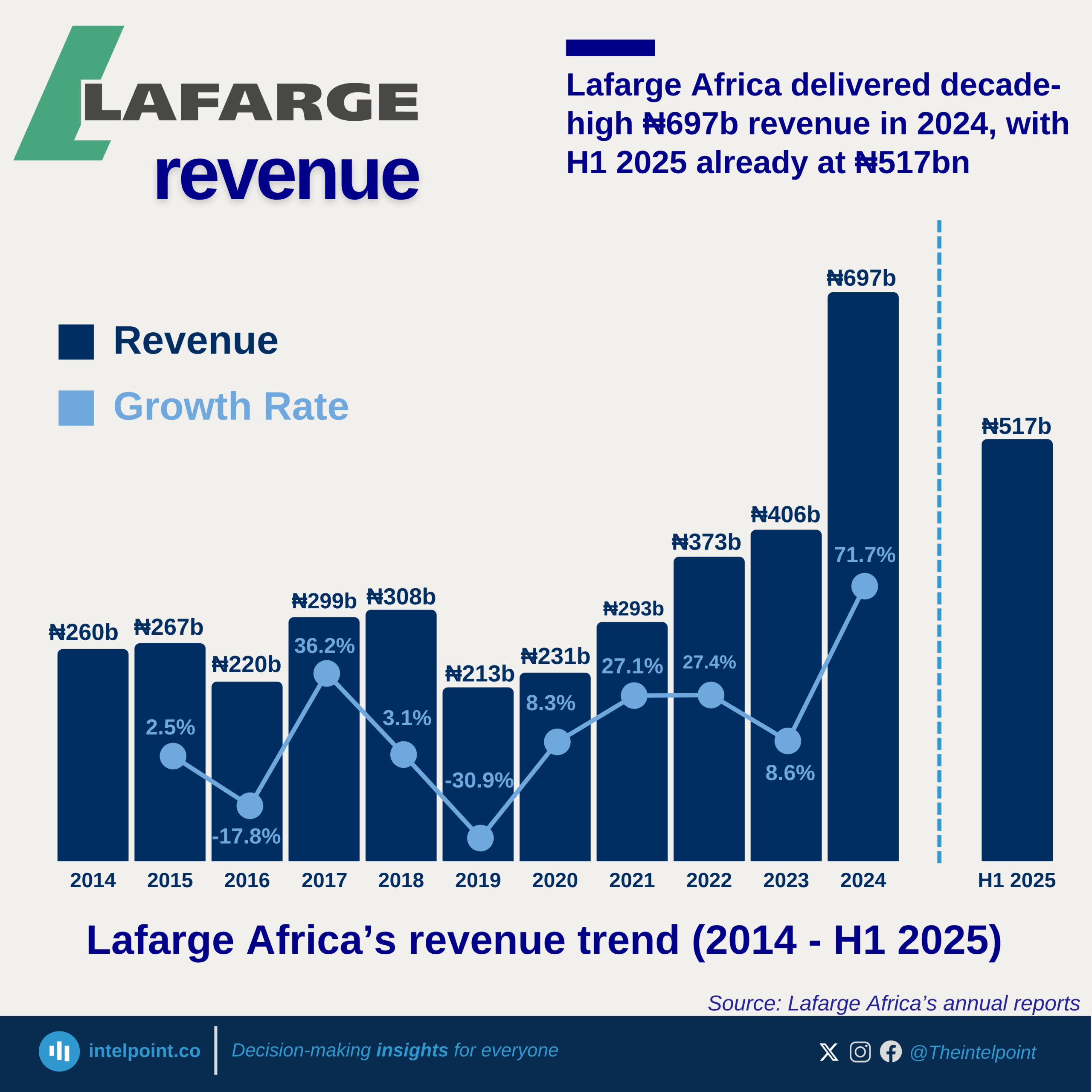
Lafarge Africa delivered decade-high ₦697b revenue in 2024, with H1 2025 already at ₦517bn
  • Lafarge Africa's revenue hit a decade-high of ₦697bn in 2024, reflecting a strong 71.7% year-on-year growth.
  • With ₦517bn in H1 2025 alone, Lafarge Africa has already achieved nearly 74% of 2024’s full-year revenue, signalling potential to surpass last year’s record if momentum continues.
  • The company has experienced sharp swings, including steep drops in 2016 (-17.8%) and 2019 (-30.9%).
  • Despite volatility, Lafarge has grown from ₦260bn in 2014 to ₦697bn in 2024, showing long-term expansion.

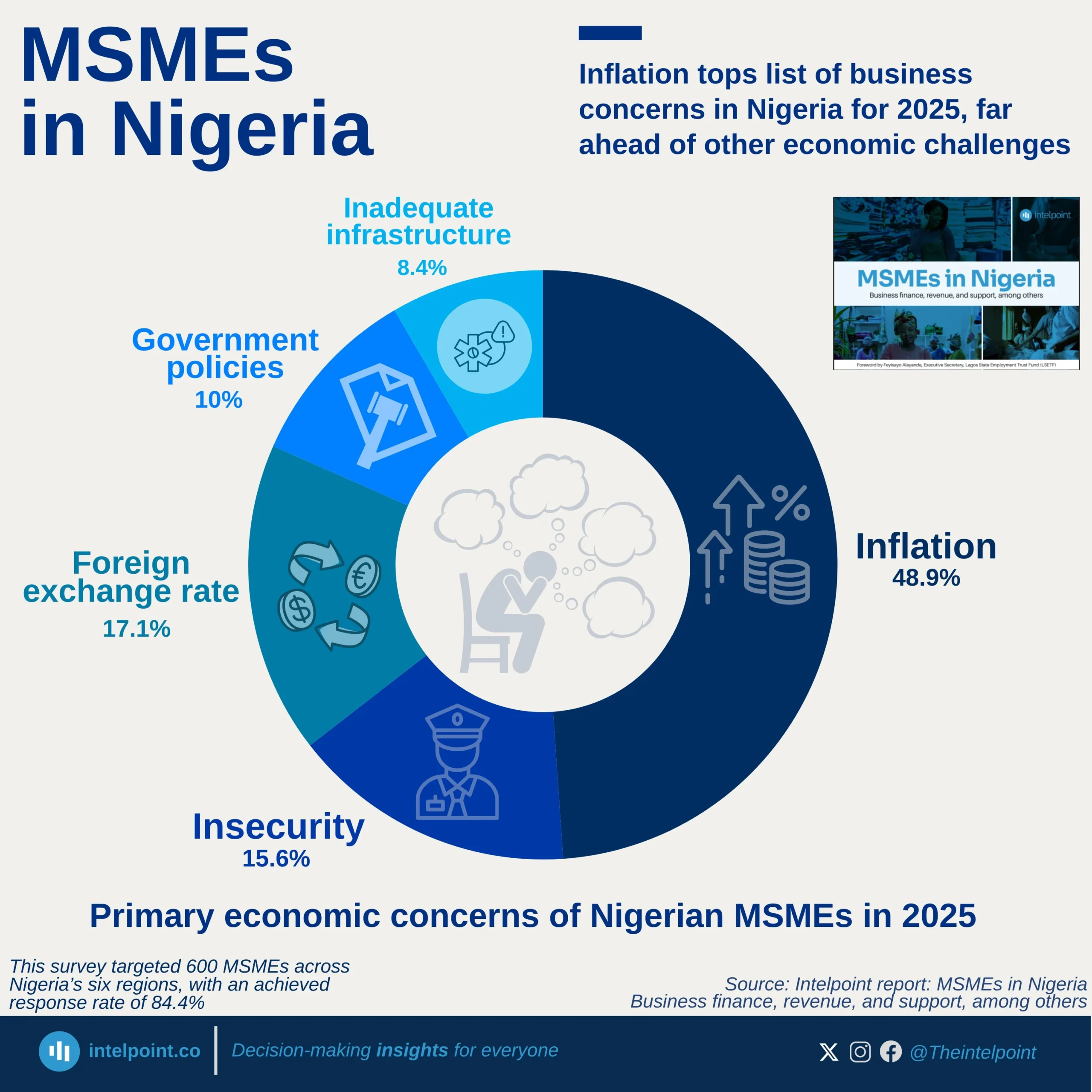
Inflation tops list of business concerns in Nigeria for 2025, far ahead of other economic challenges
  • Nearly half (48.9%) of Nigerian businesses identify inflation as their greatest economic challenge in 2025.
  • The foreign exchange rate (17.1%) is the second most pressing concern, reflecting ongoing naira volatility.
  • Insecurity (15.6%) and government policies (10.0%) remain significant worries for business operations.
  • Inadequate infrastructure (8.4%), while the least mentioned, continues to constrain growth.

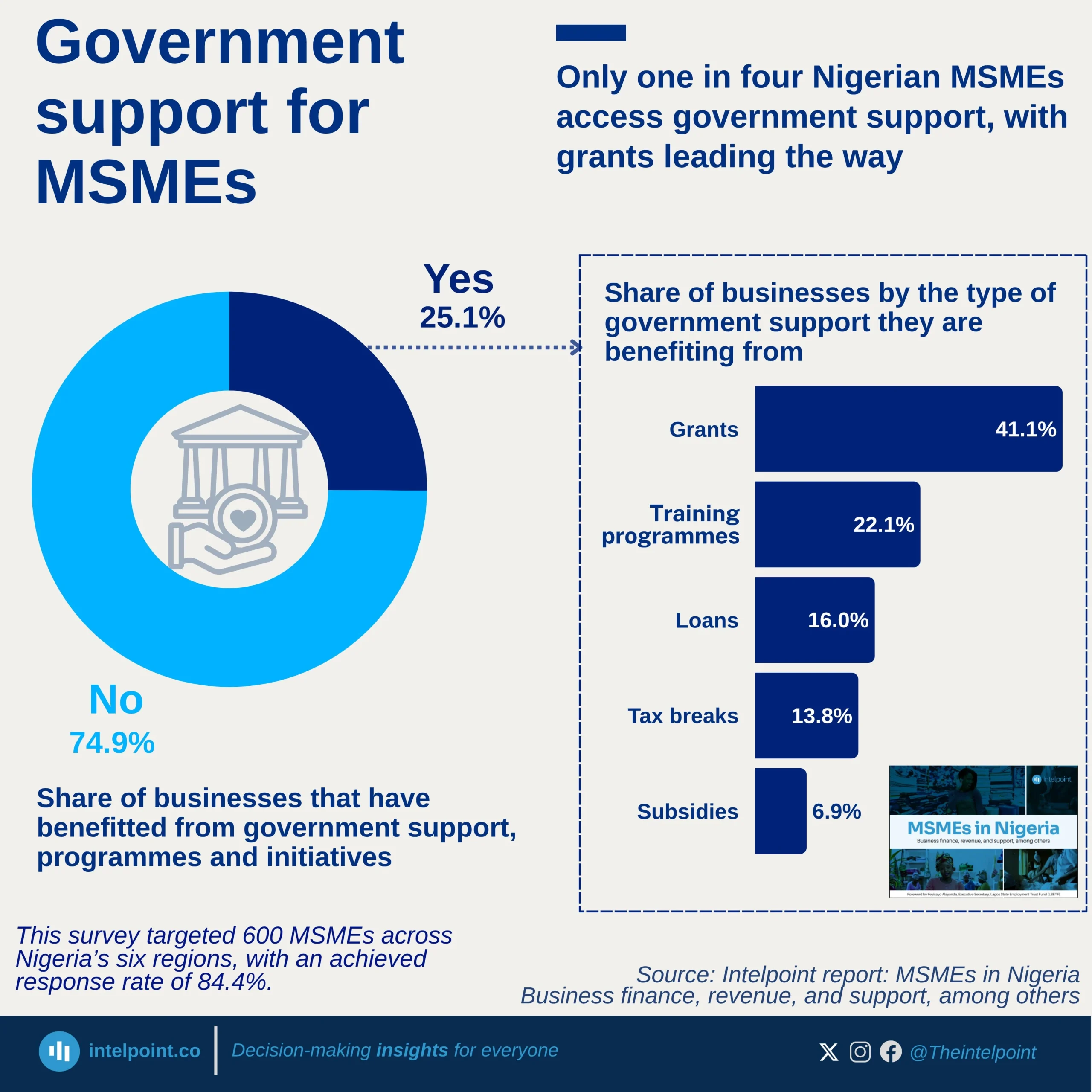
Only one in four Nigerian MSMEs access government support, with grants leading the way
  • Just 25.1% of MSMEs report receiving any form of government support, while 74.9% remain untouched by initiatives.
  • Among those who benefitted, 41.1% accessed grants, making it the most common form of support.
  • 22.1% of MSMEs participated in government training programmes, showing recognition of capacity-building needs.
  • Only 16% received loans and 13.8% got tax breaks, underscoring limited financial and fiscal support penetration.
  • A mere 6.9% of businesses report accessing subsidies, reflecting minimal impact of such schemes.

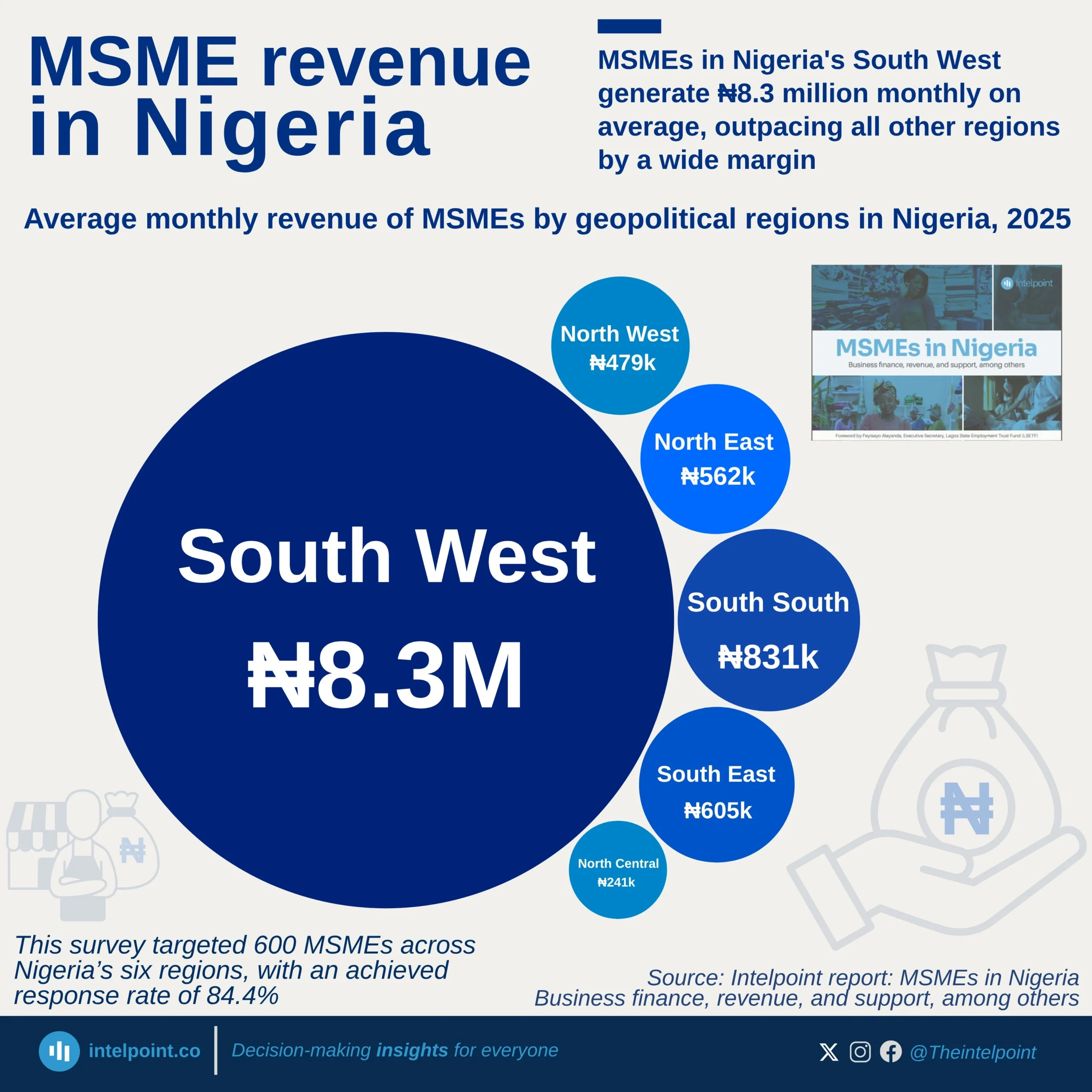
MSMEs in Nigeria's South West generate ₦8.3 million monthly on average, outpacing all other regions by a wide margin
  • The South West (₦8.3m) far surpasses all regions in monthly revenue, reflecting Lagos’ dominance as Nigeria’s commercial hub.
  • The South South (₦831k) and South East (₦605k) trail far behind but still outperform the northern regions.
  • The North East (₦562k) and North West (₦479k) show significantly lower average revenues.
  • The North Central (₦241k) records the weakest average, underlining stark regional disparities.

1 2 3 4 5 6 12

Can’t find what you’re looking for? Please fill the form below
Contact Form Demo
SIGN UP TO OUR NEWSLETTER
Get periodic updates about the African startup space, access to our reports, among others.
Subscribe Here
Subscription Form

A product of Techpoint Africa. All rights reserved