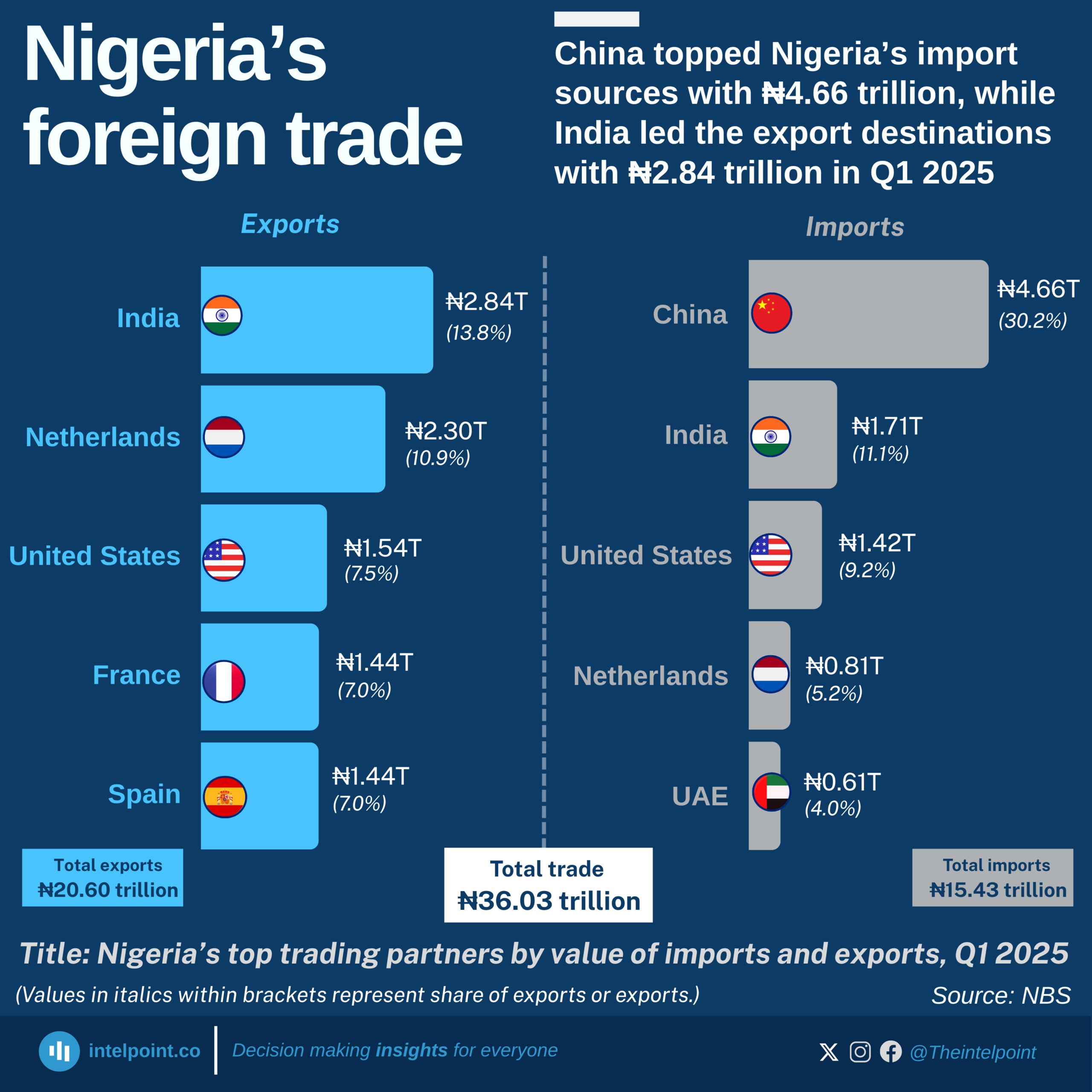
China topped Nigeria’s import sources with ₦4.66 trillion, while India led the export destinations with ₦2.84 trillion in Q1 2025

  • India is Nigeria’s largest export destination Nigeria exported ₦2.84 trillion worth of goods to India in Q1 2025, driven largely by crude oil.
  • China dominates imports into Nigeria China supplied ₦4.66 trillion worth of goods, far outpacing all other countries. Likely dominated by electronics, machinery, and manufactured goods.
  • The United States appears on both sides. Nigeria exports ₦1.54 trillion to the US and imports ₦1.42 trillion, showing a relatively balanced trade relationship.
  • European countries are major export Partners Netherlands (₦2.30T), France (₦1.44T), and Spain (₦1.44T) are prominent export destinations, indicating strong demand for Nigerian crude oil and other commodities in Europe.
  • UAE barely makes the import list. The UAE closes out the top import list at ₦0.61 trillion, showing relatively lower trade volume compared to others, but still significant enough to be in the top 5.

In the first quarter of 2025, Nigeria's total trade value reached a significant milestone of ₦36.03 trillion, reflecting the country’s continued engagement in global commerce. This figure comprises ₦20.60 trillion in exports and ₦15.43 trillion in imports, showcasing a trade surplus of ₦5.17 trillion, a positive indicator of stronger outbound trade compared to inbound. Nigeria's international trade dynamics reflect a strong reliance on commodity exports and imported manufactured goods. The country’s export activity was most heavily concentrated with India, receiving ₦2.84 trillion in goods, mostly attributed to crude oil exports, which continue to underpin Nigeria's trade economy. Following India are the Netherlands, the United States, France, and Spain, which reflect Nigeria’s enduring trade relationships with Western economies, especially in energy.

On the import side, China's dominance is notable, with ₦4.66 trillion in imports flowing into Nigeria. This is nearly three times the volume imported from India (₦1.71T), the second-largest source. China’s position illustrates its role as Nigeria’s primary supplier of machinery, electronics, and industrial goods. Other key import sources include the United States, Netherlands, and UAE, all of which maintain significant commercial ties.

Interestingly, the United States appears on both the top export and import lists, indicating a well-rounded trade engagement, rather than being skewed toward either inflow or outflow. This bilateral balance could be beneficial for both economies and may reflect growing diversification in traded products beyond oil.

While European countries dominate Nigeria’s export destinations, only the Netherlands appears among the top import sources. This might signal that Europe values Nigeria more as a supplier than as a buyer, maintaining a trade surplus.
Source:

NBS

Period:

Q1 2025
HTML code to embed chart
Want a bespoke report?
Reach out
Tags
Related Insights

Nigeria’s power grid is 69.9% powered by thermal plants
  • Thermal energy dominates Nigeria’s grid, supplying 69.9% of total power.
  • Hydro plants contribute 30.1%, making them the country’s second major source.
  • The heavy reliance on thermal generation shows Nigeria’s grid is still largely fossil-fuel driven.
  • Hydro remains a crucial but secondary source, supporting overall supply stability.

Nigeria's DisCos recorded ₦360bn revenue gap after collecting ₦1.12tn from ₦1.49tn billed in H1 2025
  • DisCos billed approximately ₦1.49 trillion but collected only ₦1.12 trillion in H1 2025.
  • Ikeja and Eko DisCos generated the highest revenues, collecting ₦206.22 billion and ₦210.59 billion, respectively.
  • Revenue collection gaps remain significant, with Jos, Kaduna, and Yola posting the weakest collection performances.
  • The wide gap between billings and actual collections suggests persistent challenges in customer payment compliance, metering, and distribution efficiency.

Nigeria has installed 3.65 million electricity metres since 2019; Ikeja DisCo leads with 823,000, and Aba Power at the bottom with 56,000
  • Approximately 3.65 million metres have been installed nationwide across all frameworks since 2019.
  • Ikeja DisCo leads by a wide margin with 823,000 installations, over twice the volume of most other DisCos.
  • Kaduna, Yola, and Aba Power recorded the lowest metre installations, each below 100,000.
  • The disparities in installation totals reveal uneven progress in achieving nationwide metering coverage.

More than 8 in 10 electricity customers of Ikeja and Eko DisCos are now metered
  • Ikeja (84.6%) and Eko (83.3%) lead Nigeria’s metering performance, keeping unmetered customers below 17%.
  • Eight out of the twelve DisCos have metering rates below 60%, showing a wide sector imbalance.
  • The worst-performing DisCos — Yola, Jos, Kaduna, and Kano — have over 65% unmetered customers.
  • Regional disparities are sharp: Lagos and Abuja outperform northern and south-eastern DisCos by large margins.

Nigeria’s public debt has soared since 2010, with domestic debt up 2,020% and external debt up 1,000% by mid 2025
  • Nigeria’s domestic debt jumped from ₦3.8 trillion in 2010 to ₦80.55 trillion by mid-2025.
  • Foreign debts increased from $4.27 billion in 2010 to $46.98 billion in 2025, reflecting growing reliance on external financing.
  • Debt accumulation surged notably after 2020, coinciding with pandemic spending, naira depreciation, and higher fiscal deficits.
  • The widening gap between revenue and debt service raises questions about Nigeria’s long-term debt sustainability.

Nigeria's energy goods imports have stayed low and stable for 7 years, while exports increased from ₦37B to ₦263B
  • Nigeria’s energy goods exports rose from ₦37.3B in 2017 to ₦262.9B in 2024, before falling to ₦154.2B in H1 2025.
  • Imports remained consistently low, ranging from ₦24.2M to ₦353.1M throughout the period.
  • Export growth outpaced imports, showing a widening trade surplus in energy goods.
  • The 2024 spike in exports represents the highest export value within the nine-year window.
  • Energy imports stayed below ₦400M yearly, indicating low dependency on foreign energy goods.

POPULAR TOPICS
SIGN UP TO OUR NEWSLETTER
Get periodic updates about the African startup space, access to our reports, among others.
Subscribe Here
Subscription Form

A product of Techpoint Africa. All rights reserved