Bite-sized Insights about
 
Providing you with data-based insights about things happening around you.
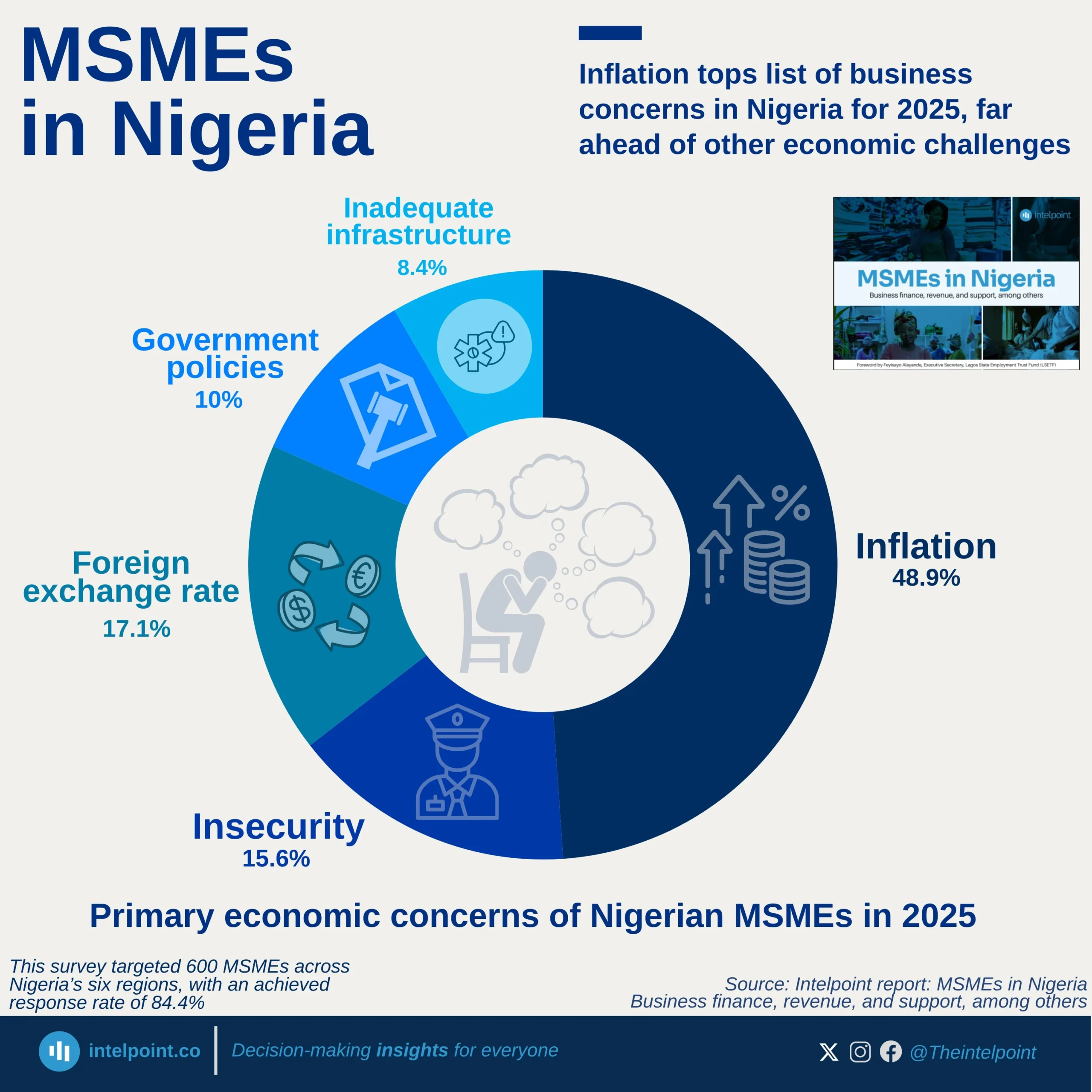
Inflation tops list of business concerns in Nigeria for 2025, far ahead of other economic challenges
  • Nearly half (48.9%) of Nigerian businesses identify inflation as their greatest economic challenge in 2025.
  • The foreign exchange rate (17.1%) is the second most pressing concern, reflecting ongoing naira volatility.
  • Insecurity (15.6%) and government policies (10.0%) remain significant worries for business operations.
  • Inadequate infrastructure (8.4%), while the least mentioned, continues to constrain growth.

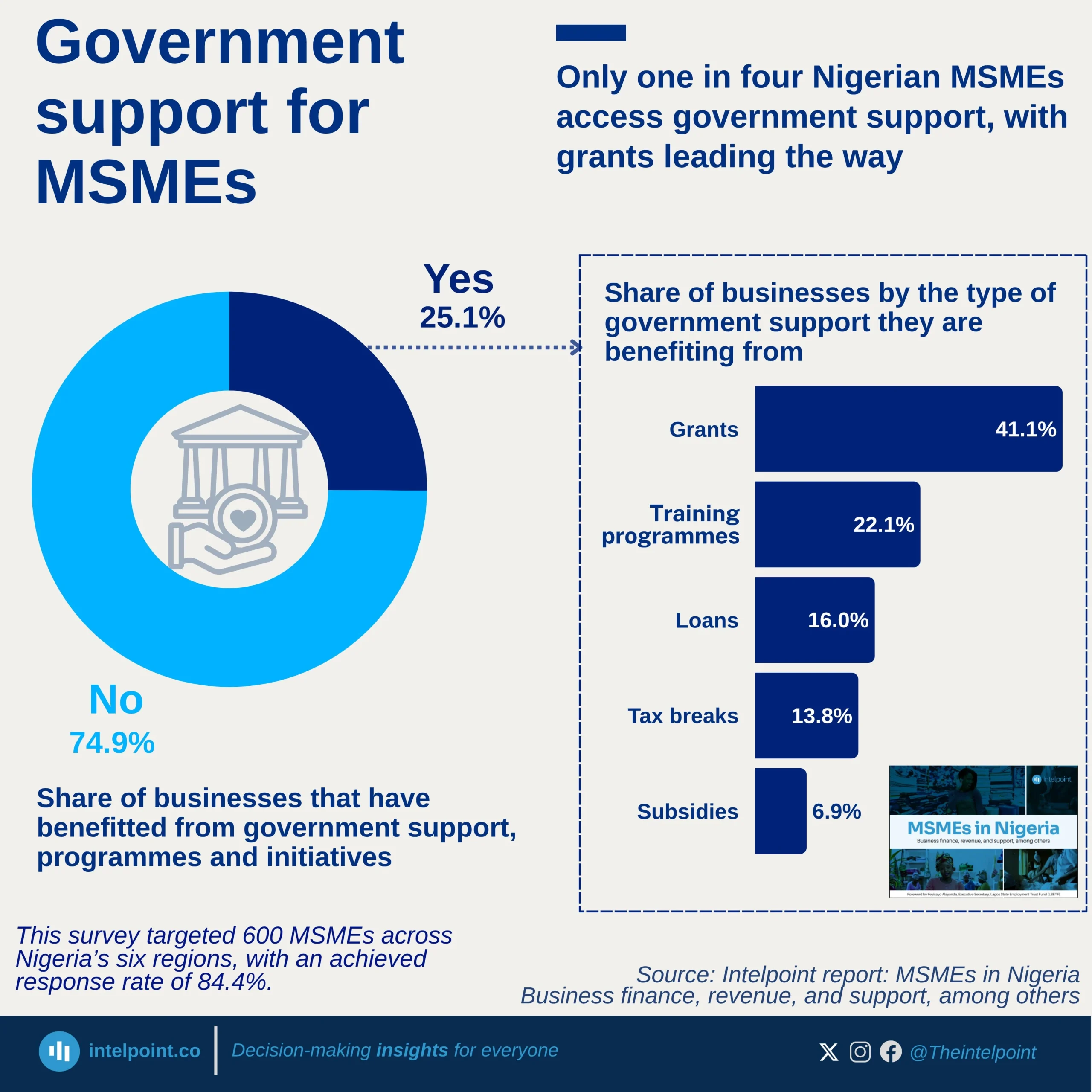
Only one in four Nigerian MSMEs access government support, with grants leading the way
  • Just 25.1% of MSMEs report receiving any form of government support, while 74.9% remain untouched by initiatives.
  • Among those who benefitted, 41.1% accessed grants, making it the most common form of support.
  • 22.1% of MSMEs participated in government training programmes, showing recognition of capacity-building needs.
  • Only 16% received loans and 13.8% got tax breaks, underscoring limited financial and fiscal support penetration.
  • A mere 6.9% of businesses report accessing subsidies, reflecting minimal impact of such schemes.

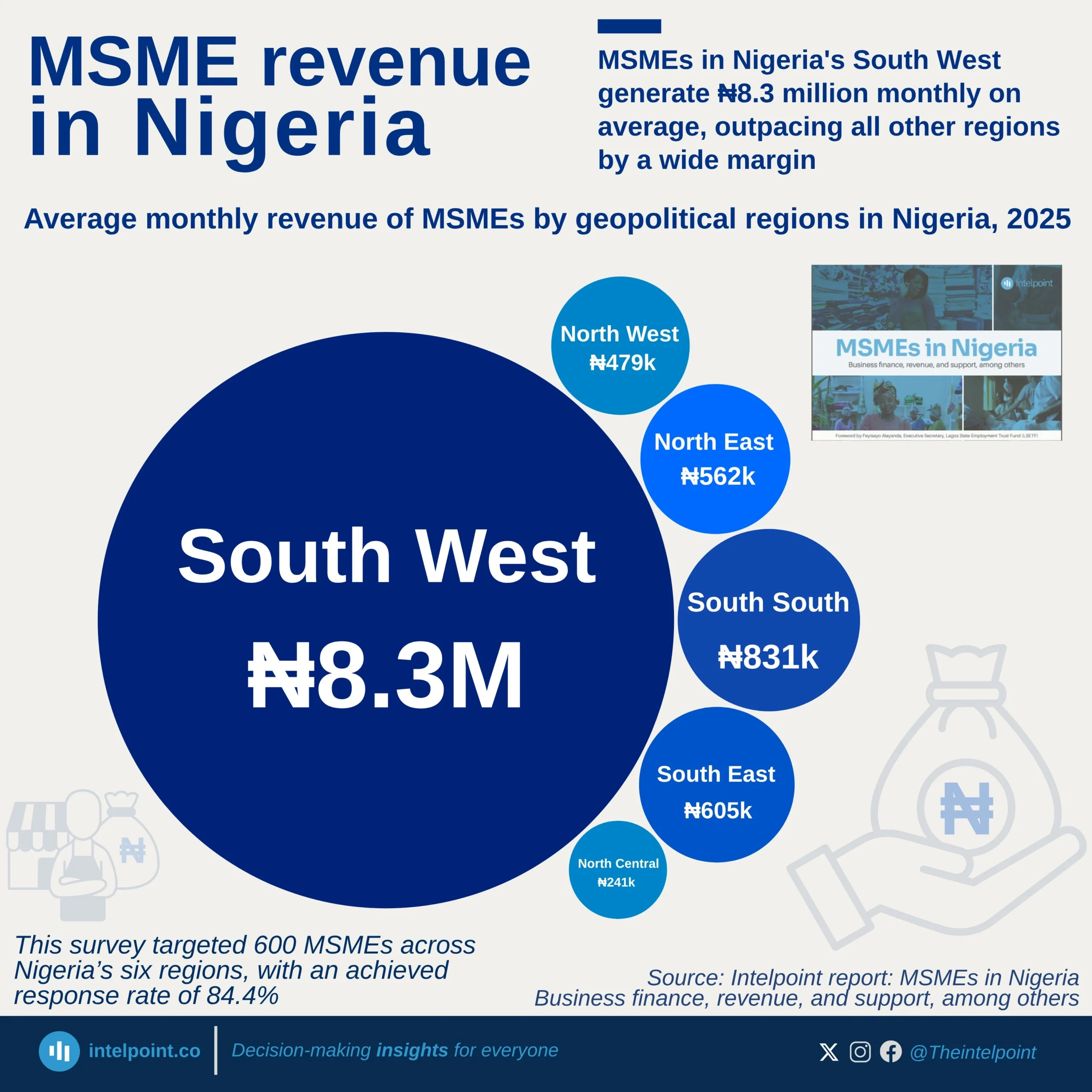
MSMEs in Nigeria's South West generate ₦8.3 million monthly on average, outpacing all other regions by a wide margin
  • The South West (₦8.3m) far surpasses all regions in monthly revenue, reflecting Lagos’ dominance as Nigeria’s commercial hub.
  • The South South (₦831k) and South East (₦605k) trail far behind but still outperform the northern regions.
  • The North East (₦562k) and North West (₦479k) show significantly lower average revenues.
  • The North Central (₦241k) records the weakest average, underlining stark regional disparities.

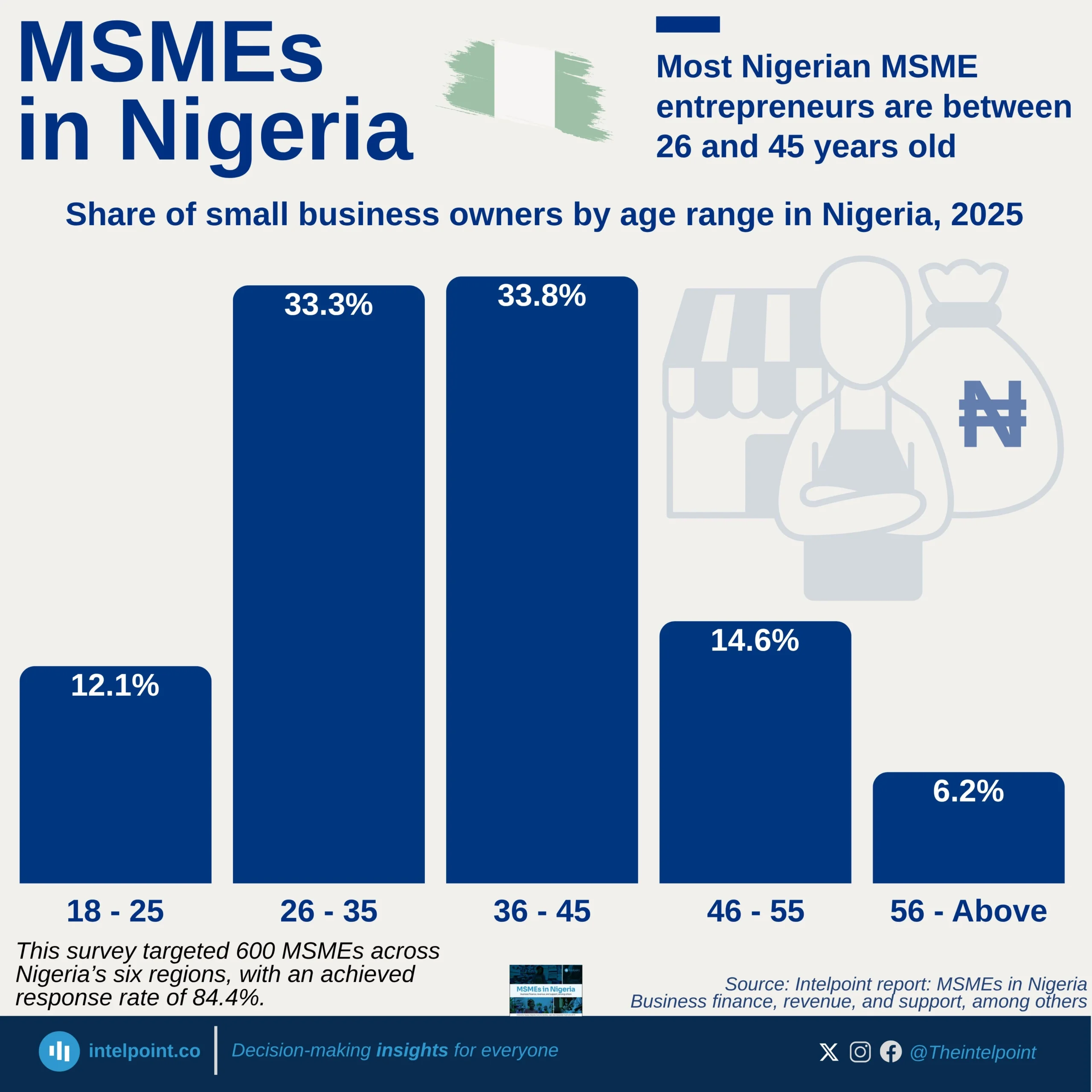
Most Nigerian MSME entrepreneurs are between 26 and 45 years old
  • Only 12.1% of entrepreneurs are aged 18–25, showing limited entry among very young adults.
  • The largest groups are 26–35 (33.3%) and 36–45 (33.8%), together accounting for two-thirds of entrepreneurs.
  • Mid-life representation: 14.6% are aged 46–55.
  • Just 6.2% are 56 and above, indicating fewer older adults start or run MSMEs.

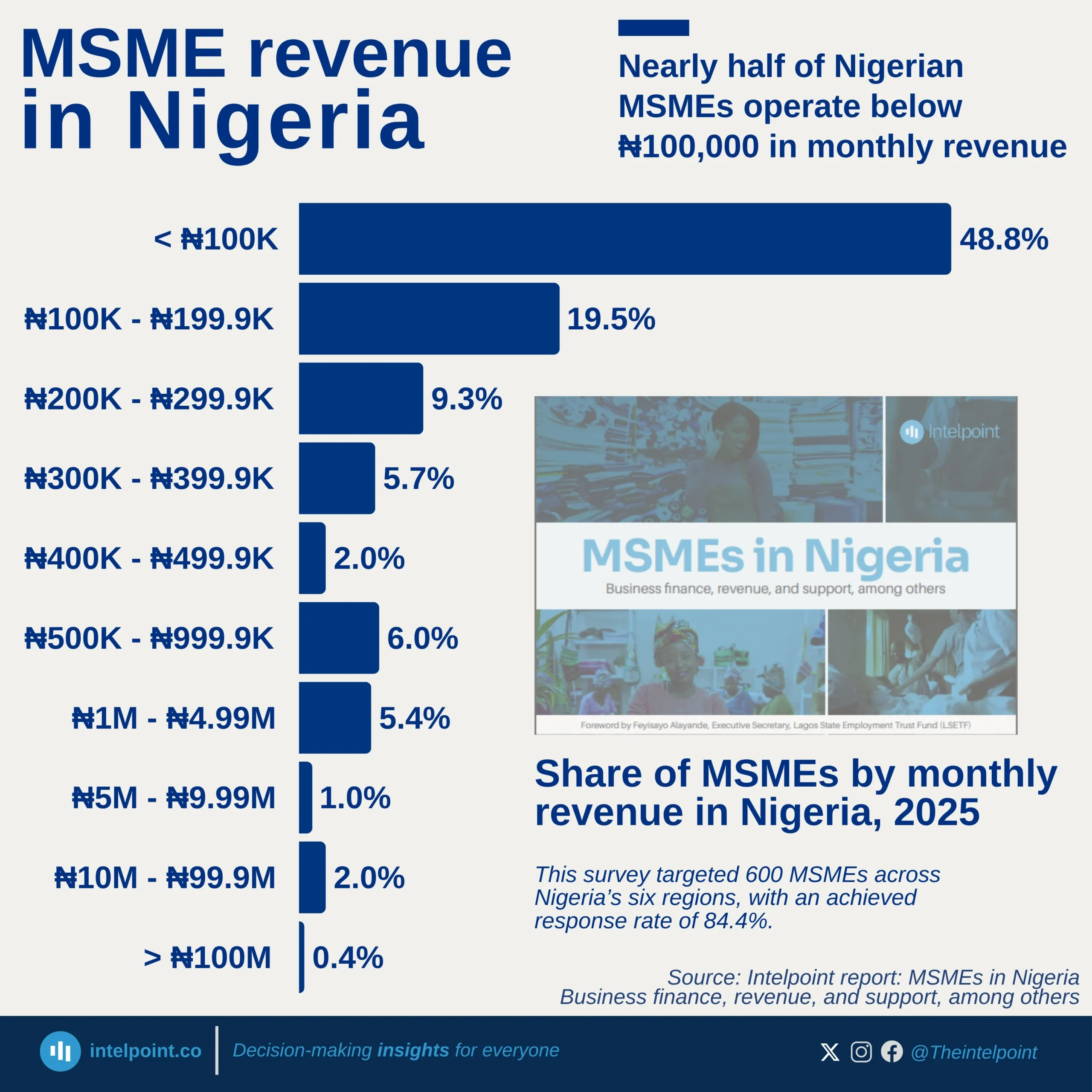
Nearly half of Nigerian MSMEs operate below ₦100,000 in monthly revenue
  • 48.8% of MSMEs earn less than ₦100,000 monthly.
  • 19.5% report revenues between ₦100,000 and ₦199,900.
  • The share of businesses decreases steadily in the ₦200,000–₦999,900 bands, ranging from 9.3% to 6%.
  • Only 8.8% of MSMEs earn above ₦1 million monthly, with just 0.4% exceeding ₦100 million.

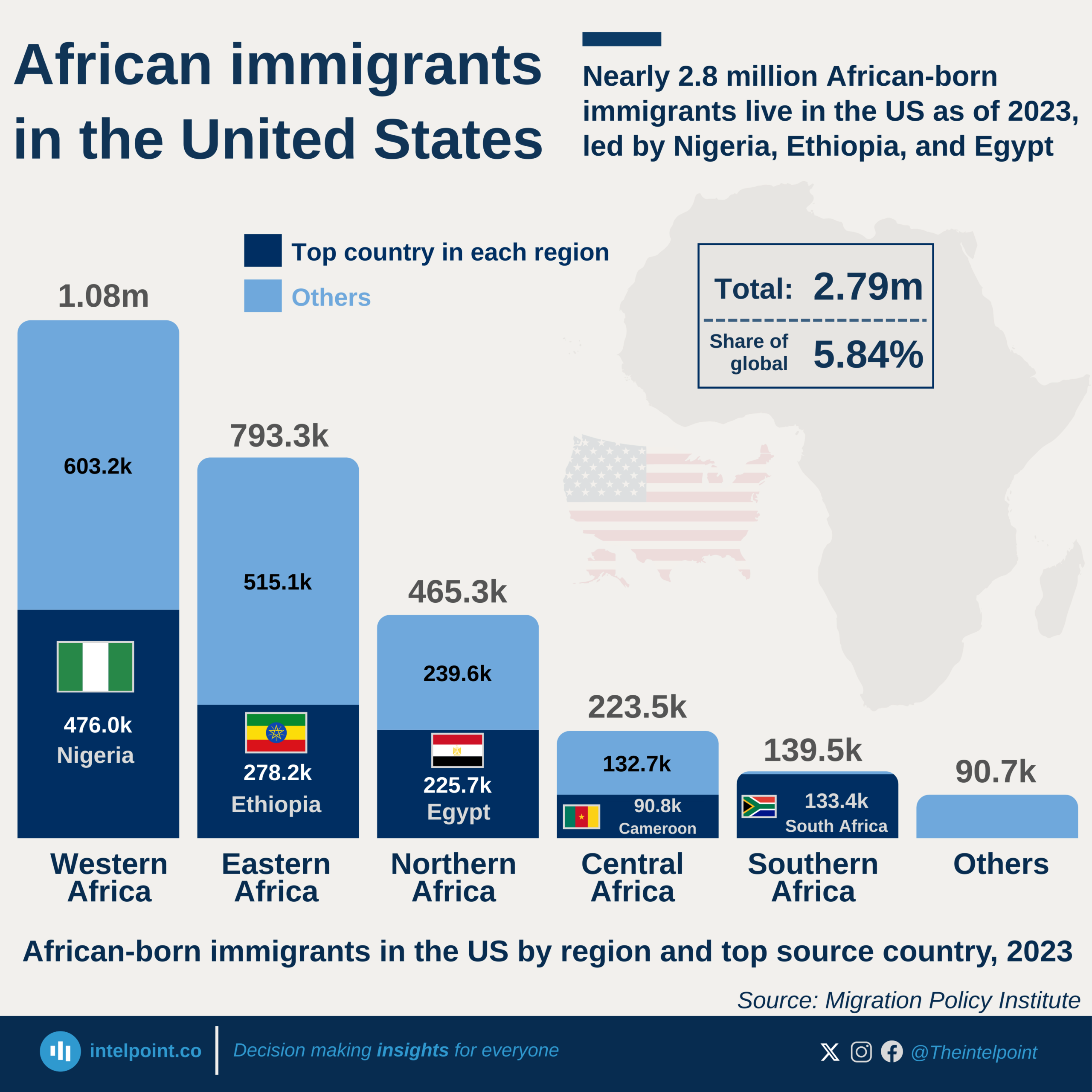
Nearly 2.8 million African-born immigrants live in the US as of 2023, led by Nigeria, Ethiopia, and Egypt
  • In 2023, the total number of African-born immigrants in the US was about 2.79 million.
  • Western Africa is the largest source region, contributing 1.08 million immigrants (39%), led by Nigeria (476k).
  • Eastern Africa is the second-largest source (28%), dominated by Ethiopia (278.2k).
  • Northern Africa accounts for 17%, mainly from Egypt (225.7k).
  • Central Africa contributes 8%, with Cameroon (90.7k) as the top country.
  • Southern Africa is smaller at 5%, almost entirely from South Africa (133.4k).
  • Five countries—Nigeria, Ethiopia, Egypt, Cameroon, and South Africa—together make up nearly half of all African-born immigrants in the US.

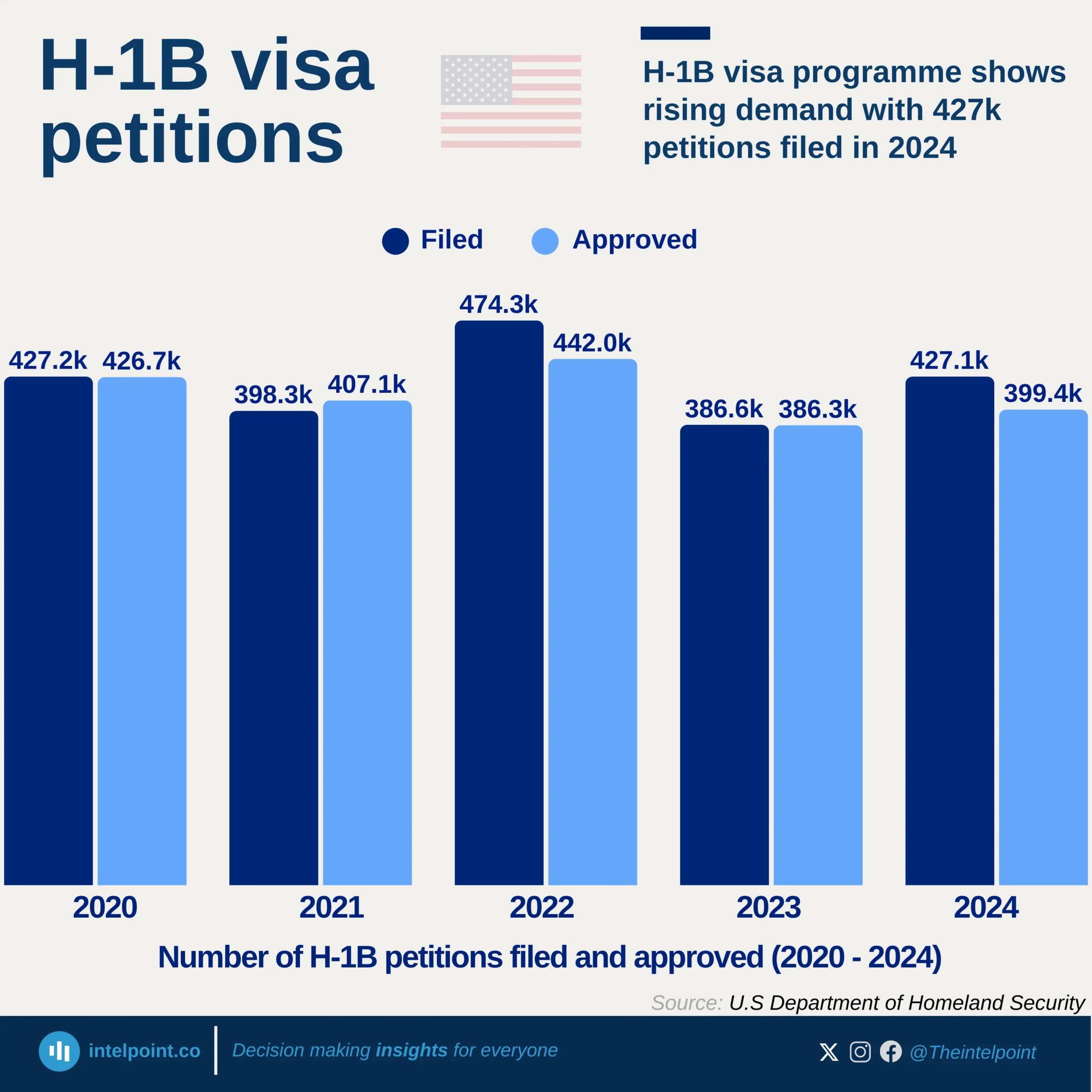
H-1B visa programme shows rising demand with 427k petitions filed in 2024
  • Petitions peaked in 2022, with 474,301 filed, but only 442,043 approved, marking the widest gap in the five-year period.
  • 2021 was unique, as approvals (407,071) actually exceeded the number of petitions filed (398,269), reflecting carryovers or adjustments from prior years.
  • 2023 saw the lowest filings and approvals, at just under 387,000 each, signalling reduced demand or stricter caps.
  • By 2024, filings rebounded to over 427,000, but approvals lagged at 399,402, continuing the trend of more petitions being filed than granted.
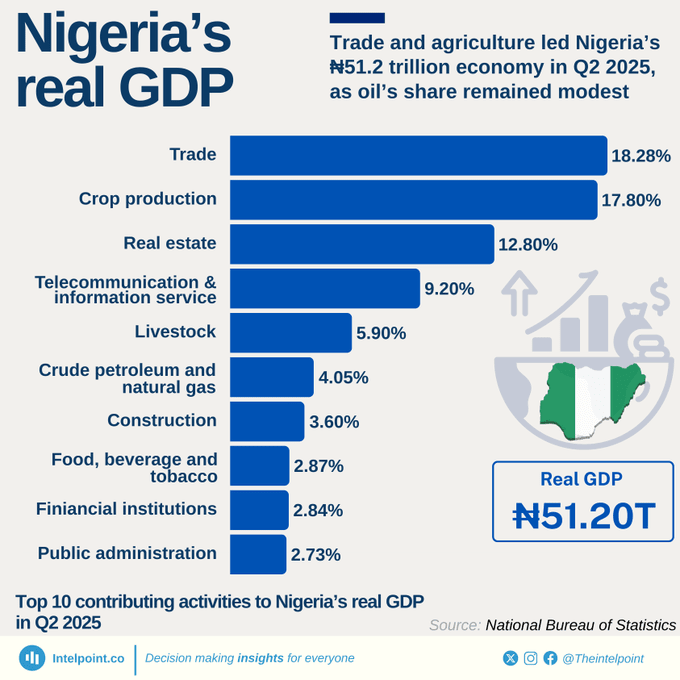
Trade and agriculture led Nigeria’s ₦51.20 trillion economy in Q2 2025, as oil’s share remained modest
  • Trade contributed 18.28%, making it the largest sector in Q2 2025's GDP.
  • Crop production followed with 17.8%, underscoring agriculture’s central role.
  • Oil and gas added just 4.05%, highlighting its shrinking share compared to non-oil sectors.
  • Real estate and telecoms reinforced the growing strength of services in the Nigerian economy.

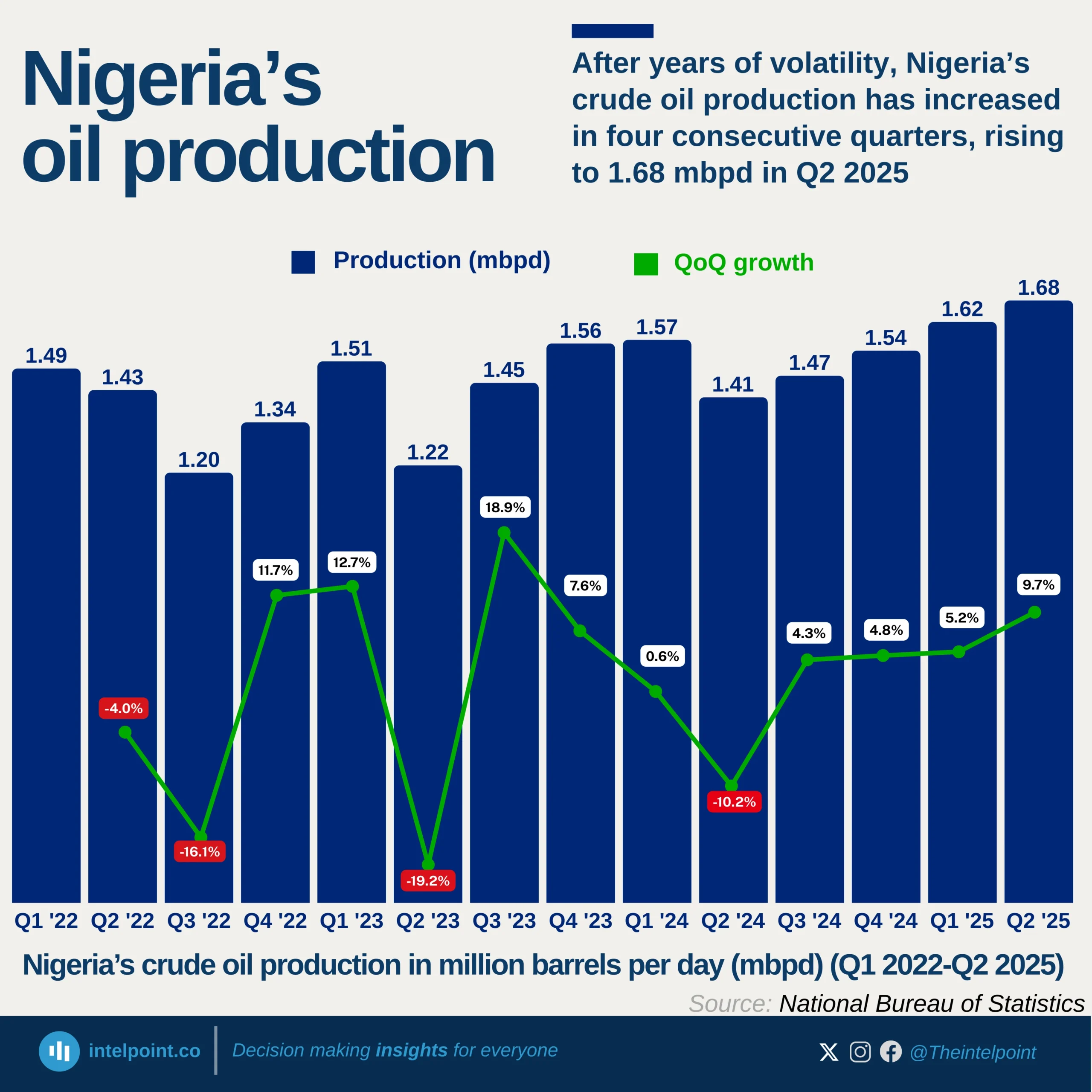
After years of volatility, Nigeria’s crude oil production has increased in four consecutive quarters, rising to 1.68 mbpd in Q2 2025
  • Production dipped sharply in 2022, with the steepest quarterly decline of –16.08% in Q3, before recovering at year-end.
  • 2023 marked a rebound year, highlighted by strong quarterly growth of 18.85% in Q3, lifting production back above 1.5 mbpd.
  • 2024 showed relative stability, with modest fluctuations; production only briefly fell below 1.5 mbpd before gradually recovering.
  • By Q2 2025, output hit 1.68 mbpd, the highest in the series, supported by consistent growth in three straight quarters.

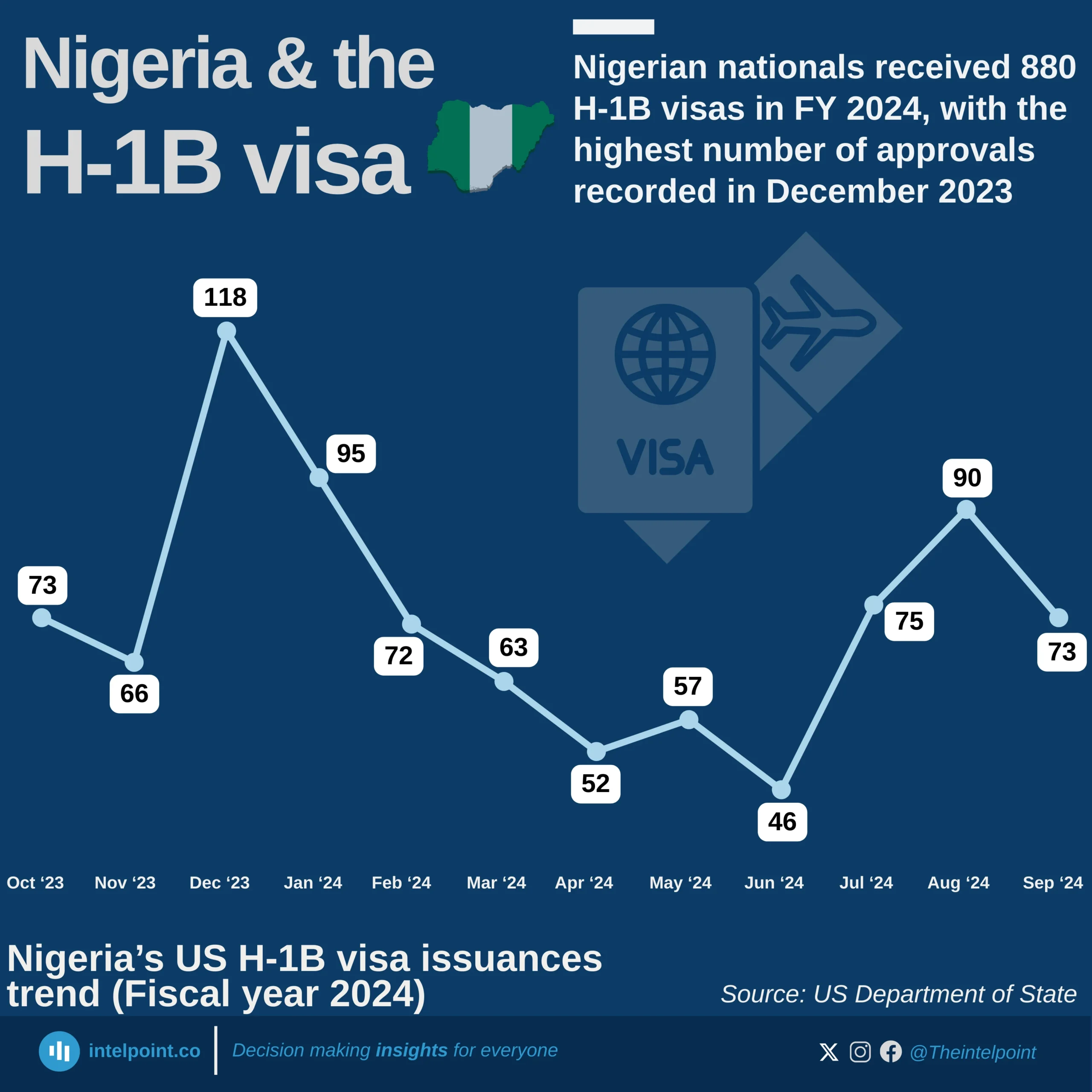
Nigerian nationals received 880 H-1B visas in FY 2024, with the highest number of approvals recorded in December 2023
  • Nigeria received a total of 880 H-1B visas in FY 2024, averaging about 73 per month.
  • December 2023 was the peak month, with 118 issuances, while June 2024 recorded the lowest at just 46.
  • Issuances fluctuated throughout the year, reflecting no clear upward trend but significant month-to-month volatility.
  • Despite peaks and dips, overall activity remained steady, with most months ranging between 60–90 approvals.

1 … 3 4 5 6 7 … 14

Can’t find what you’re looking for? Please fill the form below
Contact Form Demo
SIGN UP TO OUR NEWSLETTER
Get periodic updates about the African startup space, access to our reports, among others.
Subscribe Here
Subscription Form

A product of Techpoint Africa. All rights reserved