Bite-sized Insights about
 
Providing you with data-based insights about things happening around you.
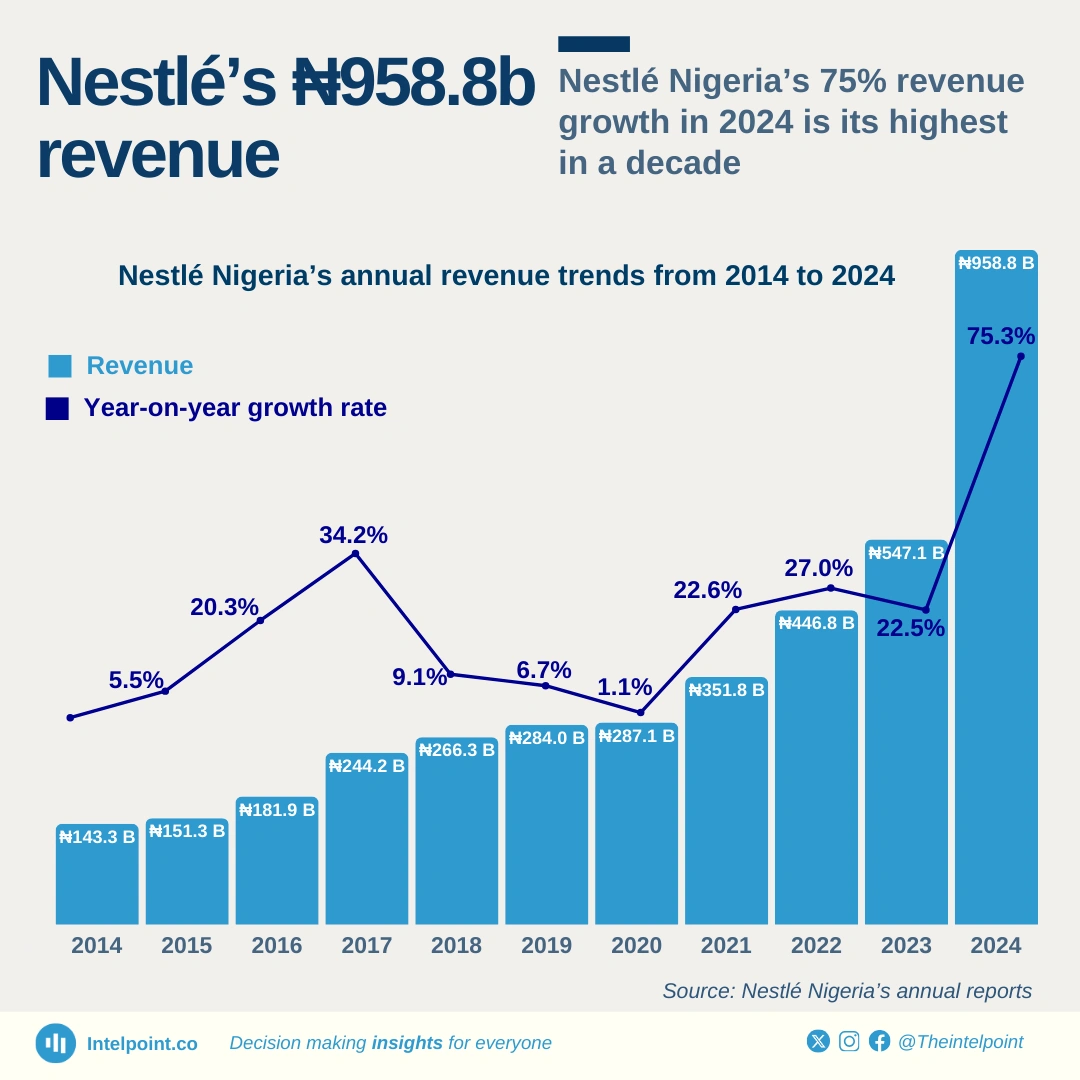
Nestlé Nigeria’s 75% revenue growth in 2024 is its highest in a decade
  • Nestlé Nigeria’s revenue grew by 75.3% in 2024, its highest growth rate since 2014.
  • Revenue jumped from ₦547.1 billion in 2023 to ₦958.8 billion in 2024, a ₦411.7 billion increase.
  • The 2024 growth rate is over three times the 22.5% growth recorded in 2023.
  • The company has grown revenue for ten straight years without decline.
  • Between 2014 and 2024, revenue increased by an average of 22.4% on a year-on-year basis.

Nestlé Nigeria’s eight-year profit streak ends with two consecutive years of losses
  • Nestlé Nigeria maintained steady profits for eight years, growing from ₦22.2 billion naira in 2014 to ₦49 billion naira in 2022
  • Nestlé Nigeria swung from a ₦49 billion naira profit in 2022 to a ₦79.5 billion naira loss in 2023, a 262% decline in one year
  • Losses deepened by 107%, from ₦79.5 billion naira in 2023 to ₦164.6 billion naira in 2024
  • A combined ₦244 billion naira loss for 2023 and 2024 nearly wiped out all the profits of ₦304.5 billion naira made between 2014 and 2022

Afrexim Research projections show that long-term debt will continue to dominate, making up 76.4% of Africa’s total debt by 2028
  • By 2028, 76.4% of Africa’s debt will be long-term, up from 75% in 2023.
  • The share of long-term debt will consistently rise each year.
  • Short-term and IMF debts will shrink to 23.6% by 2028, indicating reduced reliance on short-term borrowing.
  • The trend towards long-term debt reduces the immediate financial strain on governments but requires careful management to avoid excessive interest accumulation.
  • Countries must ensure that extended debt periods are matched with productive investments to justify future repayments.
  • A higher share of long-term debt could expose African economies to potential interest rate hikes in the future.
  • While long-term borrowing offers temporary relief, debt sustainability remains a key issue that policymakers must address.

16 Nigerian public companies each have over ₦1 trillion in market capitalisation
  • Airtel Africa leads the Nigerian stock market with a market cap of ₦8.11 trillion naira, followed by Dangote Cement at ₦8.10 trillion and BUA Foods at ₦7.52 trillion.
  • The largest public companies in Nigeria are mostly in financial services, industrial goods and consumer goods.
  • A total of 16 Nigerian public companies have surpassed the ₦1 trillion market cap threshold.
  • The lowest-ranked trillion-naira company, First HolCo, has a ₦1 trillion naira market cap.

As of March 6, 2025, Alice Walton ranks as the richest woman in the world with a net worth of $103.9 billion
Key takeaways:
  • The total wealth of the three richest women surpasses $259 billion.
  • Alice Walton is the only woman in the world whose net worth exceeds $100 billion.
  • These women share a legacy of inherited wealth that they have successfully transformed into increased wealth.
  • Each of the top three richest women holds a net worth greater than $70 billion.
  • The top three richest women in the world are engaged in philanthropic endeavours.

Nigeria’s richest man has a net worth of $23.9 billion, ranking him as the 86th richest person globally
Key takeaways:
  • The total wealth of Nigeria's top four billionaires amounts to $37.4 billion.
  • Aliko Dangote's fortune accounts for almost 64% of the overall wealth among Nigerian billionaires.
  • Dangote's net worth is more than three times the net worth of Adenuga, and nearly 16 times greater than Otedola's.
  • All four individuals accumulated their wealth primarily through entrepreneurial efforts.
  • The sources of wealth for Nigeria's four richest men span various sectors, including cement, telecommunications, agriculture, and energy.

11 African nations constituted 69% of the continent's total external debt stock as of H1 2024
  • Just 11 countries hold 69% of Africa’s total external debt.
  • South Africa (14%) carries the highest share.
  • Egypt (13%) and Nigeria (8%) are among the top three.
  • Countries from Northern and Southern regions hold over 30% of Africa’s external debt.
  • Many of these nations rely on debt to drive development, but without efficient utilisation, rising debt could become a major drag on future progress.

Aliko Dangote, the richest man in Africa has a net worth of $23.9 billion as of March 6, 2025
Key takeaways:
  • Africa’s wealthiest individual, Aliko Dangote, is approximately twice as rich as Johann Rupert and Nicky Oppenheimer.
  • Each of the three richest men in Africa have a net worth exceeding $10 billion.
  • Aliko Dangote maintains his status as Africa's wealthiest man, with a fortune that surpasses his closest rival by more than $9 billion.
  • The cumulative net worth of the five richest men in Africa is around $65.2 billion.
  • The difference in net worth between Africa's richest man and the fifth richest man is $17.1 billion.

Sudan is the leading country with the highest total number of individuals requiring assistance, alongside its UN targets among African nations
Key takeaways:
  • Mozambique has the fewest individuals requiring support from the United Nations.
  • The UN plans to help 3.6 million of the 7.8 million people in Nigeria who require assistance.
  • Sudan is the only Northern African country recorded by the UN as having people in need.
  • In East and Southern Africa, the countries with the highest and lowest numbers of individuals in need are Ethiopia and Zimbabwe, respectively.
  • The Democratic Republic of Congo and Niger have the highest and lowest number of individuals needing assistance, respectively, in West and Central Africa.

Nigeria's external reserves reached its peak in 2008, totaling 53 billion dollars
  • External reserves hit a peak of $53 billion, a level that hasn’t been reached since.
  • Reserves have moved between $27 billion and $43 billion in the last decade.
  • At $27 billion, 2016 was the most challenging period, coinciding with an economic recession and foreign exchange crises.
  • Reserves rebounded after 2016, reaching as high as $42.6 billion in 2019.
  • With $39.3 billion in reserves as of September 2024, Nigeria is in a stronger position than in some past years but still below historical highs.

1 28 29 30 31 32 51

Can’t find what you’re looking for? Please fill the form below
Contact Form Demo
SIGN UP TO OUR NEWSLETTER
Get periodic updates about the African startup space, access to our reports, among others.
Subscribe Here
Subscription Form

A product of Techpoint Africa. All rights reserved