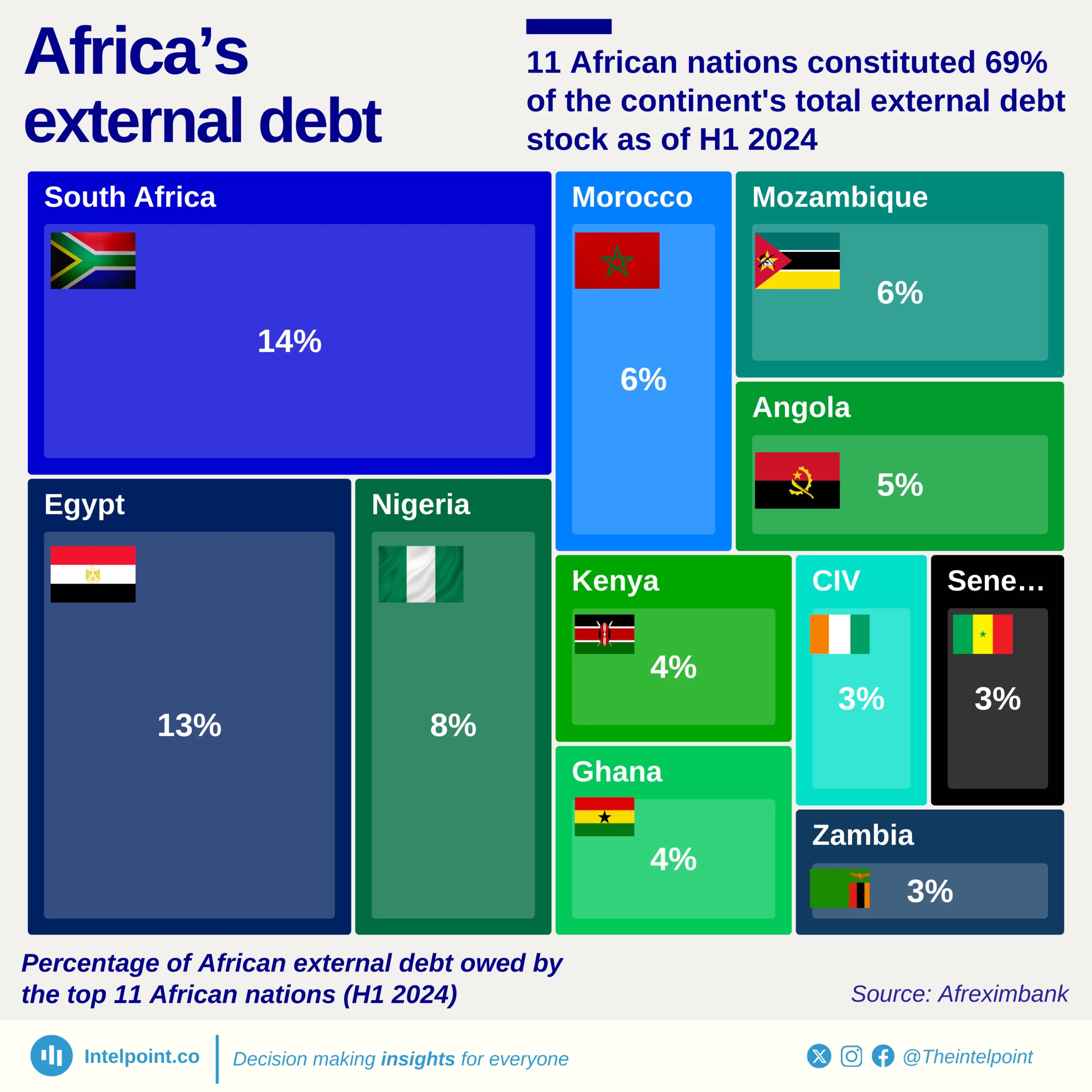
11 African nations constituted 69% of the continent's total external debt stock as of H1 2024

Key takeaways:

  • Just 11 countries hold 69% of Africa’s total external debt.
  • South Africa (14%) carries the highest share.
  • Egypt (13%) and Nigeria (8%) are among the top three.
  • Countries from Northern and Southern regions hold over 30% of Africa’s external debt.
  • Many of these nations rely on debt to drive development, but without efficient utilisation, rising debt could become a major drag on future progress.

Africa's external debt is highly concentrated, with just 11 countries accounting for 69% of the continent’s total debt stock in the first half of 2024. South Africa, Egypt, and Nigeria hold 14%, 13%, and 8% of Africa’s external debt, respectively.

A closer look at the data shows that North and Southern Africa dominate, with Egypt, Morocco, and South Africa collectively accounting for one-third of the total external debt. Meanwhile, some of Africa’s fastest-growing economies, such as Kenya and Ghana, also hold significant portions, each with 4% of the total debt stock. This raises questions about how these nations are managing their debt obligations amid growing economic challenges.
Source:

Afreximbank

Period:

2024
HTML code to embed chart
Want a bespoke report?
Reach out
Tags
Related Insights

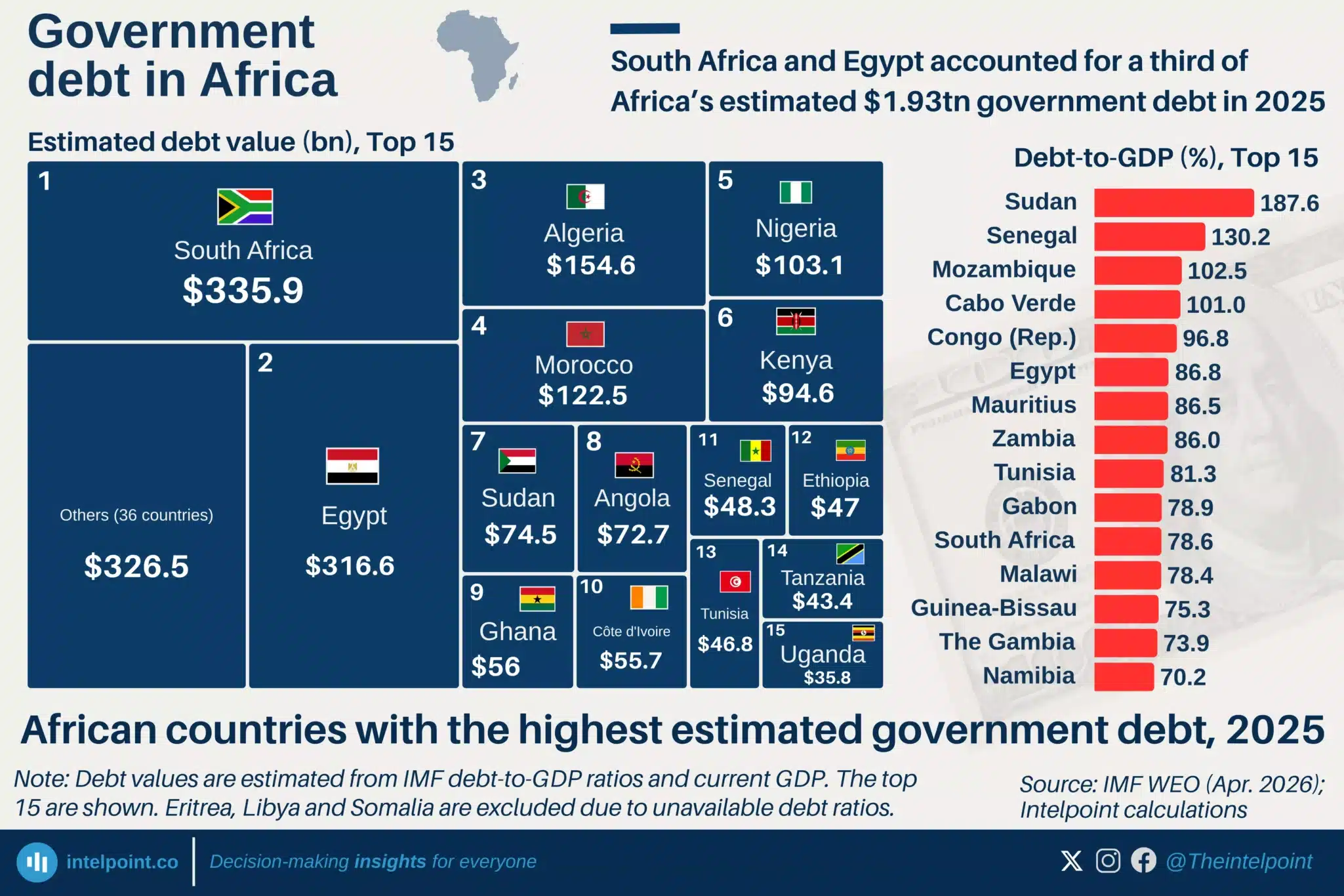
South Africa and Egypt accounted for a third of Africa’s estimated $1.93tn government debt in 2025
  • Government debt across 51 African countries was estimated at $1.93 trillion in 2025.
  • South Africa and Egypt had the largest estimated stocks and jointly accounted for 33.8% of the total.
  • Sudan had the highest debt-to-GDP ratio at 187.6%, followed by Senegal at 130.2%.
  • The estimates use IMF debt ratios and current-dollar GDP, not national authorities’ reported debt stocks.
  • Differences in government coverage, instruments and valuation mean the figures are comparable estimates, not fully harmonised official data.

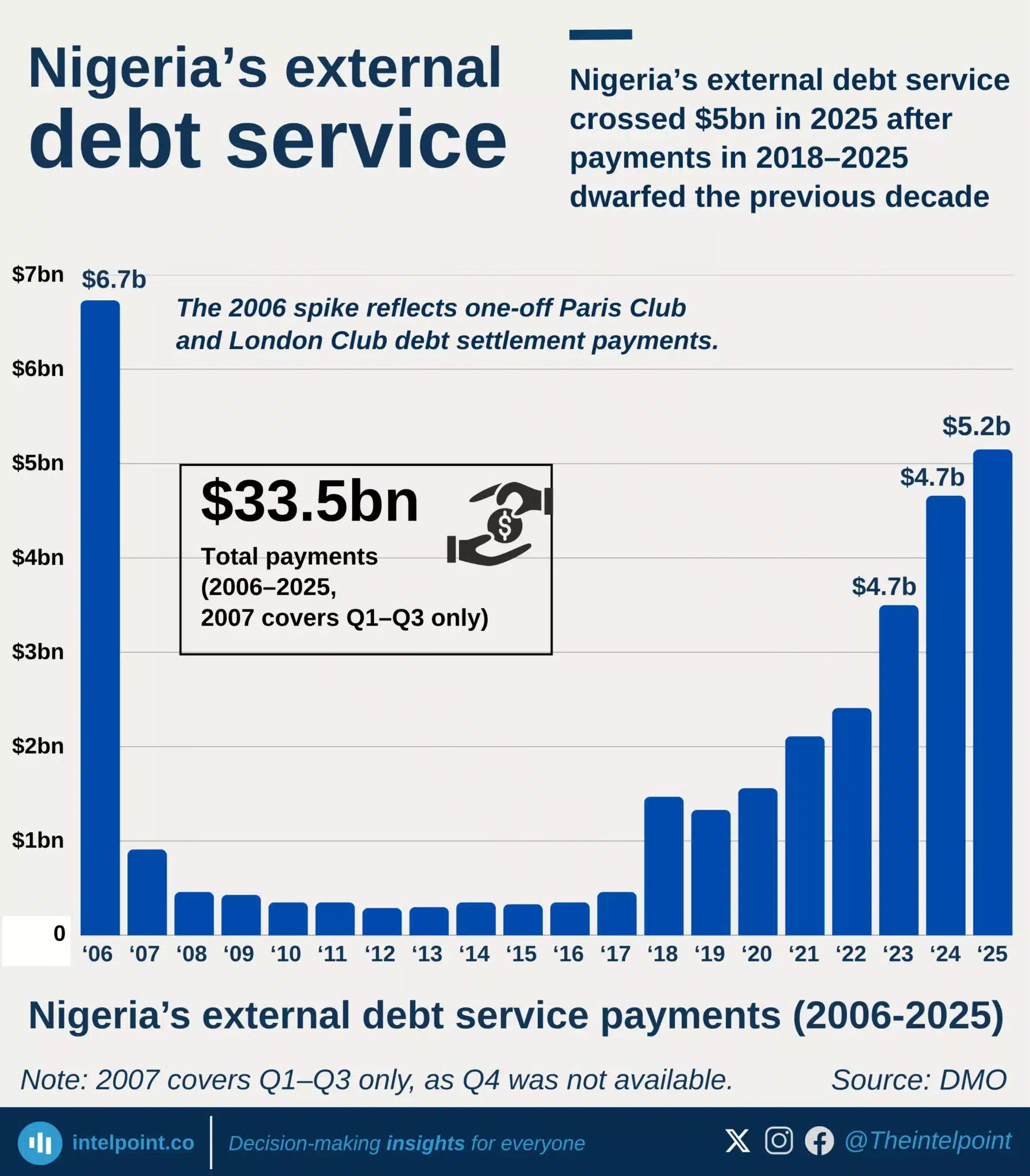
Nigeria’s external debt service crossed $5bn in 2025 after payments in 2018–2025 dwarfed the previous decade
  • Nigeria’s external debt service entered a heavier phase in 2018.
  • External debt service crossed $5bn in 2025.
  • Nigeria paid about $22.2bn from 2018 to 2025.
  • That was about 6x the $3.7bn paid from 2008 to 2017.
  • The 2006 spike reflects one-off debt settlement payments.

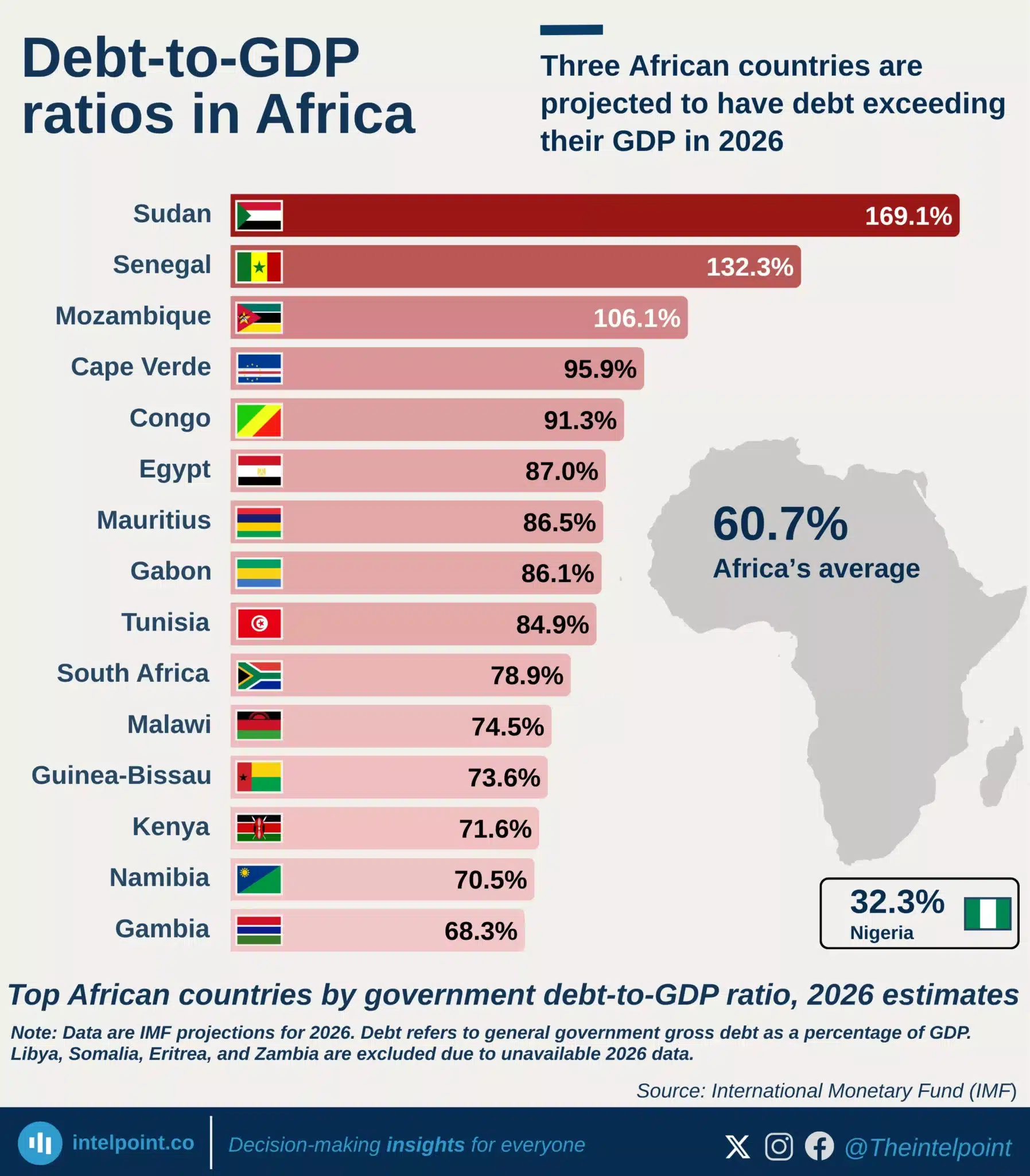
Three African countries are projected to have debt exceeding their GDP in 2026
  • Sudan is projected to have Africa’s highest debt-to-GDP ratio in 2026, at 169.1%.
  • Only three African countries are projected to owe more than the size of their economies in 2026.
  • Senegal and Mozambique join Sudan among countries with debt-to-GDP ratios above 100%.
  • Africa’s average government debt-to-GDP ratio is projected at 60.7% in 2026.
  • Nigeria’s projected debt-to-GDP ratio of 32.3% is far below the African average.

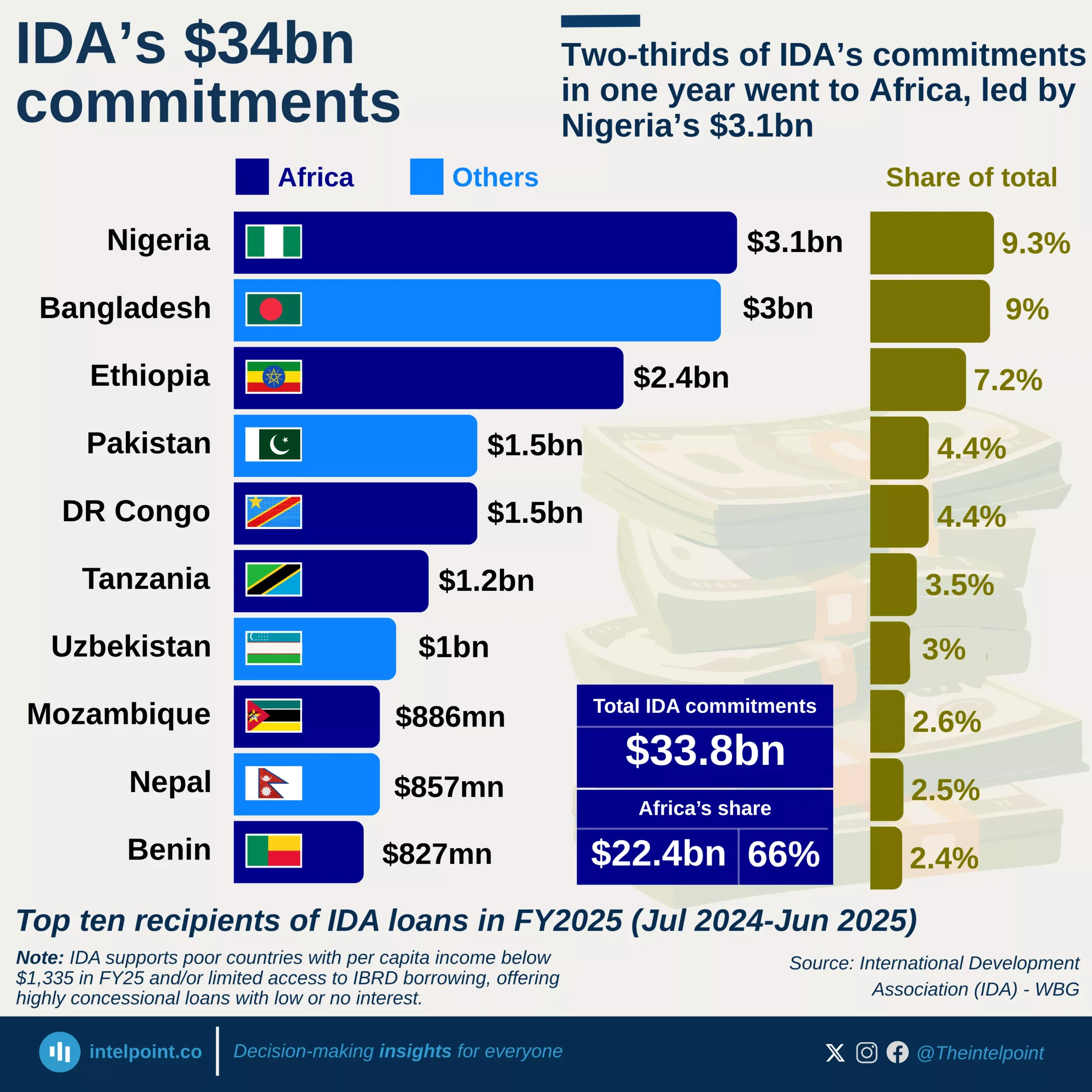
Two-thirds of IDA’s commitments in one year went to Africa, led by Nigeria’s $3.1bn
  • Africa received 66% of IDA’s FY2025 commitments.
  • Africa’s total IDA allocation was $22.4 billion out of $33.8 billion.
  • Nigeria was the largest borrower from the DA globally, with $3.1 billion in loans.
  • Bangladesh ranked second with $3 billion.
  • Six of the top ten borrowers were African countries.
  • Nigeria accounted for 9.3% of total FY2025 IDA commitments.

Oyo has reduced external debt by 36% and domestic debt by 22% under Makinde
  • Oyo reduced external and domestic debt by the end of 2025.
  • External debt fell faster than domestic debt.
  • External debt declined more consistently over the period.
  • Oyo’s local debt peaked around 2022–2023 before falling back.
  • The state appears to have prioritised reducing FX exposure.

Africa has been the world's biggest World Bank borrower since 2017, owing $152 billion as of 2024
  • Africa has been the world's biggest World Bank borrower since 2017, and the gap is widening.
  • Three crises drove it: an infrastructure gap, the 2014 commodity crash, and COVID-19.
  • The World Bank leaned in deliberately — 66% of all IDA funds went to Africa in 2025 alone.
  • It's not really "Africa's debt" — it's Nigeria's, Kenya's, Ethiopia's, Egypt's, Tanzania's, and Morocco's.
  • Every other region is slowing down, but Africa's curve is still climbing.

POPULAR TOPICS
SIGN UP TO OUR NEWSLETTER
Get periodic updates about the African startup space, access to our reports, among others.
Subscribe Here
Subscription Form

A product of Techpoint Africa. All rights reserved