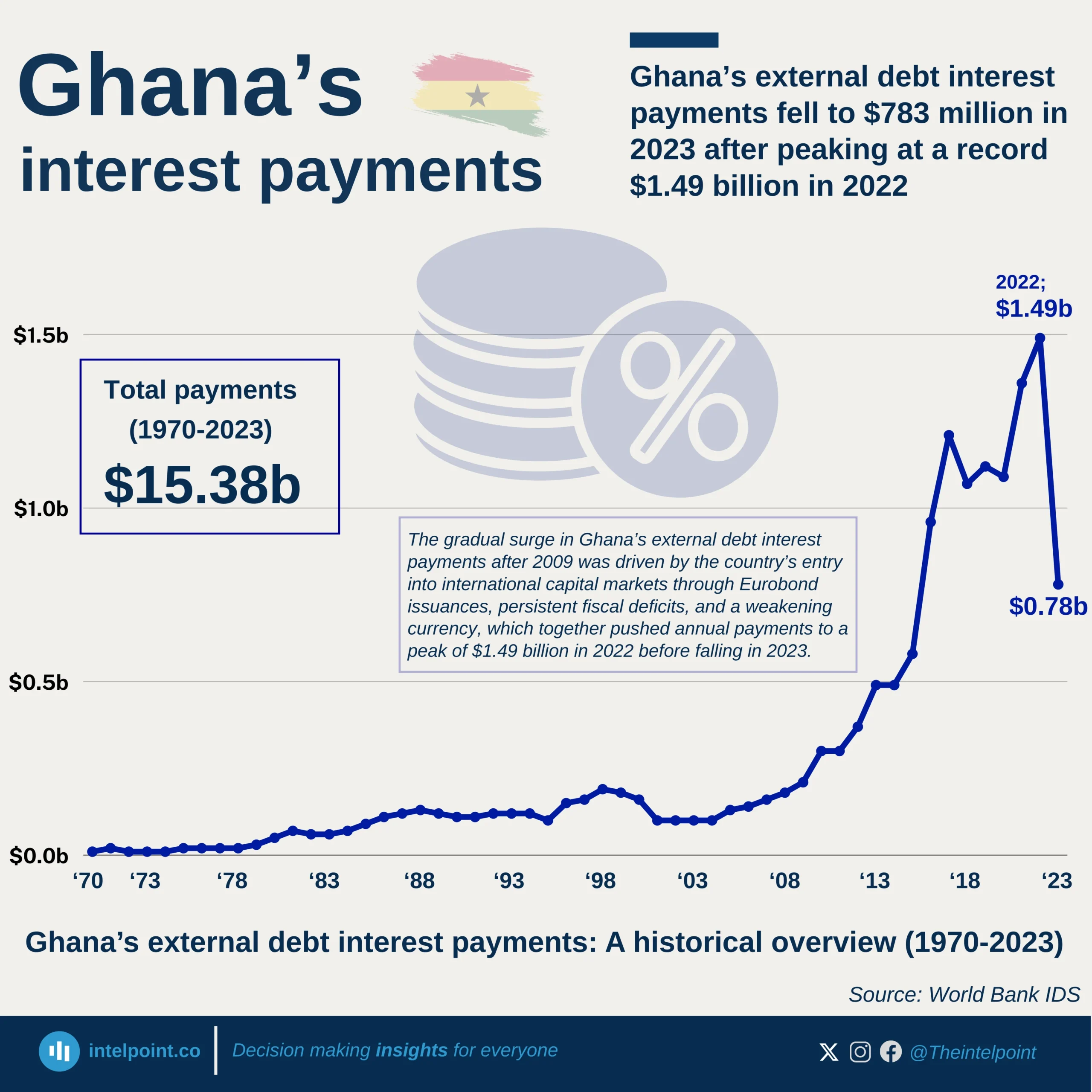
Ghana’s debt interest fell to $780 million in 2023 after peaking at a record $1.49 billion in 2022

Key Takeaways

  • Ghana’s debt interest payments remained below $200 million for nearly three decades, reflecting relatively low external borrowing.
  • From 2000 to 2010, payments rose moderately, reaching $300 million by 2010 as Ghana’s borrowing needs expanded.
  • Interest payments accelerated sharply, surpassing $1 billion in 2017 and peaking at $1.49 billion in 2022.
  • After years of growth, payments plunged to $780 million in 2023, suggesting debt restructuring, payment relief, or reduced new borrowing.

Ghana’s external debt interest payments tell a striking story of economic transition. For decades, from the 1970s through the early 2000s, the burden was modest, rarely exceeding $200 million. However, as the country pursued ambitious development goals and tapped into global capital markets, the cost of servicing debt grew rapidly. By 2016, payments approached $1 billion, and just six years later, they peaked at $1.49 billion in 2022, underscoring the intensity of Ghana’s debt exposure. In 2023, the figure dropped dramatically to $780 million, nearly half the previous year’s level, signalling a potential turning point linked to economic adjustments, fiscal reforms, or international debt relief efforts.
Source:

World Bank IDS

Period:

1970 - 2023
HTML code to embed chart
Want a bespoke report?
Reach out
Tags
Related Insights

Company income tax collections declined across 13 sectors in Q1 2026
  • Thirteen of Nigeria’s 21 sectors recorded year-on-year declines in CIT collections.
  • Extraterritorial organisations recorded the steepest fall at 53.9%.
  • Construction collections fell by 52.4%, the second-largest decline.
  • Mining and agriculture declined by 39.4% and 40.8%, respectively.
  • Manufacturing still generated ₦74.5 billion despite a 31.0% decline.

Eswatini and Morocco have remained in the World Bank's lower-middle-income band for at least 38 consecutive years
  • Nigeria has remained in the World Bank’s lower-middle-income category for 17 consecutive years.
  • Eswatini and Morocco have spent at least 38 consecutive years in the category, the longest among African countries.
  • Africa has 23 lower-middle-income economies in the World Bank’s Fiscal Year 2026 classification.
  • Tunisia, Angola, and Namibia entered the category after falling from upper-middle-income status.

Portfolio investment into Nigeria hit a 13-year quarterly high in Q1 2026
  • Portfolio investment into Nigeria reached $9.86 billion in Q1 2026, the highest quarterly level in 51 quarters.
  • The Q1 2026 portfolio inflow was higher than the previous peak of $7.11 billion recorded in Q1 2019.
  • Portfolio investment accounted for 95% of Nigeria’s total capital importation in Q1 2026.
  • Foreign Direct Investment remained low at $135 million, far below portfolio inflows.
  • Other Investment stood at $374 million, making it the second-largest inflow category in Q1 2026.

Three African countries are projected to have debt exceeding their GDP in 2026
  • Sudan is projected to have Africa’s highest debt-to-GDP ratio in 2026, at 169.1%.
  • Only three African countries are projected to owe more than the size of their economies in 2026.
  • Senegal and Mozambique join Sudan among countries with debt-to-GDP ratios above 100%.
  • Africa’s average government debt-to-GDP ratio is projected at 60.7% in 2026.
  • Nigeria’s projected debt-to-GDP ratio of 32.3% is far below the African average.

Every food item tracked has at least doubled in price since May 2023
  • Every comparable food item tracked is now at least twice as expensive as it was in May 2023.
  • Nearly half of the selected food items have more than tripled in price since the month before fuel subsidy removal.
  • Unripe plantain recorded the steepest increase, rising by 469% between May 2023 and April 2026.
  • Ripe plantain, yam tuber, and fresh tilapia also saw extreme increases of more than 300%.
  • Even the slowest-rising staples, including frozen chicken, beans, gari, and maize, still more than doubled in price.

Healthy diet costs rose fastest in Nigeria’s North-West over two years
  • Healthy diet costs rose 49% nationally in two years.
  • North-West states recorded the fastest increases.
  • All seven North-West states rose above the national average.
  • Katsina and Kogi recorded the steepest increases, at 98%.
  • Akwa Ibom had the lowest increase, at 5%.

POPULAR TOPICS
SIGN UP TO OUR NEWSLETTER
Get periodic updates about the African startup space, access to our reports, among others.
Subscribe Here
Subscription Form

A product of Techpoint Africa. All rights reserved