Bite-sized Insights about
 
Providing you with data-based insights about things happening around you.
Popular Insights
  • In the past seven years, 9mobile has experienced a consistent decline in its Internet subscriber base, with an average loss of 134k subscribers monthly since June 2016. This decline began after it reached 17.2 million subscribers — its highest ever — in April 2016. As of July 2023, 9mobile's Internet subscriber count was 3.9m. MTN had the largest share (68.1m) of Nigeria's 159m Internet subscribers as of July 2023. Glo and Airtel had almost equal shares, with 43.9m and 42.9m subscribers, respectively.
    See more

    The Federation Account Allocation Committee (FAAC) has distributed a total of ₦593 billion as derivation funds to nine oil-producing states in Nigeria. These funds are part of the statutory allocation intended to support states with significant contributions to the country's oil revenue. Delta State emerged as the largest beneficiary, receiving ₦193 billion, which constitutes 32.5% of the total allocation.

    See more
  • A Trend of Adult literacy rates of African countries

    Between 2018 and 2021, adult literacy rates across African nations exhibited significant disparities. Seychelles and South Africa led with literacy rates of 96% and 95%, respectively, indicating a high proportion of literate adults. Conversely, Chad had the lowest literacy rate during this period.

    These statistics underscore the uneven progress in educational attainment across Africa, highlighting the need for targeted interventions to improve literacy in lower-performing nations.
    See more

    Africa's sanitation crisis is alarming, with 17 of the top 20 countries having the highest open defecation rates.

    Eritrea (67%), Niger (65%), and Chad (63%) lead, putting millions at risk of disease.

    Even Nigeria, the most populous African country, has 18% of its population practising it.

    See more
  • Nigeria was the seventh most populous nation in the world in 2020, with 206.1 million people. Projected to reach a population of 401.3 million by 2050, Nigeria will rank third after India (1st) and China (2nd). According to Institut national d'études démographiques' projections, Nigeria, Ethiopia, DR Congo, Egypt, Tanzania, and Kenya will be among the world’s top 20 most populous countries by 2050.

    See more

    The FAAC's revenue distribution from 2017 to August 2023 highlights the dominance of Delta, Akwa Ibom, Rivers, and Bayelsa states in allocations. Despite Lagos' economic prominence, it ranked fifth. Here is the distribution of revenue among states between 2017 and August 2023.

    See more

  • As of 2022, Libya had the highest dentist availability in Africa.

    Many top African countries have fewer than 5 dentists per 10,000 people, with several falling below 1, and Nigeria at just 0.2.

    The WHO recommends at least 2 per 10,000 for adequate care.

    See more
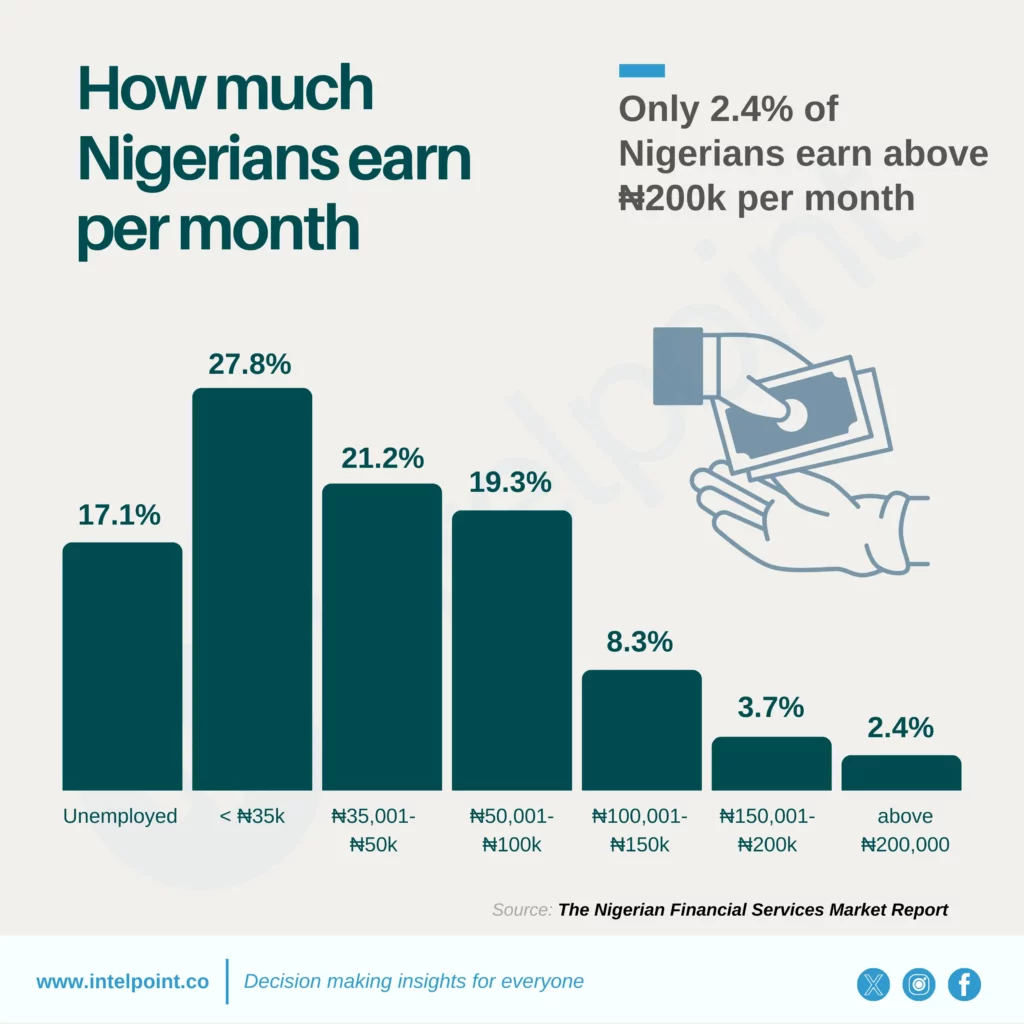
  • Only 10% of Nigerians earn above ₦100,000, according to the Nigerian Financial Services Market Report. This aligns with most reports about Nigeria, and it's in sharp contrast to the narratives online.
    See more
  • A Trend of Adult literacy rates of African countries

    Between 2018 and 2021, adult literacy rates across African nations exhibited significant disparities. Seychelles and South Africa led with literacy rates of 96% and 95%, respectively, indicating a high proportion of literate adults. Conversely, Chad had the lowest literacy rate during this period.

    These statistics underscore the uneven progress in educational attainment across Africa, highlighting the need for targeted interventions to improve literacy in lower-performing nations.

    See more

Other Insights
Key takeaways:
  • The highest percentage of requirements was met in 2019.
  • Less than 50 percent of UN funds targeted towards Nigeria's humanitarian aid was realised in 2023.
  • As of 2020, the year of the Covid-19 pandemic, approximately 58 percent of the UN target for Nigeria's humanitarian support was raised, which is lower than the percentage realised in 2019 and 2021.
  • Every year, Nigeria obtains at least 40% of the UN's humanitarian aid needs.
Read more
Key Takeaways:
  • The average price for 5kg cooking gas ranges from ₦6,000 to ₦8,100.
  • The price difference of cooking gas between various Nigerian states is 25.09%.
  • Out of Nigeria's 36 states plus Abuja, fifteen have an average price for 5kg cooking gas above the national average.
  • Taraba State is uniquely positioned as the sole state in Nigeria with an average cooking gas price above ₦8,000.
  • The national average cost for 5kg cooking gas in Nigeria is ₦7,177.27.
Read more
Key takeaways:
  • The highest amount of funds raised for Nigeria’s humanitarian aid was recorded in 2017 at $770 million.
  • From 2019 to 2020, there was only a slight increase of 0.3% in the amount raised.
  • By 2023, a decline of 23.42% from 2022's raised funds was witnessed, and it is the lowest decline experienced since 2017.
  • Regardless of fluctuations in annual assistance, Nigeria continued to receive humanitarian aid from the United Nations.
Read more
Key Takeaways:
  • The top 20 food items witnessed extreme inflation, surpassing 200%.
  • Onions and yams lead the list with remarkable price hikes of 353% and 317%, respectively.
  • Various types of rice exhibited significant price increases (310% for Ofada rice, 250% for local rice, etc).
  • Basic protein sources such as eggs (207%) and chicken (202%) saw their prices more than double, making them increasingly less affordable.
Read more
  • Nigeria’s first ATM was deployed in 1990 by Société Générale Bank, marking the start of a new era in banking.
  • Interswitch kicked off interbank transactions in 2003, allowing Nigerians to use ATMs provided by other banks asides their own.
  • The CBN has implemented several policies to regulate ATM deployment, fees, and usage.
  • ATM fees have fluctuated over the years, with a major reduction in 2020 and an increase in 2025.
Read more
Share of POS cash transaction value in selected countries (2019, 2023 and 2027)
  • Among all the 40 countries studied in the report, Nigeria leads the decline in cash transactions, dropping from 91% in 2019 to 55% in 2023, a sharper decline than any other country analysed.
  • By 2027, Nigeria’s cash transactions are projected to fall to 42%.
  • Mexico, Thailand, and Japan are also experiencing significant declines, with cash transactions expected to drop below 35% in all three countries by 2027.
  • Brazil, which started with a relatively lower cash transaction rate (48% in 2019), is on track to become one of the least cash-dependent nations in this group, with just 12% of transactions expected to be cash-based by 2027.
  • The global average for cash transactions was already low at 26% in 2019, and it is set to decline further to just 11% by 2027, making cash an increasingly rare payment method worldwide.
  • Germany, a traditionally cash-friendly economy, has seen a major drop, with cash transactions decreasing from 50% in 2019 to a projected 29% by 2027, reflecting broader changes in consumer behavior.
Read more
1 131 132 133 134 135 234

Can’t find what you’re looking for? Please fill the form below
Contact Form Demo
SIGN UP TO OUR NEWSLETTER
Get periodic updates about the African startup space, access to our reports, among others.
Subscribe Here
Subscription Form

A product of Techpoint Africa. All rights reserved