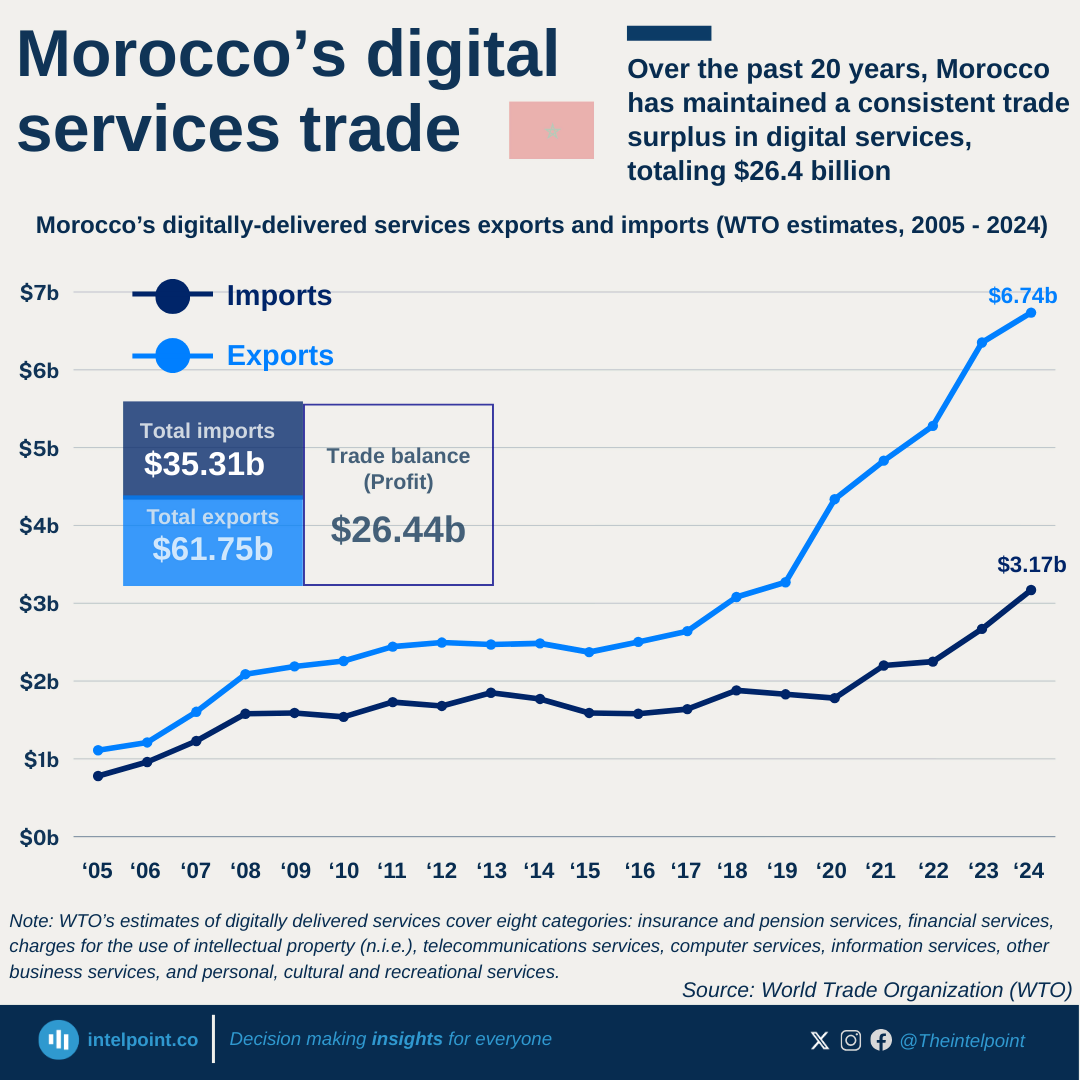
Over the past 20 years, Morocco has maintained a consistent trade surplus in digital services, totaling $26.44 billion

key takeaways:

  • Morocco recorded a total of $61.75 billion digital services trade exports and $35.31 billion imports, revealing a staggering $26.44 billion trade profit in 20 years.
  • Morocco has always been the leading country in Africa as far as digital services trade is concerned.
  • From 2005-2024, Morocco digital services exports have always outpaced imports.
  • Morocco digital export earnings have grown from $1.11b in 2005 to $6.74b in 2024, revealing over 500% growth in 20 years.
  • Imports during the same time-frame reached 3.17b from $780m in 2025.

Morocco has positioned itself as a giant in the digital services trade in Africa with the remarkable growth in its digital services trade over the past two decades, recording a staggering $61.75 billion in exports and $35.31 billion in imports, resulting in a $26.44 billion trade surplus.

Between 2005 and 2024, Morocco's digital exports have consistently outpaced imports, showcasing a thriving digital economy. Digital services export earnings have experienced an exceptional surge, growing from $1.11 billion in 2005 to an estimated $6.74 billion in 2024. This growth represents an impressive increase of over 500% over the past 20 years. Conversely, Morocco's digital imports have also risen substantially, reaching $3.17 billion in 2025 from a modest $780 million in 2005.

The consistent upward trajectory in Morocco’s digital services trade highlights the country's growing prominence in the global digital economy. The nation's export success reflects both its expanding tech sector and its increasing competitiveness in international markets. With a projected continued growth in the digital services industry, Morocco is set to further cement its position as a key player in the global digital trade landscape.
Source:

World Trade Organization

Period:

2005-2024
HTML code to embed chart
Want a bespoke report?
Reach out
Tags
Related Insights

Two-thirds of IDA’s commitments in one year went to Africa, led by Nigeria’s $3.1bn
  • Africa received 66% of IDA’s FY2025 commitments.
  • Africa’s total IDA allocation was $22.4 billion out of $33.8 billion.
  • Nigeria was the largest borrower from the DA globally, with $3.1 billion in loans.
  • Bangladesh ranked second with $3 billion.
  • Six of the top ten borrowers were African countries.
  • Nigeria accounted for 9.3% of total FY2025 IDA commitments.

Oyo has reduced external debt by 36% and domestic debt by 22% under Makinde
  • Oyo reduced external and domestic debt by the end of 2025.
  • External debt fell faster than domestic debt.
  • External debt declined more consistently over the period.
  • Oyo’s local debt peaked around 2022–2023 before falling back.
  • The state appears to have prioritised reducing FX exposure.

Africa has been the world's biggest World Bank borrower since 2017, owing $152 billion as of 2024
  • Africa has been the world's biggest World Bank borrower since 2017, and the gap is widening.
  • Three crises drove it: an infrastructure gap, the 2014 commodity crash, and COVID-19.
  • The World Bank leaned in deliberately — 66% of all IDA funds went to Africa in 2025 alone.
  • It's not really "Africa's debt" — it's Nigeria's, Kenya's, Ethiopia's, Egypt's, Tanzania's, and Morocco's.
  • Every other region is slowing down, but Africa's curve is still climbing.

Obasanjo led Nigeria's biggest GDP per capita rise at 268% in 8 years
  • Nigeria’s GDP per capita rose strongly from 1999 to 2014, then reversed.
  • The 2014 peak remains the defining turning point.
  • Obasanjo’s years show the fastest sustained climb from a very low base.
  • Yar’Adua’s short tenure still maintained upward momentum.
  • Jonathan’s period delivered the peak level, not the fastest growth rate.
  • Buhari’s tenure marks the longest clear decline in GDP per capita.
  • Tinubu’s period begins with another sharp fall.

Under Sanwo-Olu, Lagos cut its external debt and more than doubled its domestic debt
  • Lagos cut external debt, but increased domestic debt.
  • The drop in external debt was meaningful, but the rise in domestic debt was much larger.
  • Stronger IGR gave Lagos more room to borrow and repay.
  • The state chose local funding over heavier dollar exposure.

Lagos's external debt has reduced by nearly three times more than the other six states combined
  • Lagos's debt reduction is larger than the other six combined.
  • Oyo posted the fastest reduction rate.
  • The biggest percentage cut did not equal the biggest dollar cut.
  • Debt reduction was concentrated, not broad-based.
  • Higher state revenues likely created room for repayments.
  • Lagos had the strongest fiscal capacity among the states shown.
  • Smaller debt stocks made percentage declines easier for some states.

POPULAR TOPICS
SIGN UP TO OUR NEWSLETTER
Get periodic updates about the African startup space, access to our reports, among others.
Subscribe Here
Subscription Form

A product of Techpoint Africa. All rights reserved