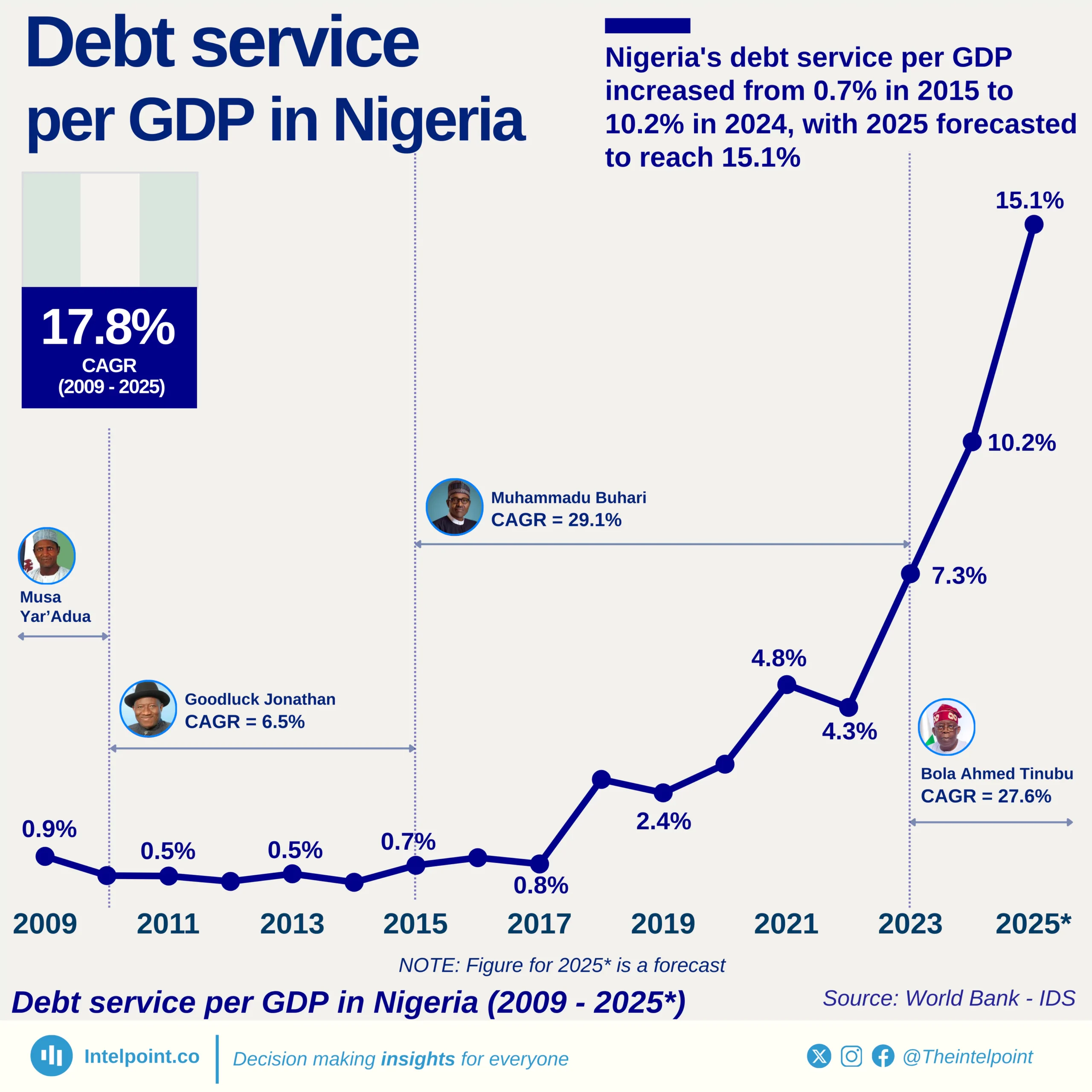
Nigeria's debt service per GDP increased from 0.7% in 2015 to 10.2% in 2024, with 2025 forecasted to reach 15.1%

  • Nigeria's debt service per GDP rose from 0.9% in 2009 to a projected 15.1% in 2025.
  • Overall CAGR from 2009 to 2025 is 17.8%.
  • President Muhammadu Buhari’s tenure saw the fastest growth (29.1% CAGR).
  • Under President Goodluck Jonathan, growth was slower (6.5% CAGR).
  • President Bola Ahmed Tinubu’s term so far shows a 27.6% CAGR.

Nigeria’s debt service per GDP has risen sharply over the past decade and a half, climbing from 0.9% in 2009 to a projected 15.1% in 2025, after hitting a peak of 10.2% in 2024. The data reveals an average growth rate (CAGR) of 17.8% between 2009 and 2025, underscoring a significant increase in the country’s debt burden.

A closer look shows that the fastest growth occurred during President Muhammadu Buhari’s tenure (2015–2023), when debt service per GDP grew at an extraordinary 29.1% CAGR. Debt service per GDP growth was slower under President Goodluck Jonathan [(6.5% CAGR), and] there has been a noticeable uptrend in the first two years of President Bola Ahmed Tinubu (27.6% CAGR so far).

The overall trend points to mounting fiscal pressure. The sharp jumps in recent years, especially from 7.3% in 2023 to 15.1% in 2025, highlight how quickly debt service obligations are consuming a larger share of Nigeria’s economy.
Source:

World Bank - IDS

Period:

2009-2025
HTML code to embed chart
Want a bespoke report?
Reach out
Tags
Related Insights

Obasanjo led Nigeria's biggest GDP per capita rise at 268% in 8 years
  • Nigeria’s GDP per capita rose strongly from 1999 to 2014, then reversed.
  • The 2014 peak remains the defining turning point.
  • Obasanjo’s years show the fastest sustained climb from a very low base.
  • Yar’Adua’s short tenure still maintained upward momentum.
  • Jonathan’s period delivered the peak level, not the fastest growth rate.
  • Buhari’s tenure marks the longest clear decline in GDP per capita.
  • Tinubu’s period begins with another sharp fall.

Under Sanwo-Olu, Lagos cut its external debt and more than doubled its domestic debt
  • Lagos cut external debt, but increased domestic debt.
  • The drop in external debt was meaningful, but the rise in domestic debt was much larger.
  • Stronger IGR gave Lagos more room to borrow and repay.
  • The state chose local funding over heavier dollar exposure.

Lagos's external debt has reduced by nearly three times more than the other six states combined
  • Lagos's debt reduction is larger than the other six combined.
  • Oyo posted the fastest reduction rate.
  • The biggest percentage cut did not equal the biggest dollar cut.
  • Debt reduction was concentrated, not broad-based.
  • Higher state revenues likely created room for repayments.
  • Lagos had the strongest fiscal capacity among the states shown.
  • Smaller debt stocks made percentage declines easier for some states.

Northern states have accounted for 12 of the 15 fastest-growing external debts in Nigeria since June 2023
  • All but four states increased their external debt between June 2023 and December 2025.
  • Northern states account for roughly 70% of the $1.34 billion added by states nationally.
  • Katsina recorded the highest growth in both absolute terms ($150 million) and rate (+296%).
  • 12 of the 15 fastest-growing state debts are in the north.
  • Lagos, Nigeria's largest debtor at $1.17 billion outstanding, was one of only four states that reduced its debt.
  • Kaduna carries the second-heaviest debt load at $684 million, despite a relatively modest 20% growth rate.

Alex Otti’s administration reduced Abia's domestic debt by 66%, with external debt rising by 14%
  • Abia’s domestic debt dropped by 66% between 2023 and 2025.
  • The state reduced domestic debt by about ₦94 billion.
  • Debt fell from roughly ₦138 billion to about ₦48.5 billion within two and a half years.
  • About ₦72 billion of inherited debt was cleared early in the administration.
  • External debt increased by 14% (+$12.9 million) over the same period.

Under Umo Eno, Akwa Ibom’s domestic debt fell 41.5%, from ₦138.6bn to ₦48.5bn
  • Akwa Ibom’s domestic debt fell 41.5% over the period, from ₦138.6 billion to ₦48.5 billion.
  • External debt was almost stable, slipping just 0.9%.
  • The sharpest debt adjustment happened in local-currency obligations, not foreign debt.
  • The highest domestic debt level during the period was in December 2023.

POPULAR TOPICS
SIGN UP TO OUR NEWSLETTER
Get periodic updates about the African startup space, access to our reports, among others.
Subscribe Here
Subscription Form

A product of Techpoint Africa. All rights reserved