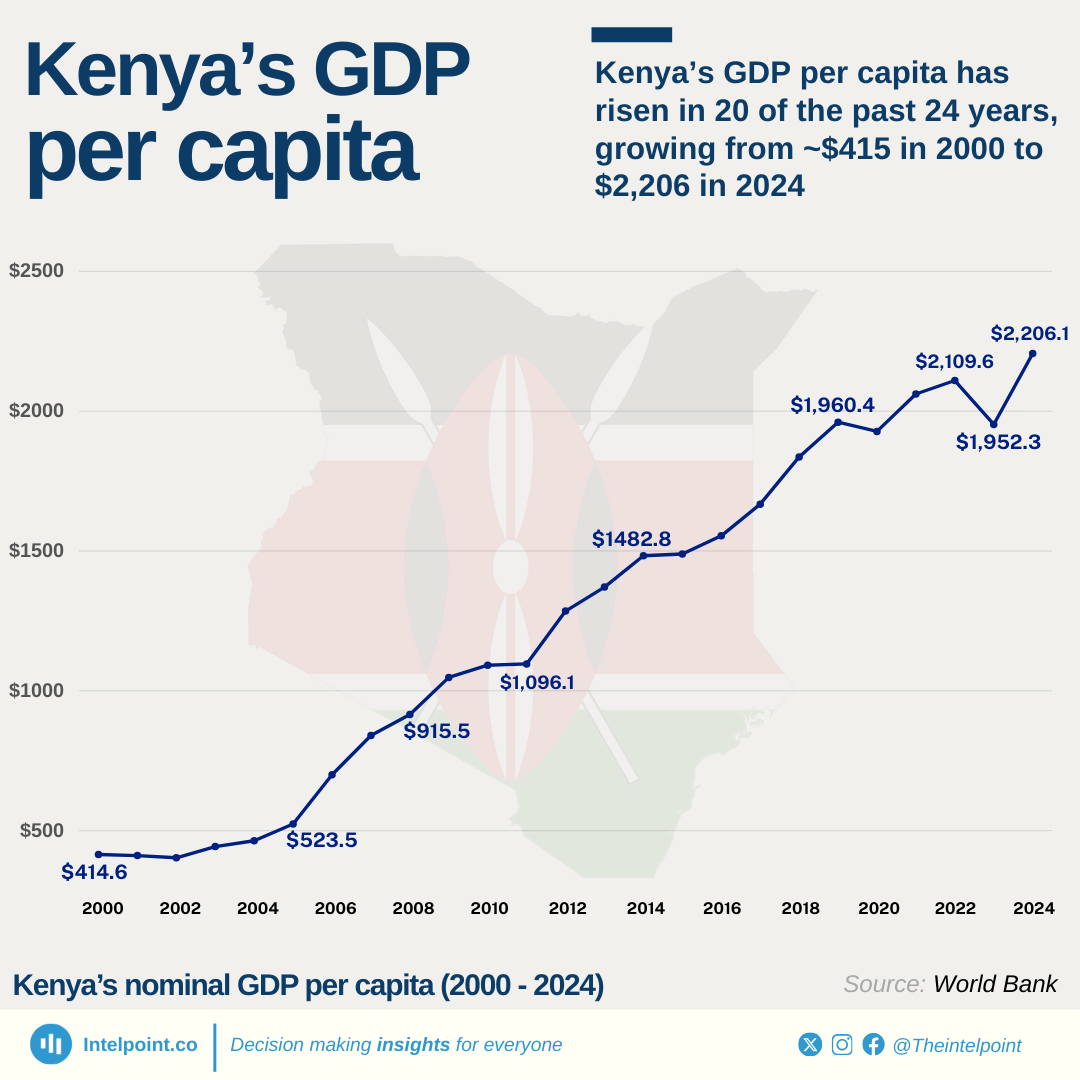
Kenya’s GDP per capita has risen in 20 of the past 25 years, growing from ~$415 in 2000 to $2,206 in 2024

key takeaways:

  • Kenya's GDP per capita soared from $414.6 in 2000 to a significant $2206.1 in 2024, marking a 532% increase.
  • The country saw its largest single-year jump between 2006 and 2007, rising by 33.7% from $523.5 to $699.8.
  • Economic downturns were visible in 2020 (-1.7%) and 2023 (-7.5%), showing vulnerability to shocks.
  • Since 2020, GDP per capita has grown by 14.5%, with 2024 recording the highest value.
  • Kenya’s GDP per capita rose in 20 of the past 24 years, and declines occurred in only 4 years (2001, 2002, 2020, and 2023).

Kenya’s GDP per capita has climbed from $414.6 in 2000 to an all-time high of $2206.1 in 2024, a 532% increase in the last 25 years.

The early 2000s began with economic stagnation and little to no growth. The country experienced its first significant growth between 2005 and 2006, recording a $176.3 (33.7%) increase. From 2006, GDP per capita continued to rise steadily, reaching $1,960.4 by 2019. However, in 2020, the COVID-19 pandemic caused a sharp decline in economic activity and income levels. Kenya quickly rebounded in 2021, moving from $1,927.7 in 2020 to $2,061.4.

In 2022, growth slowed, and by 2023, GDP per capita dipped to $1,952.3, recording a 7.5% decrease. Kenya rose by 13% in 2024 with $2.206.1, which solidified the country's lead position among other East African mainland countries like Uganda, Ethiopia and Tanzania.
Source:

World Bank

Period:

2000-2024
HTML code to embed chart
Want a bespoke report?
Reach out
Tags
Related Insights

85 cents of every dollar in capital imported into Nigeria in 2025 went to portfolio investments
  • Nigeria's total capital imports surged to $23.2bn in 2025, the highest level recorded in the entire 2014 to 2025 period.
  • Foreign Portfolio Investment dominated in 2025, claiming 85 cents of every dollar imported, up sharply from 68% in 2024.
  • Foreign Direct Investment has remained consistently weak, never exceeding 20% across all eleven years, and falling to just 4% in 2025.
  • The "Others" category, which peaked at 61% in 2023, has collapsed to just 11% in 2025, reflecting a dramatic shift toward portfolio-driven capital flows

Nigeria's foreign capital inflows nearly reached the 2019 record, but 87% went to banks and financiers
  • Inflows surged from $3.9B in 2023 to $23.2B in 2025, near the all-time record.
  • Banking and financing captured 87% of all inflows.
  • Agriculture got $167M, oil and gas $18M, and construction $6M, .
  • The recovery is real, but it is not yet reaching ordinary Nigerians.

Private sector pension contributions hit ₦744bn in the first nine months of 2025, exceeding the whole of 2024
  • Over 85x growth in 20 years; total pension contributions grew from ₦15.6 billion in 2004 to ₦1.37 trillion in 2024.
  • In Q1–Q3 2025, private-sector contributions (₦744 billion) surpassed those of the public sector (₦574 billion).
  • Contributions declined in 2015 and 2016 as crashing oil revenues choked government remittances, and again in 2021 amid COVID-19 disruptions.
  • Each time, the system recovered within a year, proving its foundations hold even under severe macro pressure

Nigeria’s four billionaires have a combined $4.5bn more than South Africa’s seven
  • South Africa leads in headcount, with seven billionaires, more than other African countries.
  • Nigeria leads in wealth, with four billionaires worth $47.5 billion, $4.5 billion more than the combined $43 billion of South Africa's seven billionaires.
  • Nigeria's billionaires are richer individually, with an average net worth of $11.9 billion, compared with South Africa's $6.1 billion.
  • North Africa punches below its weight: Egypt, Morocco, and Algeria have ten billionaires combined but just $31.4 billion in total wealth.
  • East Africa barely registers: Tanzania and Zimbabwe each have just one billionaire, both worth $2.1 billion.
 

African markets posted strong growth in 2025, with JSE leading in size and GSE in momentum
  • Seven of nine exchanges posted positive growth, signalling broad-based expansion across African equity markets in 2025.
  • Ghana Stock Exchange led all exchanges in growth rate, rising 133.86% across the year — the sharpest single-year gain in this dataset.
  • The Johannesburg Stock Exchange closed Q4 at $1.3 trillion, making it by far the largest exchange on the continent by market capitalisation.
  • The Stock Exchange of Mauritius and MERJ Exchange (Seychelles) were the only two exchanges to contract, declining 2.61% and 8.02% respectively.

Local companies have consistently contributed most of Nigeria’s Company Income Tax payments since 2016
  • Local companies dominated CIT contributions in most years, accounting for over 50% of payments in 9 of 11 periods between 2015 and 2025 (Q1–Q3).
  • Foreign companies briefly closed the gap in 2023, contributing 49%, the closest they have come to matching local firms.
  • Local companies recorded their strongest share in 2021 at 65%, marking the widest gap between local and foreign contributors.
  • “Other payments” peaked during the pandemic, rising to 17% in 2020 before dropping to 0% from 2022 onward.

POPULAR TOPICS
SIGN UP TO OUR NEWSLETTER
Get periodic updates about the African startup space, access to our reports, among others.
Subscribe Here
Subscription Form

A product of Techpoint Africa. All rights reserved