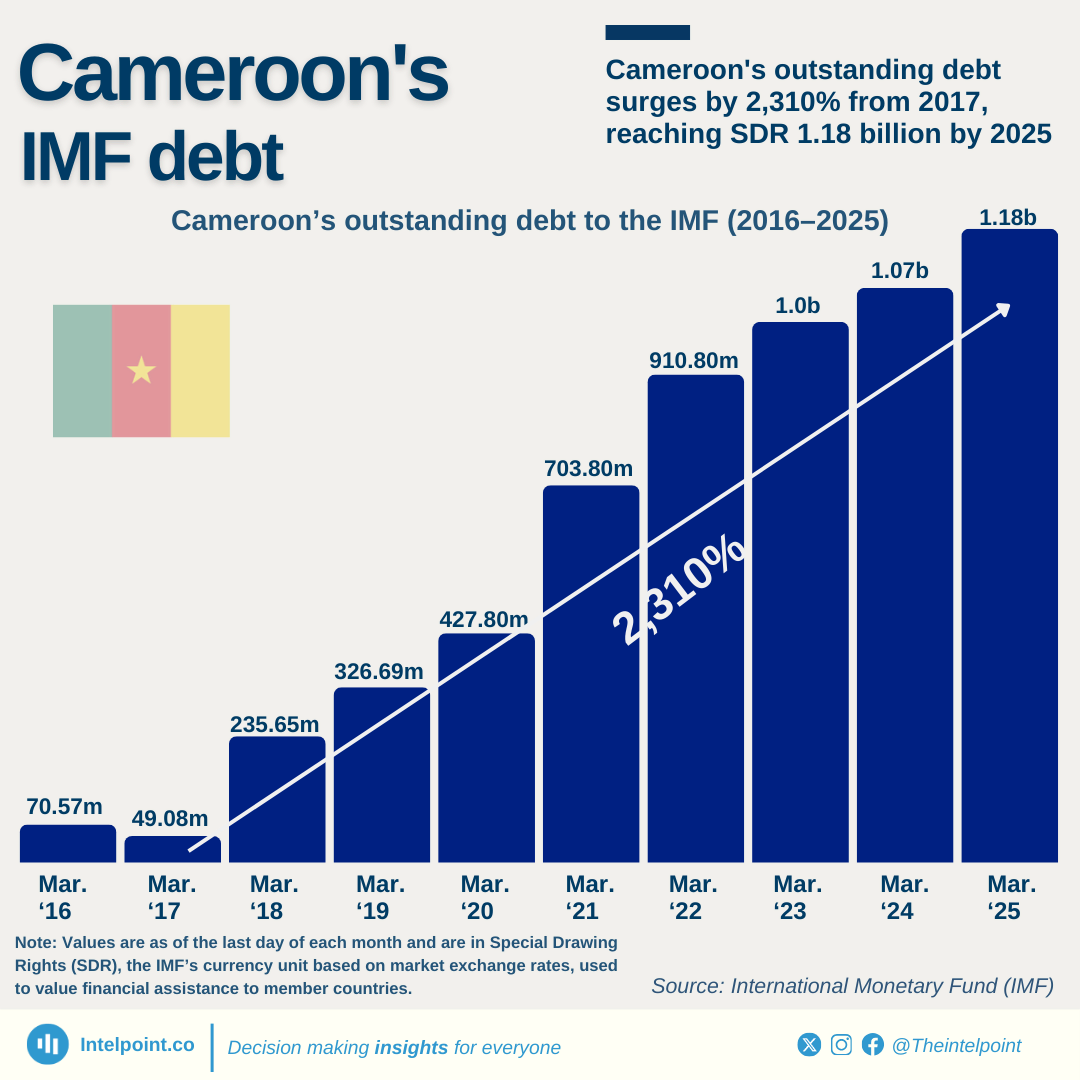
Cameroon's outstanding debt surges by 2,310% from 2017, reaching SDR 1.18 billion by 2025

Key Takeaways:

  • Cameroon’s IMF debt decreased from SDR 70.6 million in 2016 to SDR 49.1 million in 2017—a 30% reduction.
  • From 2018 onwards, the country experienced steady increases in outstanding debt.
  • After an initial 30% reduction from 2016 to 2017, debt skyrocketed by 380% in just one year (2017-2018).
  • By March 2025, Cameroon’s outstanding debt had reached SDR 1.18 billion, representing a staggering SDR 1.13 billion increase from its 2017 level.
  • Although the pace of accumulation has moderated in recent years, the overall debt trend remains upward.

Between 2016 and 2025, Cameroon’s external debt to the International Monetary Fund underwent a dramatic transformation. The country’s outstanding debt, which stood at SDR 70.6 million in 2016, decreased further to SDR 49.1 million in 2017.

However, 2018 marked the beginning of a significant and sustained shift. Debt surged to SDR 235.7 million, reflecting a 380% increase in just one year. This sharp rise signalled the start of a steady upward trend that has continued unabated through to 2025.
Source:

International Monetary Fund (IMF)

Period:

2016 - 2025
HTML code to embed chart
Want a bespoke report?
Reach out
Tags
Related Insights

Under Sanwo-Olu, Lagos cut its external debt and more than doubled its domestic debt
  • Lagos cut external debt, but increased domestic debt.
  • The drop in external debt was meaningful, but the rise in domestic debt was much larger.
  • Stronger IGR gave Lagos more room to borrow and repay.
  • The state chose local funding over heavier dollar exposure.

Lagos's external debt has reduced by nearly three times more than the other six states combined
  • Lagos's debt reduction is larger than the other six combined.
  • Oyo posted the fastest reduction rate.
  • The biggest percentage cut did not equal the biggest dollar cut.
  • Debt reduction was concentrated, not broad-based.
  • Higher state revenues likely created room for repayments.
  • Lagos had the strongest fiscal capacity among the states shown.
  • Smaller debt stocks made percentage declines easier for some states.

Northern states have accounted for 12 of the 15 fastest-growing external debts in Nigeria since June 2023
  • All but four states increased their external debt between June 2023 and December 2025.
  • Northern states account for roughly 70% of the $1.34 billion added by states nationally.
  • Katsina recorded the highest growth in both absolute terms ($150 million) and rate (+296%).
  • 12 of the 15 fastest-growing state debts are in the north.
  • Lagos, Nigeria's largest debtor at $1.17 billion outstanding, was one of only four states that reduced its debt.
  • Kaduna carries the second-heaviest debt load at $684 million, despite a relatively modest 20% growth rate.

Alex Otti’s administration reduced Abia's domestic debt by 66%, with external debt rising by 14%
  • Abia’s domestic debt dropped by 66% between 2023 and 2025.
  • The state reduced domestic debt by about ₦94 billion.
  • Debt fell from roughly ₦138 billion to about ₦48.5 billion within two and a half years.
  • About ₦72 billion of inherited debt was cleared early in the administration.
  • External debt increased by 14% (+$12.9 million) over the same period.

Under Umo Eno, Akwa Ibom’s domestic debt fell 41.5%, from ₦138.6bn to ₦48.5bn
  • Akwa Ibom’s domestic debt fell 41.5% over the period, from ₦138.6 billion to ₦48.5 billion.
  • External debt was almost stable, slipping just 0.9%.
  • The sharpest debt adjustment happened in local-currency obligations, not foreign debt.
  • The highest domestic debt level during the period was in December 2023.

Only six states and the FCT are borrowing more domestically, with the FCT leading by a 123% domestic debt growth
  • Only six states and the FCT increased domestic debt.
  • The FCT recorded the fastest domestic debt growth at 122.8%.
  • Enugu posted the second-highest increase at 70%.
  • Lagos remains the biggest borrower by value at ₦1.2 trillion.
  • Niger, Bauchi, and Kaduna saw smaller, yet notable increases.
  • Debt growth is concentrated, not broad-based across all states.

POPULAR TOPICS
SIGN UP TO OUR NEWSLETTER
Get periodic updates about the African startup space, access to our reports, among others.
Subscribe Here
Subscription Form

A product of Techpoint Africa. All rights reserved