Bite-sized Insights about
 
Providing you with data-based insights about things happening around you.
South Africa, the only African country producing black liquor, recorded 16.4 PJ of energy content in 2023 — approximately 1% of the global total
  • The United States of America led the production of black liquor with 696.0PJ produced making up 38.9% of the global total produced in 2023.
  • South Africa is the only African country producing black liquor with 16.4PJ produced making up 1% of the global total.
  • The total amount of black liquor produced globally in 2023 was 1,787PJ.
  • Sweden, Canada, Finland and Japan produced 185.1PJ - 10.4%, 157.9PJ - 8.8%, 142.5PJ - 8.0% and 133.0PJ - 7.4% respectively.

Only four countries produced a combined 96% of the total quantity of apples produced in Africa in 2023
  • In 2023, South Africa produced 1.199 million tonnes of apples, making 32.5% of the total quantity of apples produced in Africa.
  • Only ten countries in Africa produced apples, making 3.8% of the global total of apples produced.
  • South Africa exported over 50% of the apples it produced in 2023.
  • Nigeria didn't produce but imported 44.73K tonnes of apples.

DR Congo was Africa's highest charcoal producer in 2023, with charcoal output containing 274.62 PJ of energy
  • The Democratic Republic of Congo is the highest charcoal-producing country in Africa with 274.62PJ (petajoules) of charcoal produced in 2023.
  • Nigeria is the ninth country on the list, with 43.76PJ.
  • The total amount of charcoal produced in Africa in 2023 was 1,367.26PJ.
  • Africa claims 69.2% of the total quantity of charcoal produced globally.

Guinea-Bissau had the highest agricultural contribution to its GDP among African countries in 2024, at 36.8%
  • Guinea-Bissau showed the highest agricultural contribution to its GDP at 36.8% in 2024.
  • Contributions range widely, with high reliance seen in Comoros (36.6%) and Ethiopia (34.9%), contrasting with lower percentages in DR Congo (17.1%) and Angola (16.4%).
  • Agriculture, forestry, and fishing contributed a notable 20.4% to Nigeria's GDP in 2024.
  • Countries with high agricultural GDP contributions are predominantly located in West and East Africa.

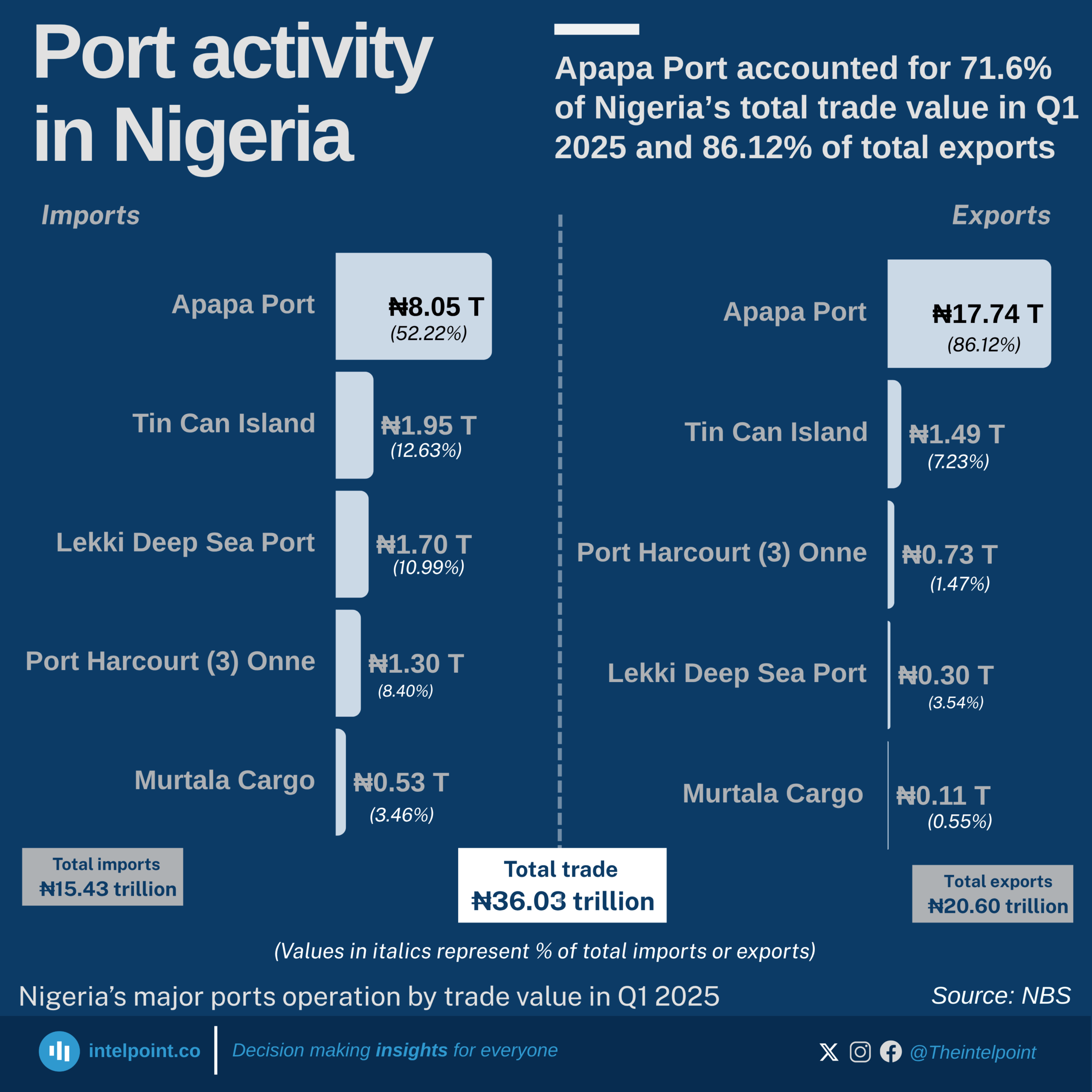
Apapa Port accounted for 71.6% of Nigeria’s total trade value in Q1 2025 and 86.12% of total exports
  • Apapa Port accounted for 71.6% of Nigeria’s total trade value in Q1 2025 and 82.12% of total exports
  • Apapa Port handled ₦25.79 trillion worth of goods in Q1 2025, representing 71.6% of total trade. It remains the country’s primary trade hub, far surpassing all other ports combined.
  •  Apapa alone facilitated ₦17.74 trillion or 86.1% of Nigeria’s total exports, showing a high dependency on a single location for outbound goods.
  • Tin Can Island is the only meaningful secondary hub With ₦3.44 trillion (9.5%) in total trade, ranking a distant second. It’s the only other port contributing more than ₦1 trillion each to imports and exports.
  • Lekki has limited export impact, despite handling ₦1.70 trillion in imports. Lekki contributed only ₦0.30 trillion (1.5%) in exports, indicating underutilization for outbound trade.
  • Murtala Muhammed International Airport processed just ₦647.91 billion (1.8%) of total trade, reinforcing that Nigeria’s international trade remains heavily maritime-focused.

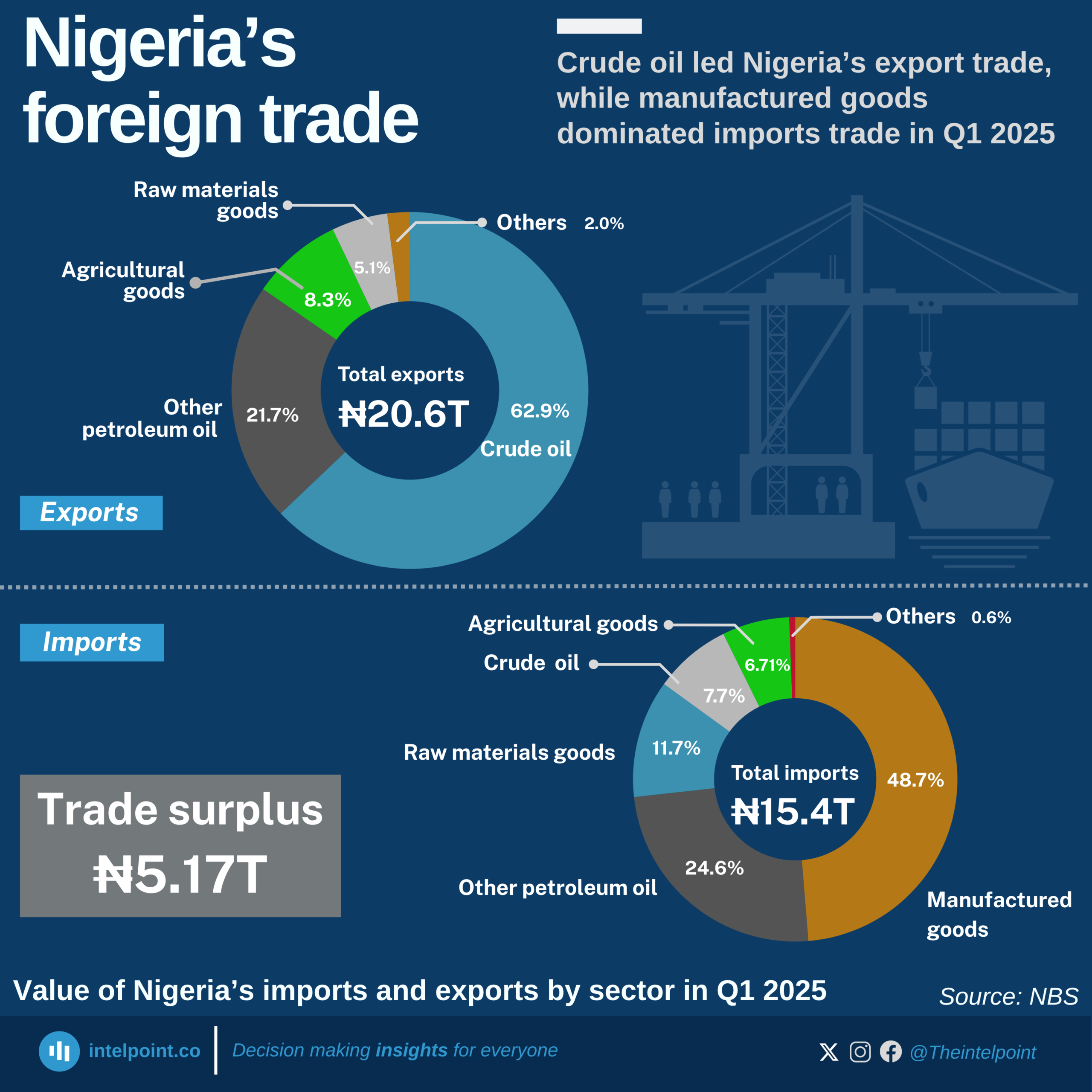
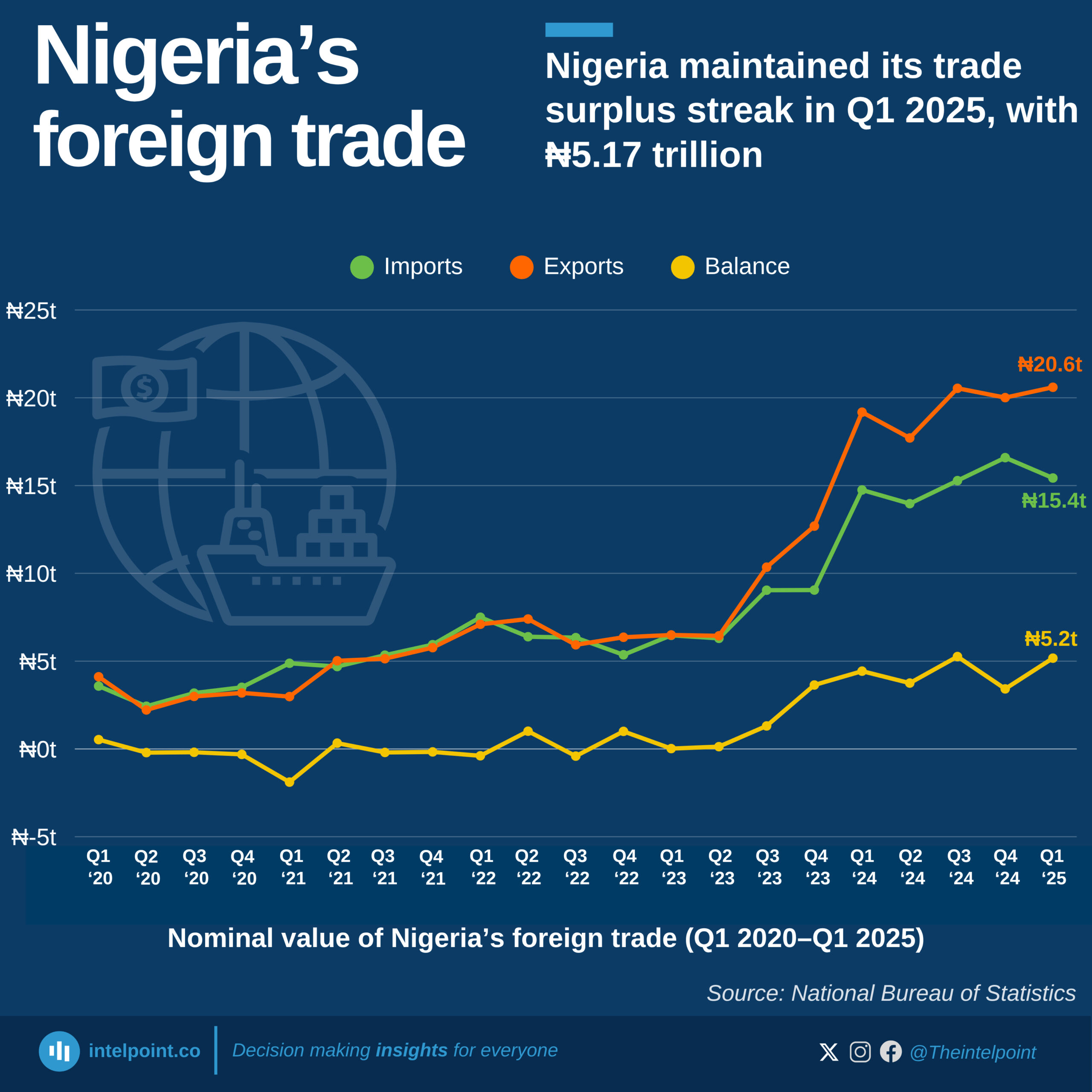
Nigeria’s foreign trade
  • Total Trade Volume in Q1 2025 stood at ₦36.02 trillion, with exports totalling ₦20.6 trillion and imports at ₦15.4 trillion, resulting in a surplus of ₦5.17 trillion.
  • Crude oil dominates Nigeria’s export trade, accounting for the largest share of export revenue. -
  • Other petroleum oil products are also a major export item, reflecting the significance of both raw and refined oil-based commodities in Nigeria’s trade portfolio. -
  • On the import side, manufactured goods dominate, showing Nigeria’s continued reliance on foreign machinery, technology, and consumer goods.
  • While Nigeria exports mostly raw and oil-based products, it imports refined, processed, or industrial goods, indicating a structural trade gap and limited local industrial capacity. -
  • Agricultural and raw material goods feature on both sides of trade, but their value is significantly less than petroleum-related trade.

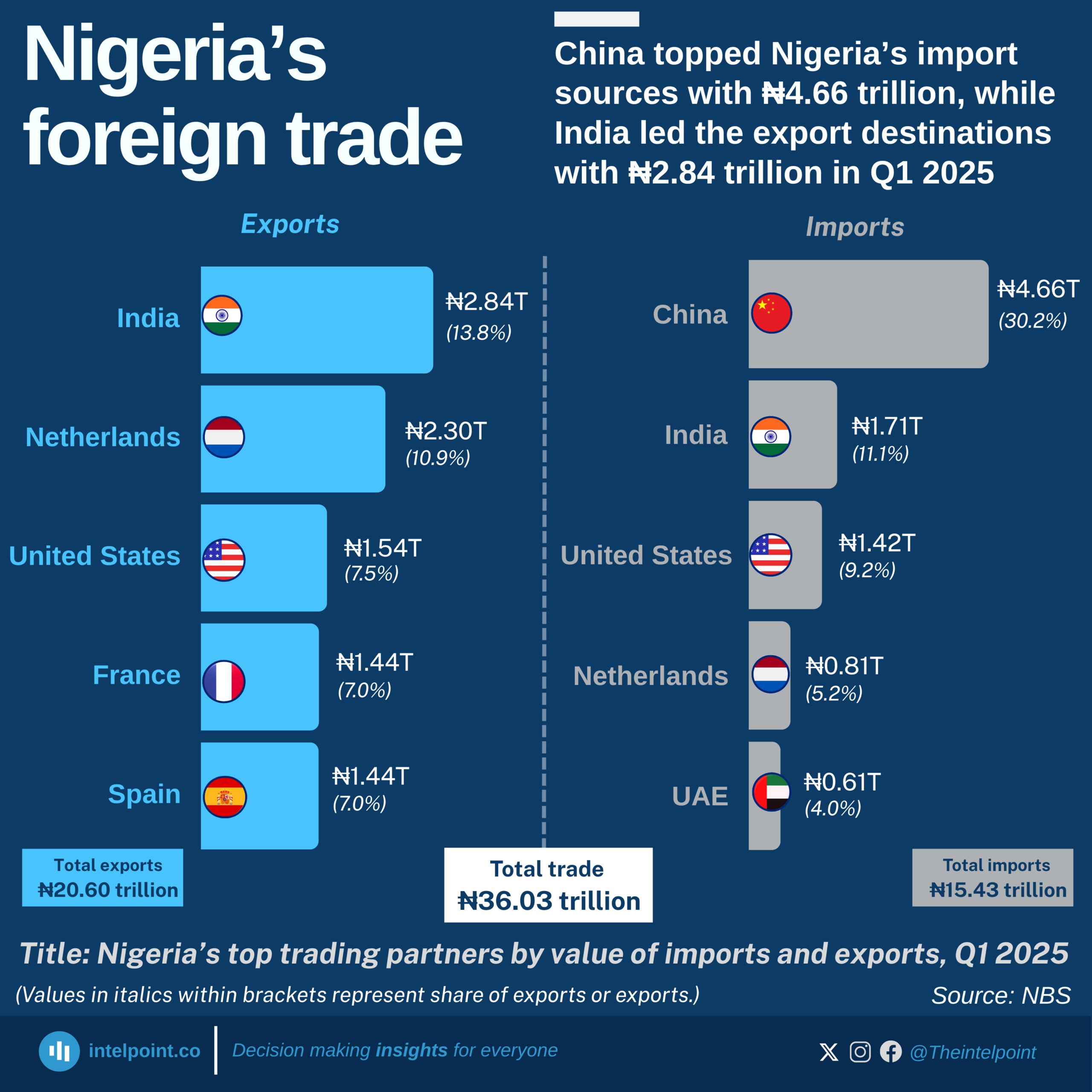
China topped Nigeria’s import sources with ₦4.66 trillion, while India led the export destinations with ₦2.84 trillion in Q1 2025
  • India is Nigeria’s largest export destination Nigeria exported ₦2.84 trillion worth of goods to India in Q1 2025, driven largely by crude oil.
  • China dominates imports into Nigeria China supplied ₦4.66 trillion worth of goods, far outpacing all other countries. Likely dominated by electronics, machinery, and manufactured goods.
  • The United States appears on both sides. Nigeria exports ₦1.54 trillion to the US and imports ₦1.42 trillion, showing a relatively balanced trade relationship.
  • European countries are major export Partners Netherlands (₦2.30T), France (₦1.44T), and Spain (₦1.44T) are prominent export destinations, indicating strong demand for Nigerian crude oil and other commodities in Europe.
  • UAE barely makes the import list. The UAE closes out the top import list at ₦0.61 trillion, showing relatively lower trade volume compared to others, but still significant enough to be in the top 5.

Guinea-Bissau had the highest agricultural contribution to its GDP among African countries in 2024, at 36.8%
  • Guinea-Bissau showed the highest agricultural contribution to its GDP at 36.8% in 2024.
  • Contributions range widely, with high reliance seen in Comoros (36.6%) and Ethiopia (34.9%), contrasting with lower percentages in DR Congo (17.1%) and Angola (16.4%).
  • Agriculture, forestry, and fishing contributed a notable 20.4% to Nigeria's GDP in 2024.
  • Countries with high agricultural GDP contributions are predominantly located in West and East Africa.

Nigeria has produced over 1.39 billion tonnes of yam since 1961, over 64% of global production
  • Nigeria is the world’s top yam producer since the 1980s.
  • West Africa supplies over 95% of global yam output.
  • Ghana and Côte d’Ivoire have grown steadily in the rankings.
  • Non-African countries play a very small role today.
  • Nigeria exports very little yam despite massive production.

India leads global banana production with 36.6M tonnes in 2024 as Nigeria ranks 4th among top producers with 7.3M tonnes
  • India dominates global banana output with 36.6 million tonnes, accounting for over a third of total production among the top 10 countries.
  • China (11.7M) and Indonesia (9.34M) round out the top three, contributing significantly to Asia’s dominance in banana farming.
  • Nigeria ranks 4th globally, producing 7.3 million tonnes, slightly ahead of Ecuador and Brazil.
  • Africa is well represented, with Nigeria, Angola, and Tanzania collectively contributing 15.86 million tonnes, or about 16% of the top 10 output.

1 4 5 6 7 8 16

Can’t find what you’re looking for? Please fill the form below
Contact Form Demo
SIGN UP TO OUR NEWSLETTER
Get periodic updates about the African startup space, access to our reports, among others.
Subscribe Here
Subscription Form

A product of Techpoint Africa. All rights reserved